GREEK ARCHITECTUREGREEK ARCHITECTURE
SUBMITTED BY:-
• ROHIT
• KAPIL
• AMIT
Origins
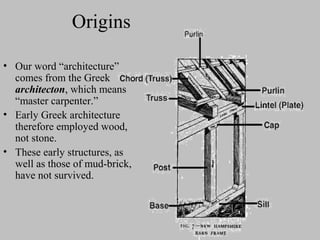
• Our word “architecture”
comes from the Greek
architecton, which means
“master carpenter.”
• Early Greek architecture
therefore employed wood,
not stone.
• These early structures, as
well as those of mud-brick,
have not survived.
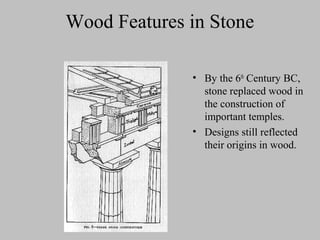
Wood Features in Stone
• By the 6th
Century BC,
stone replaced wood in
the construction of
important temples.
• Designs still reflected
their origins in wood.
Origins
• The triglyph, which alternates with the metopes, began as wooden beam
ends.
• The metope [pronounced "met-o-pee"] is a plain, smooth stone section
between triglyphs. Sometimes the metopes had statues of heroes or gods
on them. The triglyphs are a pattern of 3 vertical lines between the
metopes.
Origins
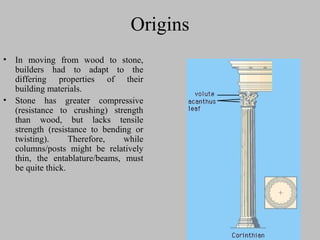
• In moving from wood to stone,
builders had to adapt to the
differing properties of their
building materials.
• Stone has greater compressive
(resistance to crushing) strength
than wood, but lacks tensile
strength (resistance to bending or
twisting). Therefore, while
columns/posts might be relatively
thin, the entablature/beams, must
be quite thick.
Origins
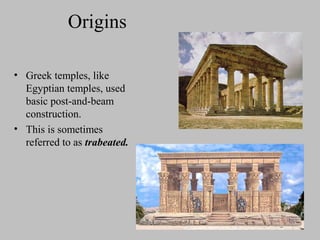
• Greek temples, like
Egyptian temples, used
basic post-and-beam
construction.
• This is sometimes
referred to as trabeated.
Origins
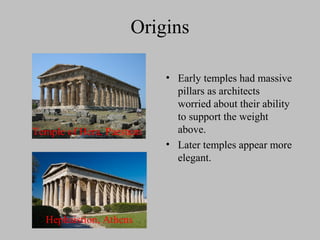
• Early temples had massive
pillars as architects
worried about their ability
to support the weight
above.
• Later temples appear more
elegant.
Temple of Hera, Paestum
Hephaistion, Athens
Origins
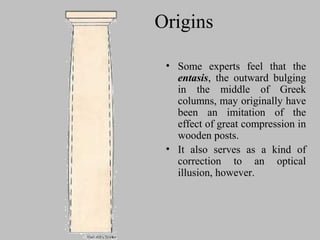
• Some experts feel that the
entasis, the outward bulging
in the middle of Greek
columns, may originally have
been an imitation of the
effect of great compression in
wooden posts.
• It also serves as a kind of
correction to an optical
illusion, however.
Entasis
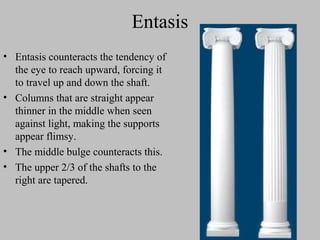
• Entasis counteracts the tendency of
the eye to reach upward, forcing it
to travel up and down the shaft.
• Columns that are straight appear
thinner in the middle when seen
against light, making the supports
appear flimsy.
• The middle bulge counteracts this.
• The upper 2/3 of the shafts to the
right are tapered.
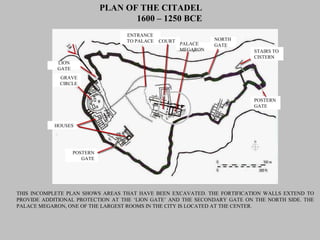
PLAN OF THE CITADEL
1600 – 1250 BCE
ENTRANCE
TO PALACE
PALACE
MEGARON
NORTH
GATE
STAIRS TO
CISTERN
POSTERN
GATE
HOUSES
GRAVE
CIRCLE
LION
GATE
POSTERN
GATE
COURT
THIS INCOMPLETE PLAN SHOWS AREAS THAT HAVE BEEN EXCAVATED. THE FORTIFICATION WALLS EXTEND TO
PROVIDE ADDITIONAL PROTECTION AT THE ‘LION GATE’ AND THE SECONDARY GATE ON THE NORTH SIDE. THE
PALACE MEGARON, ONE OF THE LARGEST ROOMS IN THE CITY IS LOCATED AT THE CENTER.
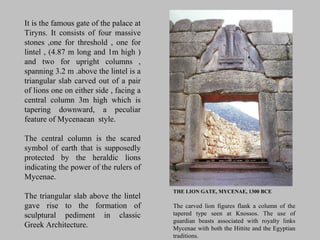
THE LION GATE, MYCENAE, 1300 BCE
The carved lion figures flank a column of the
tapered type seen at Knossos. The use of
guardian beasts associated with royalty links
Mycenae with both the Hittite and the Egyptian
traditions.
It is the famous gate of the palace at
Tiryns. It consists of four massive
stones ,one for threshold , one for
lintel , (4.87 m long and 1m high )
and two for upright columns ,
spanning 3.2 m .above the lintel is a
triangular slab carved out of a pair
of lions one on either side , facing a
central column 3m high which is
tapering downward, a peculiar
feature of Mycenaean style.
The central column is the scared
symbol of earth that is supposedly
protected by the heraldic lions
indicating the power of the rulers of
Mycenae.
The triangular slab above the lintel
gave rise to the formation of
sculptural pediment in classic
Greek Architecture.
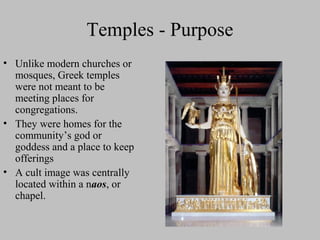
Temples - Purpose
• Unlike modern churches or
mosques, Greek temples
were not meant to be
meeting places for
congregations.
• They were homes for the
community’s god or
goddess and a place to keep
offerings
• A cult image was centrally
located within a naos, or
chapel.
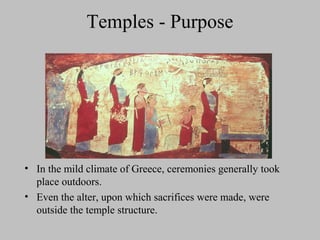
Temples - Purpose
• In the mild climate of Greece, ceremonies generally took
place outdoors.
• Even the alter, upon which sacrifices were made, were
outside the temple structure.
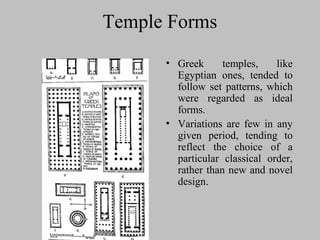
Temple Forms
• Greek temples, like
Egyptian ones, tended to
follow set patterns, which
were regarded as ideal
forms.
• Variations are few in any
given period, tending to
reflect the choice of a
particular classical order,
rather than new and novel
design.
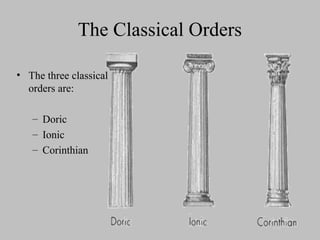
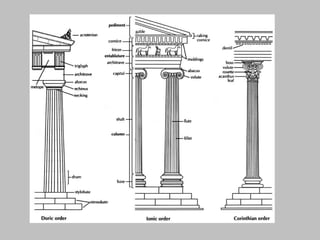
The Classical Orders
• The three classical
orders are:
– Doric
– Ionic
– Corinthian
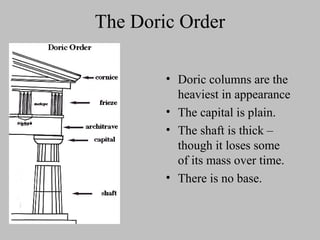
The Doric Order
• Doric columns are the
heaviest in appearance
• The capital is plain.
• The shaft is thick –
though it loses some
of its mass over time.
• There is no base.
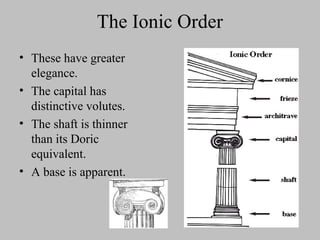
The Ionic Order
• These have greater
elegance.
• The capital has
distinctive volutes.
• The shaft is thinner
than its Doric
equivalent.
• A base is apparent.
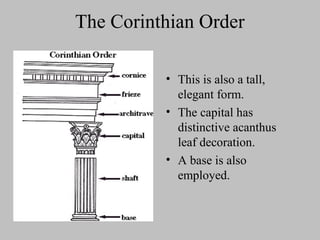
The Corinthian Order
• This is also a tall,
elegant form.
• The capital has
distinctive acanthus
leaf decoration.
• A base is also
employed.
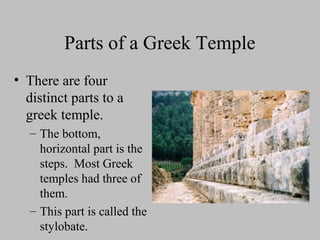
Parts of a Greek Temple
• There are four
distinct parts to a
greek temple.
– The bottom,
horizontal part is the
steps. Most Greek
temples had three of
them.
– This part is called the
stylobate.
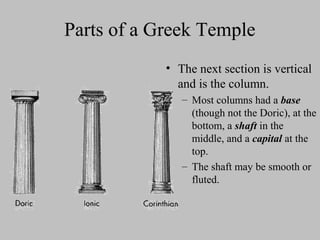
Parts of a Greek Temple
• The next section is vertical
and is the column.
– Most columns had a base
(though not the Doric), at the
bottom, a shaft in the
middle, and a capital at the
top.
– The shaft may be smooth or
fluted.
Parts of a Greek Temple
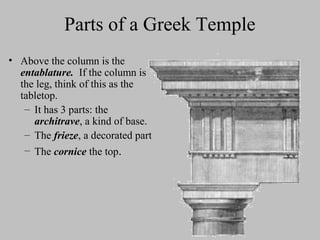
• Above the column is the
entablature. If the column is
the leg, think of this as the
tabletop.
– It has 3 parts: the
architrave, a kind of base.
– The frieze, a decorated part
– The cornice the top.
Parts of a Greek Temple
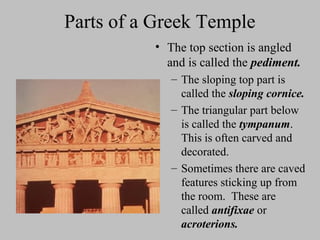
• The top section is angled
and is called the pediment.
– The sloping top part is
called the sloping cornice.
– The triangular part below
is called the tympanum.
This is often carved and
decorated.
– Sometimes there are caved
features sticking up from
the room. These are
called antifixae or
acroterions.
Plans of Greek Temples
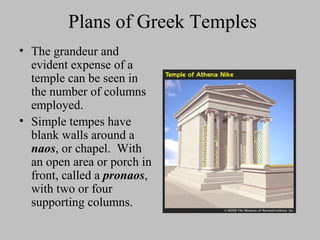
• The grandeur and
evident expense of a
temple can be seen in
the number of columns
employed.
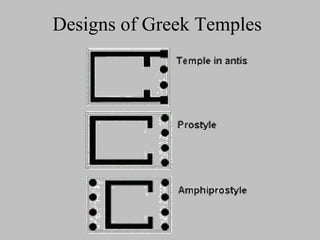
• Simple tempes have
blank walls around a
naos, or chapel. With
an open area or porch in
front, called a pronaos,
with two or four
supporting columns.
Designs of Greek Temples
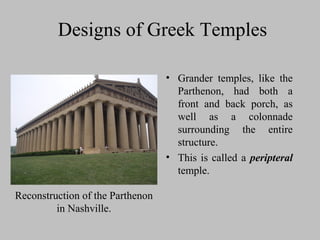
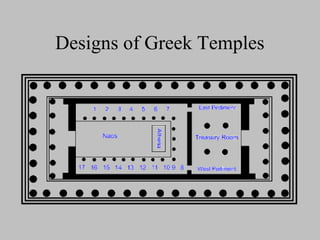
• Grander temples, like the
Parthenon, had both a
front and back porch, as
well as a colonnade
surrounding the entire
structure.
• This is called a peripteral
temple.
Reconstruction of the Parthenon
in Nashville.
Designs of Greek Temples
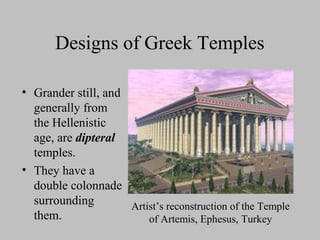
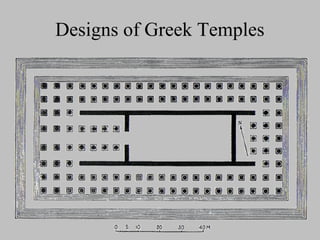
• Grander still, and
generally from
the Hellenistic
age, are dipteral
temples.
• They have a
double colonnade
surrounding
them.
Artist’s reconstruction of the Temple
of Artemis, Ephesus, Turkey
Designs of Greek Temples
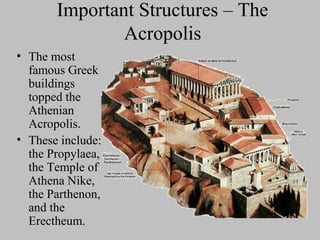
Important Structures – The
Acropolis
• The most
famous Greek
buildings
topped the
Athenian
Acropolis.
• These include:
the Propylaea,
the Temple of
Athena Nike,
the Parthenon,
and the
Erectheum.
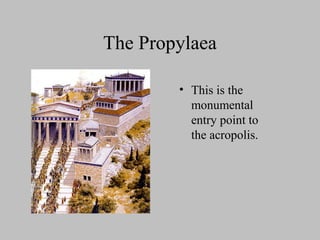
The Propylaea
• This is the
monumental
entry point to
the acropolis.
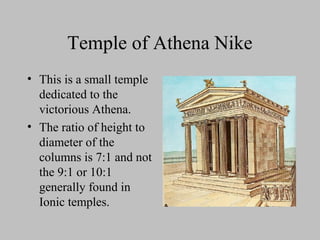
Temple of Athena Nike
• This is a small temple
dedicated to the
victorious Athena.
• The ratio of height to
diameter of the
columns is 7:1 and not
the 9:1 or 10:1
generally found in
Ionic temples.
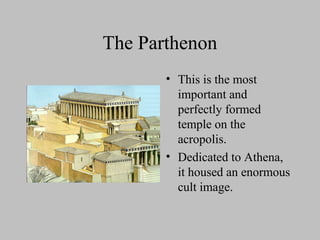
The Parthenon
• This is the most
important and
perfectly formed
temple on the
acropolis.
• Dedicated to Athena,
it housed an enormous
cult image.
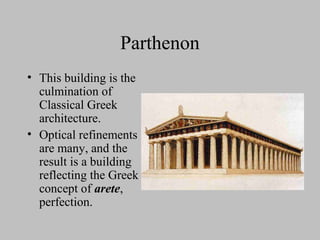
Parthenon
• This building is the
culmination of
Classical Greek
architecture.
• Optical refinements
are many, and the
result is a building
reflecting the Greek
concept of arete,
perfection.
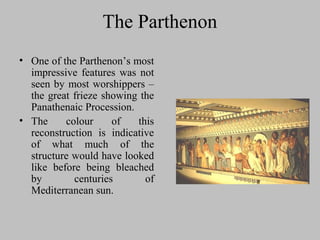
The Parthenon
• One of the Parthenon’s most
impressive features was not
seen by most worshippers –
the great frieze showing the
Panathenaic Procession.
• The colour of this
reconstruction is indicative
of what much of the
structure would have looked
like before being bleached
by centuries of
Mediterranean sun.
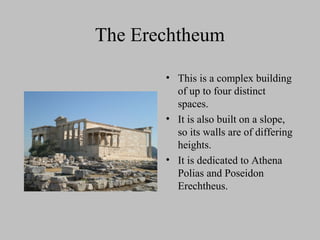
The Erechtheum
• This is a complex building
of up to four distinct
spaces.
• It is also built on a slope,
so its walls are of differing
heights.
• It is dedicated to Athena
Polias and Poseidon
Erechtheus.
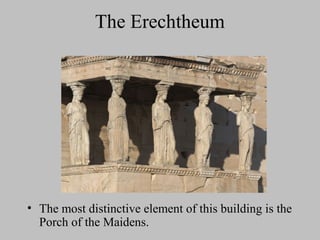
The Erechtheum
• The most distinctive element of this building is the
Porch of the Maidens.
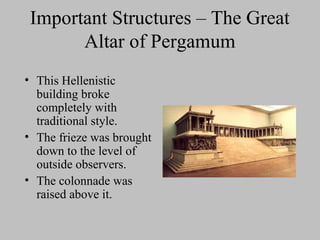
Important Structures – The Great
Altar of Pergamum
• This Hellenistic
building broke
completely with
traditional style.
• The frieze was brought
down to the level of
outside observers.
• The colonnade was
raised above it.
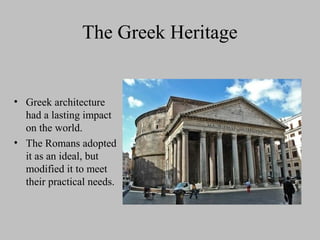
The Greek Heritage
• Greek architecture
had a lasting impact
on the world.
• The Romans adopted
it as an ideal, but
modified it to meet
their practical needs.
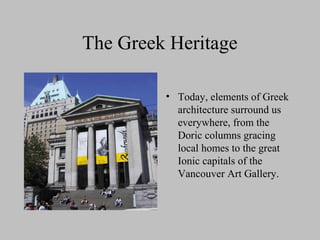
The Greek Heritage
• Today, elements of Greek
architecture surround us
everywhere, from the
Doric columns gracing
local homes to the great
Ionic capitals of the
Vancouver Art Gallery.
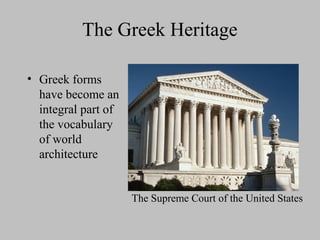
The Greek Heritage
• Greek forms
have become an
integral part of
the vocabulary
of world
architecture
The Supreme Court of the United States
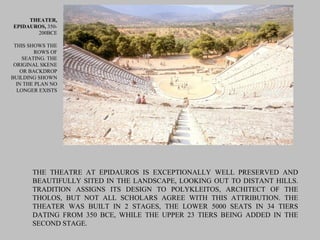
THEATER,
EPIDAUROS, 350-
200BCE
THIS SHOWS THE
ROWS OF
SEATING. THE
ORIGINAL SKENE
OR BACKDROP
BUILDING SHOWN
IN THE PLAN NO
LONGER EXISTS
THE THEATRE AT EPIDAUROS IS EXCEPTIONALLY WELL PRESERVED AND
BEAUTIFULLY SITED IN THE LANDSCAPE, LOOKING OUT TO DISTANT HILLS.
TRADITION ASSIGNS ITS DESIGN TO POLYKLEITOS, ARCHITECT OF THE
THOLOS, BUT NOT ALL SCHOLARS AGREE WITH THIS ATTRIBUTION. THE
THEATER WAS BUILT IN 2 STAGES, THE LOWER 5000 SEATS IN 34 TIERS
DATING FROM 350 BCE, WHILE THE UPPER 23 TIERS BEING ADDED IN THE
SECOND STAGE.
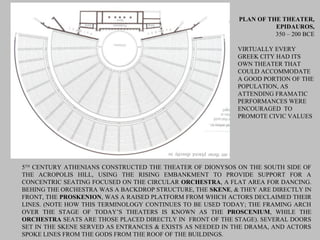
PLAN OF THE THEATER,
EPIDAUROS,
350 – 200 BCE
VIRTUALLY EVERY
GREEK CITY HAD ITS
OWN THEATER THAT
COULD ACCOMMODATE
A GOOD PORTION OF THE
POPULATION, AS
ATTENDING FRAMATIC
PERFORMANCES WERE
ENCOURAGED TO
PROMOTE CIVIC VALUES
5TH
CENTURY ATHENIANS CONSTRUCTED THE THEATER OF DIONYSOS ON THE SOUTH SIDE OF
THE ACROPOLIS HILL, USING THE RISING EMBANKMENT TO PROVIDE SUPPORT FOR A
CONCENTRIC SEATING FOCUSED ON THE CIRCULAR ORCHESTRA, A FLAT AREA FOR DANCING.
BEHING THE ORCHESTRA WAS A BACKDROP STRUCTURE, THE SKENE, & THEY ARE DIRECTLY IN
FRONT, THE PROSKENION, WAS A RAISED PLATFORM FROM WHICH ACTORS DECLAIMED THEIR
LINES. (NOTE HOW THIS TERMINOLOGY CONTINUES TO BE USED TODAY; THE FRAMING ARCH
OVER THE STAGE OF TODAY’S THEATERS IS KNOWN AS THE PROSCENIUM, WHILE THE
ORCHESTRA SEATS ARE THOSE PLACED DIRECTLY IN FRONT OF THE STAGE). SEVERAL DOORS
SET IN THE SKENE SERVED AS ENTRANCES & EXISTS AS NEEDED IN THE DRAMA, AND ACTORS
SPOKE LINES FROM THE GODS FROM THE ROOF OF THE BUILDINGS.

Greek architecture

  • 1.
    GREEK ARCHITECTUREGREEK ARCHITECTURE SUBMITTEDBY:- • ROHIT • KAPIL • AMIT
  • 2.
    Origins • Our word“architecture” comes from the Greek architecton, which means “master carpenter.” • Early Greek architecture therefore employed wood, not stone. • These early structures, as well as those of mud-brick, have not survived.
  • 3.
    Wood Features inStone • By the 6th Century BC, stone replaced wood in the construction of important temples. • Designs still reflected their origins in wood.
  • 4.
    Origins • The triglyph,which alternates with the metopes, began as wooden beam ends. • The metope [pronounced "met-o-pee"] is a plain, smooth stone section between triglyphs. Sometimes the metopes had statues of heroes or gods on them. The triglyphs are a pattern of 3 vertical lines between the metopes.
  • 5.
    Origins • In movingfrom wood to stone, builders had to adapt to the differing properties of their building materials. • Stone has greater compressive (resistance to crushing) strength than wood, but lacks tensile strength (resistance to bending or twisting). Therefore, while columns/posts might be relatively thin, the entablature/beams, must be quite thick.
  • 6.
    Origins • Greek temples,like Egyptian temples, used basic post-and-beam construction. • This is sometimes referred to as trabeated.
  • 7.
    Origins • Early templeshad massive pillars as architects worried about their ability to support the weight above. • Later temples appear more elegant. Temple of Hera, Paestum Hephaistion, Athens
  • 8.
    Origins • Some expertsfeel that the entasis, the outward bulging in the middle of Greek columns, may originally have been an imitation of the effect of great compression in wooden posts. • It also serves as a kind of correction to an optical illusion, however.
  • 9.
    Entasis • Entasis counteractsthe tendency of the eye to reach upward, forcing it to travel up and down the shaft. • Columns that are straight appear thinner in the middle when seen against light, making the supports appear flimsy. • The middle bulge counteracts this. • The upper 2/3 of the shafts to the right are tapered.
  • 10.
    PLAN OF THECITADEL 1600 – 1250 BCE ENTRANCE TO PALACE PALACE MEGARON NORTH GATE STAIRS TO CISTERN POSTERN GATE HOUSES GRAVE CIRCLE LION GATE POSTERN GATE COURT THIS INCOMPLETE PLAN SHOWS AREAS THAT HAVE BEEN EXCAVATED. THE FORTIFICATION WALLS EXTEND TO PROVIDE ADDITIONAL PROTECTION AT THE ‘LION GATE’ AND THE SECONDARY GATE ON THE NORTH SIDE. THE PALACE MEGARON, ONE OF THE LARGEST ROOMS IN THE CITY IS LOCATED AT THE CENTER.
  • 11.
    THE LION GATE,MYCENAE, 1300 BCE The carved lion figures flank a column of the tapered type seen at Knossos. The use of guardian beasts associated with royalty links Mycenae with both the Hittite and the Egyptian traditions. It is the famous gate of the palace at Tiryns. It consists of four massive stones ,one for threshold , one for lintel , (4.87 m long and 1m high ) and two for upright columns , spanning 3.2 m .above the lintel is a triangular slab carved out of a pair of lions one on either side , facing a central column 3m high which is tapering downward, a peculiar feature of Mycenaean style. The central column is the scared symbol of earth that is supposedly protected by the heraldic lions indicating the power of the rulers of Mycenae. The triangular slab above the lintel gave rise to the formation of sculptural pediment in classic Greek Architecture.
  • 12.
    Temples - Purpose •Unlike modern churches or mosques, Greek temples were not meant to be meeting places for congregations. • They were homes for the community’s god or goddess and a place to keep offerings • A cult image was centrally located within a naos, or chapel.
  • 13.
    Temples - Purpose •In the mild climate of Greece, ceremonies generally took place outdoors. • Even the alter, upon which sacrifices were made, were outside the temple structure.
  • 14.
    Temple Forms • Greektemples, like Egyptian ones, tended to follow set patterns, which were regarded as ideal forms. • Variations are few in any given period, tending to reflect the choice of a particular classical order, rather than new and novel design.
  • 15.
    The Classical Orders •The three classical orders are: – Doric – Ionic – Corinthian
  • 16.
    The Doric Order •Doric columns are the heaviest in appearance • The capital is plain. • The shaft is thick – though it loses some of its mass over time. • There is no base.
  • 17.
    The Ionic Order •These have greater elegance. • The capital has distinctive volutes. • The shaft is thinner than its Doric equivalent. • A base is apparent.
  • 18.
    The Corinthian Order •This is also a tall, elegant form. • The capital has distinctive acanthus leaf decoration. • A base is also employed.
  • 19.
    Parts of aGreek Temple • There are four distinct parts to a greek temple. – The bottom, horizontal part is the steps. Most Greek temples had three of them. – This part is called the stylobate.
  • 20.
    Parts of aGreek Temple • The next section is vertical and is the column. – Most columns had a base (though not the Doric), at the bottom, a shaft in the middle, and a capital at the top. – The shaft may be smooth or fluted.
  • 22.
    Parts of aGreek Temple • Above the column is the entablature. If the column is the leg, think of this as the tabletop. – It has 3 parts: the architrave, a kind of base. – The frieze, a decorated part – The cornice the top.
  • 23.
    Parts of aGreek Temple • The top section is angled and is called the pediment. – The sloping top part is called the sloping cornice. – The triangular part below is called the tympanum. This is often carved and decorated. – Sometimes there are caved features sticking up from the room. These are called antifixae or acroterions.
  • 24.
    Plans of GreekTemples • The grandeur and evident expense of a temple can be seen in the number of columns employed. • Simple tempes have blank walls around a naos, or chapel. With an open area or porch in front, called a pronaos, with two or four supporting columns.
  • 25.
  • 26.
    Designs of GreekTemples • Grander temples, like the Parthenon, had both a front and back porch, as well as a colonnade surrounding the entire structure. • This is called a peripteral temple. Reconstruction of the Parthenon in Nashville.
  • 27.
  • 28.
    Designs of GreekTemples • Grander still, and generally from the Hellenistic age, are dipteral temples. • They have a double colonnade surrounding them. Artist’s reconstruction of the Temple of Artemis, Ephesus, Turkey
  • 29.
  • 30.
    Important Structures –The Acropolis • The most famous Greek buildings topped the Athenian Acropolis. • These include: the Propylaea, the Temple of Athena Nike, the Parthenon, and the Erectheum.
  • 31.
    The Propylaea • Thisis the monumental entry point to the acropolis.
  • 32.
    Temple of AthenaNike • This is a small temple dedicated to the victorious Athena. • The ratio of height to diameter of the columns is 7:1 and not the 9:1 or 10:1 generally found in Ionic temples.
  • 33.
    The Parthenon • Thisis the most important and perfectly formed temple on the acropolis. • Dedicated to Athena, it housed an enormous cult image.
  • 34.
    Parthenon • This buildingis the culmination of Classical Greek architecture. • Optical refinements are many, and the result is a building reflecting the Greek concept of arete, perfection.
  • 35.
    The Parthenon • Oneof the Parthenon’s most impressive features was not seen by most worshippers – the great frieze showing the Panathenaic Procession. • The colour of this reconstruction is indicative of what much of the structure would have looked like before being bleached by centuries of Mediterranean sun.
  • 36.
    The Erechtheum • Thisis a complex building of up to four distinct spaces. • It is also built on a slope, so its walls are of differing heights. • It is dedicated to Athena Polias and Poseidon Erechtheus.
  • 37.
    The Erechtheum • Themost distinctive element of this building is the Porch of the Maidens.
  • 38.
    Important Structures –The Great Altar of Pergamum • This Hellenistic building broke completely with traditional style. • The frieze was brought down to the level of outside observers. • The colonnade was raised above it.
  • 39.
    The Greek Heritage •Greek architecture had a lasting impact on the world. • The Romans adopted it as an ideal, but modified it to meet their practical needs.
  • 40.
    The Greek Heritage •Today, elements of Greek architecture surround us everywhere, from the Doric columns gracing local homes to the great Ionic capitals of the Vancouver Art Gallery.
  • 41.
    The Greek Heritage •Greek forms have become an integral part of the vocabulary of world architecture The Supreme Court of the United States
  • 42.
    THEATER, EPIDAUROS, 350- 200BCE THIS SHOWSTHE ROWS OF SEATING. THE ORIGINAL SKENE OR BACKDROP BUILDING SHOWN IN THE PLAN NO LONGER EXISTS THE THEATRE AT EPIDAUROS IS EXCEPTIONALLY WELL PRESERVED AND BEAUTIFULLY SITED IN THE LANDSCAPE, LOOKING OUT TO DISTANT HILLS. TRADITION ASSIGNS ITS DESIGN TO POLYKLEITOS, ARCHITECT OF THE THOLOS, BUT NOT ALL SCHOLARS AGREE WITH THIS ATTRIBUTION. THE THEATER WAS BUILT IN 2 STAGES, THE LOWER 5000 SEATS IN 34 TIERS DATING FROM 350 BCE, WHILE THE UPPER 23 TIERS BEING ADDED IN THE SECOND STAGE.
  • 43.
    PLAN OF THETHEATER, EPIDAUROS, 350 – 200 BCE VIRTUALLY EVERY GREEK CITY HAD ITS OWN THEATER THAT COULD ACCOMMODATE A GOOD PORTION OF THE POPULATION, AS ATTENDING FRAMATIC PERFORMANCES WERE ENCOURAGED TO PROMOTE CIVIC VALUES 5TH CENTURY ATHENIANS CONSTRUCTED THE THEATER OF DIONYSOS ON THE SOUTH SIDE OF THE ACROPOLIS HILL, USING THE RISING EMBANKMENT TO PROVIDE SUPPORT FOR A CONCENTRIC SEATING FOCUSED ON THE CIRCULAR ORCHESTRA, A FLAT AREA FOR DANCING. BEHING THE ORCHESTRA WAS A BACKDROP STRUCTURE, THE SKENE, & THEY ARE DIRECTLY IN FRONT, THE PROSKENION, WAS A RAISED PLATFORM FROM WHICH ACTORS DECLAIMED THEIR LINES. (NOTE HOW THIS TERMINOLOGY CONTINUES TO BE USED TODAY; THE FRAMING ARCH OVER THE STAGE OF TODAY’S THEATERS IS KNOWN AS THE PROSCENIUM, WHILE THE ORCHESTRA SEATS ARE THOSE PLACED DIRECTLY IN FRONT OF THE STAGE). SEVERAL DOORS SET IN THE SKENE SERVED AS ENTRANCES & EXISTS AS NEEDED IN THE DRAMA, AND ACTORS SPOKE LINES FROM THE GODS FROM THE ROOF OF THE BUILDINGS.