Harshala Sanap
S Y B Arch - B 38
Pisa Cathedral
Pisa Cathedral is a medieval Roman Catholic cathedral dedicated to
the Assumption of the Virgin Mary, in the Piazza dei Miracoli in Pisa,
Italy. It is a notable example of Romanesque architecture, in
particular the style known as Pisan Romanesque
Location:
Pisa, Italy
History:
• Construction began in 1063 by architect Buscheto.
It include stylistic elements like Classical, Lombard-
Emilian, Byzantine and Islamic
• The cathedral was consecrated in 1118 by Pope
Gelasius II, who belonged to the Caetani family
which was powerful both in Pisa and in Rome.
• work was finished in 1180, as documented by the
date written on the bronze knockers made
by Bonanno Pisano found on the main door.
• The first radical interventions occurred after the
fire of 1595, following which the roof was replaced
and sculptors from the workshop of Giambologna,
among whom were Gasparo Mola and Pietro Tacca,
created the three bronze doors of the facade.
https://i.pinimg.com/564x/97/56/b6/9756b67b
3bdd78e14756dd732c1eb528.jpg
https://maps.wikimedia.org/img/osm-
intl,13,43.723281,10.395845,270x200.png?lang=en&domain
=en.wikipedia.org&title=Pisa+Cathedral&groups=_666ac3cfd
c1ebbfb62508ab87890a62f88f737b5
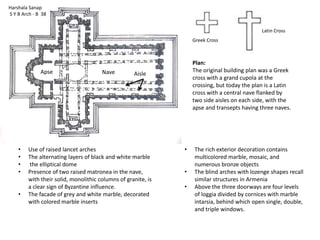
Plan:
The original building plan was a Greek
cross with a grand cupola at the
crossing, but today the plan is a Latin
cross with a central nave flanked by
two side aisles on each side, with the
apse and transepts having three naves.
Greek Cross
Latin Cross
Nave
Apse Aisle
• Use of raised lancet arches
• The alternating layers of black and white marble
• the elliptical dome
• Presence of two raised matronea in the nave,
with their solid, monolithic columns of granite, is
a clear sign of Byzantine influence.
• The facade of grey and white marble, decorated
with colored marble inserts
• The rich exterior decoration contains
multicolored marble, mosaic, and
numerous bronze objects
• The blind arches with lozenge shapes recall
similar structures in Armenia
• Above the three doorways are four levels
of loggia divided by cornices with marble
intarsia, behind which open single, double,
and triple windows.
Harshala Sanap
S Y B Arch - B 38
• The interior, subdivided at the front into a
central nave flanked by two side aisles on either
side and with the transept and apse in three
naves, is covered with white and black marble,
with monolithic grey marble columns
having corinthian capitals. It has a wooden 17th-
century coffered ceiling, painted and decorated
with gold leaf, made by Domenico and
Bartolomeo Atticciati; it bears the Medici coat of
arms. Presumably the earlier ceiling was a
structure with wooden trusses.
Harshala Sanap
S Y B Arch - B 38
https://i.pinimg.com/564x/3c/42/7c/3c427c650eaa3d29127
4f50093ebd29a.jpg
https://i.pinimg.com/564x/4c/c7/fd/4cc7fd75271cc287012db5ae20a5a
e3c.jpg

pisa cathedral.pptx

  • 1.
    Harshala Sanap S YB Arch - B 38 Pisa Cathedral Pisa Cathedral is a medieval Roman Catholic cathedral dedicated to the Assumption of the Virgin Mary, in the Piazza dei Miracoli in Pisa, Italy. It is a notable example of Romanesque architecture, in particular the style known as Pisan Romanesque Location: Pisa, Italy History: • Construction began in 1063 by architect Buscheto. It include stylistic elements like Classical, Lombard- Emilian, Byzantine and Islamic • The cathedral was consecrated in 1118 by Pope Gelasius II, who belonged to the Caetani family which was powerful both in Pisa and in Rome. • work was finished in 1180, as documented by the date written on the bronze knockers made by Bonanno Pisano found on the main door. • The first radical interventions occurred after the fire of 1595, following which the roof was replaced and sculptors from the workshop of Giambologna, among whom were Gasparo Mola and Pietro Tacca, created the three bronze doors of the facade. https://i.pinimg.com/564x/97/56/b6/9756b67b 3bdd78e14756dd732c1eb528.jpg https://maps.wikimedia.org/img/osm- intl,13,43.723281,10.395845,270x200.png?lang=en&domain =en.wikipedia.org&title=Pisa+Cathedral&groups=_666ac3cfd c1ebbfb62508ab87890a62f88f737b5
  • 2.
    Plan: The original buildingplan was a Greek cross with a grand cupola at the crossing, but today the plan is a Latin cross with a central nave flanked by two side aisles on each side, with the apse and transepts having three naves. Greek Cross Latin Cross Nave Apse Aisle • Use of raised lancet arches • The alternating layers of black and white marble • the elliptical dome • Presence of two raised matronea in the nave, with their solid, monolithic columns of granite, is a clear sign of Byzantine influence. • The facade of grey and white marble, decorated with colored marble inserts • The rich exterior decoration contains multicolored marble, mosaic, and numerous bronze objects • The blind arches with lozenge shapes recall similar structures in Armenia • Above the three doorways are four levels of loggia divided by cornices with marble intarsia, behind which open single, double, and triple windows. Harshala Sanap S Y B Arch - B 38
  • 3.
    • The interior,subdivided at the front into a central nave flanked by two side aisles on either side and with the transept and apse in three naves, is covered with white and black marble, with monolithic grey marble columns having corinthian capitals. It has a wooden 17th- century coffered ceiling, painted and decorated with gold leaf, made by Domenico and Bartolomeo Atticciati; it bears the Medici coat of arms. Presumably the earlier ceiling was a structure with wooden trusses. Harshala Sanap S Y B Arch - B 38 https://i.pinimg.com/564x/3c/42/7c/3c427c650eaa3d29127 4f50093ebd29a.jpg https://i.pinimg.com/564x/4c/c7/fd/4cc7fd75271cc287012db5ae20a5a e3c.jpg