S U B M I T T E D B Y :
R O H I T C H O P R A
V I K A S V A R M A
J I N I J O H N
S U R A J S O N I
S H O U R Y A G O S W A M I
Town Plan: Auroville
Auroville: The universal Township
 Location: Situated 10 Kms. North of Pondicherry in
the state of Tamil Nadu, India.
 Auroville is meant to be a Universal town where people
from any country or caste can live in peace and
harmony.
 Currently Aurouville resides 2345 people from almost
45 countries amongst which around 1/3 are Indian.
 The original master plan is meant to achieve a total
population of 50,000 permanent residents from all
around the world
The Concept
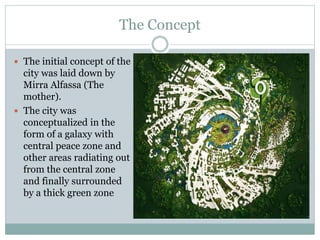
 The initial concept of the
city was laid down by
Mirra Alfassa (The
mother).
 The city was
conceptualized in the
form of a galaxy with
central peace zone and
other areas radiating out
from the central zone
and finally surrounded
by a thick green zone
Land Use
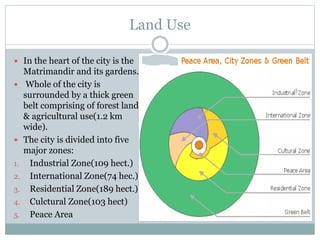
 In the heart of the city is the
Matrimandir and its gardens.
 Whole of the city is
surrounded by a thick green
belt comprising of forest land
& agricultural use(1.2 km
wide).
 The city is divided into five
major zones:
1. Industrial Zone(109 hect.)
2. International Zone(74 hec.)
3. Residential Zone(189 hect.)
4. Culctural Zone(103 hect)
5. Peace Area
Land Use(Built Area)
Use Area(Hectares) %
Residential 95 40.9
Village Settlements 20
Auroville Community 75
Commercial 19 8.2
•Manufacturing 10 4.3
•Public/Semi Public 65 28
•Roads/Streets 30 13
•Playgrounds 13 5.6
Sub total 232 100
Land Use(Unbuilt Area)
Land Use Area(Hectares)
`
%
•Regenerated Land 598 34.5
•Agricultural Land
Agriculture & Related 50 2.9
Farming 940 54.3
•Water Bodies 45 2.6
•Canyon, waste & others 98 5.7
•Sub Total 1731 100
Land Use Area
Grand Total 1963
Road Network
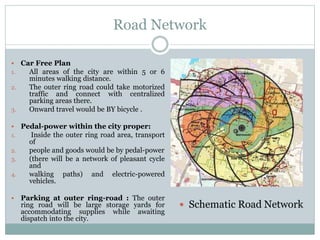
 Car Free Plan
1. All areas of the city are within 5 or 6
minutes walking distance.
2. The outer ring road could take motorized
traffic and connect with centralized
parking areas there.
3. Onward travel would be BY bicycle .
 Pedal-power within the city proper:
1. Inside the outer ring road area, transport
of
2. people and goods would be by pedal-power
3. (there will be a network of pleasant cycle
and
4. walking paths) and electric-powered
vehicles.
 Parking at outer ring-road : The outer
ring road will be large storage yards for
accommodating supplies while awaiting
dispatch into the city.
 Schematic Road Network
Waste Water Treatment
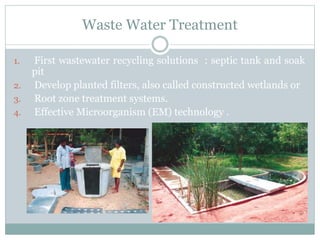
1. First wastewater recycling solutions : septic tank and soak
pit
2. Develop planted filters, also called constructed wetlands or
3. Root zone treatment systems.
4. Effective Microorganism (EM) technology .
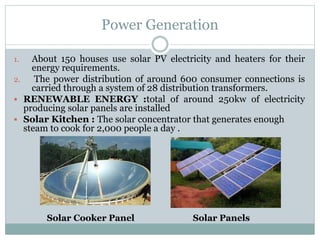
Power Generation
1. About 150 houses use solar PV electricity and heaters for their
energy requirements.
2. The power distribution of around 600 consumer connections is
carried through a system of 28 distribution transformers.
 RENEWABLE ENERGY :total of around 250kw of electricity
producing solar panels are installed
 Solar Kitchen : The solar concentrator that generates enough
steam to cook for 2,000 people a day .
Solar Cooker Panel Solar Panels
Resource Consumption
Water Consumption
Total Water Pumped 1, 502,029 KL
Total Water Pumped for Residential
Sector
522,748 KL
Per Capita/Day Consumption of
Total
1,779 litres
Per Capita/Day Consumption Reside
ntial
620 litres
Electricity
Sources
Consumptio
n(MW/Yr.)
Total% CO2
Emission
% of Total
TNEV 3965 43 3767 78
Renewable 1260 14 - 0
Diesel/Petrol 1753 19 373 8
Thermal 2322 25 672 14
WATER INFRASTRUCTURE
Auroville’s current water infrastructure is highly
decentralized with an estimated number of 150 bore wells
supplying the water requirements for the residential and
other sectors of Auroville. Water pricing differs from location
to location, as well as water metering systems, quality of
operation and maintenance .Wastewater treatment at
Auroville is either done at the settlement or the building level
using technologies such as decentralized wastewater
treatment systems or simple septic tanks.
ELECTRICITY INFRASTRUCTURE
Auroville draws its main supply of electrical energy from the Tamil Nadu
Electricity Board (TNEB) through the 110/22 kV sub-stations located at Irrumbai
village. Several load-centre sub-stations are located around the township to
step down the voltage from 22 kV to 415 V and supply 3-phase electricity
through low-tension distribution lines to the end users. As of 2014, there are
a total of 28 transformers in 15 sub-stations, with a cumulative capacity of
3,282 VA. Two standard sizes of transformers are used, either 63 kVA or 100
kVA. A few Auroville communities and establishments are also connected to
the transformers supplying electricity to the neighbouring villages.
THANK
YOU

Town plan auroville

  • 1.
    S U BM I T T E D B Y : R O H I T C H O P R A V I K A S V A R M A J I N I J O H N S U R A J S O N I S H O U R Y A G O S W A M I Town Plan: Auroville
  • 2.
    Auroville: The universalTownship  Location: Situated 10 Kms. North of Pondicherry in the state of Tamil Nadu, India.  Auroville is meant to be a Universal town where people from any country or caste can live in peace and harmony.  Currently Aurouville resides 2345 people from almost 45 countries amongst which around 1/3 are Indian.  The original master plan is meant to achieve a total population of 50,000 permanent residents from all around the world
  • 3.
    The Concept  Theinitial concept of the city was laid down by Mirra Alfassa (The mother).  The city was conceptualized in the form of a galaxy with central peace zone and other areas radiating out from the central zone and finally surrounded by a thick green zone
  • 4.
    Land Use  Inthe heart of the city is the Matrimandir and its gardens.  Whole of the city is surrounded by a thick green belt comprising of forest land & agricultural use(1.2 km wide).  The city is divided into five major zones: 1. Industrial Zone(109 hect.) 2. International Zone(74 hec.) 3. Residential Zone(189 hect.) 4. Culctural Zone(103 hect) 5. Peace Area
  • 5.
    Land Use(Built Area) UseArea(Hectares) % Residential 95 40.9 Village Settlements 20 Auroville Community 75 Commercial 19 8.2 •Manufacturing 10 4.3 •Public/Semi Public 65 28 •Roads/Streets 30 13 •Playgrounds 13 5.6 Sub total 232 100
  • 6.
    Land Use(Unbuilt Area) LandUse Area(Hectares) ` % •Regenerated Land 598 34.5 •Agricultural Land Agriculture & Related 50 2.9 Farming 940 54.3 •Water Bodies 45 2.6 •Canyon, waste & others 98 5.7 •Sub Total 1731 100 Land Use Area Grand Total 1963
  • 7.
    Road Network  CarFree Plan 1. All areas of the city are within 5 or 6 minutes walking distance. 2. The outer ring road could take motorized traffic and connect with centralized parking areas there. 3. Onward travel would be BY bicycle .  Pedal-power within the city proper: 1. Inside the outer ring road area, transport of 2. people and goods would be by pedal-power 3. (there will be a network of pleasant cycle and 4. walking paths) and electric-powered vehicles.  Parking at outer ring-road : The outer ring road will be large storage yards for accommodating supplies while awaiting dispatch into the city.  Schematic Road Network
  • 8.
    Waste Water Treatment 1.First wastewater recycling solutions : septic tank and soak pit 2. Develop planted filters, also called constructed wetlands or 3. Root zone treatment systems. 4. Effective Microorganism (EM) technology .
  • 9.
    Power Generation 1. About150 houses use solar PV electricity and heaters for their energy requirements. 2. The power distribution of around 600 consumer connections is carried through a system of 28 distribution transformers.  RENEWABLE ENERGY :total of around 250kw of electricity producing solar panels are installed  Solar Kitchen : The solar concentrator that generates enough steam to cook for 2,000 people a day . Solar Cooker Panel Solar Panels
  • 10.
    Resource Consumption Water Consumption TotalWater Pumped 1, 502,029 KL Total Water Pumped for Residential Sector 522,748 KL Per Capita/Day Consumption of Total 1,779 litres Per Capita/Day Consumption Reside ntial 620 litres Electricity Sources Consumptio n(MW/Yr.) Total% CO2 Emission % of Total TNEV 3965 43 3767 78 Renewable 1260 14 - 0 Diesel/Petrol 1753 19 373 8 Thermal 2322 25 672 14
  • 11.
    WATER INFRASTRUCTURE Auroville’s currentwater infrastructure is highly decentralized with an estimated number of 150 bore wells supplying the water requirements for the residential and other sectors of Auroville. Water pricing differs from location to location, as well as water metering systems, quality of operation and maintenance .Wastewater treatment at Auroville is either done at the settlement or the building level using technologies such as decentralized wastewater treatment systems or simple septic tanks.
  • 12.
    ELECTRICITY INFRASTRUCTURE Auroville drawsits main supply of electrical energy from the Tamil Nadu Electricity Board (TNEB) through the 110/22 kV sub-stations located at Irrumbai village. Several load-centre sub-stations are located around the township to step down the voltage from 22 kV to 415 V and supply 3-phase electricity through low-tension distribution lines to the end users. As of 2014, there are a total of 28 transformers in 15 sub-stations, with a cumulative capacity of 3,282 VA. Two standard sizes of transformers are used, either 63 kVA or 100 kVA. A few Auroville communities and establishments are also connected to the transformers supplying electricity to the neighbouring villages.
  • 13.