Abhishek K. Venkitaraman
Assistant Professor
HISTORY OF ARCHITECTURE
LECTURE 7
Gothic Architecture
Gothic Architecture
• Characteristics
– Structural
• Skeletal stone structure
– Visual
• Visual arts were important
including the role of light in
structures
– Symbolic
• Scholasticism
– Translations of real events into
stone and glass
• Cathedrals served as an image
of heaven
A R C H I T E C T U R E
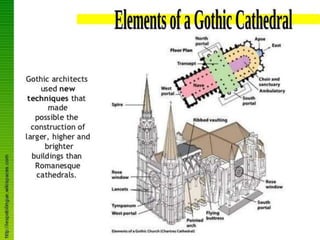
Elements taken from past:
• the compound pier and archivolt,
• the alternate system, and
• the ribbed and domed vault.
• the modified basilican plan with its triple aisles crossed by a projecting
transept, and its three apses.
This, the basis of the typical Norman and
Gothic plan, was derived directly from the Church of the Nativity at
Bethlehem, the date of which is unknown. It may have been built by
Constantine, or by Justinian, or at any date between.
• the doubled western towers,
• the lantern or central tower over the crossing, and
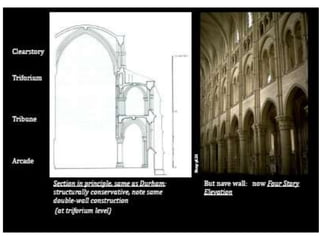
• the threefold interior system of arcade, triforium, and clerestory.
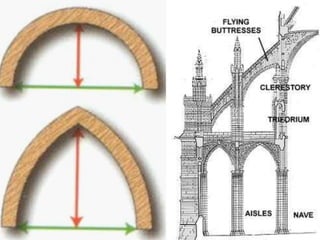
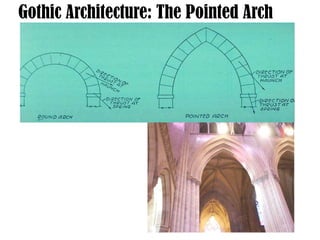
Gothic Architecture: The Pointed Arch
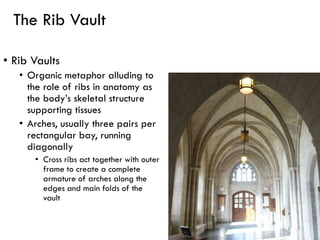
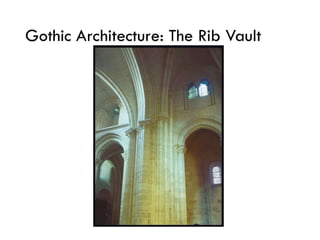
The Rib Vault
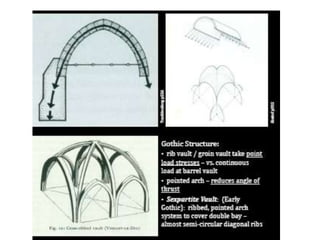
• Rib Vaults
• Organic metaphor alluding to
the role of ribs in anatomy as
the body’s skeletal structure
supporting tissues
• Arches, usually three pairs per
rectangular bay, running
diagonally
• Cross ribs act together with outer
frame to create a complete
armature of arches along the
edges and main folds of the
vault
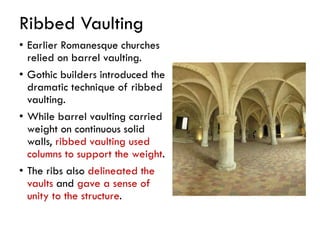
Ribbed Vaulting
• Earlier Romanesque churches
relied on barrel vaulting.
• Gothic builders introduced the
dramatic technique of ribbed
vaulting.
• While barrel vaulting carried
weight on continuous solid
walls, ribbed vaulting used
columns to support the weight.
• The ribs also delineated the
vaults and gave a sense of
unity to the structure.
Gothic Architecture: The Rib Vault
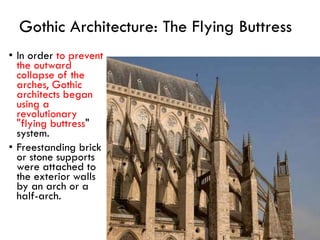
• In order to prevent
the outward
collapse of the
arches, Gothic
architects began
using a
revolutionary
"flying buttress"
system.
• Freestanding brick
or stone supports
were attached to
the exterior walls
by an arch or a
half-arch.
Gothic Architecture: The Flying Buttress
Gothic Architecture: The Flying
Buttress
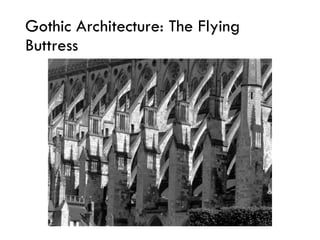
• Flying Buttress
• Effected by powerful external
arches swung above the side aisles
and the ambulatory
• Arches rise from colossal freestanding
piers
• Absorb and channel disruptive
forces, such as wind and weight,
safely to the ground
• Towering piers could be erected
without much affecting the nave or
choir interior
Gothic Architecture: The Flying
Buttress
Stained Glass Window
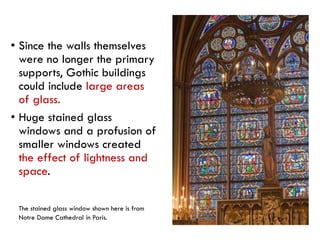
• Since the walls themselves
were no longer the primary
supports, Gothic buildings
could include large areas
of glass.
• Huge stained glass
windows and a profusion of
smaller windows created
the effect of lightness and
space.
The stained glass window shown here is from
Notre Dame Cathedral in Paris.
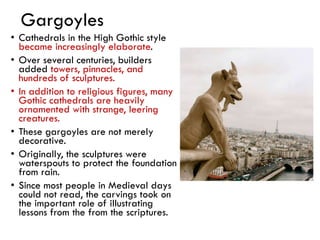
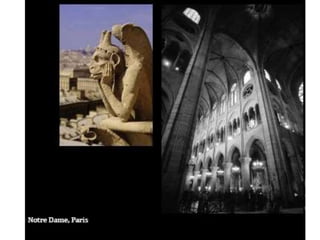
Gargoyles
• Cathedrals in the High Gothic style
became increasingly elaborate.
• Over several centuries, builders
added towers, pinnacles, and
hundreds of sculptures.
• In addition to religious figures, many
Gothic cathedrals are heavily
ornamented with strange, leering
creatures.
• These gargoyles are not merely
decorative.
• Originally, the sculptures were
waterspouts to protect the foundation
from rain.
• Since most people in Medieval days
could not read, the carvings took on
the important role of illustrating
lessons from the from the scriptures.
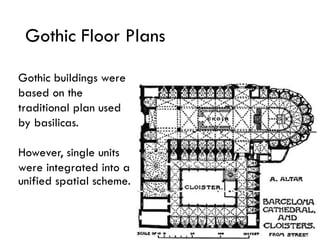
Gothic Floor Plans
Gothic buildings were
based on the
traditional plan used
by basilicas.
However, single units
were integrated into a
unified spatial scheme.
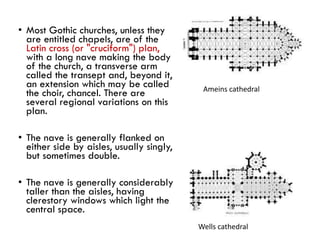
• Most Gothic churches, unless they
are entitled chapels, are of the
Latin cross (or "cruciform") plan,
with a long nave making the body
of the church, a transverse arm
called the transept and, beyond it,
an extension which may be called
the choir, chancel. There are
several regional variations on this
plan.
• The nave is generally flanked on
either side by aisles, usually singly,
but sometimes double.
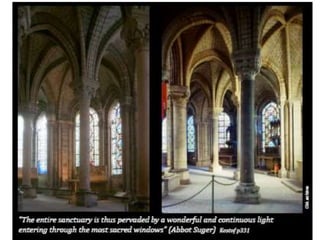
• The nave is generally considerably
taller than the aisles, having
clerestory windows which light the
central space.
Ameins cathedral
Wells cathedral
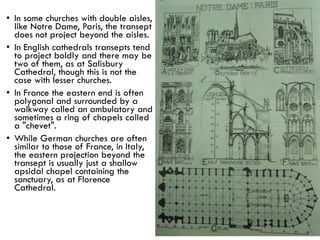
• In some churches with double aisles,
like Notre Dame, Paris, the transept
does not project beyond the aisles.
• In English cathedrals transepts tend
to project boldly and there may be
two of them, as at Salisbury
Cathedral, though this is not the
case with lesser churches.
• In France the eastern end is often
polygonal and surrounded by a
walkway called an ambulatory and
sometimes a ring of chapels called
a "chevet".
• While German churches are often
similar to those of France, in Italy,
the eastern projection beyond the
transept is usually just a shallow
apsidal chapel containing the
sanctuary, as at Florence
Cathedral.
Gothic Engineering
• Medieval man considered
himself an imperfect reflection
of the divine light of God, and
Gothic architecture was the
ideal expression of this view.
• New techniques of construction
permitted buildings to soar to
amazing new heights, dwarfing
anyone who stepped inside.
• Moreover, the concept of divine
light was suggested by the airy
quality of Gothic buildings,
which were much lighter than
churches in the earlier
Romanesque style.
Gothic Architecture: Gothic
Architecture in France
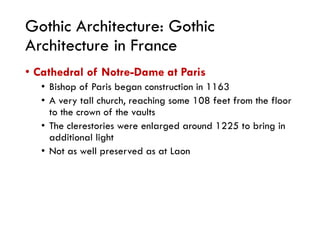
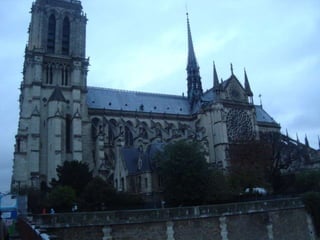
• Cathedral of Notre-Dame at Paris
• Bishop of Paris began construction in 1163
• A very tall church, reaching some 108 feet from the floor
to the crown of the vaults
• The clerestories were enlarged around 1225 to bring in
additional light
• Not as well preserved as at Laon
Notre Dame Cathedral
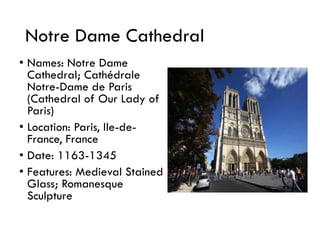
• Names: Notre Dame
Cathedral; Cathédrale
Notre-Dame de Paris
(Cathedral of Our Lady of
Paris)
• Location: Paris, Ile-de-
France, France
• Date: 1163-1345
• Features: Medieval Stained
Glass; Romanesque
Sculpture
History of the cathedral
• The Notre Dame de Paris stands on
the site of Paris' first Christian
church, Saint Etienne basilica, which
was itself built on the site of a
Roman temple to Jupiter.
• Construction on the current
cathedral began in 1163
• Construction of the west front, with
its distinctive two towers, began in
around 1200 before the nave had
been completed.
• Over the construction period,
numerous architects worked on the
site, as is evidenced by the
differing styles at different heights
of the west front and towers.
• Between 1210 and 1220, the
fourth architect oversaw the
construction of the level with the
rose window and the great halls
beneath the towers.
History of the Cathedral
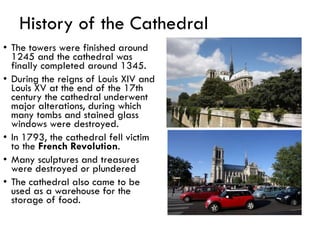
• The towers were finished around
1245 and the cathedral was
finally completed around 1345.
• During the reigns of Louis XIV and
Louis XV at the end of the 17th
century the cathedral underwent
major alterations, during which
many tombs and stained glass
windows were destroyed.
• In 1793, the cathedral fell victim
to the French Revolution.
• Many sculptures and treasures
were destroyed or plundered
• The cathedral also came to be
used as a warehouse for the
storage of food.
Gothic Architecture: Gothic
Architecture in France
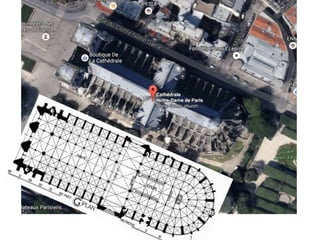
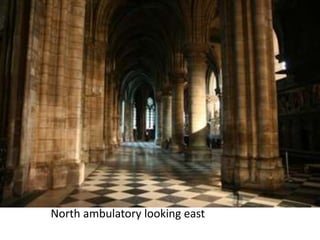
Double aisles – ambulatories on a bent axial line
Transepts not projected beyond the aisle wall
High vault – sexpartite vaulting covering double aisles (a ribbed vault whose lateral
triangles are bisected by an intermediate transverse rib, producing six triangles
within a bay)
Vault is 100ft (30m) high
Double span flying buttresses (earliest form)
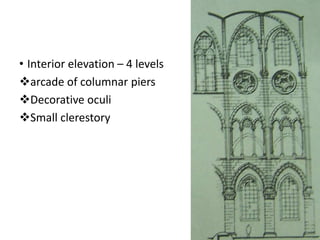
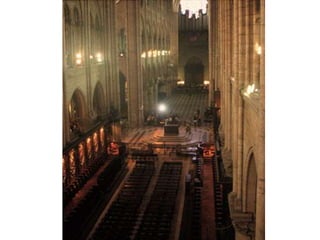
• Interior elevation – 4 levels
arcade of columnar piers
Decorative oculi
Small clerestory
North ambulatory looking east
Gothic Architecture: Gothic Architecture in France
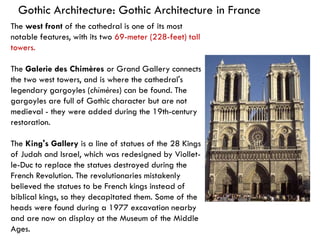
The west front of the cathedral is one of its most
notable features, with its two 69-meter (228-feet) tall
towers.
The Galerie des Chimères or Grand Gallery connects
the two west towers, and is where the cathedral's
legendary gargoyles (chimères) can be found. The
gargoyles are full of Gothic character but are not
medieval - they were added during the 19th-century
restoration.
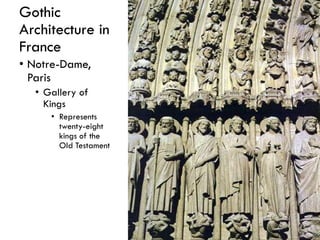
The King's Gallery is a line of statues of the 28 Kings
of Judah and Israel, which was redesigned by Viollet-
le-Duc to replace the statues destroyed during the
French Revolution. The revolutionaries mistakenly
believed the statues to be French kings instead of
biblical kings, so they decapitated them. Some of the
heads were found during a 1977 excavation nearby
and are now on display at the Museum of the Middle
Ages.
Gothic Architecture: Gothic Architecture in France
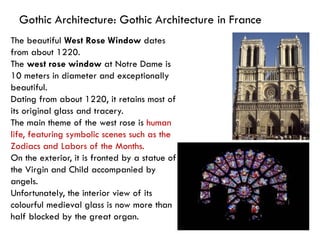
The beautiful West Rose Window dates
from about 1220.
The west rose window at Notre Dame is
10 meters in diameter and exceptionally
beautiful.
Dating from about 1220, it retains most of
its original glass and tracery.
The main theme of the west rose is human
life, featuring symbolic scenes such as the
Zodiacs and Labors of the Months.
On the exterior, it is fronted by a statue of
the Virgin and Child accompanied by
angels.
Unfortunately, the interior view of its
colourful medieval glass is now more than
half blocked by the great organ.
• The south rose
window installed
around 1260.
• its general themes
are the New
Testament, the
Triumph of Christ
• The south rose is 12.9
meters in diameter
and contains 84 panes
of glass.
• Radiating out from a
central medallion of
Christ, it consists of
four concentric circles
of 12 medallions, 24
medallions,
quadrilobes, and 24
trilobes.
SOUTH ROSE
Gothic
Architecture in
France
• Notre-Dame,
Paris
• Gallery of
Kings
• Represents
twenty-eight
kings of the
Old Testament
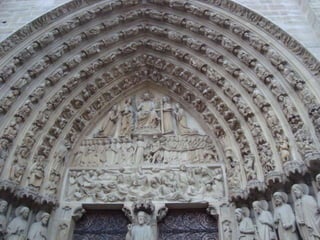
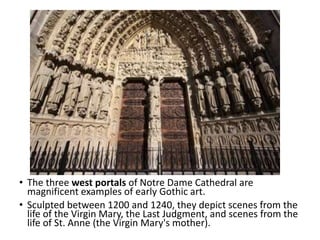
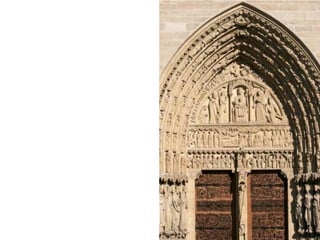
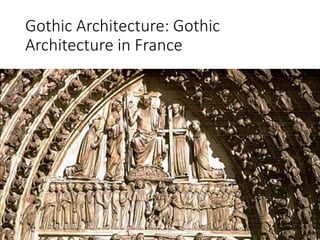
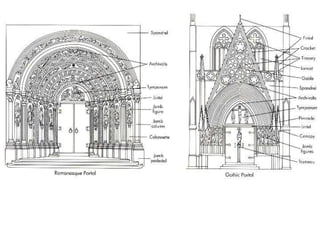
• The three west portals of Notre Dame Cathedral are
magnificent examples of early Gothic art.
• Sculpted between 1200 and 1240, they depict scenes from the
life of the Virgin Mary, the Last Judgment, and scenes from the
life of St. Anne (the Virgin Mary's mother).
Portal of St. Anne
Gothic Architecture: Gothic
Architecture in France
Examples
• Notre Dame, Paris
• Westminster Abbey
• Hampton Court Palace, London
• Doges Palace, Venice
• Milan Cathedral.
Thank you

Gothic Architecture

  • 1.
    Abhishek K. Venkitaraman AssistantProfessor HISTORY OF ARCHITECTURE LECTURE 7 Gothic Architecture
  • 2.
    Gothic Architecture • Characteristics –Structural • Skeletal stone structure – Visual • Visual arts were important including the role of light in structures – Symbolic • Scholasticism – Translations of real events into stone and glass • Cathedrals served as an image of heaven
  • 3.
    A R CH I T E C T U R E Elements taken from past: • the compound pier and archivolt, • the alternate system, and • the ribbed and domed vault. • the modified basilican plan with its triple aisles crossed by a projecting transept, and its three apses. This, the basis of the typical Norman and Gothic plan, was derived directly from the Church of the Nativity at Bethlehem, the date of which is unknown. It may have been built by Constantine, or by Justinian, or at any date between. • the doubled western towers, • the lantern or central tower over the crossing, and • the threefold interior system of arcade, triforium, and clerestory.
  • 7.
  • 8.
    The Rib Vault •Rib Vaults • Organic metaphor alluding to the role of ribs in anatomy as the body’s skeletal structure supporting tissues • Arches, usually three pairs per rectangular bay, running diagonally • Cross ribs act together with outer frame to create a complete armature of arches along the edges and main folds of the vault
  • 9.
    Ribbed Vaulting • EarlierRomanesque churches relied on barrel vaulting. • Gothic builders introduced the dramatic technique of ribbed vaulting. • While barrel vaulting carried weight on continuous solid walls, ribbed vaulting used columns to support the weight. • The ribs also delineated the vaults and gave a sense of unity to the structure.
  • 10.
  • 13.
    • In orderto prevent the outward collapse of the arches, Gothic architects began using a revolutionary "flying buttress" system. • Freestanding brick or stone supports were attached to the exterior walls by an arch or a half-arch. Gothic Architecture: The Flying Buttress
  • 14.
    Gothic Architecture: TheFlying Buttress • Flying Buttress • Effected by powerful external arches swung above the side aisles and the ambulatory • Arches rise from colossal freestanding piers • Absorb and channel disruptive forces, such as wind and weight, safely to the ground • Towering piers could be erected without much affecting the nave or choir interior
  • 15.
    Gothic Architecture: TheFlying Buttress
  • 16.
    Stained Glass Window •Since the walls themselves were no longer the primary supports, Gothic buildings could include large areas of glass. • Huge stained glass windows and a profusion of smaller windows created the effect of lightness and space. The stained glass window shown here is from Notre Dame Cathedral in Paris.
  • 17.
    Gargoyles • Cathedrals inthe High Gothic style became increasingly elaborate. • Over several centuries, builders added towers, pinnacles, and hundreds of sculptures. • In addition to religious figures, many Gothic cathedrals are heavily ornamented with strange, leering creatures. • These gargoyles are not merely decorative. • Originally, the sculptures were waterspouts to protect the foundation from rain. • Since most people in Medieval days could not read, the carvings took on the important role of illustrating lessons from the from the scriptures.
  • 19.
    Gothic Floor Plans Gothicbuildings were based on the traditional plan used by basilicas. However, single units were integrated into a unified spatial scheme.
  • 20.
    • Most Gothicchurches, unless they are entitled chapels, are of the Latin cross (or "cruciform") plan, with a long nave making the body of the church, a transverse arm called the transept and, beyond it, an extension which may be called the choir, chancel. There are several regional variations on this plan. • The nave is generally flanked on either side by aisles, usually singly, but sometimes double. • The nave is generally considerably taller than the aisles, having clerestory windows which light the central space. Ameins cathedral Wells cathedral
  • 21.
    • In somechurches with double aisles, like Notre Dame, Paris, the transept does not project beyond the aisles. • In English cathedrals transepts tend to project boldly and there may be two of them, as at Salisbury Cathedral, though this is not the case with lesser churches. • In France the eastern end is often polygonal and surrounded by a walkway called an ambulatory and sometimes a ring of chapels called a "chevet". • While German churches are often similar to those of France, in Italy, the eastern projection beyond the transept is usually just a shallow apsidal chapel containing the sanctuary, as at Florence Cathedral.
  • 22.
    Gothic Engineering • Medievalman considered himself an imperfect reflection of the divine light of God, and Gothic architecture was the ideal expression of this view. • New techniques of construction permitted buildings to soar to amazing new heights, dwarfing anyone who stepped inside. • Moreover, the concept of divine light was suggested by the airy quality of Gothic buildings, which were much lighter than churches in the earlier Romanesque style.
  • 24.
    Gothic Architecture: Gothic Architecturein France • Cathedral of Notre-Dame at Paris • Bishop of Paris began construction in 1163 • A very tall church, reaching some 108 feet from the floor to the crown of the vaults • The clerestories were enlarged around 1225 to bring in additional light • Not as well preserved as at Laon
  • 25.
    Notre Dame Cathedral •Names: Notre Dame Cathedral; Cathédrale Notre-Dame de Paris (Cathedral of Our Lady of Paris) • Location: Paris, Ile-de- France, France • Date: 1163-1345 • Features: Medieval Stained Glass; Romanesque Sculpture
  • 26.
    History of thecathedral • The Notre Dame de Paris stands on the site of Paris' first Christian church, Saint Etienne basilica, which was itself built on the site of a Roman temple to Jupiter. • Construction on the current cathedral began in 1163 • Construction of the west front, with its distinctive two towers, began in around 1200 before the nave had been completed. • Over the construction period, numerous architects worked on the site, as is evidenced by the differing styles at different heights of the west front and towers. • Between 1210 and 1220, the fourth architect oversaw the construction of the level with the rose window and the great halls beneath the towers.
  • 27.
    History of theCathedral • The towers were finished around 1245 and the cathedral was finally completed around 1345. • During the reigns of Louis XIV and Louis XV at the end of the 17th century the cathedral underwent major alterations, during which many tombs and stained glass windows were destroyed. • In 1793, the cathedral fell victim to the French Revolution. • Many sculptures and treasures were destroyed or plundered • The cathedral also came to be used as a warehouse for the storage of food.
  • 28.
  • 29.
    Double aisles –ambulatories on a bent axial line Transepts not projected beyond the aisle wall High vault – sexpartite vaulting covering double aisles (a ribbed vault whose lateral triangles are bisected by an intermediate transverse rib, producing six triangles within a bay) Vault is 100ft (30m) high Double span flying buttresses (earliest form)
  • 32.
    • Interior elevation– 4 levels arcade of columnar piers Decorative oculi Small clerestory
  • 34.
  • 35.
    Gothic Architecture: GothicArchitecture in France The west front of the cathedral is one of its most notable features, with its two 69-meter (228-feet) tall towers. The Galerie des Chimères or Grand Gallery connects the two west towers, and is where the cathedral's legendary gargoyles (chimères) can be found. The gargoyles are full of Gothic character but are not medieval - they were added during the 19th-century restoration. The King's Gallery is a line of statues of the 28 Kings of Judah and Israel, which was redesigned by Viollet- le-Duc to replace the statues destroyed during the French Revolution. The revolutionaries mistakenly believed the statues to be French kings instead of biblical kings, so they decapitated them. Some of the heads were found during a 1977 excavation nearby and are now on display at the Museum of the Middle Ages.
  • 36.
    Gothic Architecture: GothicArchitecture in France The beautiful West Rose Window dates from about 1220. The west rose window at Notre Dame is 10 meters in diameter and exceptionally beautiful. Dating from about 1220, it retains most of its original glass and tracery. The main theme of the west rose is human life, featuring symbolic scenes such as the Zodiacs and Labors of the Months. On the exterior, it is fronted by a statue of the Virgin and Child accompanied by angels. Unfortunately, the interior view of its colourful medieval glass is now more than half blocked by the great organ.
  • 37.
    • The southrose window installed around 1260. • its general themes are the New Testament, the Triumph of Christ • The south rose is 12.9 meters in diameter and contains 84 panes of glass. • Radiating out from a central medallion of Christ, it consists of four concentric circles of 12 medallions, 24 medallions, quadrilobes, and 24 trilobes. SOUTH ROSE
  • 38.
    Gothic Architecture in France • Notre-Dame, Paris •Gallery of Kings • Represents twenty-eight kings of the Old Testament
  • 40.
    • The threewest portals of Notre Dame Cathedral are magnificent examples of early Gothic art. • Sculpted between 1200 and 1240, they depict scenes from the life of the Virgin Mary, the Last Judgment, and scenes from the life of St. Anne (the Virgin Mary's mother).
  • 41.
  • 42.
  • 50.
    Examples • Notre Dame,Paris • Westminster Abbey • Hampton Court Palace, London • Doges Palace, Venice • Milan Cathedral.
  • 51.