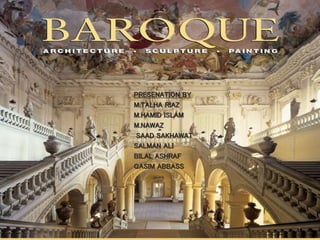

PRESENATION BY
M.TALHA RIAZ
M.HAMID ISLAM
M.NAWAZ
SAAD SAKHAWAT
SALMAN ALI
BILAL ASHRAF
QASIM ABBASS
1
Baroque
1600-1750 AD
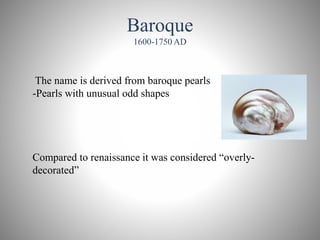
The name is derived from baroque pearls
-Pearls with unusual odd shapes
Compared to renaissance it was considered “overly-
decorated”
2
Introduction
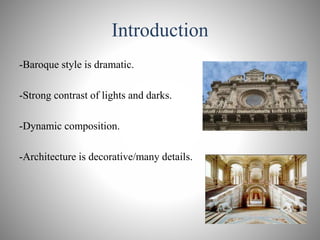
-Baroque style is dramatic.
-Strong contrast of lights and darks.
-Dynamic composition.
-Architecture is decorative/many details.
3
-The plans of the building were usually ellipse or oval.
Complex shapes derived from geometric figures were also
used.
-In spite of their bizarre shape the buildings were functional as
well.
-Other details, on entablatures, doors, and keystones of arches
and at corners included volutes, stucco figures and scrolls
4
Characteristics of Baroque
• Buildings in the Baroque style have many of these features:
• Complicated shapes
• Large curved forms
• Twisted columns
• Grand stairways
• High domes
• Trompe l'oeil paintings
5
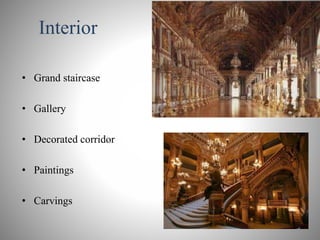
Interior
• Grand staircase
• Gallery
• Decorated corridor
• Paintings
• Carvings
6
Baroque style spread throughout
Europe
• Italy
• Holland
• France
• Spain
7
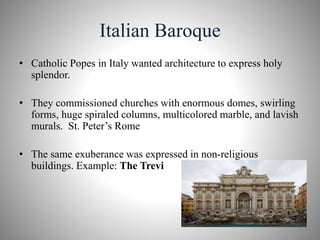
Italian Baroque
• Catholic Popes in Italy wanted architecture to express holy
splendor.
• They commissioned churches with enormous domes, swirling
forms, huge spiraled columns, multicolored marble, and lavish
murals. St. Peter’s Rome
• The same exuberance was expressed in non-religious
buildings. Example: The Trevi
8
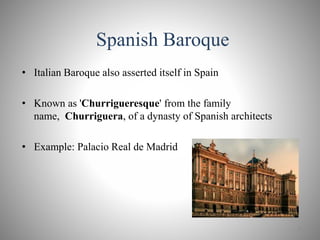
Spanish Baroque
• Italian Baroque also asserted itself in Spain
• Known as 'Churrigueresque' from the family
name, Churriguera, of a dynasty of Spanish architects
• Example: Palacio Real de Madrid
9
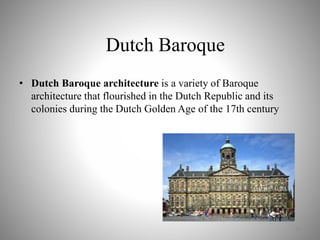
Dutch Baroque
• Dutch Baroque architecture is a variety of Baroque
architecture that flourished in the Dutch Republic and its
colonies during the Dutch Golden Age of the 17th century
10
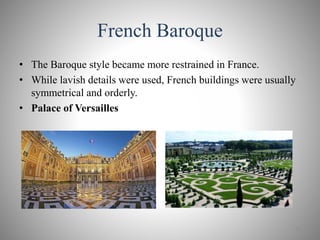
French Baroque
• The Baroque style became more restrained in France.
• While lavish details were used, French buildings were usually
symmetrical and orderly.
• Palace of Versailles
11
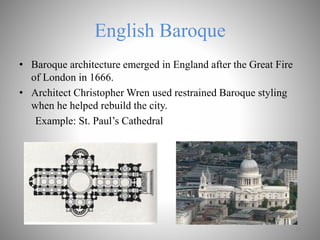
English Baroque
• Baroque architecture emerged in England after the Great Fire
of London in 1666.
• Architect Christopher Wren used restrained Baroque styling
when he helped rebuild the city.
Example: St. Paul’s Cathedral
12
• In Germany, Austria, Eastern Europe, and Russia,
Baroque ideas were often applied with a lighter touch.
13
Famous buildings of this era
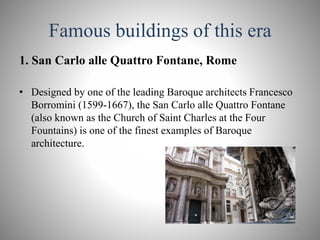
1. San Carlo alle Quattro Fontane, Rome
• Designed by one of the leading Baroque architects Francesco
Borromini (1599-1667), the San Carlo alle Quattro Fontane
(also known as the Church of Saint Charles at the Four
Fountains) is one of the finest examples of Baroque
architecture.
14
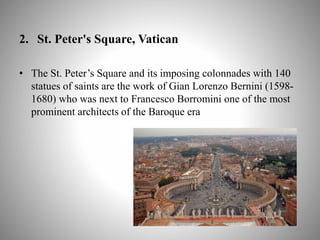
2. St. Peter's Square, Vatican
• The St. Peter’s Square and its imposing colonnades with 140
statues of saints are the work of Gian Lorenzo Bernini (1598-
1680) who was next to Francesco Borromini one of the most
prominent architects of the Baroque era
15
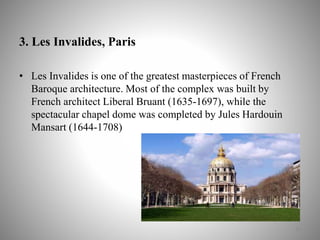
3. Les Invalides, Paris
• Les Invalides is one of the greatest masterpieces of French
Baroque architecture. Most of the complex was built by
French architect Liberal Bruant (1635-1697), while the
spectacular chapel dome was completed by Jules Hardouin
Mansart (1644-1708)
16
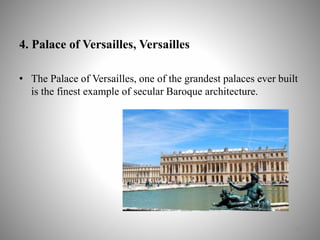
4. Palace of Versailles, Versailles
• The Palace of Versailles, one of the grandest palaces ever built
is the finest example of secular Baroque architecture.
17
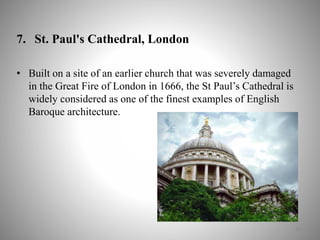
7. St. Paul's Cathedral, London
• Built on a site of an earlier church that was severely damaged
in the Great Fire of London in 1666, the St Paul’s Cathedral is
widely considered as one of the finest examples of English
Baroque architecture.
18
Thank you
19

Baroque architecture

  • 1.
    PRESENATION BY M.TALHA RIAZ M.HAMIDISLAM M.NAWAZ SAAD SAKHAWAT SALMAN ALI BILAL ASHRAF QASIM ABBASS 1
  • 2.
    Baroque 1600-1750 AD The nameis derived from baroque pearls -Pearls with unusual odd shapes Compared to renaissance it was considered “overly- decorated” 2
  • 3.
    Introduction -Baroque style isdramatic. -Strong contrast of lights and darks. -Dynamic composition. -Architecture is decorative/many details. 3
  • 4.
    -The plans ofthe building were usually ellipse or oval. Complex shapes derived from geometric figures were also used. -In spite of their bizarre shape the buildings were functional as well. -Other details, on entablatures, doors, and keystones of arches and at corners included volutes, stucco figures and scrolls 4
  • 5.
    Characteristics of Baroque •Buildings in the Baroque style have many of these features: • Complicated shapes • Large curved forms • Twisted columns • Grand stairways • High domes • Trompe l'oeil paintings 5
  • 6.
    Interior • Grand staircase •Gallery • Decorated corridor • Paintings • Carvings 6
  • 7.
    Baroque style spreadthroughout Europe • Italy • Holland • France • Spain 7
  • 8.
    Italian Baroque • CatholicPopes in Italy wanted architecture to express holy splendor. • They commissioned churches with enormous domes, swirling forms, huge spiraled columns, multicolored marble, and lavish murals. St. Peter’s Rome • The same exuberance was expressed in non-religious buildings. Example: The Trevi 8
  • 9.
    Spanish Baroque • ItalianBaroque also asserted itself in Spain • Known as 'Churrigueresque' from the family name, Churriguera, of a dynasty of Spanish architects • Example: Palacio Real de Madrid 9
  • 10.
    Dutch Baroque • DutchBaroque architecture is a variety of Baroque architecture that flourished in the Dutch Republic and its colonies during the Dutch Golden Age of the 17th century 10
  • 11.
    French Baroque • TheBaroque style became more restrained in France. • While lavish details were used, French buildings were usually symmetrical and orderly. • Palace of Versailles 11
  • 12.
    English Baroque • Baroquearchitecture emerged in England after the Great Fire of London in 1666. • Architect Christopher Wren used restrained Baroque styling when he helped rebuild the city. Example: St. Paul’s Cathedral 12
  • 13.
    • In Germany,Austria, Eastern Europe, and Russia, Baroque ideas were often applied with a lighter touch. 13
  • 14.
    Famous buildings ofthis era 1. San Carlo alle Quattro Fontane, Rome • Designed by one of the leading Baroque architects Francesco Borromini (1599-1667), the San Carlo alle Quattro Fontane (also known as the Church of Saint Charles at the Four Fountains) is one of the finest examples of Baroque architecture. 14
  • 15.
    2. St. Peter'sSquare, Vatican • The St. Peter’s Square and its imposing colonnades with 140 statues of saints are the work of Gian Lorenzo Bernini (1598- 1680) who was next to Francesco Borromini one of the most prominent architects of the Baroque era 15
  • 16.
    3. Les Invalides,Paris • Les Invalides is one of the greatest masterpieces of French Baroque architecture. Most of the complex was built by French architect Liberal Bruant (1635-1697), while the spectacular chapel dome was completed by Jules Hardouin Mansart (1644-1708) 16
  • 17.
    4. Palace ofVersailles, Versailles • The Palace of Versailles, one of the grandest palaces ever built is the finest example of secular Baroque architecture. 17
  • 18.
    7. St. Paul'sCathedral, London • Built on a site of an earlier church that was severely damaged in the Great Fire of London in 1666, the St Paul’s Cathedral is widely considered as one of the finest examples of English Baroque architecture. 18
  • 19.