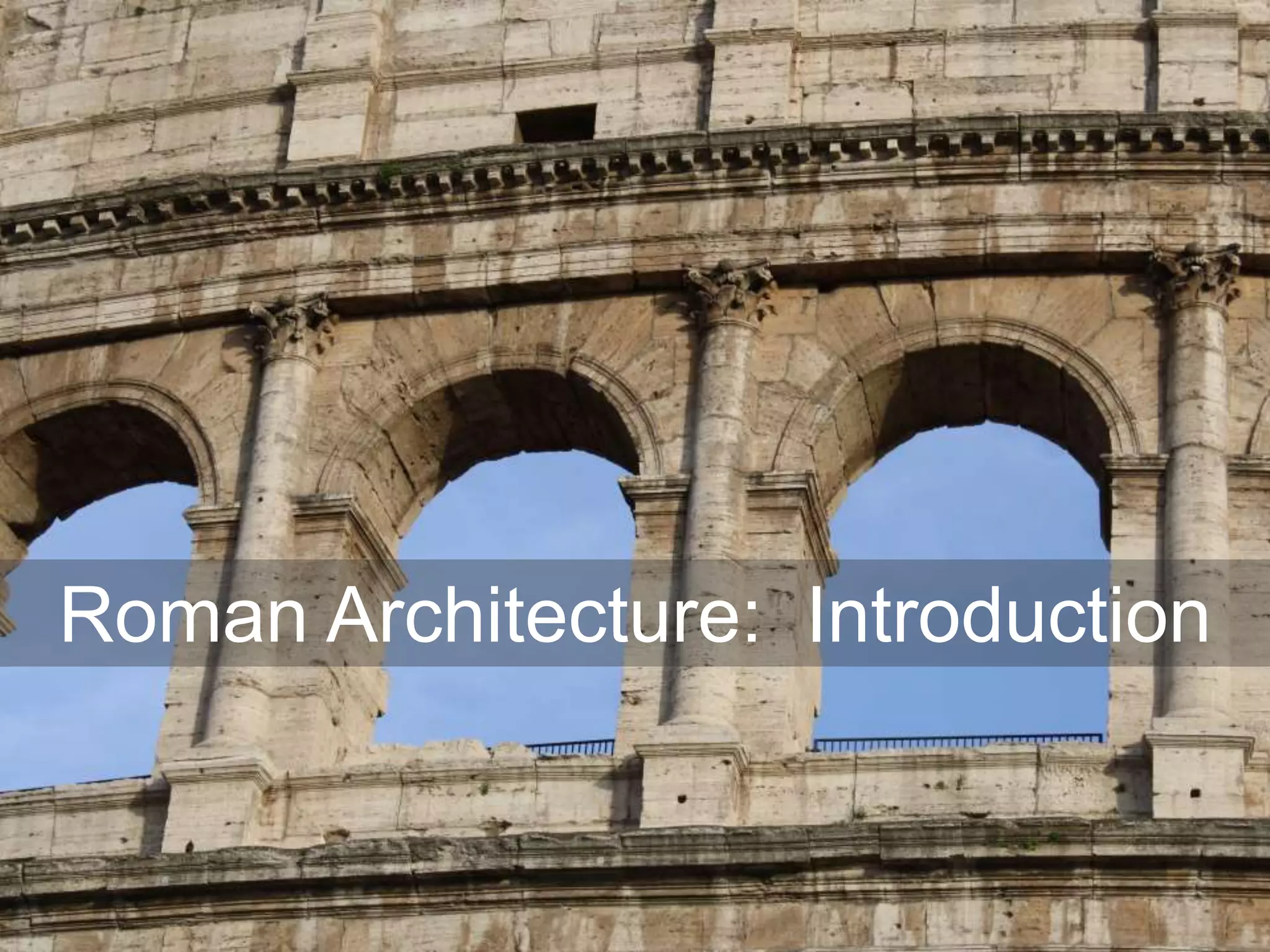
Roman Architecture: Introduction
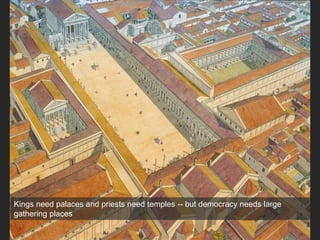
Kings need palaces and priests need temples -- but democracy needs large
gathering places
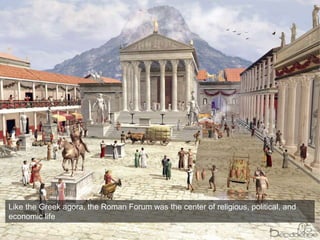
Like the Greek agora, the Roman Forum was the center of religious, political, and
economic life
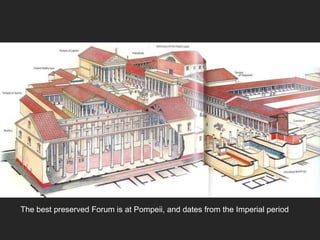
The best preserved Forum is at Pompeii, and dates from the Imperial period
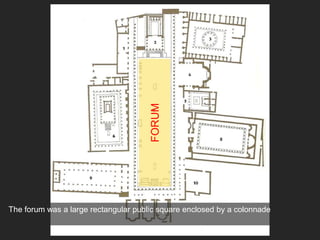
The forum was a large rectangular public square enclosed by a colonnade
FORUM
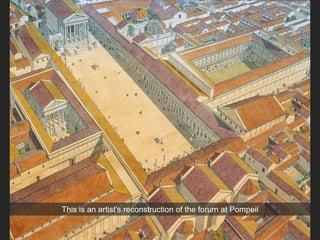
This is an artist’s reconstruction of the forum at Pompeii
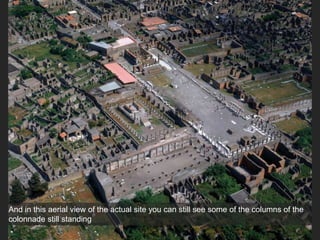
Aerial view of the Forum at Pompeii
And in this aerial view of the actual site you can still see some of the columns of the
colonnade still standing
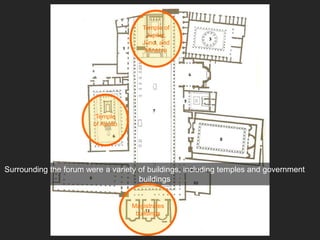
Surrounding the forum were a variety of buildings, including temples and government
buildings
Temple of
Jupiter,
Juno, and
Minerva
Temple
of Apollo
Magistrates
buildings
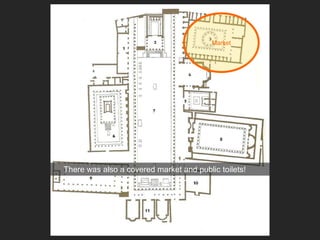
There was also a covered market and public toilets!
Market
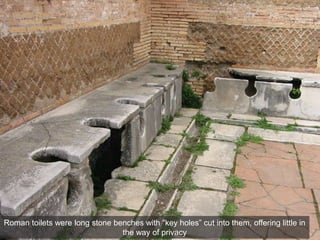
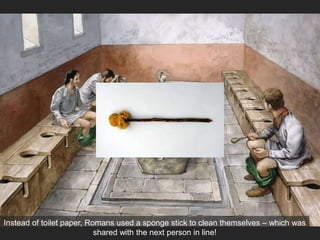
Roman toilets were long stone benches with “key holes” cut into them, offering little in
the way of privacy
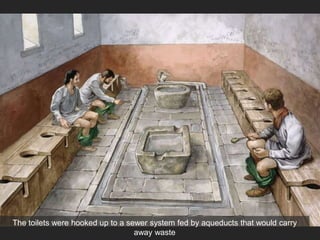
The toilets were hooked up to a sewer system fed by aqueducts that would carry
away waste
Instead of toilet paper, Romans used a sponge stick to clean themselves – which was
shared with the next person in line!
Yeah, its kinda gross – but hey, they had toilets and plumbing!!!
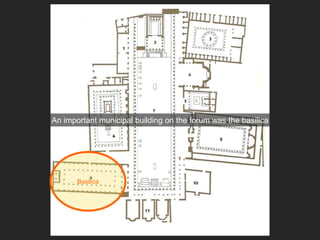
An important municipal building on the forum was the basilica
Basilica
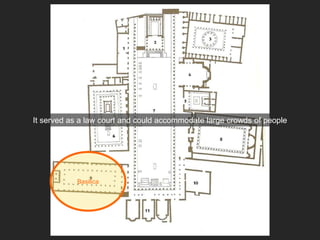
It served as a law court and could accommodate large crowds of people
Basilica
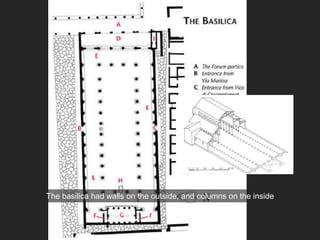
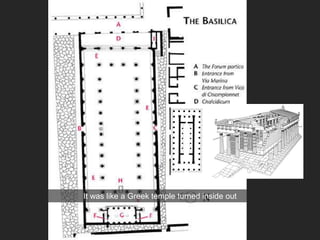
The basilica had walls on the outside, and columns on the inside
It was like a Greek temple turned inside out
Reconstruction of the Basilica Ulpia: http://student-kmt.hku.nl/~joost1/forumtrajani/NE%20Basilica.html
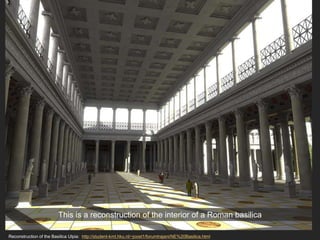
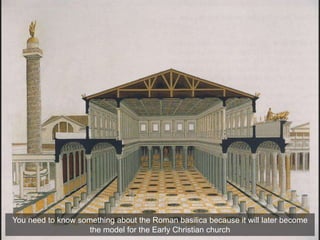
This is a reconstruction of the interior of a Roman basilica
Reconstruction of the Basilica Ulpia: http://student-kmt.hku.nl/~joost1/forumtrajani/NE%20Basilica.html
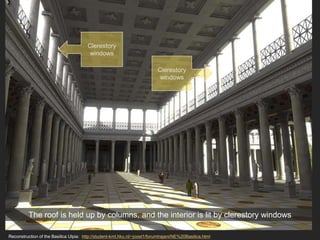
The roof is held up by columns, and the interior is lit by clerestory windows
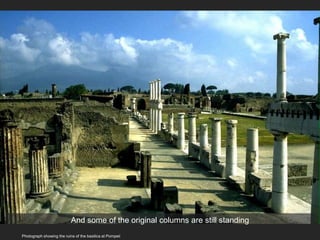
Photograph showing the ruins of the basilica at Pompeii
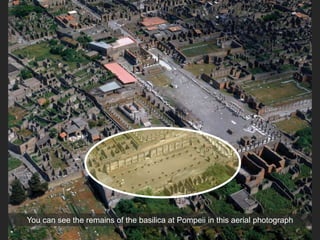
You can see the remains of the basilica at Pompeii in this aerial photograph
Photograph showing the ruins of the basilica at Pompeii
And some of the original columns are still standing
You need to know something about the Roman basilica because it will later become
the model for the Early Christian church
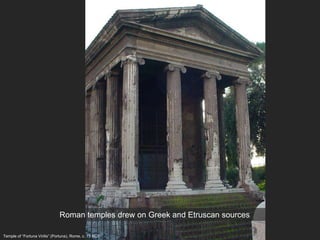
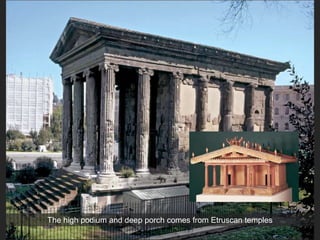
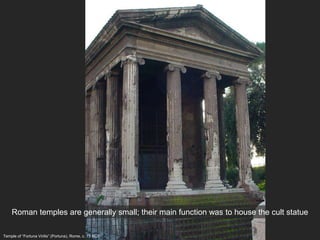
Temple of “Fortuna Virilis” (Portuna), Rome, c. 75 BCE
Roman temples drew on Greek and Etruscan sources
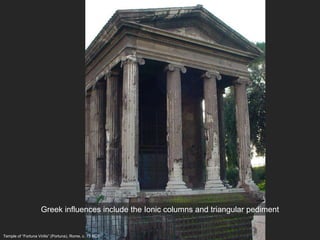
Temple of “Fortuna Virilis” (Portuna), Rome, c. 75 BCE
Greek influences include the Ionic columns and triangular pediment
The high podium and deep porch comes from Etruscan temples
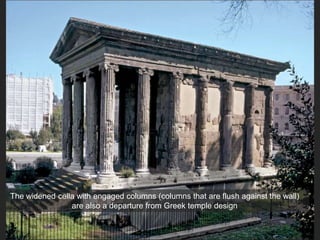
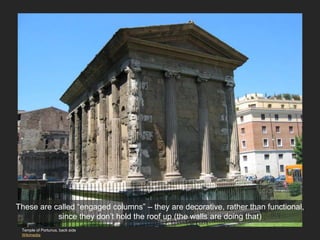
The widened cella with engaged columns (columns that are flush against the wall)
are also a departure from Greek temple design
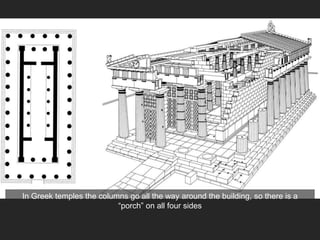
In Greek temples the columns go all the way around the building, so there is a
“porch” on all four sides
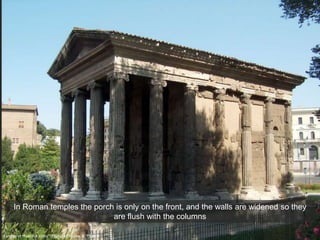
Temple of “Fortuna Virilis” (Portuna), Rome, c. 75 BCE
In Roman temples the porch is only on the front, and the walls are widened so they
are flush with the columns
Temple of Portunus, back side
Wikimedia
These are called “engaged columns” – they are decorative, rather than functional,
since they don’t hold the roof up (the walls are doing that)
Temple of “Fortuna Virilis” (Portuna), Rome, c. 75 BCE
Roman temples are generally small; their main function was to house the cult statue
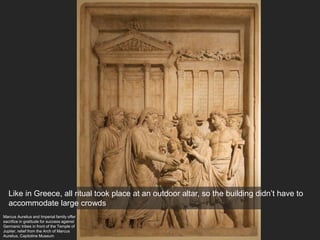
Marcus Aurelius and Imperial family offer
sacrifice in gratitude for success against
Germanic tribes in front of the Temple of
Jupiter, relief from the Arch of Marcus
Aurelius, Capitoline Museum
Like in Greece, all ritual took place at an outdoor altar, so the building didn’t have to
accommodate large crowds
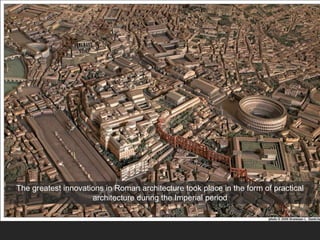
The greatest innovations in Roman architecture took place in the form of practical
architecture during the Imperial period
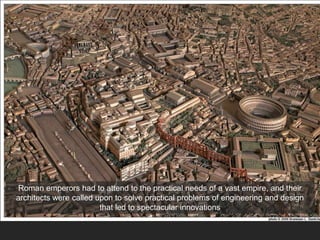
Roman emperors had to attend to the practical needs of a vast empire, and their
architects were called upon to solve practical problems of engineering and design
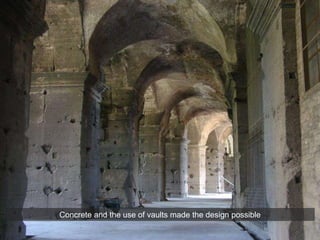
that led to spectacular innovations
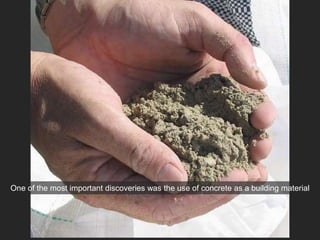
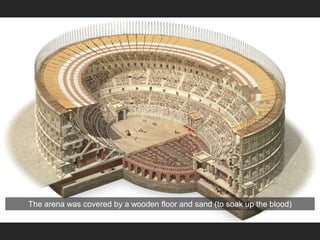
One of the most important discoveries was the use of concrete as a building material
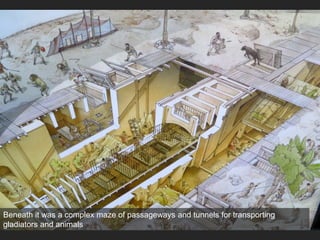
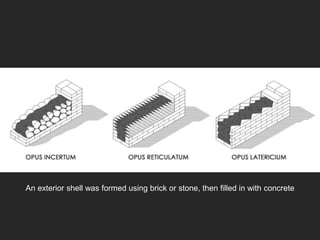
An exterior shell was formed using brick or stone, then filled in with concrete
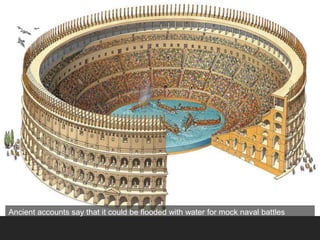
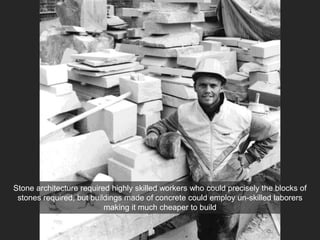
Stone architecture required highly skilled workers who could precisely the blocks of
stones required, but buildings made of concrete could employ un-skilled laborers
making it much cheaper to build
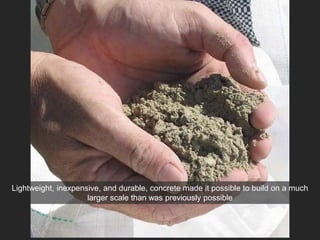
Lightweight, inexpensive, and durable, concrete made it possible to build on a much
larger scale than was previously possible
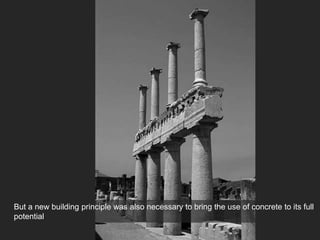
But a new building principle was also necessary to bring the use of concrete to its full
potential
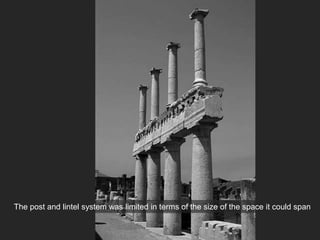
The post and lintel system was limited in terms of the size of the space it could span
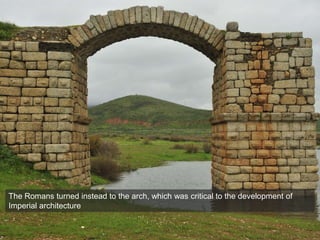
The Romans turned instead to the arch, which was critical to the development of
Imperial architecture
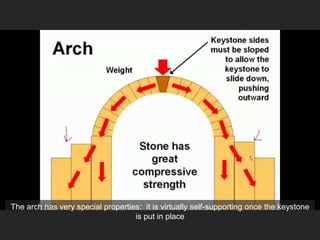
The arch has very special properties: it is virtually self-supporting once the keystone
is put in place
http://www.supertool.com/arch19.jpg
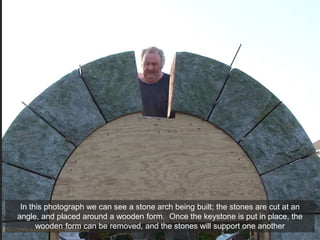
In this photograph we can see a stone arch being built; the stones are cut at an
angle, and placed around a wooden form. Once the keystone is put in place, the
wooden form can be removed, and the stones will support one another
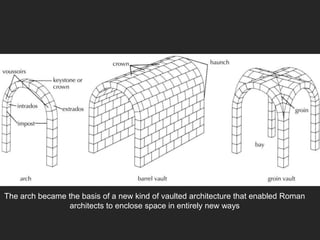
The arch became the basis of a new kind of vaulted architecture that enabled Roman
architects to enclose space in entirely new ways
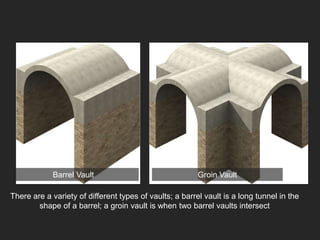
Barrel Vault Groin Vault
There are a variety of different types of vaults; a barrel vault is a long tunnel in the
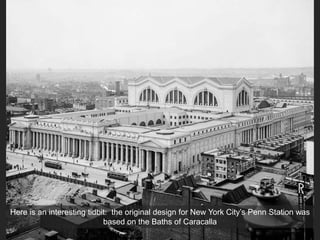
shape of a barrel; a groin vault is when two barrel vaults intersect
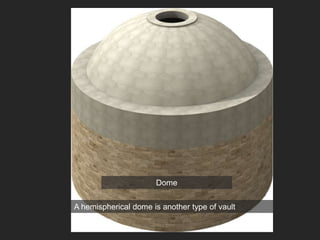
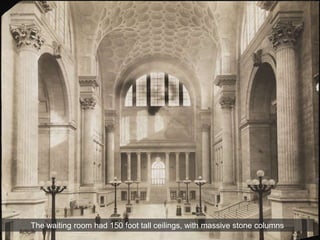
Dome
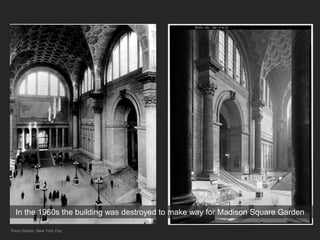
A hemispherical dome is another type of vault
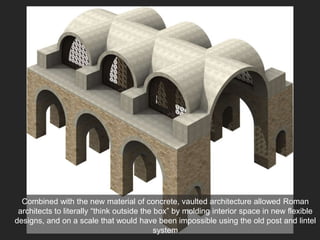
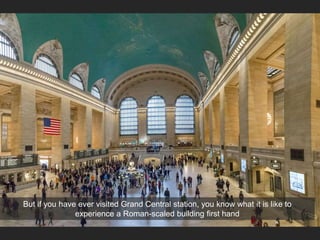
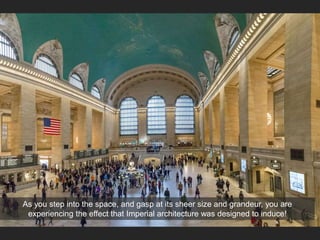
Combined with the new material of concrete, vaulted architecture allowed Roman
architects to literally “think outside the box” by molding interior space in new flexible
designs, and on a scale that would have been impossible using the old post and lintel
system
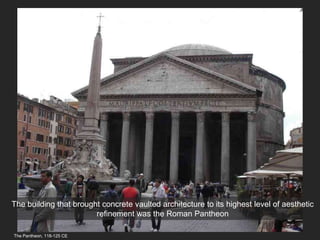
Thanks for listening!
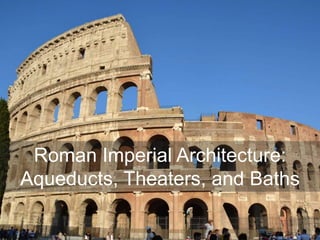
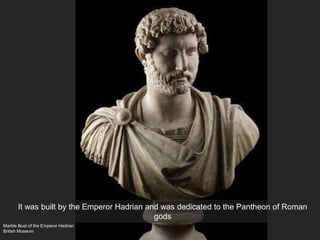
Roman Imperial Architecture:
Aqueducts, Theaters, and Baths
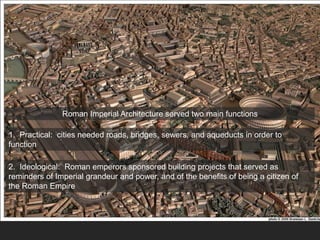
Roman Imperial Architecture served two main functions
1. Practical: cities needed roads, bridges, sewers, and aqueducts in order to
function
2. Ideological: Roman emperors sponsored building projects that served as
reminders of Imperial grandeur and power, and of the benefits of being a citizen of
the Roman Empire
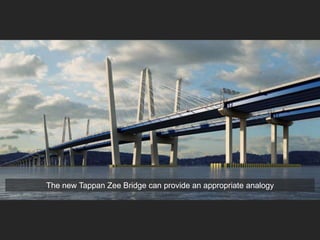
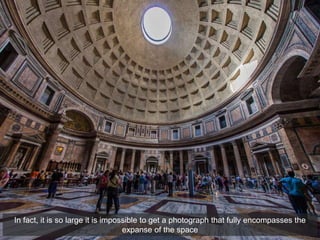
The new Tappan Zee Bridge can provide an appropriate analogy
Governor Andrew Cuomo has staked his political career on this project, and its
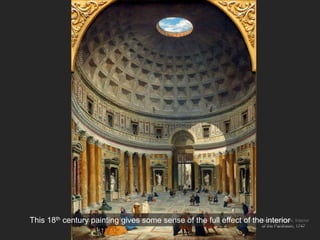
completion will earn him considerable political capital and popular support
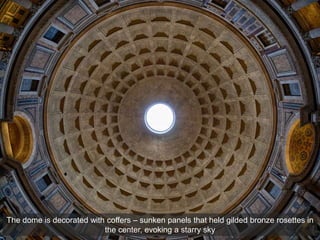
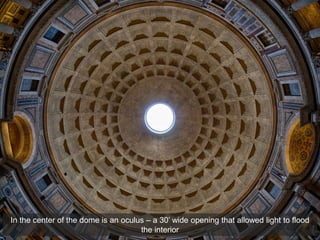
The bridge is practical: it will get cars, trucks and buses over the Hudson River, but it
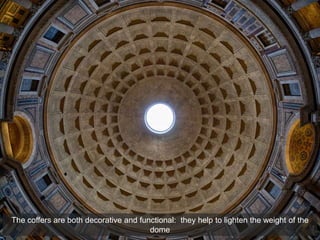
is also intended to be beautiful (it will become a tourist destination with its viewing
deck), and symbolic of the regions economic renewal
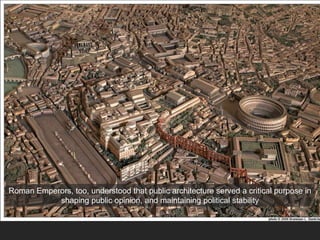
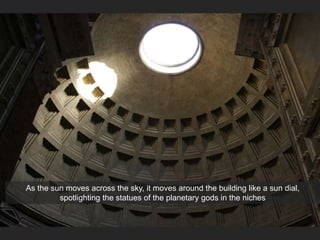
Roman Emperors, too, understood that public architecture served a critical purpose in
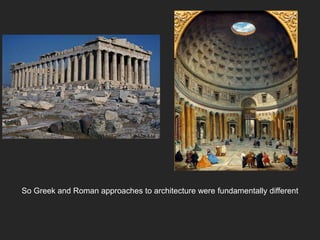
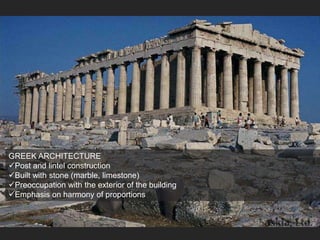
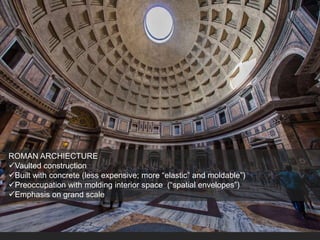
shaping public opinion, and maintaining political stability
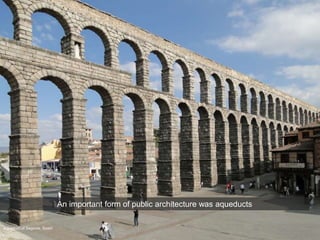
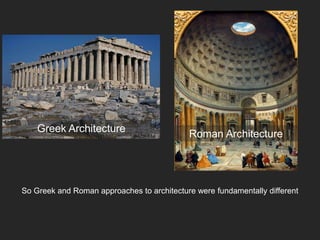
Aquaduct of Segovia, Spain
An important form of public architecture was aqueducts
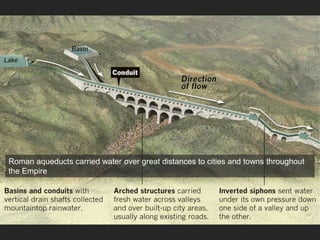
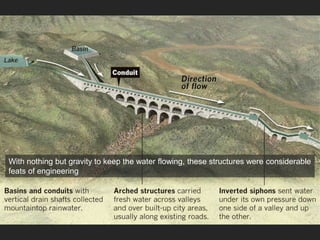
Roman aqueducts carried water over great distances to cities and towns throughout
the Empire
With nothing but gravity to keep the water flowing, these structures were considerable
feats of engineering
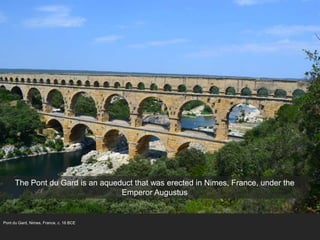
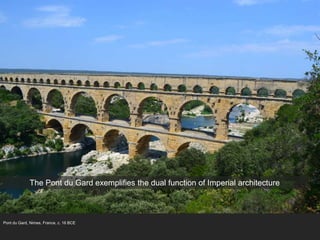
Pont du Gard, Nimes, France, c. 16 BCE
The Pont du Gard is an aqueduct that was erected in Nimes, France, under the
Emperor Augustus
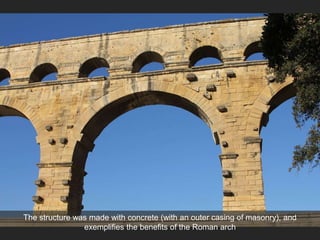
The structure was made with concrete (with an outer casing of masonry), and
exemplifies the benefits of the Roman arch
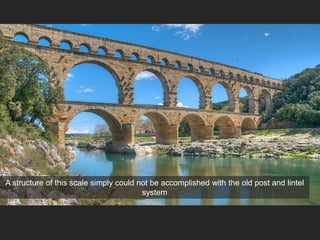
A structure of this scale simply could not be accomplished with the old post and lintel
system
Pont du Gard, Nimes, France, c. 16 BCE
The Pont du Gard exemplifies the dual function of Imperial architecture
Imperial Architecture
Pont du Gard, Nimes, France, c. 16 BCE
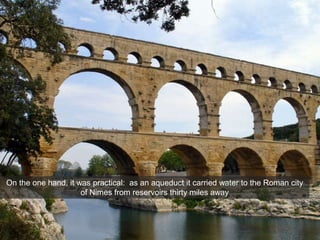
On the one hand, it was practical: as an aqueduct it carried water to the Roman city
of Nimes from reservoirs thirty miles away
Imperial Architecture
Pont du Gard, Nimes, France, c. 16 BCE
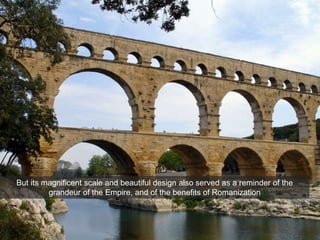
But its magnificent scale and beautiful design also served as a reminder of the
grandeur of the Empire, and of the benefits of Romanization
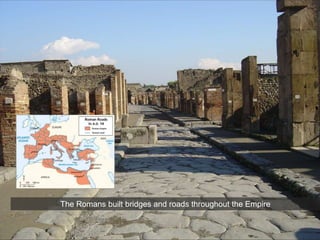
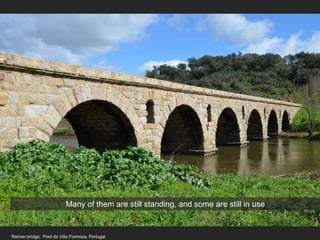
The Romans built bridges and roads throughout the Empire
Many of them are still standing, and some are still in use
Roman bridge: Pont da Villa Formosa, Portugal
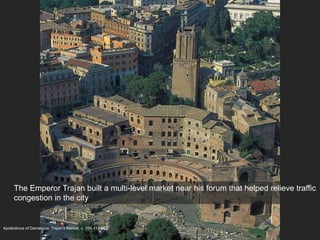
Apollodorus of Damascus, Trajan’s Market, c. 100-112 BCE
The Emperor Trajan built a multi-level market near his forum that helped relieve traffic
congestion in the city
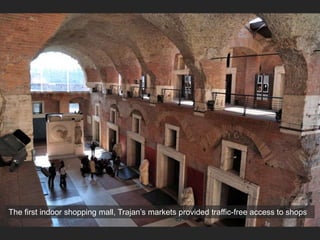
The first indoor shopping mall, Trajan’s markets provided traffic-free access to shops
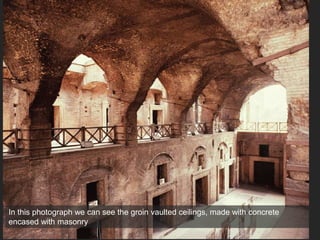
In this photograph we can see the groin vaulted ceilings, made with concrete
encased with masonry
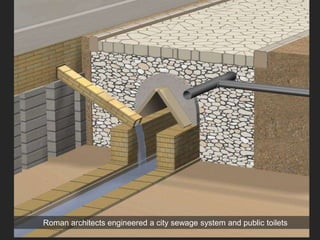
Roman architects engineered a city sewage system and public toilets
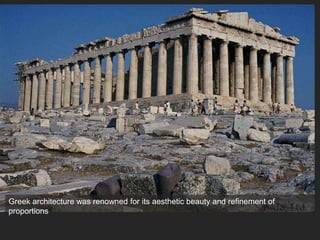
Greek architecture was renowned for its aesthetic beauty and refinement of
proportions
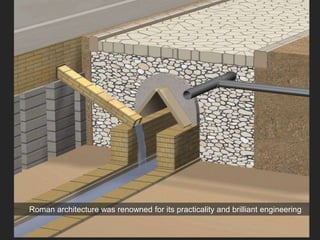
Roman architecture was renowned for its practicality and brilliant engineering
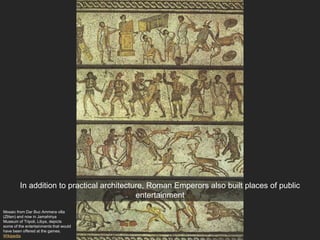
Mosaic from Dar Buc Ammera villa
(Zliten) and now in Jamahiriya
Museum of Tripoli, Libya, depicts
some of the entertainments that would
have been offered at the games.
Wikipedia
In addition to practical architecture, Roman Emperors also built places of public
entertainment
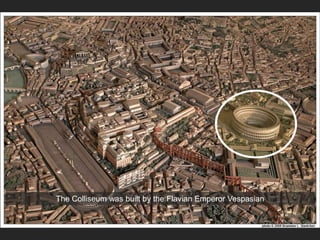
The Colliseum was built by the Flavian Emperor Vespasian
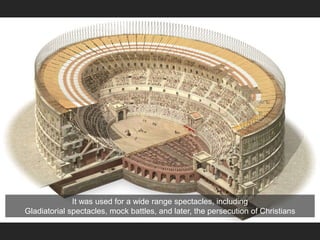
It was used for a wide range spectacles, including
Gladiatorial spectacles, mock battles, and later, the persecution of Christians
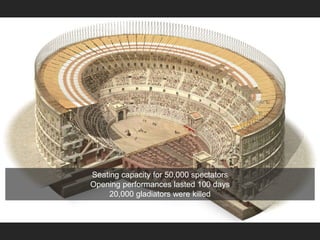
Seating capacity for 50,000 spectators
Opening performances lasted 100 days
20,000 gladiators were killed
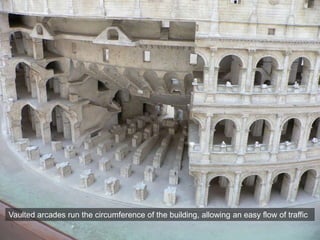
Vaulted arcades run the circumference of the building, allowing an easy flow of traffic
Concrete and the use of vaults made the design possible
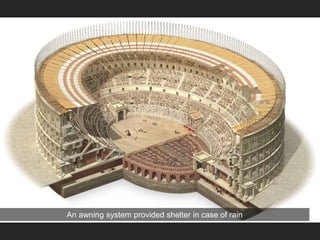
The arena was covered by a wooden floor and sand (to soak up the blood)
Beneath it was a complex maze of passageways and tunnels for transporting
gladiators and animals
Ancient accounts say that it could be flooded with water for mock naval battles
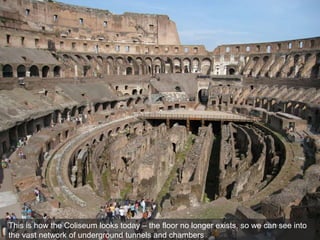
This is how the Coliseum looks today – the floor no longer exists, so we can see into
the vast network of underground tunnels and chambers
An awning system provided shelter in case of rain
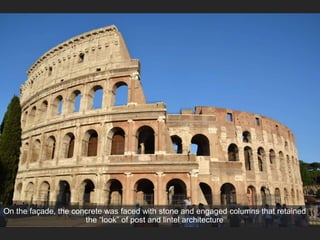
On the façade, the concrete was faced with stone and engaged columns that retained
the “look” of post and lintel architecture
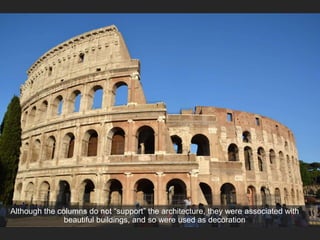
Although the columns do not “support” the architecture, they were associated with
beautiful buildings, and so were used as decoration
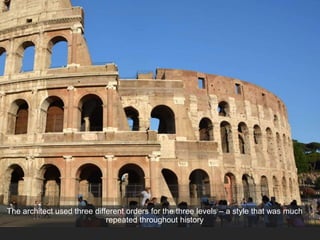
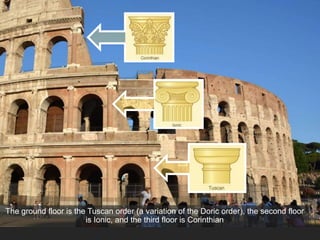
The architect used three different orders for the three levels – a style that was much
repeated throughout history
The ground floor is the Tuscan order (a variation of the Doric order), the second floor
is Ionic, and the third floor is Corinthian
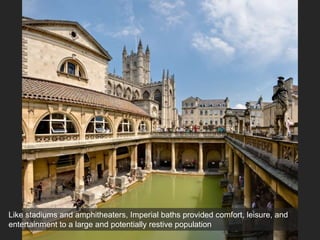
Like stadiums and amphitheaters, Imperial baths provided comfort, leisure, and
entertainment to a large and potentially restive population
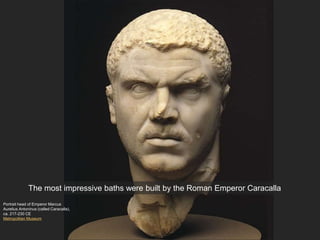
Portrait head of Emperor Marcus
Aurelius Antoninus (called Caracalla),
ca. 217-230 CE
Metropolitan Museum
The most impressive baths were built by the Roman Emperor Caracalla
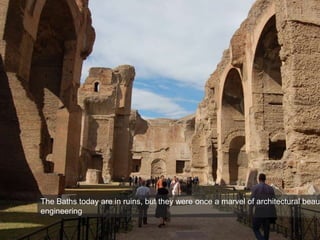
Baths of Caracalla, Rome 212-216 CE
Image source: http://commons.wikimedia.org/wiki/File:BathsOfCaracalla.jpg
The Baths today are in ruins, but they were once a marvel of architectural beaut
engineering
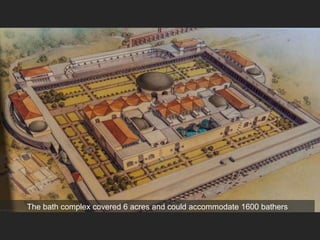
The bath complex covered 6 acres and could accommodate 1600 bathers
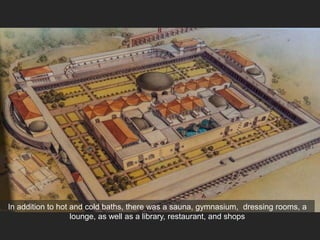
In addition to hot and cold baths, there was a sauna, gymnasium, dressing rooms, a
lounge, as well as a library, restaurant, and shops
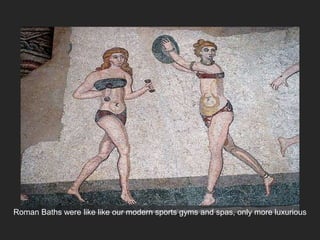
Roman Baths were like like our modern sports gyms and spas, only more luxurious
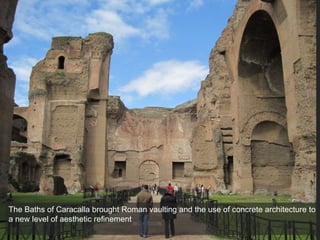
The Baths of Caracalla brought Roman vaulting and the use of concrete architecture to
a new level of aesthetic refinement
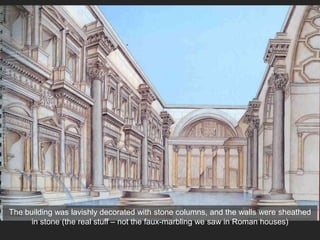
The building was lavishly decorated with stone columns, and the walls were sheathed
in stone (the real stuff – not the faux-marbling we saw in Roman houses)
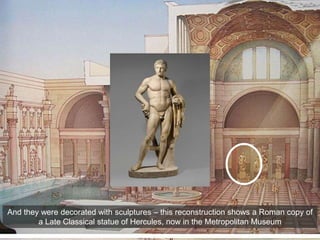
And they were decorated with sculptures – this reconstruction shows a Roman copy of
a Late Classical statue of Hercules, now in the Metropolitan Museum
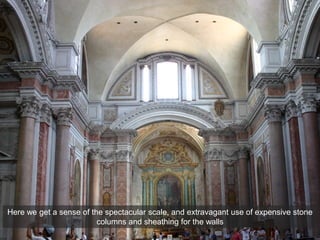
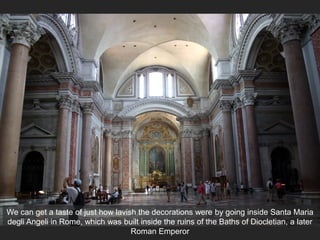
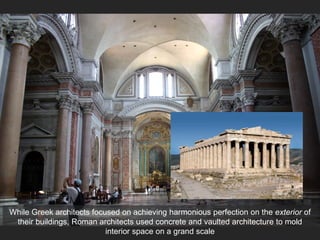
We can get a taste of just how lavish the decorations were by going inside Santa Maria
degli Angeli in Rome, which was built inside the ruins of the Baths of Diocletian, a later
Roman Emperor
Here we get a sense of the spectacular scale, and extravagant use of expensive stone
columns and sheathing for the walls
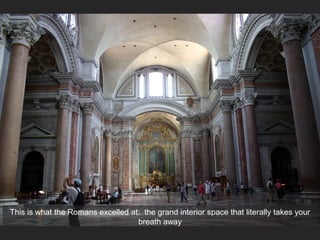
This is what the Romans excelled at: the grand interior space that literally takes your
breath away
While Greek architects focused on achieving harmonious perfection on the exterior of
their buildings, Roman architects used concrete and vaulted architecture to mold
interior space on a grand scale
Here is an interesting tidbit: the original design for New York City’s Penn Station was
based on the Baths of Caracalla
The waiting room had 150 foot tall ceilings, with massive stone columns
Penn Station, New York City
In the 1960s the building was destroyed to make way for Madison Square Garden
But if you have ever visited Grand Central station, you know what it is like to
experience a Roman-scaled building first hand
As you step into the space, and gasp at its sheer size and grandeur, you are
experiencing the effect that Imperial architecture was designed to induce!
Thanks for listening
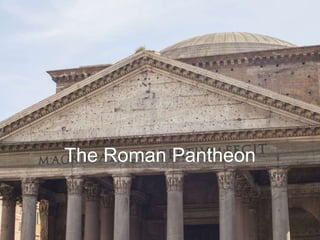
The Roman Pantheon
The Pantheon, 118-125 CE
The building that brought concrete vaulted architecture to its highest level of aesthetic
refinement was the Roman Pantheon
Marble Bust of the Emperor Hadrian
British Museum
It was built by the Emperor Hadrian and was dedicated to the Pantheon of Roman
gods
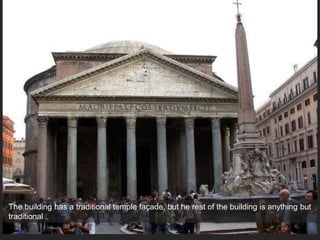
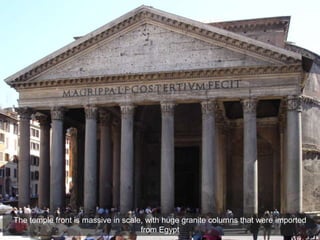
The building has a traditional temple façade, but he rest of the building is anything but
traditional
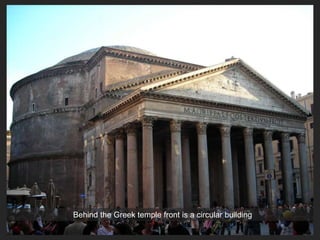
Behind the Greek temple front is a circular building
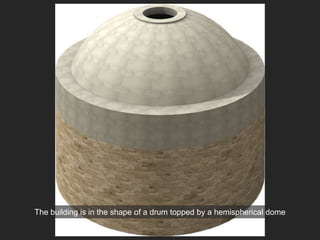
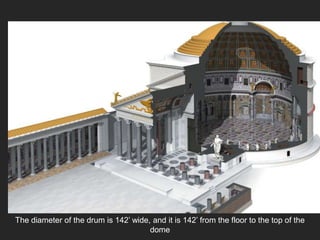
The building is in the shape of a drum topped by a hemispherical dome
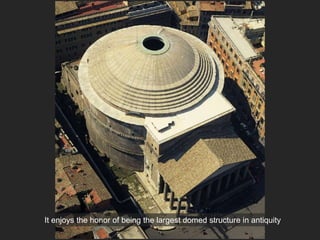
It enjoys the honor of being the largest domed structure in antiquity
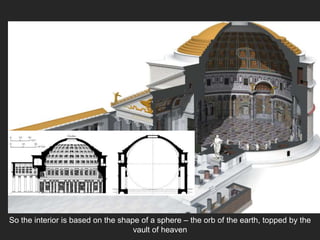
The diameter of the drum is 142’ wide, and it is 142’ from the floor to the top of the
dome
So the interior is based on the shape of a sphere – the orb of the earth, topped by the
vault of heaven
The temple front is massive in scale, with huge granite columns that were imported
from Egypt
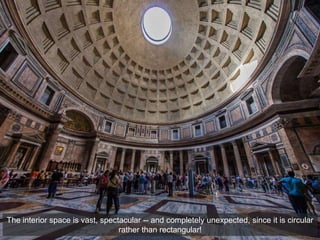
The interior space is vast, spectacular -- and completely unexpected, since it is circular
rather than rectangular!
In fact, it is so large it is impossible to get a photograph that fully encompasses the
expanse of the space
Giovanni Panini, Interior
of the Pantheon, 1747
This 18th century painting gives some sense of the full effect of the interior
The dome is decorated with coffers – sunken panels that held gilded bronze rosettes in
the center, evoking a starry sky
The coffers are both decorative and functional: they help to lighten the weight of the
dome
In the center of the dome is an oculus – a 30’ wide opening that allowed light to flood
the interior
As the sun moves across the sky, it moves around the building like a sun dial,
spotlighting the statues of the planetary gods in the niches
So Greek and Roman approaches to architecture were fundamentally different
Greek Architecture
Roman Architecture
GREEK ARCHITECTURE
Post and lintel construction
Built with stone (marble, limestone)
Preoccupation with the exterior of the building
Emphasis on harmony of proportions
ROMAN ARCHIECTURE
Vaulted construction
Built with concrete (less expensive; more “elastic” and moldable”)
Preoccupation with molding interior space (“spatial envelopes”)
Emphasis on grand scale
Thanks for listening

Roman Architecture

  • 1.
  • 2.
    Kings need palacesand priests need temples -- but democracy needs large gathering places
  • 3.
    Like the Greekagora, the Roman Forum was the center of religious, political, and economic life
  • 4.
    The best preservedForum is at Pompeii, and dates from the Imperial period
  • 5.
    The forum wasa large rectangular public square enclosed by a colonnade FORUM
  • 6.
    This is anartist’s reconstruction of the forum at Pompeii
  • 7.
    Aerial view ofthe Forum at Pompeii And in this aerial view of the actual site you can still see some of the columns of the colonnade still standing
  • 8.
    Surrounding the forumwere a variety of buildings, including temples and government buildings Temple of Jupiter, Juno, and Minerva Temple of Apollo Magistrates buildings
  • 9.
    There was alsoa covered market and public toilets! Market
  • 10.
    Roman toilets werelong stone benches with “key holes” cut into them, offering little in the way of privacy
  • 11.
    The toilets werehooked up to a sewer system fed by aqueducts that would carry away waste
  • 12.
    Instead of toiletpaper, Romans used a sponge stick to clean themselves – which was shared with the next person in line!
  • 13.
    Yeah, its kindagross – but hey, they had toilets and plumbing!!!
  • 14.
    An important municipalbuilding on the forum was the basilica Basilica
  • 15.
    It served asa law court and could accommodate large crowds of people Basilica
  • 16.
    The basilica hadwalls on the outside, and columns on the inside
  • 17.
    It was likea Greek temple turned inside out
  • 18.
    Reconstruction of theBasilica Ulpia: http://student-kmt.hku.nl/~joost1/forumtrajani/NE%20Basilica.html This is a reconstruction of the interior of a Roman basilica
  • 19.
    Reconstruction of theBasilica Ulpia: http://student-kmt.hku.nl/~joost1/forumtrajani/NE%20Basilica.html The roof is held up by columns, and the interior is lit by clerestory windows
  • 20.
    Photograph showing theruins of the basilica at Pompeii You can see the remains of the basilica at Pompeii in this aerial photograph
  • 21.
    Photograph showing theruins of the basilica at Pompeii And some of the original columns are still standing
  • 22.
    You need toknow something about the Roman basilica because it will later become the model for the Early Christian church
  • 23.
    Temple of “FortunaVirilis” (Portuna), Rome, c. 75 BCE Roman temples drew on Greek and Etruscan sources
  • 24.
    Temple of “FortunaVirilis” (Portuna), Rome, c. 75 BCE Greek influences include the Ionic columns and triangular pediment
  • 25.
    The high podiumand deep porch comes from Etruscan temples
  • 26.
    The widened cellawith engaged columns (columns that are flush against the wall) are also a departure from Greek temple design
  • 27.
    In Greek templesthe columns go all the way around the building, so there is a “porch” on all four sides
  • 28.
    Temple of “FortunaVirilis” (Portuna), Rome, c. 75 BCE In Roman temples the porch is only on the front, and the walls are widened so they are flush with the columns
  • 29.
    Temple of Portunus,back side Wikimedia These are called “engaged columns” – they are decorative, rather than functional, since they don’t hold the roof up (the walls are doing that)
  • 30.
    Temple of “FortunaVirilis” (Portuna), Rome, c. 75 BCE Roman temples are generally small; their main function was to house the cult statue
  • 31.
    Marcus Aurelius andImperial family offer sacrifice in gratitude for success against Germanic tribes in front of the Temple of Jupiter, relief from the Arch of Marcus Aurelius, Capitoline Museum Like in Greece, all ritual took place at an outdoor altar, so the building didn’t have to accommodate large crowds
  • 32.
    The greatest innovationsin Roman architecture took place in the form of practical architecture during the Imperial period
  • 33.
    Roman emperors hadto attend to the practical needs of a vast empire, and their architects were called upon to solve practical problems of engineering and design that led to spectacular innovations
  • 34.
    One of themost important discoveries was the use of concrete as a building material
  • 35.
    An exterior shellwas formed using brick or stone, then filled in with concrete
  • 36.
    Stone architecture requiredhighly skilled workers who could precisely the blocks of stones required, but buildings made of concrete could employ un-skilled laborers making it much cheaper to build
  • 37.
    Lightweight, inexpensive, anddurable, concrete made it possible to build on a much larger scale than was previously possible
  • 38.
    But a newbuilding principle was also necessary to bring the use of concrete to its full potential
  • 39.
    The post andlintel system was limited in terms of the size of the space it could span
  • 40.
    The Romans turnedinstead to the arch, which was critical to the development of Imperial architecture
  • 41.
    The arch hasvery special properties: it is virtually self-supporting once the keystone is put in place
  • 42.
    http://www.supertool.com/arch19.jpg In this photographwe can see a stone arch being built; the stones are cut at an angle, and placed around a wooden form. Once the keystone is put in place, the wooden form can be removed, and the stones will support one another
  • 43.
    The arch becamethe basis of a new kind of vaulted architecture that enabled Roman architects to enclose space in entirely new ways
  • 44.
    Barrel Vault GroinVault There are a variety of different types of vaults; a barrel vault is a long tunnel in the shape of a barrel; a groin vault is when two barrel vaults intersect
  • 45.
    Dome A hemispherical domeis another type of vault
  • 46.
    Combined with thenew material of concrete, vaulted architecture allowed Roman architects to literally “think outside the box” by molding interior space in new flexible designs, and on a scale that would have been impossible using the old post and lintel system
  • 47.
  • 48.
  • 49.
    Roman Imperial Architectureserved two main functions 1. Practical: cities needed roads, bridges, sewers, and aqueducts in order to function 2. Ideological: Roman emperors sponsored building projects that served as reminders of Imperial grandeur and power, and of the benefits of being a citizen of the Roman Empire
  • 50.
    The new TappanZee Bridge can provide an appropriate analogy
  • 51.
    Governor Andrew Cuomohas staked his political career on this project, and its completion will earn him considerable political capital and popular support
  • 52.
    The bridge ispractical: it will get cars, trucks and buses over the Hudson River, but it is also intended to be beautiful (it will become a tourist destination with its viewing deck), and symbolic of the regions economic renewal
  • 53.
    Roman Emperors, too,understood that public architecture served a critical purpose in shaping public opinion, and maintaining political stability
  • 54.
    Aquaduct of Segovia,Spain An important form of public architecture was aqueducts
  • 55.
    Roman aqueducts carriedwater over great distances to cities and towns throughout the Empire
  • 56.
    With nothing butgravity to keep the water flowing, these structures were considerable feats of engineering
  • 57.
    Pont du Gard,Nimes, France, c. 16 BCE The Pont du Gard is an aqueduct that was erected in Nimes, France, under the Emperor Augustus
  • 58.
    The structure wasmade with concrete (with an outer casing of masonry), and exemplifies the benefits of the Roman arch
  • 59.
    A structure ofthis scale simply could not be accomplished with the old post and lintel system
  • 60.
    Pont du Gard,Nimes, France, c. 16 BCE The Pont du Gard exemplifies the dual function of Imperial architecture
  • 61.
    Imperial Architecture Pont duGard, Nimes, France, c. 16 BCE On the one hand, it was practical: as an aqueduct it carried water to the Roman city of Nimes from reservoirs thirty miles away
  • 62.
    Imperial Architecture Pont duGard, Nimes, France, c. 16 BCE But its magnificent scale and beautiful design also served as a reminder of the grandeur of the Empire, and of the benefits of Romanization
  • 63.
    The Romans builtbridges and roads throughout the Empire
  • 64.
    Many of themare still standing, and some are still in use Roman bridge: Pont da Villa Formosa, Portugal
  • 65.
    Apollodorus of Damascus,Trajan’s Market, c. 100-112 BCE The Emperor Trajan built a multi-level market near his forum that helped relieve traffic congestion in the city
  • 66.
    The first indoorshopping mall, Trajan’s markets provided traffic-free access to shops
  • 67.
    In this photographwe can see the groin vaulted ceilings, made with concrete encased with masonry
  • 68.
    Roman architects engineereda city sewage system and public toilets
  • 69.
    Greek architecture wasrenowned for its aesthetic beauty and refinement of proportions
  • 70.
    Roman architecture wasrenowned for its practicality and brilliant engineering
  • 71.
    Mosaic from DarBuc Ammera villa (Zliten) and now in Jamahiriya Museum of Tripoli, Libya, depicts some of the entertainments that would have been offered at the games. Wikipedia In addition to practical architecture, Roman Emperors also built places of public entertainment
  • 72.
    The Colliseum wasbuilt by the Flavian Emperor Vespasian
  • 73.
    It was usedfor a wide range spectacles, including Gladiatorial spectacles, mock battles, and later, the persecution of Christians
  • 74.
    Seating capacity for50,000 spectators Opening performances lasted 100 days 20,000 gladiators were killed
  • 75.
    Vaulted arcades runthe circumference of the building, allowing an easy flow of traffic
  • 76.
    Concrete and theuse of vaults made the design possible
  • 77.
    The arena wascovered by a wooden floor and sand (to soak up the blood)
  • 78.
    Beneath it wasa complex maze of passageways and tunnels for transporting gladiators and animals
  • 79.
    Ancient accounts saythat it could be flooded with water for mock naval battles
  • 80.
    This is howthe Coliseum looks today – the floor no longer exists, so we can see into the vast network of underground tunnels and chambers
  • 81.
    An awning systemprovided shelter in case of rain
  • 82.
    On the façade,the concrete was faced with stone and engaged columns that retained the “look” of post and lintel architecture
  • 83.
    Although the columnsdo not “support” the architecture, they were associated with beautiful buildings, and so were used as decoration
  • 84.
    The architect usedthree different orders for the three levels – a style that was much repeated throughout history
  • 85.
    The ground flooris the Tuscan order (a variation of the Doric order), the second floor is Ionic, and the third floor is Corinthian
  • 86.
    Like stadiums andamphitheaters, Imperial baths provided comfort, leisure, and entertainment to a large and potentially restive population
  • 87.
    Portrait head ofEmperor Marcus Aurelius Antoninus (called Caracalla), ca. 217-230 CE Metropolitan Museum The most impressive baths were built by the Roman Emperor Caracalla
  • 88.
    Baths of Caracalla,Rome 212-216 CE Image source: http://commons.wikimedia.org/wiki/File:BathsOfCaracalla.jpg The Baths today are in ruins, but they were once a marvel of architectural beaut engineering
  • 89.
    The bath complexcovered 6 acres and could accommodate 1600 bathers
  • 90.
    In addition tohot and cold baths, there was a sauna, gymnasium, dressing rooms, a lounge, as well as a library, restaurant, and shops
  • 91.
    Roman Baths werelike like our modern sports gyms and spas, only more luxurious
  • 92.
    The Baths ofCaracalla brought Roman vaulting and the use of concrete architecture to a new level of aesthetic refinement
  • 93.
    The building waslavishly decorated with stone columns, and the walls were sheathed in stone (the real stuff – not the faux-marbling we saw in Roman houses)
  • 94.
    And they weredecorated with sculptures – this reconstruction shows a Roman copy of a Late Classical statue of Hercules, now in the Metropolitan Museum
  • 95.
    We can geta taste of just how lavish the decorations were by going inside Santa Maria degli Angeli in Rome, which was built inside the ruins of the Baths of Diocletian, a later Roman Emperor
  • 96.
    Here we geta sense of the spectacular scale, and extravagant use of expensive stone columns and sheathing for the walls
  • 97.
    This is whatthe Romans excelled at: the grand interior space that literally takes your breath away
  • 98.
    While Greek architectsfocused on achieving harmonious perfection on the exterior of their buildings, Roman architects used concrete and vaulted architecture to mold interior space on a grand scale
  • 99.
    Here is aninteresting tidbit: the original design for New York City’s Penn Station was based on the Baths of Caracalla
  • 100.
    The waiting roomhad 150 foot tall ceilings, with massive stone columns
  • 101.
    Penn Station, NewYork City In the 1960s the building was destroyed to make way for Madison Square Garden
  • 102.
    But if youhave ever visited Grand Central station, you know what it is like to experience a Roman-scaled building first hand
  • 103.
    As you stepinto the space, and gasp at its sheer size and grandeur, you are experiencing the effect that Imperial architecture was designed to induce!
  • 104.
  • 105.
  • 106.
    The Pantheon, 118-125CE The building that brought concrete vaulted architecture to its highest level of aesthetic refinement was the Roman Pantheon
  • 107.
    Marble Bust ofthe Emperor Hadrian British Museum It was built by the Emperor Hadrian and was dedicated to the Pantheon of Roman gods
  • 108.
    The building hasa traditional temple façade, but he rest of the building is anything but traditional
  • 109.
    Behind the Greektemple front is a circular building
  • 110.
    The building isin the shape of a drum topped by a hemispherical dome
  • 111.
    It enjoys thehonor of being the largest domed structure in antiquity
  • 112.
    The diameter ofthe drum is 142’ wide, and it is 142’ from the floor to the top of the dome
  • 113.
    So the interioris based on the shape of a sphere – the orb of the earth, topped by the vault of heaven
  • 114.
    The temple frontis massive in scale, with huge granite columns that were imported from Egypt
  • 115.
    The interior spaceis vast, spectacular -- and completely unexpected, since it is circular rather than rectangular!
  • 116.
    In fact, itis so large it is impossible to get a photograph that fully encompasses the expanse of the space
  • 117.
    Giovanni Panini, Interior ofthe Pantheon, 1747 This 18th century painting gives some sense of the full effect of the interior
  • 118.
    The dome isdecorated with coffers – sunken panels that held gilded bronze rosettes in the center, evoking a starry sky
  • 119.
    The coffers areboth decorative and functional: they help to lighten the weight of the dome
  • 120.
    In the centerof the dome is an oculus – a 30’ wide opening that allowed light to flood the interior
  • 121.
    As the sunmoves across the sky, it moves around the building like a sun dial, spotlighting the statues of the planetary gods in the niches
  • 122.
    So Greek andRoman approaches to architecture were fundamentally different
  • 123.
    So Greek andRoman approaches to architecture were fundamentally different Greek Architecture Roman Architecture
  • 124.
    GREEK ARCHITECTURE Post andlintel construction Built with stone (marble, limestone) Preoccupation with the exterior of the building Emphasis on harmony of proportions
  • 125.
    ROMAN ARCHIECTURE Vaulted construction Builtwith concrete (less expensive; more “elastic” and moldable”) Preoccupation with molding interior space (“spatial envelopes”) Emphasis on grand scale
  • 126.