CONTENT
 Classical Order
• Doric order
• Ionic order
• Corinthian order
• Tuscan order
• Composite order
CLASSICAL ORDER
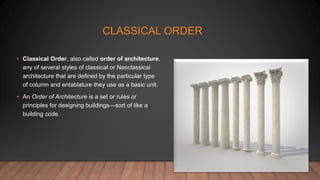
• Classical Order, also called order of architecture,
any of several styles of classical or Neoclassical
architecture that are defined by the particular type
of column and entablature they use as a basic unit.
• An Order of Architecture is a set or rules or
principles for designing buildings—sort of like a
building code.
CLASSICAL ORDER
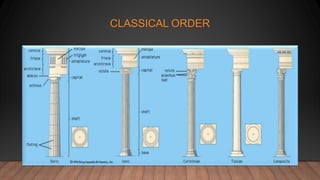
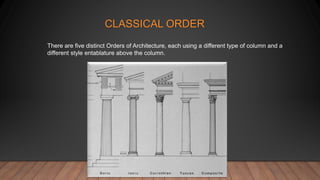
There are five distinct Orders of Architecture, each using a different type of column and a
different style entablature above the column.
CLASSICAL ORDER
THE GREEK ORDERS OF ARCHITECTURE:
There are three distinct orders in Ancient Greek architecture:
 Doric
 Ionic
 Corinthian
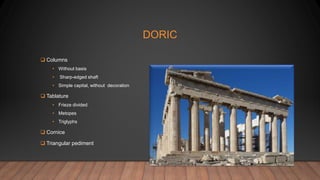
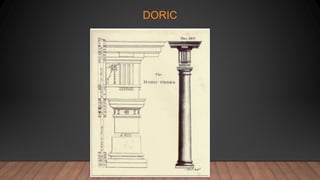
DORIC
 Columns
• Without basis
• Sharp-edged shaft
• Simple capital, without decoration
 Tablature
• Frieze divided
• Metopes
• Triglyphs
 Cornice
 Triangular pediment
DORIC
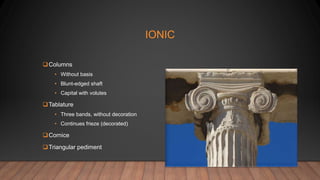
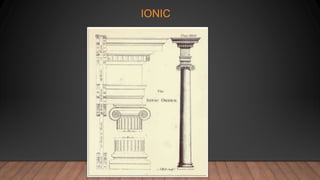
IONIC
Columns
• Without basis
• Blunt-edged shaft
• Capital with volutes
Tablature
• Three bands, without decoration
• Continues frieze (decorated)
Cornice
Triangular pediment
IONIC
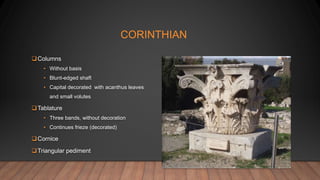
CORINTHIAN
Columns
• Without basis
• Blunt-edged shaft
• Capital decorated with acanthus leaves
and small volutes
Tablature
• Three bands, without decoration
• Continues frieze (decorated)
Cornice
Triangular pediment
CORINTHIAN
THE ROMAN ORDERS OF ARCHITECTURE:
The Romans adapted all the Greek orders and also developed two orders of
their own, basically modifications of Greek orders.
 Tuscan
 Composite
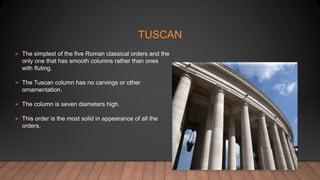
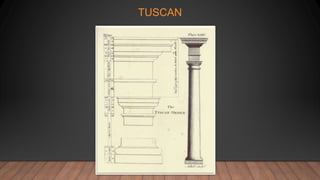
TUSCAN
 The simplest of the five Roman classical orders and the
only one that has smooth columns rather than ones
with fluting.
 The Tuscan column has no carvings or other
ornamentation.
 The column is seven diameters high.
 This order is the most solid in appearance of all the
orders.
TUSCAN
COMPOSITE
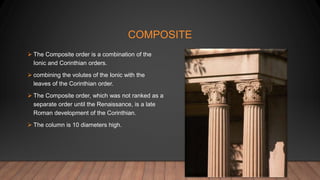
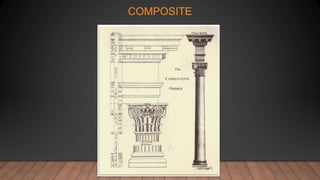
 The Composite order is a combination of the
Ionic and Corinthian orders.
 combining the volutes of the Ionic with the
leaves of the Corinthian order.
 The Composite order, which was not ranked as a
separate order until the Renaissance, is a late
Roman development of the Corinthian.
 The column is 10 diameters high.
COMPOSITE
QUESTIONS?

CLASSICAL ORDER

  • 3.
    CONTENT  Classical Order •Doric order • Ionic order • Corinthian order • Tuscan order • Composite order
  • 4.
    CLASSICAL ORDER • ClassicalOrder, also called order of architecture, any of several styles of classical or Neoclassical architecture that are defined by the particular type of column and entablature they use as a basic unit. • An Order of Architecture is a set or rules or principles for designing buildings—sort of like a building code.
  • 5.
  • 6.
    There are fivedistinct Orders of Architecture, each using a different type of column and a different style entablature above the column. CLASSICAL ORDER
  • 7.
    THE GREEK ORDERSOF ARCHITECTURE: There are three distinct orders in Ancient Greek architecture:  Doric  Ionic  Corinthian
  • 8.
    DORIC  Columns • Withoutbasis • Sharp-edged shaft • Simple capital, without decoration  Tablature • Frieze divided • Metopes • Triglyphs  Cornice  Triangular pediment
  • 9.
  • 10.
    IONIC Columns • Without basis •Blunt-edged shaft • Capital with volutes Tablature • Three bands, without decoration • Continues frieze (decorated) Cornice Triangular pediment
  • 11.
  • 12.
    CORINTHIAN Columns • Without basis •Blunt-edged shaft • Capital decorated with acanthus leaves and small volutes Tablature • Three bands, without decoration • Continues frieze (decorated) Cornice Triangular pediment
  • 13.
  • 14.
    THE ROMAN ORDERSOF ARCHITECTURE: The Romans adapted all the Greek orders and also developed two orders of their own, basically modifications of Greek orders.  Tuscan  Composite
  • 15.
    TUSCAN  The simplestof the five Roman classical orders and the only one that has smooth columns rather than ones with fluting.  The Tuscan column has no carvings or other ornamentation.  The column is seven diameters high.  This order is the most solid in appearance of all the orders.
  • 16.
  • 17.
    COMPOSITE  The Compositeorder is a combination of the Ionic and Corinthian orders.  combining the volutes of the Ionic with the leaves of the Corinthian order.  The Composite order, which was not ranked as a separate order until the Renaissance, is a late Roman development of the Corinthian.  The column is 10 diameters high.
  • 18.
  • 19.