AMITY SCHOOL OF ARCHITECTURE AND PLANNING
Page1
AMITY UNIVERSITY
–– RAJASTHAN––
BMCT : GLASS REPORT
SUBMITTED TO : SUBMITTED BY:
AR DEEPTI RUGHANI SHOURYA PURI
AR ANJANI KUMAR SHUKLA S SAI GOUTAM
AMITY SCHOOL OF ARCHITECTURE AND PLANNING
Page2
TABLE OF CONTENT
1. INTRODUCTION
2. MANUFACTURING PROCESS
3. TYPE OF ARCHITECTURAL GLASS
• FLAT GLASS
• ACOUSTIC GLASS
• SAFETY GLASS
• COLOURED GLASS
• SPECIAL GLASS
• EXTRA CLEAR GLASS
• ACID ETCHED GLASS
• ETCHED GLASS
• FIRE RATED GLASS
• COLOURED GLASS
• MIRROR GLASS
• ANNEALED GLASS PATTERN GLASS
4. MARKET SURVEY RATES
5. CONCLUSION
AMITY SCHOOL OF ARCHITECTURE AND PLANNING
Page3
1. INTODUCTION
Glass is a non-crystalline solid that is often transparent and has widespread practical,
technological, and decorative usage in things like window panes, tableware, and
optoelectronics. Scientifically, the term "glass" is often defined in a broader sense,
encompassing every solid that possesses a non-crystalline (that is, amorphous) structure at the
atomic scale and that exhibits a glass transition when heated towards the liquid state.
Glass is one of the most useful materials in our daily lives. There is a special relationship
between glass and buildings. Glass is a magical material which has so many different
properties and uses, that it has presented many new possibilities and designs. The types of
glass presently manufactured in India are float glass and sheet glass.
The glass industry in India is worth around Rs 5,500 crore, which has which has shown good
growth in the past few quarters driven by an uptick in demand from user-industries such as
infrastructure, construction, automobiles, food processing, beverages, pharmaceuticals and
cosmetics, among others. The glass industry is diversifying into interior decoration, furniture,
murals and other value additions to keep the show going. The growth of the industry is
dependent on construction and architecture activities. However, the automobile sector is still
a big user of flat glass. The construction sector is the largest consumer of float glass. Around
60 % of the total production is used by the construction sector. The glass sector has been
growing at 10-12 per cent a year over the past five years. Real estate is the biggest consumer
of flat glass for windows, doors, partitions and a host of other applications.
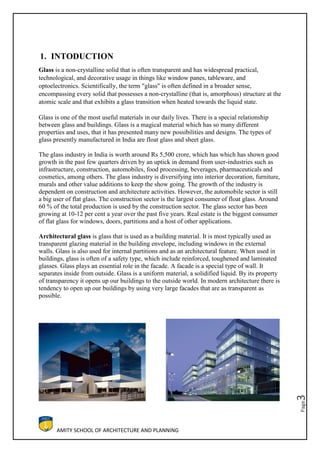
Architectural glass is glass that is used as a building material. It is most typically used as
transparent glazing material in the building envelope, including windows in the external
walls. Glass is also used for internal partitions and as an architectural feature. When used in
buildings, glass is often of a safety type, which include reinforced, toughened and laminated
glasses. Glass plays an essential role in the facade. A facade is a special type of wall. It
separates inside from outside. Glass is a uniform material, a solidified liquid. By its property
of transparency it opens up our buildings to the outside world. In modern architecture there is
tendency to open up our buildings by using very large facades that are as transparent as
possible.
AMITY SCHOOL OF ARCHITECTURE AND PLANNING
Page4
2. MANUFACTURING PROCESS
The glass is manufactured by the PPG process. This process was invented by Sir Alistair
Pilkington in 1952 and is the most popular and widely used process in manufacturing
architectural glass in the world today.
COMPOSITION
Glass is made from the following raw materials: Sand; soda-ash; limestone; dolomite;
feldspar; sodium sulphate. These substances are themselves compounds of various
elements and a chemical analysis shows that flat glass is made up from the following
materials, used in various proportions:
 Silica (S2O2) 71.0 to 78.0%
 Alumina (Al2O3) 0.5 to 1.5%
 Iron oxide (Fe203) 0.05 to 0.15%
 Calcium oxide (CaO) 5.0 to 10.0%
 Magnesium oxide (MgO) 2.0 to 5.0%
 Sodium oxide (Na2O) 13.0 to 16.0%
 Potassium oxide (K2O) 0.0 to 1.0%
 Sulphur trioxide (SO3) 0.0 to 0.5%
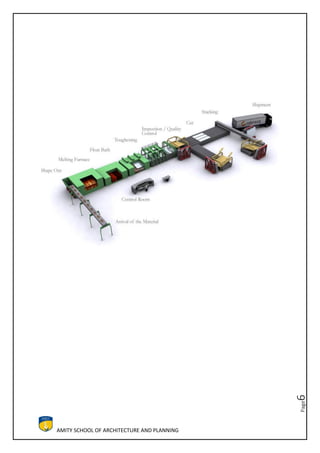
It consists of the following steps:
Stage 1- Melting & Refining:
Fine grained ingredients closely controlled for quality, are mixed to make a batch, which flows
into the furnace, which is heated up to 1500 degree Celsius.
The raw materials that go into the manufacturing of clear float glass are:
 SiO2 – Silica Sand
 Na2O – Sodium Oxide from Soda Ash
 CaO – Calcium oxide from Limestone / Dolomite
 MgO – Dolomite
 Al2O3 – Feldspar
The above raw materials primarily mixed in batch helps to make clear glass. If certain metal
oxides are mixed to this batch they impart colors to the glass giving it a body tint.
For e.g.
 NiO & CoO – to give grey tinted glasses (Oxides of Nickel & Cobalt)
 SeO – to give Bronze tinted glasses (oxide of Selenium)
 Fe2O3 – To give Green tinted glasses (oxides of iron which at times is also present as
impurity in Silica Sand)
AMITY SCHOOL OF ARCHITECTURE AND PLANNING
Page5
 CoO – To give blue tinted glass (oxides of Cobalt)
Apart from the above basic raw material, broken glass aka cullet, is added to the mixture to the
tune of nearly 25% ~ 30% which acts primarily as flux. The flux in a batch helps in reducing
the melting point of the batch thus reducing the energy consumed to carry out the process.
Stage 2 - Float Bath:
Glass from the furnace gently flows over the refractory spout on to the mirror-like surface of
molten tin, starting at 1100 deg Celsius and leaving the float bath as solid ribbon at 600 deg
Celsius.
Stage 3 - Coating (for making reflective glasses):
Coatings that make profound changes in optical properties can be applied by advanced high
temperature technology to the cooling ribbon of glass. Online Chemical Vapour Deposition
(CVD) is the most significant advance in the float process since it was invented. CVD can be
used to lay down a variety of coatings, a few microns thick, for reflect visible and infra-red
radiance for instance. Multiple coatings can be deposited in the few seconds available as the
glass flows beneath the coater (e.g. Sunergy)
Stage 4 - Annealing:
Despite the tranquillity with which the glass is formed, considerable stresses are developed in
the ribbon as the glass cools. The glass is made to move through the annealing lehr where such
internal stresses are removed, as the glass is cooled gradually, to make the glass more prone to
cutting.
Stage 5 - Inspection:
To ensure the highest quality inspection takes place at every stage. Occasionally a bubble that
is not removed during refining, a sand grain that refuses to melt or a tremor in the tin puts
ripples in the glass ribbon. Automated online inspection does two things. It reveals process
faults upstream that can be corrected. And it enables computers downstream to steer round the
flaws. Inspection technology now allows 100 million inspections per second to be made across
the ribbon, locating flaws the unaided eye would be unable to see.
Stage 6 - Cutting to Order:
Diamond steels trim off selvedge – stressed edges- and cut ribbon to size dictated by the
computer. Glass is finally sold only in square meters.
AMITY SCHOOL OF ARCHITECTURE AND PLANNING
Page6
AMITY SCHOOL OF ARCHITECTURE AND PLANNING
Page7
3. TYPE OF ARCHITECTURE GLASS
• Toughened glass
• Flat glass
• Safety glass
• Acoustic glass
• Coloured glass
• Special glass
• Extra clear glass
• Acid etched glass
• Etched glass
• Fire rated glass
• Mirror glass
• Coated glass
• Pattern glass
• Annealed glass
AMITY SCHOOL OF ARCHITECTURE AND PLANNING
Page8
3 (A)TOUGHENED GLASS
Toughened glass acquires a degree of strength for excess of the strength of normal glass sheet
or plate glass, which if broken shatters into small and comparatively harmless pieces. It is
claimed that the resistance to mechanical stock of toughened plate glass is 4 to 5 times more
than that of ordinary plate glass. A toughened glass has better resistance to the vibration,
mechanical shock and abrasion. Toughened Glass has to pass the following important tests:
i. Transfer strength test on sheets on simply supplied (Modules of rupture and
electricity)
ii. Impact test: By following weight on sheets supported on two wooden battens
iii. iii. Impact by falling weight on sheet evenly bedded (on putty)
iv. iv. Impact by falling weight on edge of sheet
v. v. Repeated twisting tests
vi. vi. Sand blast abrasion
vii. vii. Thermal tests
Because of the strength and other specific physical properties mentioned above, it
finds applications in the following fields:
i. Automobile: Cars, trucks, Industry buses, tempos etc
. ii. Railways: Coaches
iii. Defence: Fleets, vehicles factory
iv. Commercial: Hotels, shops, complex
v. Air ports: Doors
Characteristics of Toughened Glass
Toughened glass is four to five times stronger than annealed glass of the same size and
thickness against impact. Toughened glass has higher thermal strength and can withstand a
high temperature differential upto 250°C.Toughened glass is considered as safety glass. It is
difficult to break and even in the event of a breakage, disintegrates into small globules, which
are relatively harmless.
Toughening does not alter the basic characteristics of glass such as light transmission and solar
radiant heat properties.
After heat treatment, the surface of toughened glass has the same resistance to surface damage
as annealed glass. Toughened glass cannot be cut, drilled or altered.
Heat soak test is recommended to be carried out on Toughened glass that is used for overhead
and horizontal application, to prevent the spontaneous breakage caused due to nickel sulphide
inclusion.
Strength & Safety Consideration
 Four to five times stronger than annealed glass
 Two to three times stronger than heat strengthened glass
 Fragments into small, relatively harmless pieces, reducing the likelihood of injury
AMITY SCHOOL OF ARCHITECTURE AND PLANNING
Page9
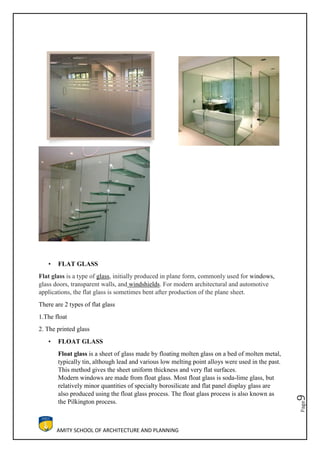
• FLAT GLASS
Flat glass is a type of glass, initially produced in plane form, commonly used for windows,
glass doors, transparent walls, and windshields. For modern architectural and automotive
applications, the flat glass is sometimes bent after production of the plane sheet.
There are 2 types of flat glass
1.The float
2. The printed glass
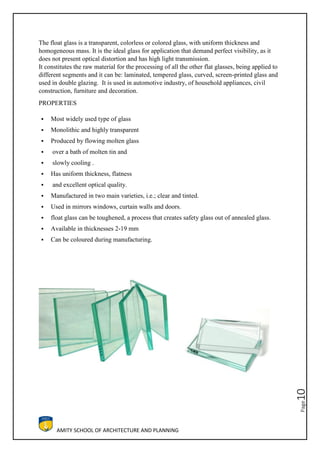
• FLOAT GLASS
Float glass is a sheet of glass made by floating molten glass on a bed of molten metal,
typically tin, although lead and various low melting point alloys were used in the past.
This method gives the sheet uniform thickness and very flat surfaces.
Modern windows are made from float glass. Most float glass is soda-lime glass, but
relatively minor quantities of specialty borosilicate and flat panel display glass are
also produced using the float glass process. The float glass process is also known as
the Pilkington process.
AMITY SCHOOL OF ARCHITECTURE AND PLANNING
Page10
The float glass is a transparent, colorless or colored glass, with uniform thickness and
homogeneous mass. It is the ideal glass for application that demand perfect visibility, as it
does not present optical distortion and has high light transmission.
It constitutes the raw material for the processing of all the other flat glasses, being applied to
different segments and it can be: laminated, tempered glass, curved, screen-printed glass and
used in double glazing. It is used in automotive industry, of household appliances, civil
construction, furniture and decoration.
PROPERTIES
 Most widely used type of glass
 Monolithic and highly transparent
 Produced by flowing molten glass
 over a bath of molten tin and
 slowly cooling .
 Has uniform thickness, flatness
 and excellent optical quality.
 Manufactured in two main varieties, i.e.; clear and tinted.
 Used in mirrors windows, curtain walls and doors.
 float glass can be toughened, a process that creates safety glass out of annealed glass.
 Available in thicknesses 2-19 mm
 Can be coloured during manufacturing.
AMITY SCHOOL OF ARCHITECTURE AND PLANNING
Page11
3 (B)PRINTED GLASS
The printed glass is a translucent flat glass, colorless or colored, which receives the printing
of a pattern (drawing) when is leaving the furnace. It is used in civil construction, household
appliances, furniture and decoration.
• SAFETY GLASS
It is produced from the float glass, aiming to reduce the risks in case of accident and
accidental break. The safety glasses are defined by ABNT as “those that, when broken,
produce fragments less susceptible to cause serious injuries”. It can be: Tempered and
laminated.
It is of two types :
1. Tempered glass
2. Laminated glass
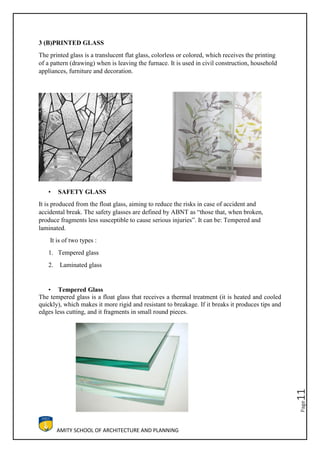
• Tempered Glass
The tempered glass is a float glass that receives a thermal treatment (it is heated and cooled
quickly), which makes it more rigid and resistant to breakage. If it breaks it produces tips and
edges less cutting, and it fragments in small round pieces.
AMITY SCHOOL OF ARCHITECTURE AND PLANNING
Page12
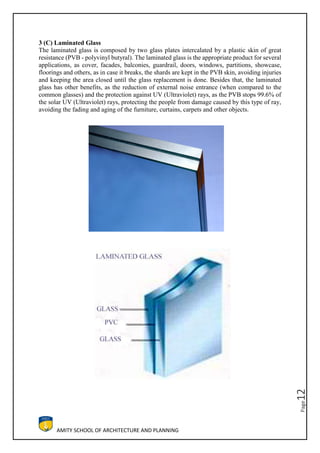
3 (C) Laminated Glass
The laminated glass is composed by two glass plates intercalated by a plastic skin of great
resistance (PVB - polyvinyl butyral). The laminated glass is the appropriate product for several
applications, as cover, facades, balconies, guardrail, doors, windows, partitions, showcase,
floorings and others, as in case it breaks, the shards are kept in the PVB skin, avoiding injuries
and keeping the area closed until the glass replacement is done. Besides that, the laminated
glass has other benefits, as the reduction of external noise entrance (when compared to the
common glasses) and the protection against UV (Ultraviolet) rays, as the PVB stops 99.6% of
the solar UV (Ultraviolet) rays, protecting the people from damage caused by this type of ray,
avoiding the fading and aging of the furniture, curtains, carpets and other objects.
AMITY SCHOOL OF ARCHITECTURE AND PLANNING
Page13
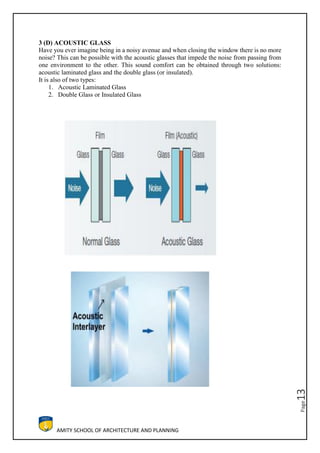
3 (D) ACOUSTIC GLASS
Have you ever imagine being in a noisy avenue and when closing the window there is no more
noise? This can be possible with the acoustic glasses that impede the noise from passing from
one environment to the other. This sound comfort can be obtained through two solutions:
acoustic laminated glass and the double glass (or insulated).
It is also of two types:
1. Acoustic Laminated Glass
2. Double Glass or Insulated Glass
AMITY SCHOOL OF ARCHITECTURE AND PLANNING
Page14
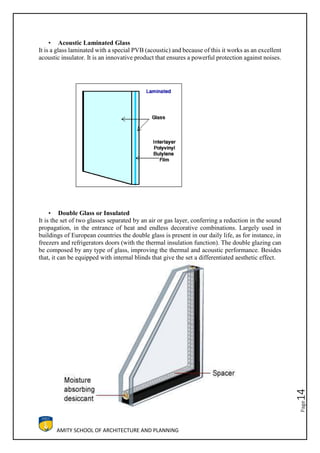
• Acoustic Laminated Glass
It is a glass laminated with a special PVB (acoustic) and because of this it works as an excellent
acoustic insulator. It is an innovative product that ensures a powerful protection against noises.
• Double Glass or Insulated
It is the set of two glasses separated by an air or gas layer, conferring a reduction in the sound
propagation, in the entrance of heat and endless decorative combinations. Largely used in
buildings of European countries the double glass is present in our daily life, as for instance, in
freezers and refrigerators doors (with the thermal insulation function). The double glazing can
be composed by any type of glass, improving the thermal and acoustic performance. Besides
that, it can be equipped with internal blinds that give the set a differentiated aesthetic effect.
AMITY SCHOOL OF ARCHITECTURE AND PLANNING
Page15
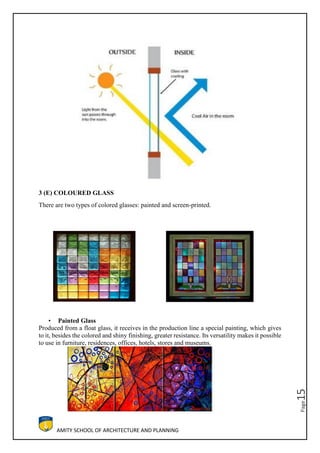
3 (E) COLOURED GLASS
There are two types of colored glasses: painted and screen-printed.
• Painted Glass
Produced from a float glass, it receives in the production line a special painting, which gives
to it, besides the colored and shiny finishing, greater resistance. Its versatility makes it possible
to use in furniture, residences, offices, hotels, stores and museums.
AMITY SCHOOL OF ARCHITECTURE AND PLANNING
Page16
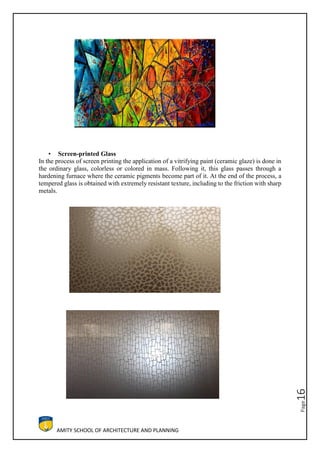
• Screen-printed Glass
In the process of screen printing the application of a vitrifying paint (ceramic glaze) is done in
the ordinary glass, colorless or colored in mass. Following it, this glass passes through a
hardening furnace where the ceramic pigments become part of it. At the end of the process, a
tempered glass is obtained with extremely resistant texture, including to the friction with sharp
metals.
AMITY SCHOOL OF ARCHITECTURE AND PLANNING
Page17
3(F) SPECIAL GLASS
With the technological advance in the creation of micro layers, several special types of glasses
have come up. Actually, theses glasses have layers of diverse type of materials, these layers of
microscopic dimension that offer several differentiated characteristics to the glass. Types of
special glasses: Solar control, self-cleaning, low reflection and low-emissivity.
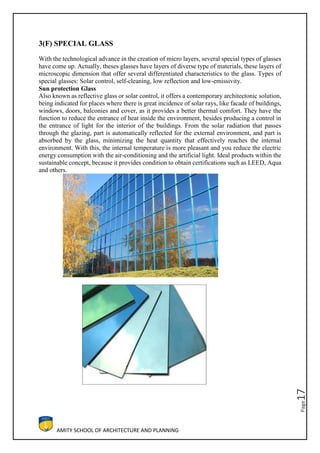
Sun protection Glass
Also known as reflective glass or solar control, it offers a contemporary architectonic solution,
being indicated for places where there is great incidence of solar rays, like facade of buildings,
windows, doors, balconies and cover, as it provides a better thermal comfort. They have the
function to reduce the entrance of heat inside the environment, besides producing a control in
the entrance of light for the interior of the buildings. From the solar radiation that passes
through the glazing, part is automatically reflected for the external environment, and part is
absorbed by the glass, minimizing the heat quantity that effectively reaches the internal
environment. With this, the internal temperature is more pleasant and you reduce the electric
energy consumption with the air-conditioning and the artificial light. Ideal products within the
sustainable concept, because it provides condition to obtain certifications such as LEED, Aqua
and others.
AMITY SCHOOL OF ARCHITECTURE AND PLANNING
Page18
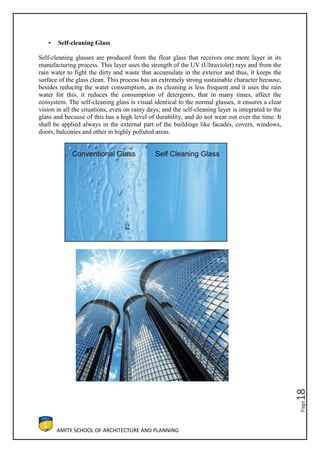
• Self-cleaning Glass
Self-cleaning glasses are produced from the float glass that receives one more layer in its
manufacturing process. This layer uses the strength of the UV (Ultraviolet) rays and from the
rain water to fight the dirty and waste that accumulate in the exterior and thus, it keeps the
surface of the glass clean. This process has an extremely strong sustainable character because,
besides reducing the water consumption, as its cleaning is less frequent and it uses the rain
water for this, it reduces the consumption of detergents, that in many times, affect the
ecosystem. The self-cleaning glass is visual identical to the normal glasses, it ensures a clear
vision in all the situations, even on rainy days; and the self-cleaning layer is integrated to the
glass and because of this has a high level of durability, and do not wear out over the time. It
shall be applied always in the external part of the buildings like facades, covers, windows,
doors, balconies and other in highly polluted areas.
AMITY SCHOOL OF ARCHITECTURE AND PLANNING
Page19
• Low Reflection Glass
It is an extra clear float glass (glasses with low concentration of iron in its composition and
because of this are extremely clear and not green) that receives a layer capable to reduce the
reflection in 5 times (compared to the colorless float glass). Ideal for showcases, showrooms,
museums, authorized dealers, displays and other types of applications that need to avoid the
discomfort of the light reflection in the glass, which many times forces the person to create a
shadow in front to observe the object that is behind the glass.
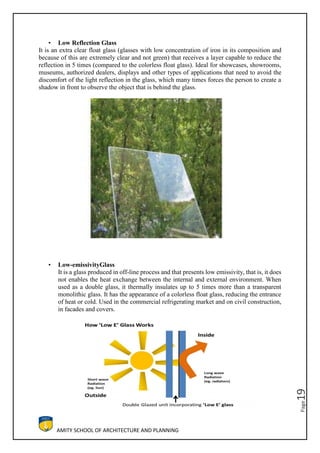
• Low-emissivityGlass
It is a glass produced in off-line process and that presents low emissivity, that is, it does
not enables the heat exchange between the internal and external environment. When
used as a double glass, it thermally insulates up to 5 times more than a transparent
monolithic glass. It has the appearance of a colorless float glass, reducing the entrance
of heat or cold. Used in the commercial refrigerating market and on civil construction,
in facades and covers.
AMITY SCHOOL OF ARCHITECTURE AND PLANNING
Page20
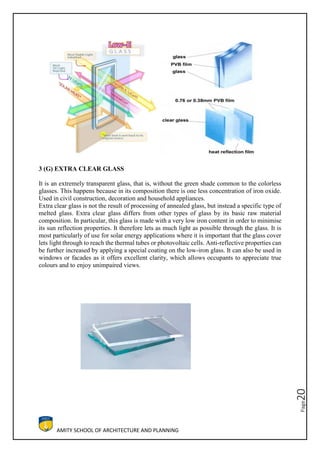
3 (G) EXTRA CLEAR GLASS
It is an extremely transparent glass, that is, without the green shade common to the colorless
glasses. This happens because in its composition there is one less concentration of iron oxide.
Used in civil construction, decoration and household appliances.
Extra clear glass is not the result of processing of annealed glass, but instead a specific type of
melted glass. Extra clear glass differs from other types of glass by its basic raw material
composition. In particular, this glass is made with a very low iron content in order to minimise
its sun reflection properties. It therefore lets as much light as possible through the glass. It is
most particularly of use for solar energy applications where it is important that the glass cover
lets light through to reach the thermal tubes or photovoltaic cells. Anti-reflective properties can
be further increased by applying a special coating on the low-iron glass. It can also be used in
windows or facades as it offers excellent clarity, which allows occupants to appreciate true
colours and to enjoy unimpaired views.
AMITY SCHOOL OF ARCHITECTURE AND PLANNING
Page21
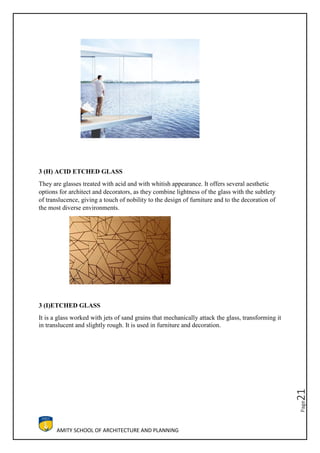
3 (H) ACID ETCHED GLASS
They are glasses treated with acid and with whitish appearance. It offers several aesthetic
options for architect and decorators, as they combine lightness of the glass with the subtlety
of translucence, giving a touch of nobility to the design of furniture and to the decoration of
the most diverse environments.
3 (I)ETCHED GLASS
It is a glass worked with jets of sand grains that mechanically attack the glass, transforming it
in translucent and slightly rough. It is used in furniture and decoration.
AMITY SCHOOL OF ARCHITECTURE AND PLANNING
Page22
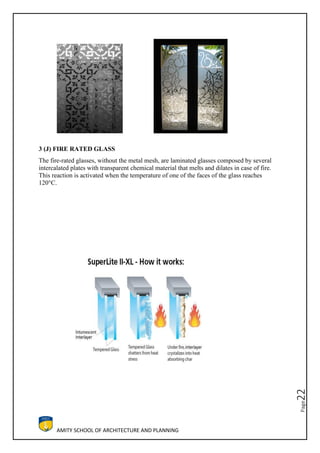
3 (J) FIRE RATED GLASS
The fire-rated glasses, without the metal mesh, are laminated glasses composed by several
intercalated plates with transparent chemical material that melts and dilates in case of fire.
This reaction is activated when the temperature of one of the faces of the glass reaches
120°C.
AMITY SCHOOL OF ARCHITECTURE AND PLANNING
Page23
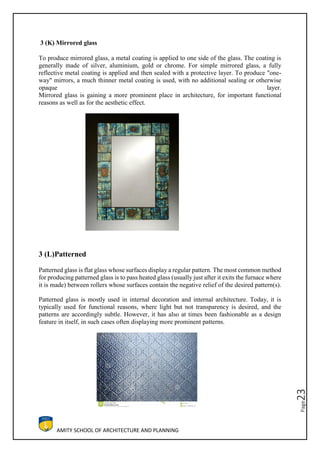
3 (K) Mirrored glass
To produce mirrored glass, a metal coating is applied to one side of the glass. The coating is
generally made of silver, aluminium, gold or chrome. For simple mirrored glass, a fully
reflective metal coating is applied and then sealed with a protective layer. To produce "one-
way" mirrors, a much thinner metal coating is used, with no additional sealing or otherwise
opaque layer.
Mirrored glass is gaining a more prominent place in architecture, for important functional
reasons as well as for the aesthetic effect.
3 (L)Patterned
Patterned glass is flat glass whose surfaces display a regular pattern. The most common method
for producing patterned glass is to pass heated glass (usually just after it exits the furnace where
it is made) between rollers whose surfaces contain the negative relief of the desired pattern(s).
Patterned glass is mostly used in internal decoration and internal architecture. Today, it is
typically used for functional reasons, where light but not transparency is desired, and the
patterns are accordingly subtle. However, it has also at times been fashionable as a design
feature in itself, in such cases often displaying more prominent patterns.
AMITY SCHOOL OF ARCHITECTURE AND PLANNING
Page24
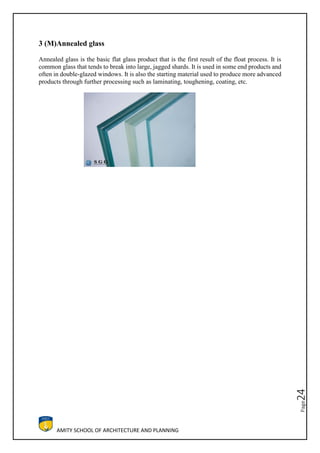
3 (M)Annealed glass
Annealed glass is the basic flat glass product that is the first result of the float process. It is
common glass that tends to break into large, jagged shards. It is used in some end products and
often in double-glazed windows. It is also the starting material used to produce more advanced
products through further processing such as laminating, toughening, coating, etc.
AMITY SCHOOL OF ARCHITECTURE AND PLANNING
Page25
4 RATE OF GLASSES (MARKET SURVEY)
• PLANE GLASS
12mm 104rs
8mm 71rs
6mm 50rs
5mm 40rs
4mm 31rs
COLOUR
5mm black 50rs
5mm brown 51rs
BAJRI 22rs
MIRROR 5mm 72mm
Tukdi small 35rs per piece
TUFFUN
12mm 165rs
10mm 135rs
8mm 125rs
Patti 12mm 1.75rs
RAILING 12mm 235rs
Tukdi design big 350rs
AMITY SCHOOL OF ARCHITECTURE AND PLANNING
Page26
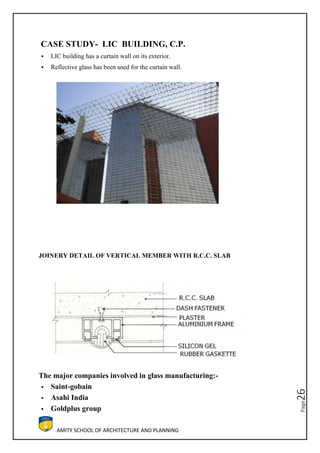
CASE STUDY- LIC BUILDING, C.P.
 LIC building has a curtain wall on its exterior.
 Reflective glass has been used for the curtain wall.
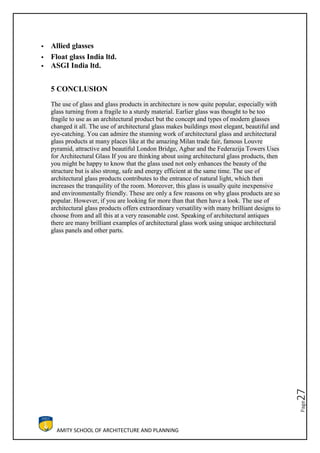
JOINERY DETAIL OF VERTICAL MEMBER WITH R.C.C. SLAB
The major companies involved in glass manufacturing:-
 Saint-gobain
 Asahi India
 Goldplus group
AMITY SCHOOL OF ARCHITECTURE AND PLANNING
Page27
 Allied glasses
 Float glass India ltd.
 ASGI India ltd.
5 CONCLUSION
The use of glass and glass products in architecture is now quite popular, especially with
glass turning from a fragile to a sturdy material. Earlier glass was thought to be too
fragile to use as an architectural product but the concept and types of modern glasses
changed it all. The use of architectural glass makes buildings most elegant, beautiful and
eye-catching. You can admire the stunning work of architectural glass and architectural
glass products at many places like at the amazing Milan trade fair, famous Louvre
pyramid, attractive and beautiful London Bridge, Agbar and the Federazija Towers Uses
for Architectural Glass If you are thinking about using architectural glass products, then
you might be happy to know that the glass used not only enhances the beauty of the
structure but is also strong, safe and energy efficient at the same time. The use of
architectural glass products contributes to the entrance of natural light, which then
increases the tranquility of the room. Moreover, this glass is usually quite inexpensive
and environmentally friendly. These are only a few reasons on why glass products are so
popular. However, if you are looking for more than that then have a look. The use of
architectural glass products offers extraordinary versatility with many brilliant designs to
choose from and all this at a very reasonable cost. Speaking of architectural antiques
there are many brilliant examples of architectural glass work using unique architectural
glass panels and other parts.

Glass Report

  • 1.
    AMITY SCHOOL OFARCHITECTURE AND PLANNING Page1 AMITY UNIVERSITY –– RAJASTHAN–– BMCT : GLASS REPORT SUBMITTED TO : SUBMITTED BY: AR DEEPTI RUGHANI SHOURYA PURI AR ANJANI KUMAR SHUKLA S SAI GOUTAM
  • 2.
    AMITY SCHOOL OFARCHITECTURE AND PLANNING Page2 TABLE OF CONTENT 1. INTRODUCTION 2. MANUFACTURING PROCESS 3. TYPE OF ARCHITECTURAL GLASS • FLAT GLASS • ACOUSTIC GLASS • SAFETY GLASS • COLOURED GLASS • SPECIAL GLASS • EXTRA CLEAR GLASS • ACID ETCHED GLASS • ETCHED GLASS • FIRE RATED GLASS • COLOURED GLASS • MIRROR GLASS • ANNEALED GLASS PATTERN GLASS 4. MARKET SURVEY RATES 5. CONCLUSION
  • 3.
    AMITY SCHOOL OFARCHITECTURE AND PLANNING Page3 1. INTODUCTION Glass is a non-crystalline solid that is often transparent and has widespread practical, technological, and decorative usage in things like window panes, tableware, and optoelectronics. Scientifically, the term "glass" is often defined in a broader sense, encompassing every solid that possesses a non-crystalline (that is, amorphous) structure at the atomic scale and that exhibits a glass transition when heated towards the liquid state. Glass is one of the most useful materials in our daily lives. There is a special relationship between glass and buildings. Glass is a magical material which has so many different properties and uses, that it has presented many new possibilities and designs. The types of glass presently manufactured in India are float glass and sheet glass. The glass industry in India is worth around Rs 5,500 crore, which has which has shown good growth in the past few quarters driven by an uptick in demand from user-industries such as infrastructure, construction, automobiles, food processing, beverages, pharmaceuticals and cosmetics, among others. The glass industry is diversifying into interior decoration, furniture, murals and other value additions to keep the show going. The growth of the industry is dependent on construction and architecture activities. However, the automobile sector is still a big user of flat glass. The construction sector is the largest consumer of float glass. Around 60 % of the total production is used by the construction sector. The glass sector has been growing at 10-12 per cent a year over the past five years. Real estate is the biggest consumer of flat glass for windows, doors, partitions and a host of other applications. Architectural glass is glass that is used as a building material. It is most typically used as transparent glazing material in the building envelope, including windows in the external walls. Glass is also used for internal partitions and as an architectural feature. When used in buildings, glass is often of a safety type, which include reinforced, toughened and laminated glasses. Glass plays an essential role in the facade. A facade is a special type of wall. It separates inside from outside. Glass is a uniform material, a solidified liquid. By its property of transparency it opens up our buildings to the outside world. In modern architecture there is tendency to open up our buildings by using very large facades that are as transparent as possible.
  • 4.
    AMITY SCHOOL OFARCHITECTURE AND PLANNING Page4 2. MANUFACTURING PROCESS The glass is manufactured by the PPG process. This process was invented by Sir Alistair Pilkington in 1952 and is the most popular and widely used process in manufacturing architectural glass in the world today. COMPOSITION Glass is made from the following raw materials: Sand; soda-ash; limestone; dolomite; feldspar; sodium sulphate. These substances are themselves compounds of various elements and a chemical analysis shows that flat glass is made up from the following materials, used in various proportions:  Silica (S2O2) 71.0 to 78.0%  Alumina (Al2O3) 0.5 to 1.5%  Iron oxide (Fe203) 0.05 to 0.15%  Calcium oxide (CaO) 5.0 to 10.0%  Magnesium oxide (MgO) 2.0 to 5.0%  Sodium oxide (Na2O) 13.0 to 16.0%  Potassium oxide (K2O) 0.0 to 1.0%  Sulphur trioxide (SO3) 0.0 to 0.5% It consists of the following steps: Stage 1- Melting & Refining: Fine grained ingredients closely controlled for quality, are mixed to make a batch, which flows into the furnace, which is heated up to 1500 degree Celsius. The raw materials that go into the manufacturing of clear float glass are:  SiO2 – Silica Sand  Na2O – Sodium Oxide from Soda Ash  CaO – Calcium oxide from Limestone / Dolomite  MgO – Dolomite  Al2O3 – Feldspar The above raw materials primarily mixed in batch helps to make clear glass. If certain metal oxides are mixed to this batch they impart colors to the glass giving it a body tint. For e.g.  NiO & CoO – to give grey tinted glasses (Oxides of Nickel & Cobalt)  SeO – to give Bronze tinted glasses (oxide of Selenium)  Fe2O3 – To give Green tinted glasses (oxides of iron which at times is also present as impurity in Silica Sand)
  • 5.
    AMITY SCHOOL OFARCHITECTURE AND PLANNING Page5  CoO – To give blue tinted glass (oxides of Cobalt) Apart from the above basic raw material, broken glass aka cullet, is added to the mixture to the tune of nearly 25% ~ 30% which acts primarily as flux. The flux in a batch helps in reducing the melting point of the batch thus reducing the energy consumed to carry out the process. Stage 2 - Float Bath: Glass from the furnace gently flows over the refractory spout on to the mirror-like surface of molten tin, starting at 1100 deg Celsius and leaving the float bath as solid ribbon at 600 deg Celsius. Stage 3 - Coating (for making reflective glasses): Coatings that make profound changes in optical properties can be applied by advanced high temperature technology to the cooling ribbon of glass. Online Chemical Vapour Deposition (CVD) is the most significant advance in the float process since it was invented. CVD can be used to lay down a variety of coatings, a few microns thick, for reflect visible and infra-red radiance for instance. Multiple coatings can be deposited in the few seconds available as the glass flows beneath the coater (e.g. Sunergy) Stage 4 - Annealing: Despite the tranquillity with which the glass is formed, considerable stresses are developed in the ribbon as the glass cools. The glass is made to move through the annealing lehr where such internal stresses are removed, as the glass is cooled gradually, to make the glass more prone to cutting. Stage 5 - Inspection: To ensure the highest quality inspection takes place at every stage. Occasionally a bubble that is not removed during refining, a sand grain that refuses to melt or a tremor in the tin puts ripples in the glass ribbon. Automated online inspection does two things. It reveals process faults upstream that can be corrected. And it enables computers downstream to steer round the flaws. Inspection technology now allows 100 million inspections per second to be made across the ribbon, locating flaws the unaided eye would be unable to see. Stage 6 - Cutting to Order: Diamond steels trim off selvedge – stressed edges- and cut ribbon to size dictated by the computer. Glass is finally sold only in square meters.
  • 6.
    AMITY SCHOOL OFARCHITECTURE AND PLANNING Page6
  • 7.
    AMITY SCHOOL OFARCHITECTURE AND PLANNING Page7 3. TYPE OF ARCHITECTURE GLASS • Toughened glass • Flat glass • Safety glass • Acoustic glass • Coloured glass • Special glass • Extra clear glass • Acid etched glass • Etched glass • Fire rated glass • Mirror glass • Coated glass • Pattern glass • Annealed glass
  • 8.
    AMITY SCHOOL OFARCHITECTURE AND PLANNING Page8 3 (A)TOUGHENED GLASS Toughened glass acquires a degree of strength for excess of the strength of normal glass sheet or plate glass, which if broken shatters into small and comparatively harmless pieces. It is claimed that the resistance to mechanical stock of toughened plate glass is 4 to 5 times more than that of ordinary plate glass. A toughened glass has better resistance to the vibration, mechanical shock and abrasion. Toughened Glass has to pass the following important tests: i. Transfer strength test on sheets on simply supplied (Modules of rupture and electricity) ii. Impact test: By following weight on sheets supported on two wooden battens iii. iii. Impact by falling weight on sheet evenly bedded (on putty) iv. iv. Impact by falling weight on edge of sheet v. v. Repeated twisting tests vi. vi. Sand blast abrasion vii. vii. Thermal tests Because of the strength and other specific physical properties mentioned above, it finds applications in the following fields: i. Automobile: Cars, trucks, Industry buses, tempos etc . ii. Railways: Coaches iii. Defence: Fleets, vehicles factory iv. Commercial: Hotels, shops, complex v. Air ports: Doors Characteristics of Toughened Glass Toughened glass is four to five times stronger than annealed glass of the same size and thickness against impact. Toughened glass has higher thermal strength and can withstand a high temperature differential upto 250°C.Toughened glass is considered as safety glass. It is difficult to break and even in the event of a breakage, disintegrates into small globules, which are relatively harmless. Toughening does not alter the basic characteristics of glass such as light transmission and solar radiant heat properties. After heat treatment, the surface of toughened glass has the same resistance to surface damage as annealed glass. Toughened glass cannot be cut, drilled or altered. Heat soak test is recommended to be carried out on Toughened glass that is used for overhead and horizontal application, to prevent the spontaneous breakage caused due to nickel sulphide inclusion. Strength & Safety Consideration  Four to five times stronger than annealed glass  Two to three times stronger than heat strengthened glass  Fragments into small, relatively harmless pieces, reducing the likelihood of injury
  • 9.
    AMITY SCHOOL OFARCHITECTURE AND PLANNING Page9 • FLAT GLASS Flat glass is a type of glass, initially produced in plane form, commonly used for windows, glass doors, transparent walls, and windshields. For modern architectural and automotive applications, the flat glass is sometimes bent after production of the plane sheet. There are 2 types of flat glass 1.The float 2. The printed glass • FLOAT GLASS Float glass is a sheet of glass made by floating molten glass on a bed of molten metal, typically tin, although lead and various low melting point alloys were used in the past. This method gives the sheet uniform thickness and very flat surfaces. Modern windows are made from float glass. Most float glass is soda-lime glass, but relatively minor quantities of specialty borosilicate and flat panel display glass are also produced using the float glass process. The float glass process is also known as the Pilkington process.
  • 10.
    AMITY SCHOOL OFARCHITECTURE AND PLANNING Page10 The float glass is a transparent, colorless or colored glass, with uniform thickness and homogeneous mass. It is the ideal glass for application that demand perfect visibility, as it does not present optical distortion and has high light transmission. It constitutes the raw material for the processing of all the other flat glasses, being applied to different segments and it can be: laminated, tempered glass, curved, screen-printed glass and used in double glazing. It is used in automotive industry, of household appliances, civil construction, furniture and decoration. PROPERTIES  Most widely used type of glass  Monolithic and highly transparent  Produced by flowing molten glass  over a bath of molten tin and  slowly cooling .  Has uniform thickness, flatness  and excellent optical quality.  Manufactured in two main varieties, i.e.; clear and tinted.  Used in mirrors windows, curtain walls and doors.  float glass can be toughened, a process that creates safety glass out of annealed glass.  Available in thicknesses 2-19 mm  Can be coloured during manufacturing.
  • 11.
    AMITY SCHOOL OFARCHITECTURE AND PLANNING Page11 3 (B)PRINTED GLASS The printed glass is a translucent flat glass, colorless or colored, which receives the printing of a pattern (drawing) when is leaving the furnace. It is used in civil construction, household appliances, furniture and decoration. • SAFETY GLASS It is produced from the float glass, aiming to reduce the risks in case of accident and accidental break. The safety glasses are defined by ABNT as “those that, when broken, produce fragments less susceptible to cause serious injuries”. It can be: Tempered and laminated. It is of two types : 1. Tempered glass 2. Laminated glass • Tempered Glass The tempered glass is a float glass that receives a thermal treatment (it is heated and cooled quickly), which makes it more rigid and resistant to breakage. If it breaks it produces tips and edges less cutting, and it fragments in small round pieces.
  • 12.
    AMITY SCHOOL OFARCHITECTURE AND PLANNING Page12 3 (C) Laminated Glass The laminated glass is composed by two glass plates intercalated by a plastic skin of great resistance (PVB - polyvinyl butyral). The laminated glass is the appropriate product for several applications, as cover, facades, balconies, guardrail, doors, windows, partitions, showcase, floorings and others, as in case it breaks, the shards are kept in the PVB skin, avoiding injuries and keeping the area closed until the glass replacement is done. Besides that, the laminated glass has other benefits, as the reduction of external noise entrance (when compared to the common glasses) and the protection against UV (Ultraviolet) rays, as the PVB stops 99.6% of the solar UV (Ultraviolet) rays, protecting the people from damage caused by this type of ray, avoiding the fading and aging of the furniture, curtains, carpets and other objects.
  • 13.
    AMITY SCHOOL OFARCHITECTURE AND PLANNING Page13 3 (D) ACOUSTIC GLASS Have you ever imagine being in a noisy avenue and when closing the window there is no more noise? This can be possible with the acoustic glasses that impede the noise from passing from one environment to the other. This sound comfort can be obtained through two solutions: acoustic laminated glass and the double glass (or insulated). It is also of two types: 1. Acoustic Laminated Glass 2. Double Glass or Insulated Glass
  • 14.
    AMITY SCHOOL OFARCHITECTURE AND PLANNING Page14 • Acoustic Laminated Glass It is a glass laminated with a special PVB (acoustic) and because of this it works as an excellent acoustic insulator. It is an innovative product that ensures a powerful protection against noises. • Double Glass or Insulated It is the set of two glasses separated by an air or gas layer, conferring a reduction in the sound propagation, in the entrance of heat and endless decorative combinations. Largely used in buildings of European countries the double glass is present in our daily life, as for instance, in freezers and refrigerators doors (with the thermal insulation function). The double glazing can be composed by any type of glass, improving the thermal and acoustic performance. Besides that, it can be equipped with internal blinds that give the set a differentiated aesthetic effect.
  • 15.
    AMITY SCHOOL OFARCHITECTURE AND PLANNING Page15 3 (E) COLOURED GLASS There are two types of colored glasses: painted and screen-printed. • Painted Glass Produced from a float glass, it receives in the production line a special painting, which gives to it, besides the colored and shiny finishing, greater resistance. Its versatility makes it possible to use in furniture, residences, offices, hotels, stores and museums.
  • 16.
    AMITY SCHOOL OFARCHITECTURE AND PLANNING Page16 • Screen-printed Glass In the process of screen printing the application of a vitrifying paint (ceramic glaze) is done in the ordinary glass, colorless or colored in mass. Following it, this glass passes through a hardening furnace where the ceramic pigments become part of it. At the end of the process, a tempered glass is obtained with extremely resistant texture, including to the friction with sharp metals.
  • 17.
    AMITY SCHOOL OFARCHITECTURE AND PLANNING Page17 3(F) SPECIAL GLASS With the technological advance in the creation of micro layers, several special types of glasses have come up. Actually, theses glasses have layers of diverse type of materials, these layers of microscopic dimension that offer several differentiated characteristics to the glass. Types of special glasses: Solar control, self-cleaning, low reflection and low-emissivity. Sun protection Glass Also known as reflective glass or solar control, it offers a contemporary architectonic solution, being indicated for places where there is great incidence of solar rays, like facade of buildings, windows, doors, balconies and cover, as it provides a better thermal comfort. They have the function to reduce the entrance of heat inside the environment, besides producing a control in the entrance of light for the interior of the buildings. From the solar radiation that passes through the glazing, part is automatically reflected for the external environment, and part is absorbed by the glass, minimizing the heat quantity that effectively reaches the internal environment. With this, the internal temperature is more pleasant and you reduce the electric energy consumption with the air-conditioning and the artificial light. Ideal products within the sustainable concept, because it provides condition to obtain certifications such as LEED, Aqua and others.
  • 18.
    AMITY SCHOOL OFARCHITECTURE AND PLANNING Page18 • Self-cleaning Glass Self-cleaning glasses are produced from the float glass that receives one more layer in its manufacturing process. This layer uses the strength of the UV (Ultraviolet) rays and from the rain water to fight the dirty and waste that accumulate in the exterior and thus, it keeps the surface of the glass clean. This process has an extremely strong sustainable character because, besides reducing the water consumption, as its cleaning is less frequent and it uses the rain water for this, it reduces the consumption of detergents, that in many times, affect the ecosystem. The self-cleaning glass is visual identical to the normal glasses, it ensures a clear vision in all the situations, even on rainy days; and the self-cleaning layer is integrated to the glass and because of this has a high level of durability, and do not wear out over the time. It shall be applied always in the external part of the buildings like facades, covers, windows, doors, balconies and other in highly polluted areas.
  • 19.
    AMITY SCHOOL OFARCHITECTURE AND PLANNING Page19 • Low Reflection Glass It is an extra clear float glass (glasses with low concentration of iron in its composition and because of this are extremely clear and not green) that receives a layer capable to reduce the reflection in 5 times (compared to the colorless float glass). Ideal for showcases, showrooms, museums, authorized dealers, displays and other types of applications that need to avoid the discomfort of the light reflection in the glass, which many times forces the person to create a shadow in front to observe the object that is behind the glass. • Low-emissivityGlass It is a glass produced in off-line process and that presents low emissivity, that is, it does not enables the heat exchange between the internal and external environment. When used as a double glass, it thermally insulates up to 5 times more than a transparent monolithic glass. It has the appearance of a colorless float glass, reducing the entrance of heat or cold. Used in the commercial refrigerating market and on civil construction, in facades and covers.
  • 20.
    AMITY SCHOOL OFARCHITECTURE AND PLANNING Page20 3 (G) EXTRA CLEAR GLASS It is an extremely transparent glass, that is, without the green shade common to the colorless glasses. This happens because in its composition there is one less concentration of iron oxide. Used in civil construction, decoration and household appliances. Extra clear glass is not the result of processing of annealed glass, but instead a specific type of melted glass. Extra clear glass differs from other types of glass by its basic raw material composition. In particular, this glass is made with a very low iron content in order to minimise its sun reflection properties. It therefore lets as much light as possible through the glass. It is most particularly of use for solar energy applications where it is important that the glass cover lets light through to reach the thermal tubes or photovoltaic cells. Anti-reflective properties can be further increased by applying a special coating on the low-iron glass. It can also be used in windows or facades as it offers excellent clarity, which allows occupants to appreciate true colours and to enjoy unimpaired views.
  • 21.
    AMITY SCHOOL OFARCHITECTURE AND PLANNING Page21 3 (H) ACID ETCHED GLASS They are glasses treated with acid and with whitish appearance. It offers several aesthetic options for architect and decorators, as they combine lightness of the glass with the subtlety of translucence, giving a touch of nobility to the design of furniture and to the decoration of the most diverse environments. 3 (I)ETCHED GLASS It is a glass worked with jets of sand grains that mechanically attack the glass, transforming it in translucent and slightly rough. It is used in furniture and decoration.
  • 22.
    AMITY SCHOOL OFARCHITECTURE AND PLANNING Page22 3 (J) FIRE RATED GLASS The fire-rated glasses, without the metal mesh, are laminated glasses composed by several intercalated plates with transparent chemical material that melts and dilates in case of fire. This reaction is activated when the temperature of one of the faces of the glass reaches 120°C.
  • 23.
    AMITY SCHOOL OFARCHITECTURE AND PLANNING Page23 3 (K) Mirrored glass To produce mirrored glass, a metal coating is applied to one side of the glass. The coating is generally made of silver, aluminium, gold or chrome. For simple mirrored glass, a fully reflective metal coating is applied and then sealed with a protective layer. To produce "one- way" mirrors, a much thinner metal coating is used, with no additional sealing or otherwise opaque layer. Mirrored glass is gaining a more prominent place in architecture, for important functional reasons as well as for the aesthetic effect. 3 (L)Patterned Patterned glass is flat glass whose surfaces display a regular pattern. The most common method for producing patterned glass is to pass heated glass (usually just after it exits the furnace where it is made) between rollers whose surfaces contain the negative relief of the desired pattern(s). Patterned glass is mostly used in internal decoration and internal architecture. Today, it is typically used for functional reasons, where light but not transparency is desired, and the patterns are accordingly subtle. However, it has also at times been fashionable as a design feature in itself, in such cases often displaying more prominent patterns.
  • 24.
    AMITY SCHOOL OFARCHITECTURE AND PLANNING Page24 3 (M)Annealed glass Annealed glass is the basic flat glass product that is the first result of the float process. It is common glass that tends to break into large, jagged shards. It is used in some end products and often in double-glazed windows. It is also the starting material used to produce more advanced products through further processing such as laminating, toughening, coating, etc.
  • 25.
    AMITY SCHOOL OFARCHITECTURE AND PLANNING Page25 4 RATE OF GLASSES (MARKET SURVEY) • PLANE GLASS 12mm 104rs 8mm 71rs 6mm 50rs 5mm 40rs 4mm 31rs COLOUR 5mm black 50rs 5mm brown 51rs BAJRI 22rs MIRROR 5mm 72mm Tukdi small 35rs per piece TUFFUN 12mm 165rs 10mm 135rs 8mm 125rs Patti 12mm 1.75rs RAILING 12mm 235rs Tukdi design big 350rs
  • 26.
    AMITY SCHOOL OFARCHITECTURE AND PLANNING Page26 CASE STUDY- LIC BUILDING, C.P.  LIC building has a curtain wall on its exterior.  Reflective glass has been used for the curtain wall. JOINERY DETAIL OF VERTICAL MEMBER WITH R.C.C. SLAB The major companies involved in glass manufacturing:-  Saint-gobain  Asahi India  Goldplus group
  • 27.
    AMITY SCHOOL OFARCHITECTURE AND PLANNING Page27  Allied glasses  Float glass India ltd.  ASGI India ltd. 5 CONCLUSION The use of glass and glass products in architecture is now quite popular, especially with glass turning from a fragile to a sturdy material. Earlier glass was thought to be too fragile to use as an architectural product but the concept and types of modern glasses changed it all. The use of architectural glass makes buildings most elegant, beautiful and eye-catching. You can admire the stunning work of architectural glass and architectural glass products at many places like at the amazing Milan trade fair, famous Louvre pyramid, attractive and beautiful London Bridge, Agbar and the Federazija Towers Uses for Architectural Glass If you are thinking about using architectural glass products, then you might be happy to know that the glass used not only enhances the beauty of the structure but is also strong, safe and energy efficient at the same time. The use of architectural glass products contributes to the entrance of natural light, which then increases the tranquility of the room. Moreover, this glass is usually quite inexpensive and environmentally friendly. These are only a few reasons on why glass products are so popular. However, if you are looking for more than that then have a look. The use of architectural glass products offers extraordinary versatility with many brilliant designs to choose from and all this at a very reasonable cost. Speaking of architectural antiques there are many brilliant examples of architectural glass work using unique architectural glass panels and other parts.