TOPIC: GREEK ARCHITECTURE
SUBMITED TO: ADITI JOSHI, SUBMITED BY: DIVYANG BARDOLIA{0902} , SUB: HISTORY ,SEM: 6TH
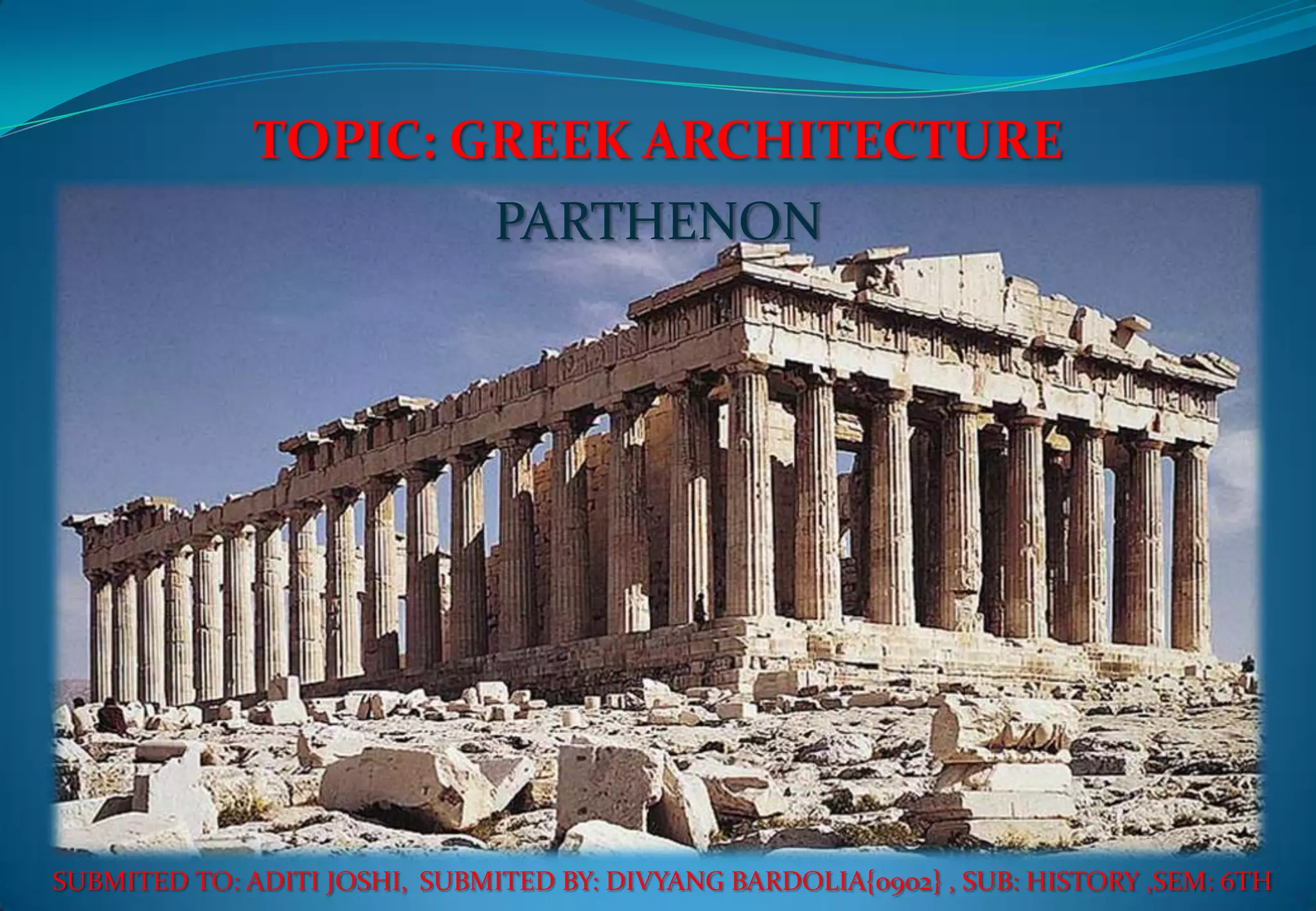
PARTHENON
Type Greek Temple
Architectural style Classical
Location Athens, Greece
Current tenants Museum
Construction started 432 BC
Completed 447 BC
Destroyed Partly on 26 September 1687
Height 13.72 m (45.0 ft)
Technical details
Size 69.5 by 30.9 m (228 by 101 ft)
Other dimensions Cella: 29.8 by 19.2 m (98 by 63 ft)
Design and construction
Owner Greek government
Architect Iktinos, Kallikrates
Other designers Phidias (sculptor)
INTRODUCTION
HISTORY
๏‚— The single greatest building constructed during the Greek
Classical period. Built as a temple to worship Athena who was
the patron goddess of the city of Athens. The architects of the
Parthenon intended the brilliant white marble to be the
ultimate expression of Athens grandeur. Even in ruins, it
crowns the Acropolis. The Parthenon remained relatively intact
until 1687 when it was severely damaged in an explosion.
๏‚— The Parthenon was heavily damaged in 1678 by Turkish
bombardment. It is currently being carefully reconstructed.
๏‚— In addition to damage in wartime, it has lost many of its
sculptures. Some are in the British Museum, some in other
museums.
CLIMATE
๏‚— Encompasses the statistics
of temperature, humidity, atmospheric
pressure, wind, precipitation, atmospheric particle count
and other meteorological elemental measurements in a
given region over long periods. Climate can be contrasted
to weather, which is the present condition of these
elements and their variations over shorter periods.
๏‚— A region's climate is generated by the climate system,
which has five
components: atmosphere,hydrosphere, cryosphere, land
surface, and biosphere.
๏‚— The climate of a location is affected by its latitude, terrain,
and altitude, as well as nearby water bodies and their currents.
Climates can be classified according to the average and the typical
ranges of different variables, most commonly temperature and
precipitation. The most commonly used classification scheme was
originally developed by Wladimir Kรถppen. The Thornthwaite
system, in use since 1948, incorporatesevapotranspiration along
with temperature and precipitation information and is used in
studying animal species diversity and potential effects of climate
changes. The Bergeron and Spatial Synoptic Classification
systems focus on the origin of air masses that define the climate of a
region.
CULTURE
๏‚— The culture of Greece has evolved over thousands of years, beginning in
Mycenaean Greece, continuing most notably into Classical Greece,
through the influence of the Roman Empire and its successor
the Byzantine Empire. Other cultures and states such as Latin and
Frankish states, the Ottoman Empire, the Venetian Republic, Genoese
Republic, and British Empire have also left their influence on modern
Greek culture, but historians credit the Greek War of Independence with
revitalising Greece and giving birth to a single entity of its multi-faceted
culture.
๏‚— In ancient times, Greece was the birthplace of Western culture. Modern
democracies owe a debt to Greek beliefs in government by the people,
trial by jury, and equality under the law. The ancient Greeks pioneered in
many fields that rely on systematic thought, including biology, geometry,
history, philosophy, and physics. They introduced such important literary
forms as epic and lyric poetry, history, tragedy, and comedy. In their
pursuit of order and proportion, the Greeks created an ideal of beauty
that strongly influenced Western art.
GEOGRAPHY
๏‚— Greece is a country located in Southern Europe, on the southern
end of the Balkan Peninsula. Greece is surrounded on the north
by Bulgaria, the Republic of Macedonia and Albania; to the west by
the Ionian Sea; to the south by the Mediterranean Sea and to the
east by the Aegean Sea and Turkey. The country ranges
approximately in latitude from 35ยฐ00โ€ฒN to 42ยฐ00โ€ฒN and
in longitude from 19ยฐ00โ€ฒE to 28ยฐ30โ€ฒE. As a result, it has considerable
climatic variation, as discussed below. The country consists of a
large mainland; the Peloponnese, a peninsula connected to the
southern tip of the mainland by the Isthmus of Corinth; and a large
number of islands, including Crete, Rhodes, Corfu,
the Dodecanese and the Cyclades. According to the CIA World
Factbook, Greece has 13,676 kilometres (8,498 mi) of coastline
๏‚— 80% of Greece is mountainous, and the country is one of the most
mountainous countries of Europe. The Pindus, a chain of mountains
lies across the center of the country in a northwest-to-southeast
direction, with a maximum elevation of 2637 m. Extensions of the
same mountain range stretch across the Peloponnese and underwater
across the Aegean, forming many of the Aegean
Islands including Crete, and joining with the Taurus Mountains of
southern Turkey. Central and Western Greece contain high and steep
peaks dissected by many canyons and other karstic landscapes,
including the Meteora and the Vikos Gorges - the latter being one of
the largest of the world and the third deepest after the Copper
Canyon in Mexico and the Grand Canyon in the USA, plunging vertically
for more than 1,100 metres. Mount Olympus is the highest point of
Greece and the fourth highest in relative topographical prominence in
Europe, rising to 2,919 m above sea level. The Rhodope
Mountains form the border between Greece and Bulgaria; that area is
covered with vast and thick forests.
THE TEMPLE FORM
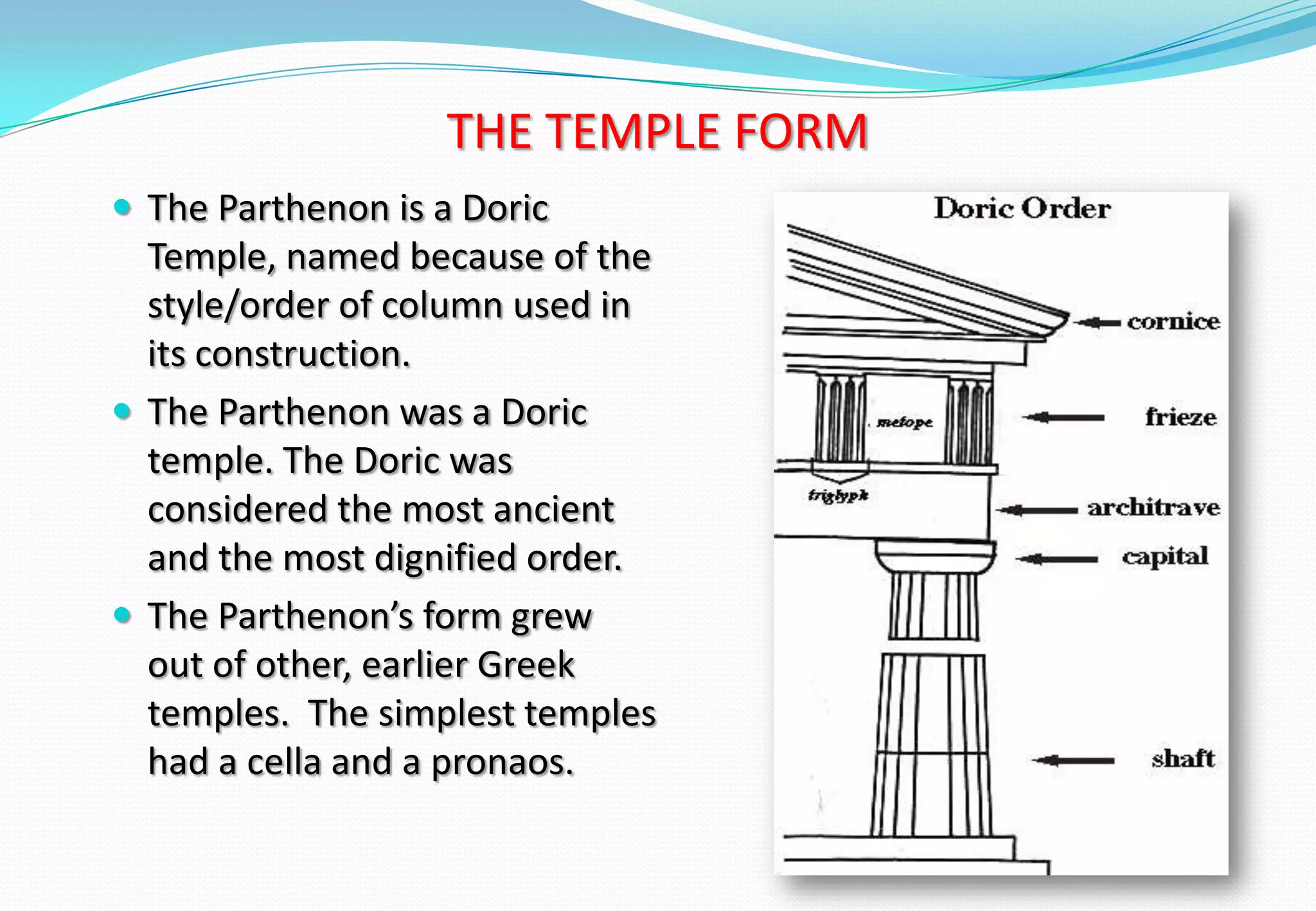
๏‚— The Parthenon is a Doric
Temple, named because of the
style/order of column used in
its construction.
๏‚— The Parthenon was a Doric
temple. The Doric was
considered the most ancient
and the most dignified order.
๏‚— The Parthenonโ€™s form grew
out of other, earlier Greek
temples. The simplest temples
had a cella and a pronaos.
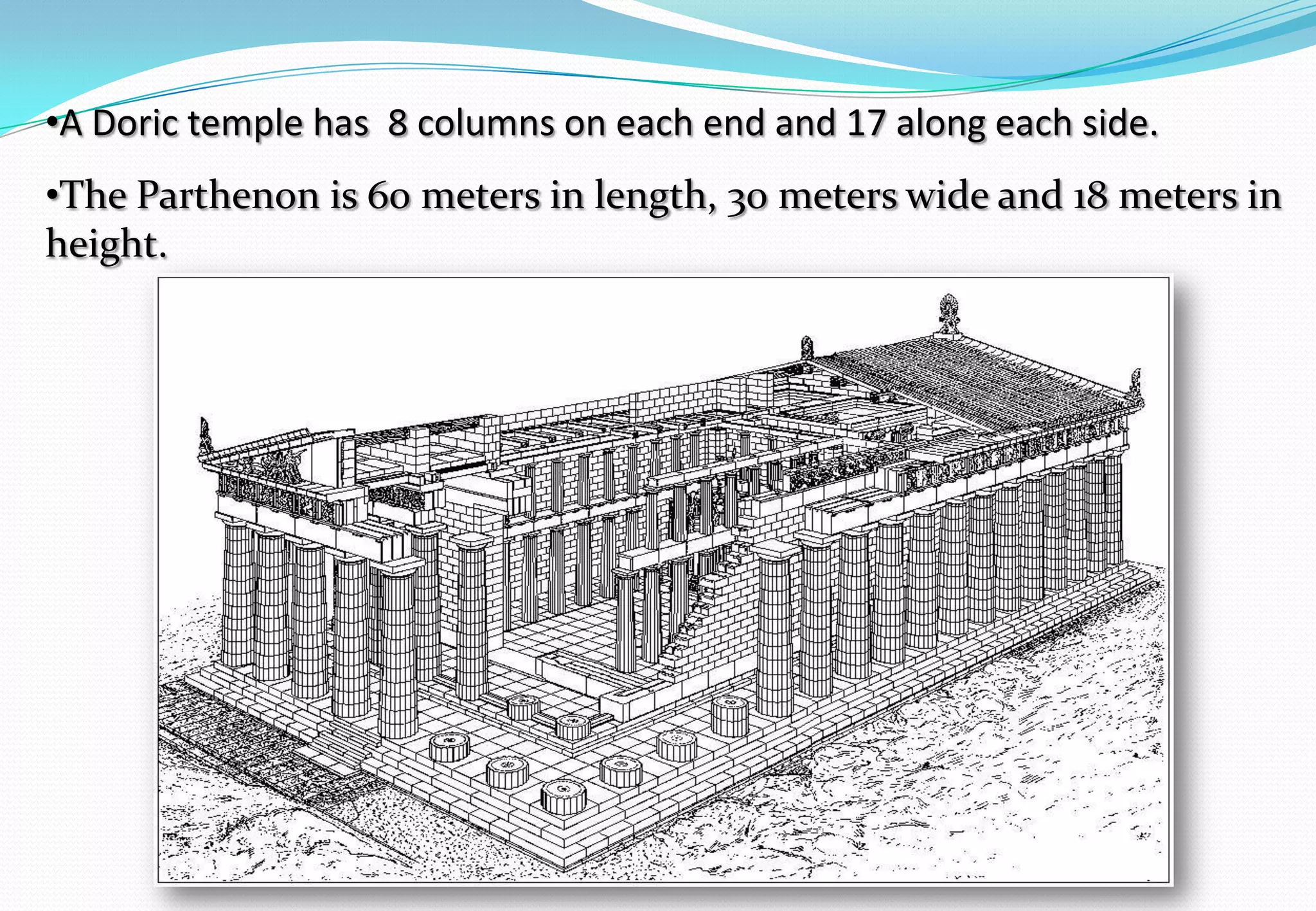
โ€ขA Doric temple has 8 columns on each end and 17 along each side.
โ€ขThe Parthenon is 60 meters in length, 30 meters wide and 18 meters in
height.
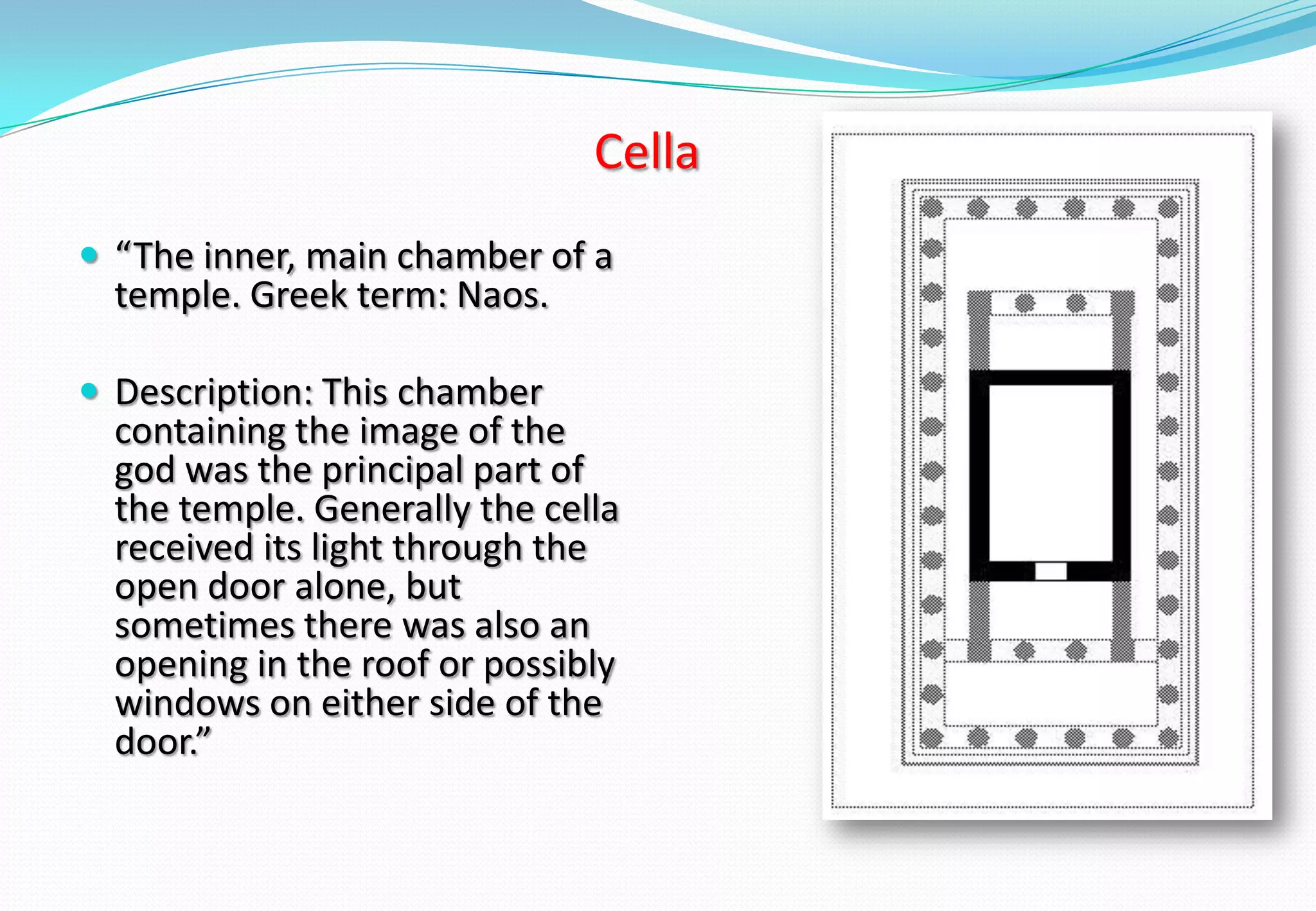
Cella
๏‚— โ€œThe inner, main chamber of a
temple. Greek term: Naos.
๏‚— Description: This chamber
containing the image of the
god was the principal part of
the temple. Generally the cella
received its light through the
open door alone, but
sometimes there was also an
opening in the roof or possibly
windows on either side of the
door.โ€
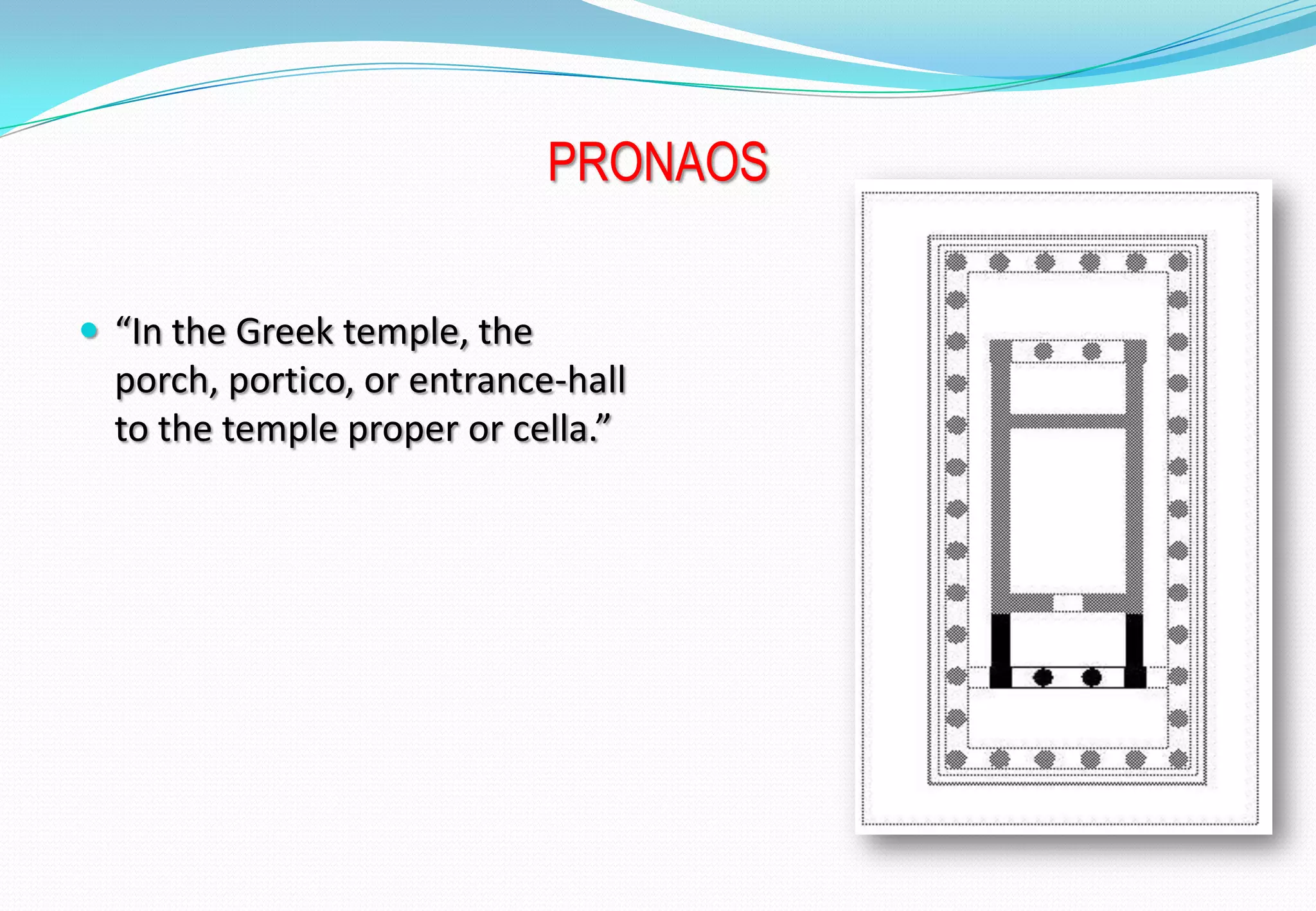
๏‚— โ€œIn the Greek temple, the
porch, portico, or entrance-hall
to the temple proper or cella.โ€
PRONAOS
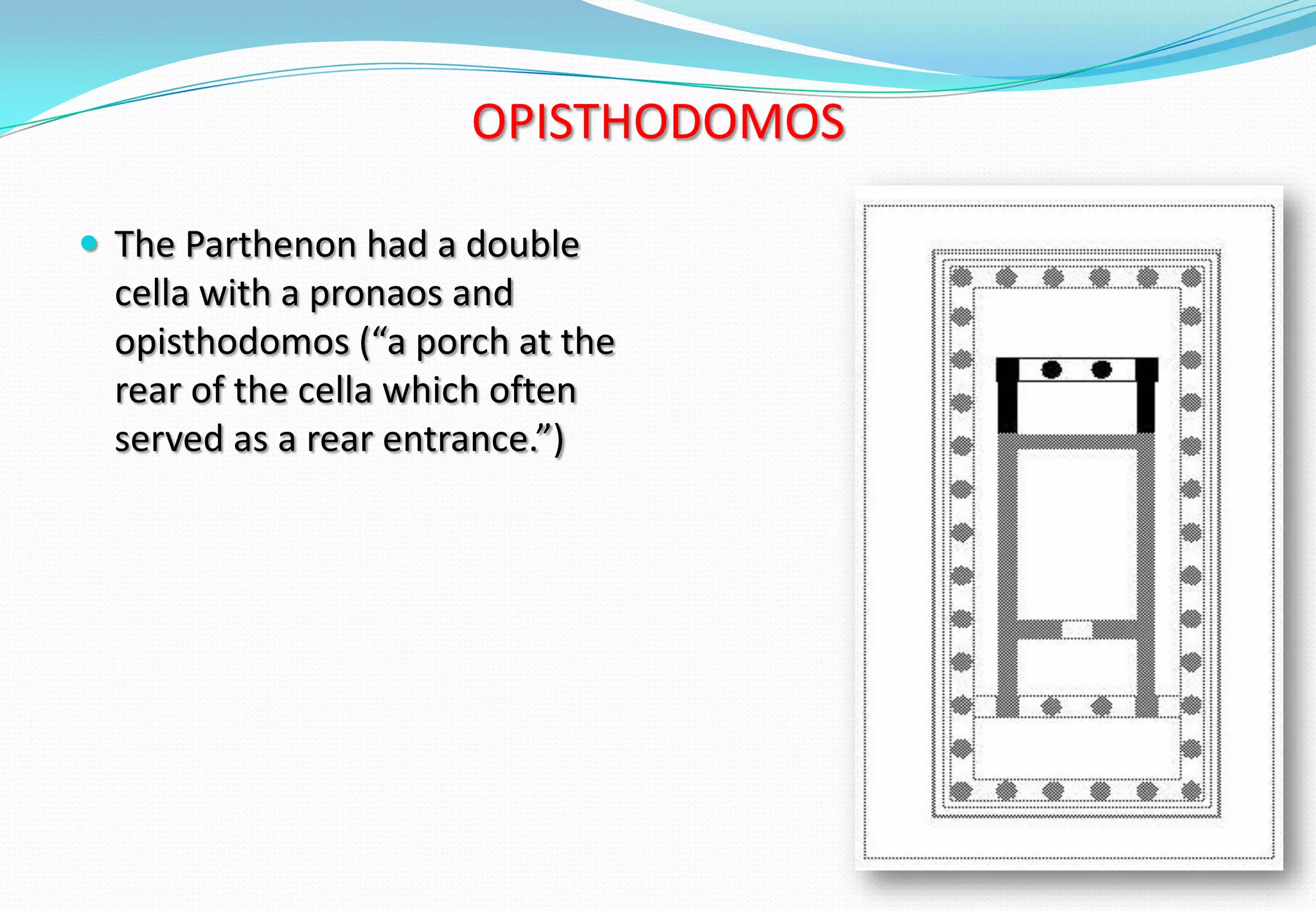
OPISTHODOMOS
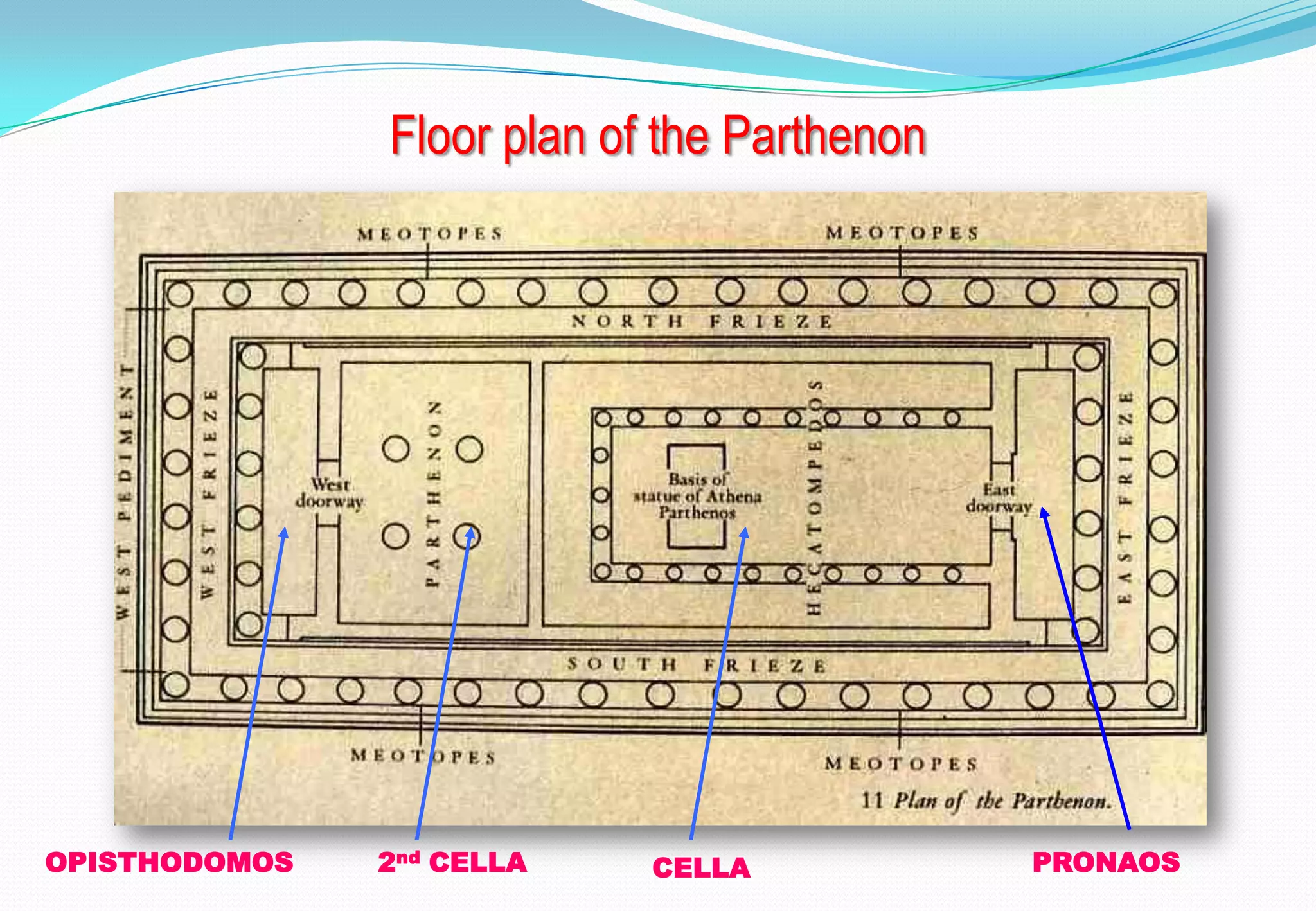
๏‚— The Parthenon had a double
cella with a pronaos and
opisthodomos (โ€œa porch at the
rear of the cella which often
served as a rear entrance.โ€)
Floor plan of the Parthenon
CELLA PRONAOS2nd CELLAOPISTHODOMOS
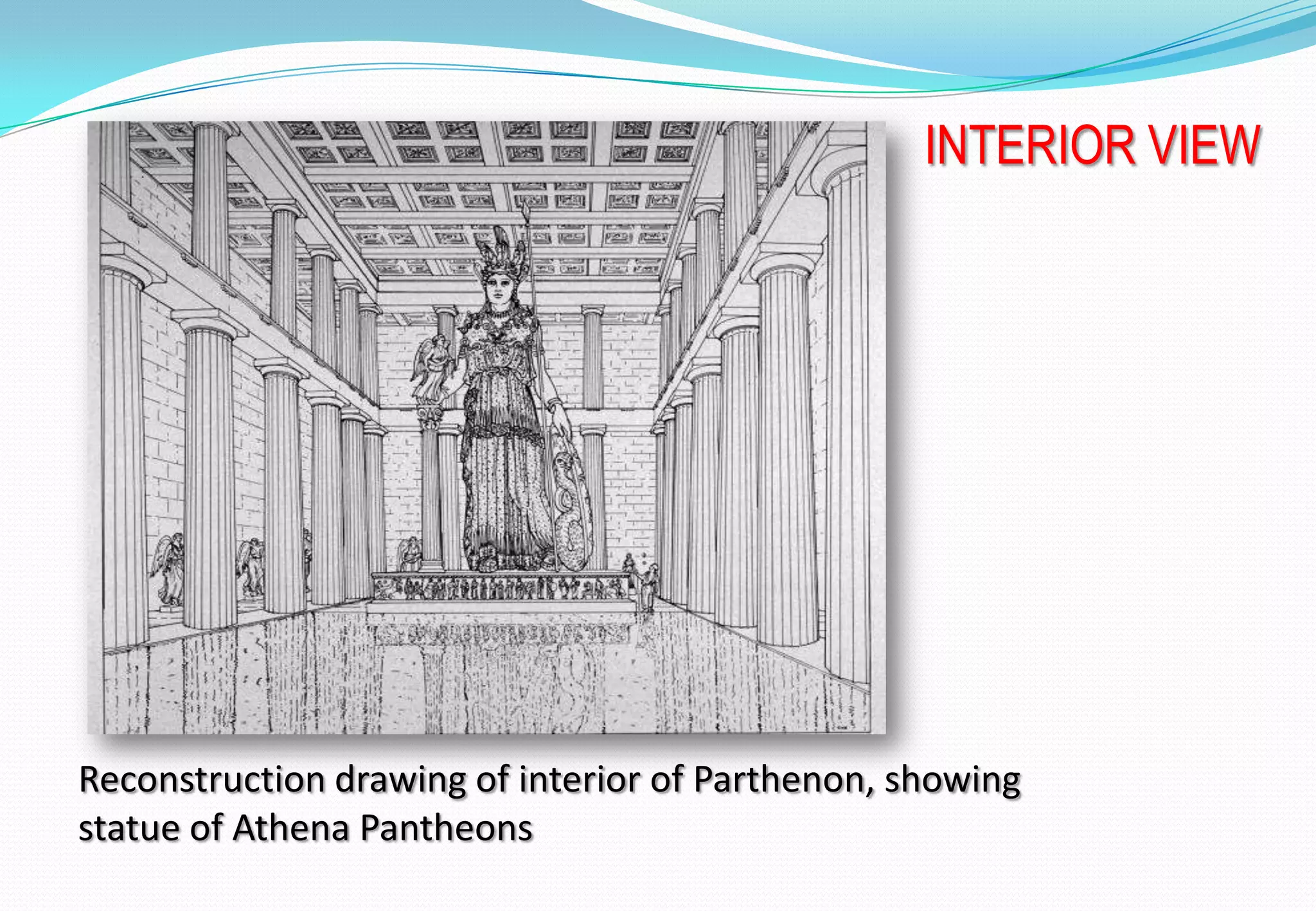
Reconstruction drawing of interior of Parthenon, showing
statue of Athena Pantheons
INTERIOR VIEW
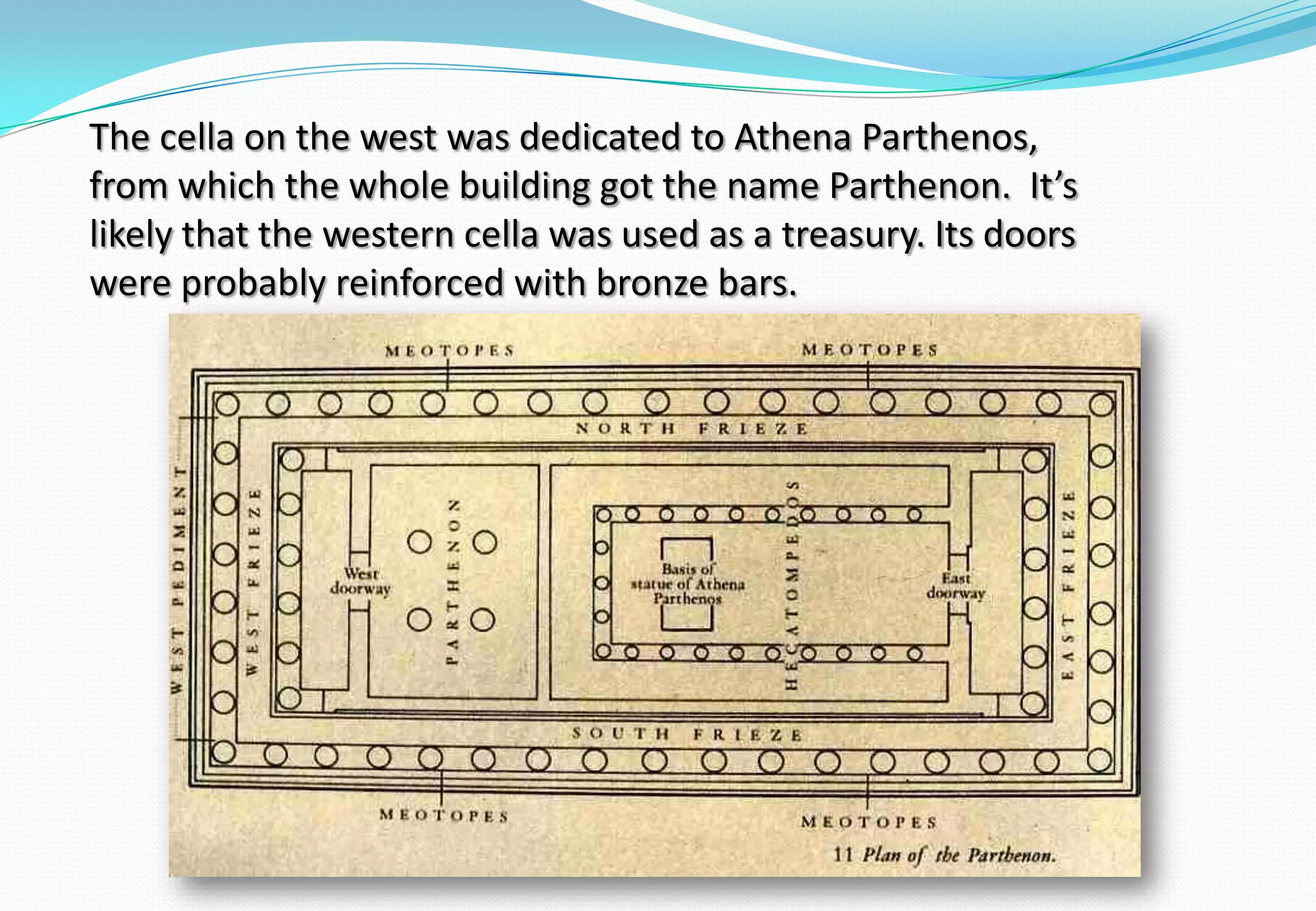
The cella on the west was dedicated to Athena Parthenos,
from which the whole building got the name Parthenon. Itโ€™s
likely that the western cella was used as a treasury. Its doors
were probably reinforced with bronze bars.
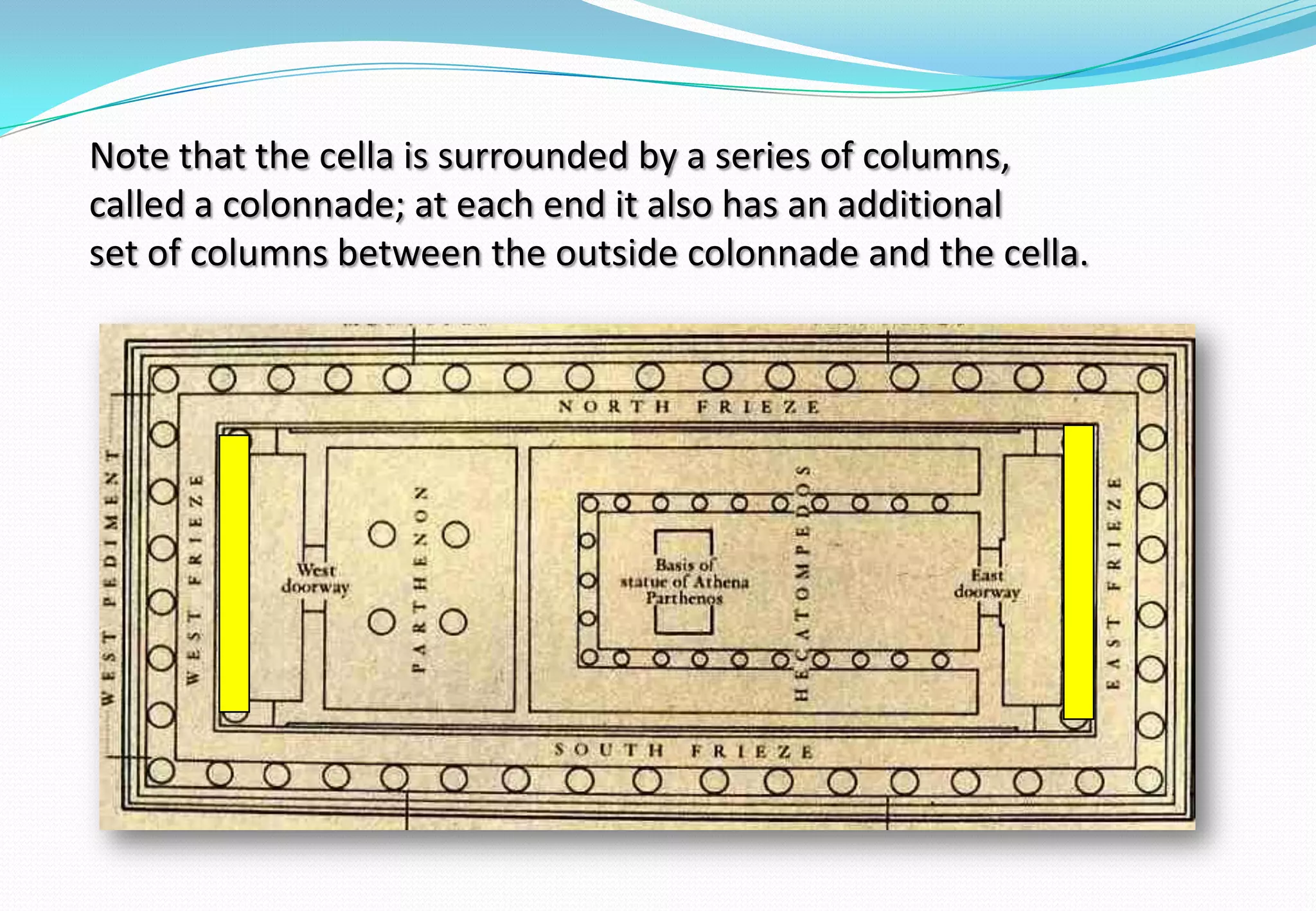
Note that the cella is surrounded by a series of columns,
called a colonnade; at each end it also has an additional
set of columns between the outside colonnade and the cella.
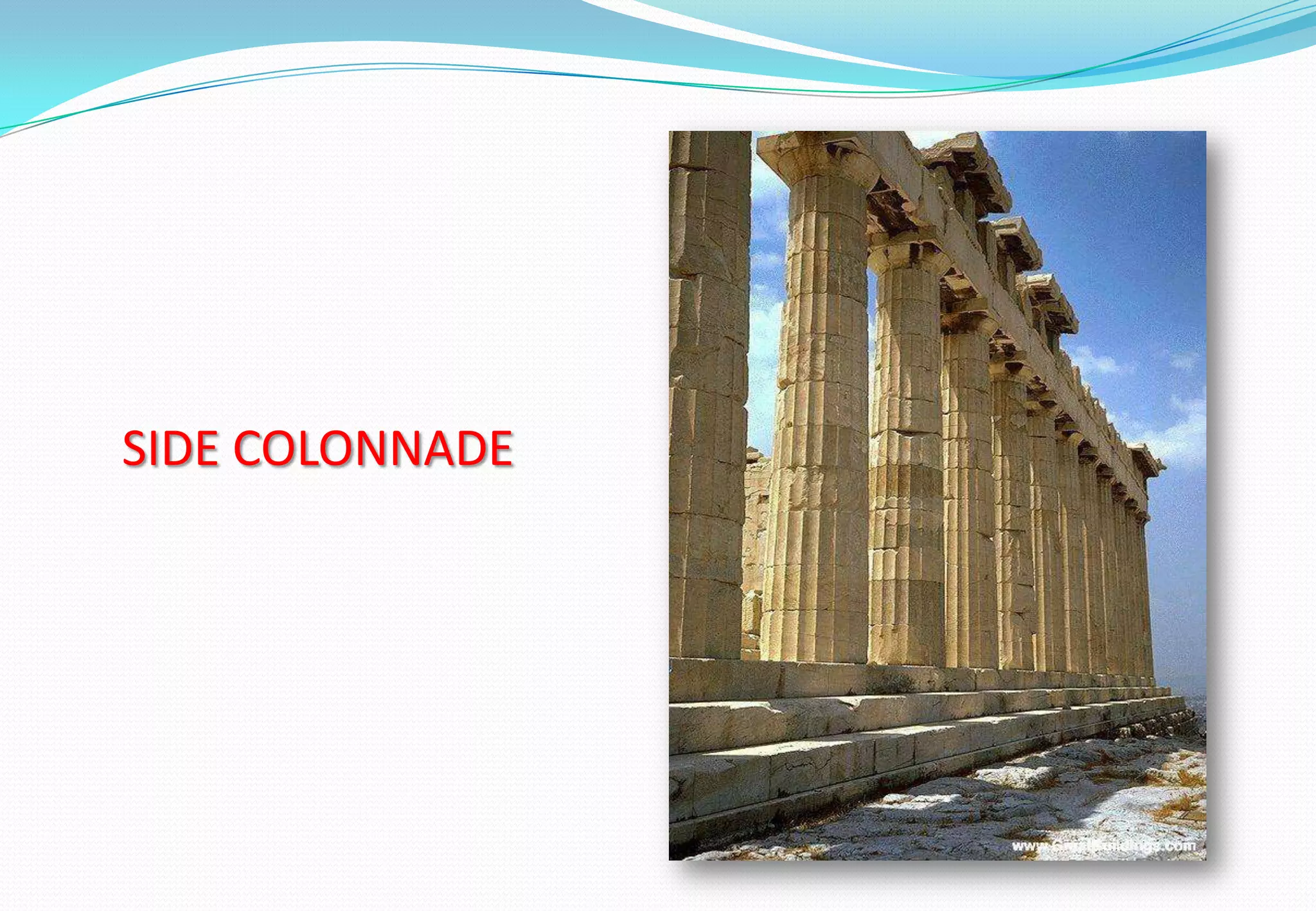
SIDE COLONNADE
GREEK ARCHITECTURE : PARTHENON

GREEK ARCHITECTURE : PARTHENON

  • 1.
    TOPIC: GREEK ARCHITECTURE SUBMITEDTO: ADITI JOSHI, SUBMITED BY: DIVYANG BARDOLIA{0902} , SUB: HISTORY ,SEM: 6TH PARTHENON
  • 2.
    Type Greek Temple Architecturalstyle Classical Location Athens, Greece Current tenants Museum Construction started 432 BC Completed 447 BC Destroyed Partly on 26 September 1687 Height 13.72 m (45.0 ft) Technical details Size 69.5 by 30.9 m (228 by 101 ft) Other dimensions Cella: 29.8 by 19.2 m (98 by 63 ft) Design and construction Owner Greek government Architect Iktinos, Kallikrates Other designers Phidias (sculptor) INTRODUCTION
  • 3.
    HISTORY ๏‚— The singlegreatest building constructed during the Greek Classical period. Built as a temple to worship Athena who was the patron goddess of the city of Athens. The architects of the Parthenon intended the brilliant white marble to be the ultimate expression of Athens grandeur. Even in ruins, it crowns the Acropolis. The Parthenon remained relatively intact until 1687 when it was severely damaged in an explosion. ๏‚— The Parthenon was heavily damaged in 1678 by Turkish bombardment. It is currently being carefully reconstructed. ๏‚— In addition to damage in wartime, it has lost many of its sculptures. Some are in the British Museum, some in other museums.
  • 4.
    CLIMATE ๏‚— Encompasses thestatistics of temperature, humidity, atmospheric pressure, wind, precipitation, atmospheric particle count and other meteorological elemental measurements in a given region over long periods. Climate can be contrasted to weather, which is the present condition of these elements and their variations over shorter periods. ๏‚— A region's climate is generated by the climate system, which has five components: atmosphere,hydrosphere, cryosphere, land surface, and biosphere.
  • 5.
    ๏‚— The climateof a location is affected by its latitude, terrain, and altitude, as well as nearby water bodies and their currents. Climates can be classified according to the average and the typical ranges of different variables, most commonly temperature and precipitation. The most commonly used classification scheme was originally developed by Wladimir Kรถppen. The Thornthwaite system, in use since 1948, incorporatesevapotranspiration along with temperature and precipitation information and is used in studying animal species diversity and potential effects of climate changes. The Bergeron and Spatial Synoptic Classification systems focus on the origin of air masses that define the climate of a region.
  • 6.
    CULTURE ๏‚— The cultureof Greece has evolved over thousands of years, beginning in Mycenaean Greece, continuing most notably into Classical Greece, through the influence of the Roman Empire and its successor the Byzantine Empire. Other cultures and states such as Latin and Frankish states, the Ottoman Empire, the Venetian Republic, Genoese Republic, and British Empire have also left their influence on modern Greek culture, but historians credit the Greek War of Independence with revitalising Greece and giving birth to a single entity of its multi-faceted culture. ๏‚— In ancient times, Greece was the birthplace of Western culture. Modern democracies owe a debt to Greek beliefs in government by the people, trial by jury, and equality under the law. The ancient Greeks pioneered in many fields that rely on systematic thought, including biology, geometry, history, philosophy, and physics. They introduced such important literary forms as epic and lyric poetry, history, tragedy, and comedy. In their pursuit of order and proportion, the Greeks created an ideal of beauty that strongly influenced Western art.
  • 7.
    GEOGRAPHY ๏‚— Greece isa country located in Southern Europe, on the southern end of the Balkan Peninsula. Greece is surrounded on the north by Bulgaria, the Republic of Macedonia and Albania; to the west by the Ionian Sea; to the south by the Mediterranean Sea and to the east by the Aegean Sea and Turkey. The country ranges approximately in latitude from 35ยฐ00โ€ฒN to 42ยฐ00โ€ฒN and in longitude from 19ยฐ00โ€ฒE to 28ยฐ30โ€ฒE. As a result, it has considerable climatic variation, as discussed below. The country consists of a large mainland; the Peloponnese, a peninsula connected to the southern tip of the mainland by the Isthmus of Corinth; and a large number of islands, including Crete, Rhodes, Corfu, the Dodecanese and the Cyclades. According to the CIA World Factbook, Greece has 13,676 kilometres (8,498 mi) of coastline
  • 8.
    ๏‚— 80% ofGreece is mountainous, and the country is one of the most mountainous countries of Europe. The Pindus, a chain of mountains lies across the center of the country in a northwest-to-southeast direction, with a maximum elevation of 2637 m. Extensions of the same mountain range stretch across the Peloponnese and underwater across the Aegean, forming many of the Aegean Islands including Crete, and joining with the Taurus Mountains of southern Turkey. Central and Western Greece contain high and steep peaks dissected by many canyons and other karstic landscapes, including the Meteora and the Vikos Gorges - the latter being one of the largest of the world and the third deepest after the Copper Canyon in Mexico and the Grand Canyon in the USA, plunging vertically for more than 1,100 metres. Mount Olympus is the highest point of Greece and the fourth highest in relative topographical prominence in Europe, rising to 2,919 m above sea level. The Rhodope Mountains form the border between Greece and Bulgaria; that area is covered with vast and thick forests.
  • 9.
    THE TEMPLE FORM ๏‚—The Parthenon is a Doric Temple, named because of the style/order of column used in its construction. ๏‚— The Parthenon was a Doric temple. The Doric was considered the most ancient and the most dignified order. ๏‚— The Parthenonโ€™s form grew out of other, earlier Greek temples. The simplest temples had a cella and a pronaos.
  • 10.
    โ€ขA Doric templehas 8 columns on each end and 17 along each side. โ€ขThe Parthenon is 60 meters in length, 30 meters wide and 18 meters in height.
  • 11.
    Cella ๏‚— โ€œThe inner,main chamber of a temple. Greek term: Naos. ๏‚— Description: This chamber containing the image of the god was the principal part of the temple. Generally the cella received its light through the open door alone, but sometimes there was also an opening in the roof or possibly windows on either side of the door.โ€
  • 12.
    ๏‚— โ€œIn theGreek temple, the porch, portico, or entrance-hall to the temple proper or cella.โ€ PRONAOS
  • 13.
    OPISTHODOMOS ๏‚— The Parthenonhad a double cella with a pronaos and opisthodomos (โ€œa porch at the rear of the cella which often served as a rear entrance.โ€)
  • 14.
    Floor plan ofthe Parthenon CELLA PRONAOS2nd CELLAOPISTHODOMOS
  • 15.
    Reconstruction drawing ofinterior of Parthenon, showing statue of Athena Pantheons INTERIOR VIEW
  • 16.
    The cella onthe west was dedicated to Athena Parthenos, from which the whole building got the name Parthenon. Itโ€™s likely that the western cella was used as a treasury. Its doors were probably reinforced with bronze bars.
  • 17.
    Note that thecella is surrounded by a series of columns, called a colonnade; at each end it also has an additional set of columns between the outside colonnade and the cella.
  • 18.