HIGH EMPIRE (96-192 CE)

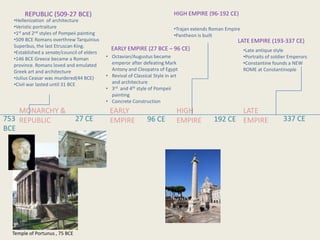
REPUBLIC (509-27 BCE)

•Hellenization of architecture
•Veristic portraiture
•1st and 2nd styles of Pompeii painting
•509 BCE Romans overthrew Tarquinius
Superbus, the last Etruscan King.
•Established a senate/council of elders
•146 BCE Greece became a Roman
province. Romans loved and emulated
Greek art and architecture
•Julius Ceasar was murdered(44 BCE)
•Civil war lasted until 31 BCE

MONARCHY &
753 REPUBLIC
BCE

Temple of Portunus , 75 BCE

27 CE

•Trajan extends Roman Empire
•Pantheon is built

LATE EMPIRE (193-337 CE)

EARLY EMPIRE (27 BCE – 96 CE)
• Octavian/Augustus became
emperor after defeating Mark
Antony and Cleopatra of Egypt
• Revival of Classical Style in art
and architecture
• 3rd and 4th style of Pompeii
painting
• Concrete Construction

EARLY
EMPIRE

96 CE

HIGH
EMPIRE

•Late antique style
•Portraits of soldier Emperors
•Constantine founds a NEW
ROME at Constantinople

LATE
192 CE EMPIRE

337 CE
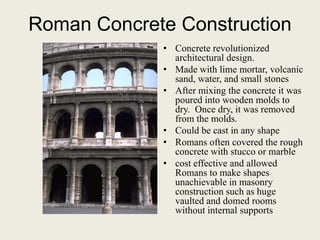
Roman Concrete Construction
• Concrete revolutionized
architectural design.
• Made with lime mortar, volcanic
sand, water, and small stones
• After mixing the concrete it was
poured into wooden molds to
dry. Once dry, it was removed
from the molds.
• Could be cast in any shape
• Romans often covered the rough
concrete with stucco or marble
• cost effective and allowed
Romans to make shapes
unachievable in masonry
construction such as huge
vaulted and domed rooms
without internal supports
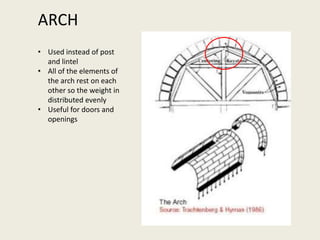
ARCH
• Used instead of post
and lintel
• All of the elements of
the arch rest on each
other so the weight in
distributed evenly
• Useful for doors and
openings
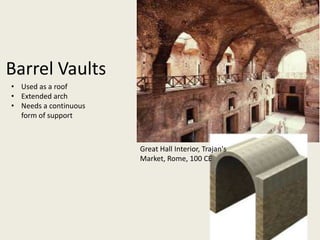
Barrel Vaults
• Used as a roof
• Extended arch
• Needs a continuous
form of support

Great Hall Interior, Trajan's
Market, Rome, 100 CE
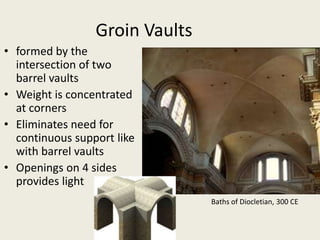
Groin Vaults
• formed by the
intersection of two
barrel vaults
• Weight is concentrated
at corners
• Eliminates need for
continuous support like
with barrel vaults
• Openings on 4 sides
provides light
Baths of Diocletian, 300 CE
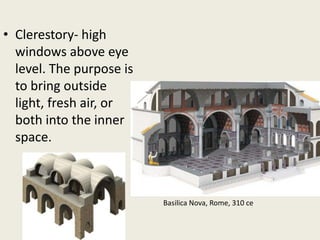
• Clerestory- high
windows above eye
level. The purpose is
to bring outside
light, fresh air, or
both into the inner
space.

Basilica Nova, Rome, 310 ce
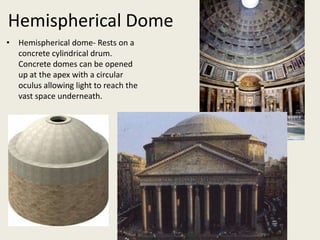
Hemispherical Dome
• Hemispherical dome- Rests on a
concrete cylindrical drum.
Concrete domes can be opened
up at the apex with a circular
oculus allowing light to reach the
vast space underneath.
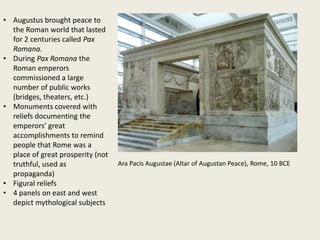
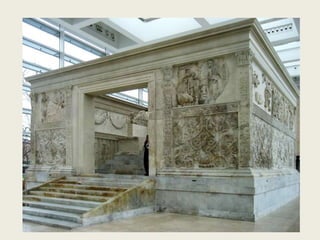
• Augustus brought peace to
the Roman world that lasted
for 2 centuries called Pax
Romana.
• During Pax Romana the
Roman emperors
commissioned a large
number of public works
(bridges, theaters, etc.)
• Monuments covered with
reliefs documenting the
emperors’ great
accomplishments to remind
people that Rome was a
place of great prosperity (not
truthful, used as
propaganda)
• Figural reliefs
• 4 panels on east and west
depict mythological subjects

Ara Pacis Augustae (Altar of Augustan Peace), Rome, 10 BCE
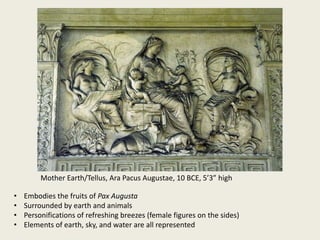
Mother Earth/Tellus, Ara Pacus Augustae, 10 BCE, 5’3” high
•
•
•
•

Embodies the fruits of Pax Augusta
Surrounded by earth and animals
Personifications of refreshing breezes (female figures on the sides)
Elements of earth, sky, and water are all represented
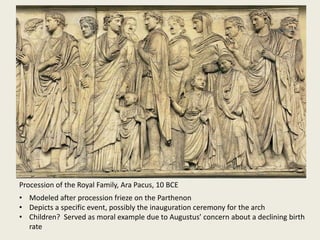
Procession of the Royal Family, Ara Pacus, 10 BCE
• Modeled after procession frieze on the Parthenon
• Depicts a specific event, possibly the inauguration ceremony for the arch
• Children? Served as moral example due to Augustus’ concern about a declining birth
rate
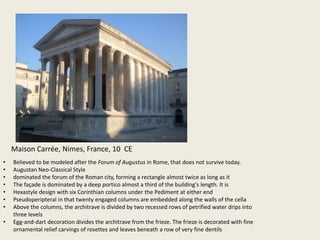
Maison Carrée, Nimes, France, 10 CE
•
•
•
•
•
•
•
•

Believed to be modeled after the Forum of Augustus in Rome, that does not survive today.
Augustan Neo-Classical Style
dominated the forum of the Roman city, forming a rectangle almost twice as long as it
The façade is dominated by a deep portico almost a third of the building's length. It is
Hexastyle design with six Corinthian columns under the Pediment at either end
Pseudoperipteral in that twenty engaged columns are embedded along the walls of the cella
Above the columns, the architrave is divided by two recessed rows of petrified water drips into
three levels
Egg-and-dart decoration divides the architrave from the frieze. The frieze is decorated with fine
ornamental relief carvings of rosettes and leaves beneath a row of very fine dentils
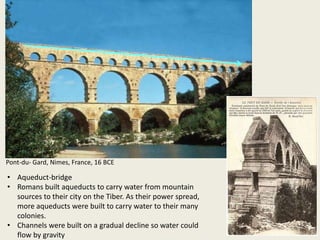
Pont-du- Gard, Nimes, France, 16 BCE

• Aqueduct-bridge
• Romans built aqueducts to carry water from mountain
sources to their city on the Tiber. As their power spread,
more aqueducts were built to carry water to their many
colonies.
• Channels were built on a gradual decline so water could
flow by gravity
•

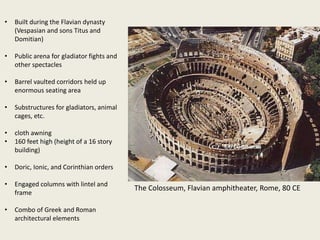
Built during the Flavian dynasty
(Vespasian and sons Titus and
Domitian)

•

Public arena for gladiator fights and
other spectacles

•

Barrel vaulted corridors held up
enormous seating area

•

Substructures for gladiators, animal
cages, etc.

•
•

cloth awning
160 feet high (height of a 16 story
building)

•

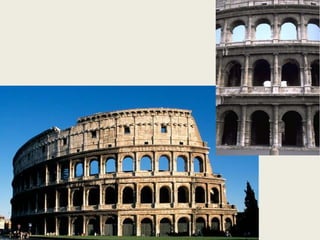
Doric, Ionic, and Corinthian orders

•

Engaged columns with lintel and
frame

•

Combo of Greek and Roman
architectural elements

The Colosseum, Flavian amphitheater, Rome, 80 CE
•

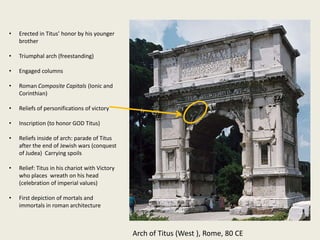
Erected in Titus’ honor by his younger
brother

•

Triumphal arch (freestanding)

•

Engaged columns

•

Roman Composite Capitals (Ionic and
Corinthian)

•

Reliefs of personifications of victory

•

Inscription (to honor GOD Titus)

•

Reliefs inside of arch: parade of Titus
after the end of Jewish wars (conquest
of Judea) Carrying spoils

•

Relief: Titus in his chariot with Victory
who places wreath on his head
(celebration of imperial values)

•

First depiction of mortals and
immortals in roman architecture

Arch of Titus (West ), Rome, 80 CE
•
•
•
•
•
•
•

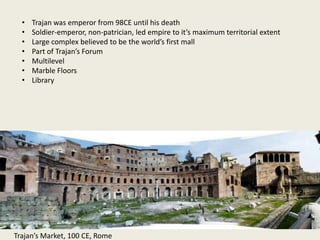
Trajan was emperor from 98CE until his death
Soldier-emperor, non-patrician, led empire to it’s maximum territorial extent
Large complex believed to be the world’s first mall
Part of Trajan’s Forum
Multilevel
Marble Floors
Library

Trajan’s Market, 100 CE, Rome

Roman architecture

  • 1.
    HIGH EMPIRE (96-192CE) REPUBLIC (509-27 BCE) •Hellenization of architecture •Veristic portraiture •1st and 2nd styles of Pompeii painting •509 BCE Romans overthrew Tarquinius Superbus, the last Etruscan King. •Established a senate/council of elders •146 BCE Greece became a Roman province. Romans loved and emulated Greek art and architecture •Julius Ceasar was murdered(44 BCE) •Civil war lasted until 31 BCE MONARCHY & 753 REPUBLIC BCE Temple of Portunus , 75 BCE 27 CE •Trajan extends Roman Empire •Pantheon is built LATE EMPIRE (193-337 CE) EARLY EMPIRE (27 BCE – 96 CE) • Octavian/Augustus became emperor after defeating Mark Antony and Cleopatra of Egypt • Revival of Classical Style in art and architecture • 3rd and 4th style of Pompeii painting • Concrete Construction EARLY EMPIRE 96 CE HIGH EMPIRE •Late antique style •Portraits of soldier Emperors •Constantine founds a NEW ROME at Constantinople LATE 192 CE EMPIRE 337 CE
  • 2.
    Roman Concrete Construction •Concrete revolutionized architectural design. • Made with lime mortar, volcanic sand, water, and small stones • After mixing the concrete it was poured into wooden molds to dry. Once dry, it was removed from the molds. • Could be cast in any shape • Romans often covered the rough concrete with stucco or marble • cost effective and allowed Romans to make shapes unachievable in masonry construction such as huge vaulted and domed rooms without internal supports
  • 3.
    ARCH • Used insteadof post and lintel • All of the elements of the arch rest on each other so the weight in distributed evenly • Useful for doors and openings
  • 4.
    Barrel Vaults • Usedas a roof • Extended arch • Needs a continuous form of support Great Hall Interior, Trajan's Market, Rome, 100 CE
  • 5.
    Groin Vaults • formedby the intersection of two barrel vaults • Weight is concentrated at corners • Eliminates need for continuous support like with barrel vaults • Openings on 4 sides provides light Baths of Diocletian, 300 CE
  • 6.
    • Clerestory- high windowsabove eye level. The purpose is to bring outside light, fresh air, or both into the inner space. Basilica Nova, Rome, 310 ce
  • 7.
    Hemispherical Dome • Hemisphericaldome- Rests on a concrete cylindrical drum. Concrete domes can be opened up at the apex with a circular oculus allowing light to reach the vast space underneath.
  • 8.
    • Augustus broughtpeace to the Roman world that lasted for 2 centuries called Pax Romana. • During Pax Romana the Roman emperors commissioned a large number of public works (bridges, theaters, etc.) • Monuments covered with reliefs documenting the emperors’ great accomplishments to remind people that Rome was a place of great prosperity (not truthful, used as propaganda) • Figural reliefs • 4 panels on east and west depict mythological subjects Ara Pacis Augustae (Altar of Augustan Peace), Rome, 10 BCE
  • 10.
    Mother Earth/Tellus, AraPacus Augustae, 10 BCE, 5’3” high • • • • Embodies the fruits of Pax Augusta Surrounded by earth and animals Personifications of refreshing breezes (female figures on the sides) Elements of earth, sky, and water are all represented
  • 11.
    Procession of theRoyal Family, Ara Pacus, 10 BCE • Modeled after procession frieze on the Parthenon • Depicts a specific event, possibly the inauguration ceremony for the arch • Children? Served as moral example due to Augustus’ concern about a declining birth rate
  • 12.
    Maison Carrée, Nimes,France, 10 CE • • • • • • • • Believed to be modeled after the Forum of Augustus in Rome, that does not survive today. Augustan Neo-Classical Style dominated the forum of the Roman city, forming a rectangle almost twice as long as it The façade is dominated by a deep portico almost a third of the building's length. It is Hexastyle design with six Corinthian columns under the Pediment at either end Pseudoperipteral in that twenty engaged columns are embedded along the walls of the cella Above the columns, the architrave is divided by two recessed rows of petrified water drips into three levels Egg-and-dart decoration divides the architrave from the frieze. The frieze is decorated with fine ornamental relief carvings of rosettes and leaves beneath a row of very fine dentils
  • 13.
    Pont-du- Gard, Nimes,France, 16 BCE • Aqueduct-bridge • Romans built aqueducts to carry water from mountain sources to their city on the Tiber. As their power spread, more aqueducts were built to carry water to their many colonies. • Channels were built on a gradual decline so water could flow by gravity
  • 14.
    • Built during theFlavian dynasty (Vespasian and sons Titus and Domitian) • Public arena for gladiator fights and other spectacles • Barrel vaulted corridors held up enormous seating area • Substructures for gladiators, animal cages, etc. • • cloth awning 160 feet high (height of a 16 story building) • Doric, Ionic, and Corinthian orders • Engaged columns with lintel and frame • Combo of Greek and Roman architectural elements The Colosseum, Flavian amphitheater, Rome, 80 CE
  • 16.
    • Erected in Titus’honor by his younger brother • Triumphal arch (freestanding) • Engaged columns • Roman Composite Capitals (Ionic and Corinthian) • Reliefs of personifications of victory • Inscription (to honor GOD Titus) • Reliefs inside of arch: parade of Titus after the end of Jewish wars (conquest of Judea) Carrying spoils • Relief: Titus in his chariot with Victory who places wreath on his head (celebration of imperial values) • First depiction of mortals and immortals in roman architecture Arch of Titus (West ), Rome, 80 CE
  • 17.
    • • • • • • • Trajan was emperorfrom 98CE until his death Soldier-emperor, non-patrician, led empire to it’s maximum territorial extent Large complex believed to be the world’s first mall Part of Trajan’s Forum Multilevel Marble Floors Library Trajan’s Market, 100 CE, Rome