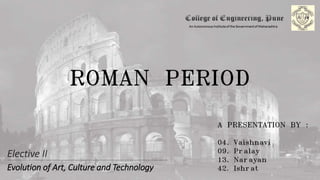
ROMAN PERIOD
A PRESENTATION BY :
04. Vaishnavi
09. Pralay
13. Narayan
42. Ishrat
Elective II
Evolution of Art, Culture and Technology
Structure of the presentation
• Overview and Location
• History of Roman Empire
• Architecture and City Planning
• Technology
• Occupation
• Trade and Commerce
• Art and Culture
LOCATION OF ROME
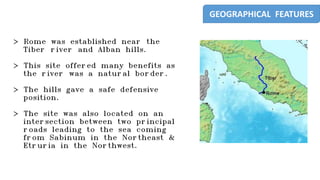
> Rome was established near the
Tiber river and Alban hills.
> This site offered many benefits as
the river was a natural border.
> The hills gave a safe defensive
position.
> The site was also located on an
intersection between two principal
roads leading to the sea coming
from Sabinum in the Northeast &
Etruria in the Northwest.
GEOGRAPHICAL FEATURES
> According to Greek mythology,
Romulus & Remus, twin sons
of Rhea Silvia & Mars, the God of
war were born in 771 BC.
> Due to prophecy, they were
abandoned after birth on Tiber
river.
> A she wolf took care of them.
> Faustulus and his wife Acca
Larentia raised them further.
> Romulus killed Remus and founded
the city of Rome.
ORIGIN
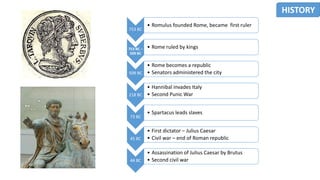
753 BC
• Romulus founded Rome, became first ruler
753 BC –
509 BC
• Rome ruled by kings
509 BC
• Rome becomes a republic
• Senators administered the city
218 BC
• Hannibal invades Italy
• Second Punic War
73 BC
• Spartacus leads slaves
45 BC
• First dictator – Julius Caesar
• Civil war – end of Roman republic
44 BC
• Assassination of Julius Caesar by Brutus
• Second civil war
HISTORY
27 BC
• Roman empire begins.
• Caesar Augustus – 1st Roman emperor
80 AD
• Colosseum was built
121 AD
• The Hadrian Wall was built
306 AD
• Constantine becomes emperor
• Spread of Christianity.
380 AD
• Rome splits into two empires.
476 AD
• End of western Roman empire
• Romulus Augustus – Last Roman emperor
HISTORY
HISTORY
FATHER OF ROMAN ARCHITECTURE – M. Vergilius Eurysaces
‘ All buildings
must be executed
in such a way as to
take account of
durability, utility &
beauty. ‘
ARCHITECTURE
• Architectural ideals
• Building materials
• Structures
- Walls
- Bridges
- Arches & Vault
- Dome
- Aqueducts
- Theatres, Circuses & Arenas
- Bath
- Temples & Pantheons
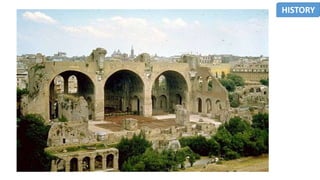
- Basilicas
- Tomb
ARCHITECTURE
• ARCHITECTURAL IDEALS
- SPACE :
> To the Romans, the space inside a structure was just
as important as the exterior.
> Interior space was the primary focus of Roman
architecture and was shaped by vaults, arches and
walls.
- EXTRAVAGANCY :
> Architecture for the powerful was gaudy and
colourful, not like the ruins seen today.
ARCHITECTURE
• BUILDING MATERIALS USED
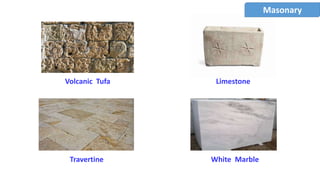
- STONES :
> Volcanic tufa - walls
> Limestone - sculptures
> Travertine - aqueducts and tiling
> White marble - sculptures
- BRICK
- CEMENT
> Made from pozzolanic ash / pozzolana
- CONCRETE
ARCHITECTURE
Masonary
Travertine White Marble
Volcanic Tufa Limestone
Masonry
Opus Incertum Opus Testaceum Opus Mixtum
• STRUCTURES
- Walls :
> For defense purpose
> Minimum height of 3.5m
> Width ranged from 1.8m to 6m
ARCHITECTURE
• STRUCTURES
- BRIDGES :
> Generally lower in height and broader than
aqueducts
> Two important Roman bridges :
1. Pons Fabricus
2. Pons Milvius
ARCHITECTURE
• STRUCTURES
- ARCHES :
> More intricate than a simple post-and-lintel system.
> Formed by a multitude of small elements that curve
over space by resting against each other in a
delicate balance.
ARCHITECTURE
ARCHITECTURE
• STRUCTURES
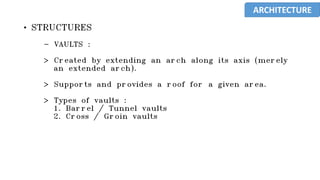
- VAULTS :
> Created by extending an arch along its axis (merely
an extended arch).
> Supports and provides a roof for a given area.
> Types of vaults :
1. Barrel / Tunnel vaults
2. Cross / Groin vaults
ARCHITECTURE
ARCHITECTURE
Barrel / Tunnel Vault Cross / Groin Vault
• STRUCTURES
- DOME :
ARCHITECTURE
Cloister Dome True Dome
• STRUCTURES
- AQUEDUCTS :
> Used to supply the civilization with water from afar.
> Utilized an arch to create a continuous line of
decent of water.
> Built using stone, brick or concrete.
> Aqua Claudia :
~ Brought water over solid masonry from some ten
miles into Rome
ARCHITECTURE
ARCHITECTURE
• STRUCTURES
- Basilicas :
> Pure Roman style of architecture
> Means, a roofed hall rectangular in plan,
sometimes with an apse.
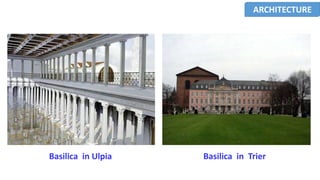
> Basilica Ulpia
~ Finest example of the columner basilica
> Basilica in Trier, Germany
~ Built by Constantine
~ Served as an important model in the
Roman period of architecture
ARCHITECTURE
ARCHITECTURE
Basilica in Ulpia Basilica in Trier
• STRUCTURES
- THEATRES :
> Roman theatres were closed while Greeks had open,
outside theatre.
ARCHITECTURE
• STRUCTURES
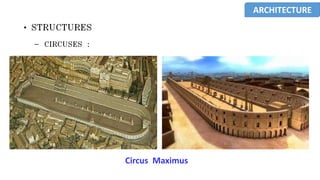
- CIRCUSES :
ARCHITECTURE
Circus Maximus
• STRUCTURES
- ARENAS :
> Emperors fought gladiators and wild animals
> Deadly sports like Chariot racing, etc.
ARCHITECTURE
Colosseum
ARCHITECTURE
• STRUCTURES
- BATHS :
> Strenuous daily life promoted the Romans to
construct large public baths.
> Wealthy citizens also constructed private baths in
their domiciles.
> Featured elaborate heating systems
~ Furnaces beneath floors
~ Heat was transmitted to rooms by tile ducts,
warming the floors and the walls.
ARCHITECTURE
Apodyterium Tepedarium
Caldarium Frigidarium
• ARCHITECTURAL IDEALS
- Temples :
> Earliest Roman temples resembled Etruscan temples
and Greek temples
~ Axial plan
~ Deep porch
~ Widely spaced columns
~ High podiums
> Temple of Jupiter Capitolinus
> Pantheon :
~ Immense, domed cella
~ Deep, octastyle Corinthian porch
~ Block-like intermediate structure
ARCHITECTURE
Temples
• STRUCTURES
- Tombs :
ARCHITECTURE
> Lower classes in meagre, cramped apartments
> Middle classes on the lower floors. Their housing
was called as INSULAS.
> Upper classes usually owned a house known as
DOMUS.
Housing
Ancient Insulas
Housing
Housing
Modern Ancient
Roads
Road Pavement Structure
Roads
Modern Ancient
Water Supply & Sanitation
City Planning
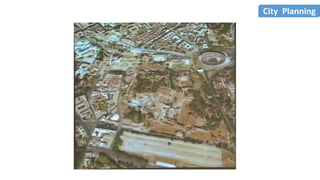
> The basic city plan consisted of a central forum with other
city services.
> It was surrounded by a wall for defense purpose.
> The wall also marked city limits & was covered by a
PORTCULLIS.
> Streets were laid at right angles, in a square grid.
> All roads were equal in length & width.
> Each squared marked by 4 roads was called an INSULA.
City Planning
> Most Roman cities had a population between between
5,000 & 15,000 people.
> Cities were more important to the Roman Empire
because they were where the empire collected taxes.
> The Ancient Roman city planning still is very clear in
modern Rome & it has influenced many towns across
Europe & the world.
City Planning
City Planning
City Planning
CITY OF TIMGAD
CITY OF POMPEII
City Planning
City Planning
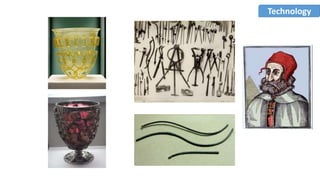
> Romans technologically excelled in :
- Civil Engineering
- Engineering construction materials
- Transport technology
- Inventions such as the mechanical reaper.
- Rome was also medically advanced.
~ GALEN (129 to 217 AD.) was the first physician
~ Father of Medicine in Rome
~ excelled in both surgery & herbal medicines.
~ He served as a physician of the Roman Emperor
Marcus Aurelius.
- Roman Arenas
Technology
Technology
Technology
• Types of jobs :
- Farmer
- Soldier
- Merchant
- Craftsmen
- Entertainers
- Lawyers, teachers & engineers
- Government
Occupation
> City served as a central point for commerce.
> Farmers brought produce into the city for good
coins.
> Cheating was prevented.
Trade & Commerce
Trade & Commerce
Patricians
Plebeians
Slaves
Social Structure
LIFESTYLE
> Daily life
> Clothing
> Food
Culture & Tradition
LIFESTYLE
> Food
Culture & Tradition
LIFESTYLE
> Clothing :
Culture & Tradition
RELIGION
Ancient Roman deity Role Ancient Greek deity
Jupiter King of the Gods Zeus
Juno Wife of the king, Goddess
of women & childbirth
Hera
Neptune God of the sea Poseidon
Mars God of war Ares
Venus Goddess of love & beauty Aphrodite
Bacchus God of wine & pleasure Dionysus
Vesta Goddess of the hearth Hestia
1. DERIVED FROM GREEK
MYTHOLOGY
2. CHRISTIANITY
LANGUAGE : Greek & Latin
Culture & Tradition
Funeral Customs
Cremations Burial
Culture & Tradition
LITERATURE
> Philosophy :
INDUSTRIA- to
work hard,
diligence
CLEMENTIA-
equity of rights
VIRTUS- courage,
honour, desire
to excel
FIDES- honesty,
believability,
dependability
GRAVITAS- self
control, dignity,
seriousness,
responsibility
PIETAS- respect,
dutifulness, good
living,
VALUES
Culture & Tradition
~ Virgil (70 BC to 19 BC) : History poems
~ Horace (65 BC to 8 BC) : Satires
~ Ovid (43 BC to 117 AD) : Love poems
> Poetry :
> Speeches : Rhetorics
LITERATURE
Ovid Horace
Culture & Tradition
VISUAL ARTS
> Sculptures :
Culture & Tradition
> Bust :
VISUAL ARTS
Culture & Tradition
> Paintings :
VISUAL ARTS
Culture & Tradition
Paintings
> Mosaics :
VISUAL ARTS
Culture & Tradition
> Theatres :
ENTERTAINMENT
Culture & Tradition
> Arenas & Circuses :
ENTERTAINMENT
Culture & Tradition
SPECIAL THANKS TO
OMKAR SIR
PRESENTED BY
04. Vaishnavi
09. Pralay
13. Narayan
42. Ishrat
THANK YOU

13 Roman cities

  • 1.
    ROMAN PERIOD A PRESENTATIONBY : 04. Vaishnavi 09. Pralay 13. Narayan 42. Ishrat Elective II Evolution of Art, Culture and Technology
  • 2.
    Structure of thepresentation • Overview and Location • History of Roman Empire • Architecture and City Planning • Technology • Occupation • Trade and Commerce • Art and Culture
  • 4.
  • 5.
    > Rome wasestablished near the Tiber river and Alban hills. > This site offered many benefits as the river was a natural border. > The hills gave a safe defensive position. > The site was also located on an intersection between two principal roads leading to the sea coming from Sabinum in the Northeast & Etruria in the Northwest. GEOGRAPHICAL FEATURES
  • 7.
    > According toGreek mythology, Romulus & Remus, twin sons of Rhea Silvia & Mars, the God of war were born in 771 BC. > Due to prophecy, they were abandoned after birth on Tiber river. > A she wolf took care of them. > Faustulus and his wife Acca Larentia raised them further. > Romulus killed Remus and founded the city of Rome. ORIGIN
  • 9.
    753 BC • Romulusfounded Rome, became first ruler 753 BC – 509 BC • Rome ruled by kings 509 BC • Rome becomes a republic • Senators administered the city 218 BC • Hannibal invades Italy • Second Punic War 73 BC • Spartacus leads slaves 45 BC • First dictator – Julius Caesar • Civil war – end of Roman republic 44 BC • Assassination of Julius Caesar by Brutus • Second civil war HISTORY
  • 10.
    27 BC • Romanempire begins. • Caesar Augustus – 1st Roman emperor 80 AD • Colosseum was built 121 AD • The Hadrian Wall was built 306 AD • Constantine becomes emperor • Spread of Christianity. 380 AD • Rome splits into two empires. 476 AD • End of western Roman empire • Romulus Augustus – Last Roman emperor HISTORY
  • 11.
  • 13.
    FATHER OF ROMANARCHITECTURE – M. Vergilius Eurysaces ‘ All buildings must be executed in such a way as to take account of durability, utility & beauty. ‘ ARCHITECTURE
  • 14.
    • Architectural ideals •Building materials • Structures - Walls - Bridges - Arches & Vault - Dome - Aqueducts - Theatres, Circuses & Arenas - Bath - Temples & Pantheons - Basilicas - Tomb ARCHITECTURE
  • 15.
    • ARCHITECTURAL IDEALS -SPACE : > To the Romans, the space inside a structure was just as important as the exterior. > Interior space was the primary focus of Roman architecture and was shaped by vaults, arches and walls. - EXTRAVAGANCY : > Architecture for the powerful was gaudy and colourful, not like the ruins seen today. ARCHITECTURE
  • 16.
    • BUILDING MATERIALSUSED - STONES : > Volcanic tufa - walls > Limestone - sculptures > Travertine - aqueducts and tiling > White marble - sculptures - BRICK - CEMENT > Made from pozzolanic ash / pozzolana - CONCRETE ARCHITECTURE
  • 17.
  • 18.
    Masonry Opus Incertum OpusTestaceum Opus Mixtum
  • 19.
    • STRUCTURES - Walls: > For defense purpose > Minimum height of 3.5m > Width ranged from 1.8m to 6m ARCHITECTURE
  • 20.
    • STRUCTURES - BRIDGES: > Generally lower in height and broader than aqueducts > Two important Roman bridges : 1. Pons Fabricus 2. Pons Milvius ARCHITECTURE
  • 21.
    • STRUCTURES - ARCHES: > More intricate than a simple post-and-lintel system. > Formed by a multitude of small elements that curve over space by resting against each other in a delicate balance. ARCHITECTURE
  • 22.
  • 23.
    • STRUCTURES - VAULTS: > Created by extending an arch along its axis (merely an extended arch). > Supports and provides a roof for a given area. > Types of vaults : 1. Barrel / Tunnel vaults 2. Cross / Groin vaults ARCHITECTURE
  • 24.
    ARCHITECTURE Barrel / TunnelVault Cross / Groin Vault
  • 25.
    • STRUCTURES - DOME: ARCHITECTURE Cloister Dome True Dome
  • 26.
    • STRUCTURES - AQUEDUCTS: > Used to supply the civilization with water from afar. > Utilized an arch to create a continuous line of decent of water. > Built using stone, brick or concrete. > Aqua Claudia : ~ Brought water over solid masonry from some ten miles into Rome ARCHITECTURE
  • 27.
  • 28.
    • STRUCTURES - Basilicas: > Pure Roman style of architecture > Means, a roofed hall rectangular in plan, sometimes with an apse. > Basilica Ulpia ~ Finest example of the columner basilica > Basilica in Trier, Germany ~ Built by Constantine ~ Served as an important model in the Roman period of architecture ARCHITECTURE
  • 29.
  • 30.
    • STRUCTURES - THEATRES: > Roman theatres were closed while Greeks had open, outside theatre. ARCHITECTURE
  • 31.
    • STRUCTURES - CIRCUSES: ARCHITECTURE Circus Maximus
  • 32.
    • STRUCTURES - ARENAS: > Emperors fought gladiators and wild animals > Deadly sports like Chariot racing, etc. ARCHITECTURE
  • 33.
  • 34.
    • STRUCTURES - BATHS: > Strenuous daily life promoted the Romans to construct large public baths. > Wealthy citizens also constructed private baths in their domiciles. > Featured elaborate heating systems ~ Furnaces beneath floors ~ Heat was transmitted to rooms by tile ducts, warming the floors and the walls. ARCHITECTURE
  • 35.
  • 36.
    • ARCHITECTURAL IDEALS -Temples : > Earliest Roman temples resembled Etruscan temples and Greek temples ~ Axial plan ~ Deep porch ~ Widely spaced columns ~ High podiums > Temple of Jupiter Capitolinus > Pantheon : ~ Immense, domed cella ~ Deep, octastyle Corinthian porch ~ Block-like intermediate structure ARCHITECTURE
  • 37.
  • 38.
    • STRUCTURES - Tombs: ARCHITECTURE
  • 39.
    > Lower classesin meagre, cramped apartments > Middle classes on the lower floors. Their housing was called as INSULAS. > Upper classes usually owned a house known as DOMUS. Housing Ancient Insulas
  • 40.
  • 41.
  • 42.
  • 43.
  • 44.
    Water Supply &Sanitation
  • 45.
  • 46.
    > The basiccity plan consisted of a central forum with other city services. > It was surrounded by a wall for defense purpose. > The wall also marked city limits & was covered by a PORTCULLIS. > Streets were laid at right angles, in a square grid. > All roads were equal in length & width. > Each squared marked by 4 roads was called an INSULA. City Planning
  • 47.
    > Most Romancities had a population between between 5,000 & 15,000 people. > Cities were more important to the Roman Empire because they were where the empire collected taxes. > The Ancient Roman city planning still is very clear in modern Rome & it has influenced many towns across Europe & the world. City Planning
  • 48.
  • 49.
  • 50.
  • 51.
  • 53.
    > Romans technologicallyexcelled in : - Civil Engineering - Engineering construction materials - Transport technology - Inventions such as the mechanical reaper. - Rome was also medically advanced. ~ GALEN (129 to 217 AD.) was the first physician ~ Father of Medicine in Rome ~ excelled in both surgery & herbal medicines. ~ He served as a physician of the Roman Emperor Marcus Aurelius. - Roman Arenas Technology
  • 54.
  • 55.
  • 57.
    • Types ofjobs : - Farmer - Soldier - Merchant - Craftsmen - Entertainers - Lawyers, teachers & engineers - Government Occupation
  • 59.
    > City servedas a central point for commerce. > Farmers brought produce into the city for good coins. > Cheating was prevented. Trade & Commerce
  • 60.
  • 62.
  • 64.
    LIFESTYLE > Daily life >Clothing > Food Culture & Tradition
  • 65.
  • 66.
  • 67.
    RELIGION Ancient Roman deityRole Ancient Greek deity Jupiter King of the Gods Zeus Juno Wife of the king, Goddess of women & childbirth Hera Neptune God of the sea Poseidon Mars God of war Ares Venus Goddess of love & beauty Aphrodite Bacchus God of wine & pleasure Dionysus Vesta Goddess of the hearth Hestia 1. DERIVED FROM GREEK MYTHOLOGY 2. CHRISTIANITY LANGUAGE : Greek & Latin Culture & Tradition
  • 68.
  • 69.
    LITERATURE > Philosophy : INDUSTRIA-to work hard, diligence CLEMENTIA- equity of rights VIRTUS- courage, honour, desire to excel FIDES- honesty, believability, dependability GRAVITAS- self control, dignity, seriousness, responsibility PIETAS- respect, dutifulness, good living, VALUES Culture & Tradition
  • 70.
    ~ Virgil (70BC to 19 BC) : History poems ~ Horace (65 BC to 8 BC) : Satires ~ Ovid (43 BC to 117 AD) : Love poems > Poetry : > Speeches : Rhetorics LITERATURE Ovid Horace Culture & Tradition
  • 71.
    VISUAL ARTS > Sculptures: Culture & Tradition
  • 72.
    > Bust : VISUALARTS Culture & Tradition
  • 73.
    > Paintings : VISUALARTS Culture & Tradition
  • 74.
  • 75.
    > Mosaics : VISUALARTS Culture & Tradition
  • 76.
  • 77.
    > Arenas &Circuses : ENTERTAINMENT Culture & Tradition
  • 78.
    SPECIAL THANKS TO OMKARSIR PRESENTED BY 04. Vaishnavi 09. Pralay 13. Narayan 42. Ishrat THANK YOU