PRESENTED BY:
SYEDA TAMANNA YASMIN
DU2017MSC0130
M.Sc Microbiology,2nd sem
INTRODUCTION
 The rolling circle model for DNA replication suggests
that DNA must de circular.
 It describes a process of unidirectional nucleic acid
replication.
Three basic steps: (i) Initiation
(ii) elongation
(iii) termination
STEPS
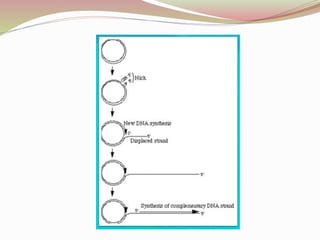
 Circular dsDNA will be “nicked”.
 3’ end is elongated- leading strand
 5’ end is displaced- Lagging strand
 Replication of both “unnicked” and displaced ssDNA.
 Displaced DNA circulates and synthesis its own
complementary strand.
INITIATION
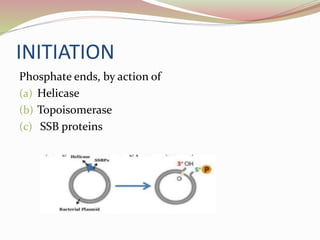
Phosphate ends, by action of
(a) Helicase
(b) Topoisomerase
(c) SSB proteins
ELONGATION
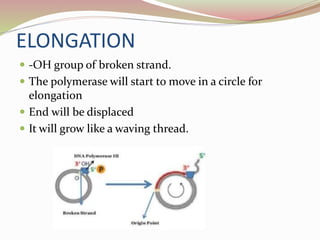
 -OH group of broken strand.
 The polymerase will start to move in a circle for
elongation
 End will be displaced
 It will grow like a waving thread.
TERMINATION
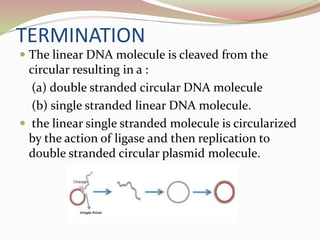
 The linear DNA molecule is cleaved from the
circular resulting in a :
(a) double stranded circular DNA molecule
(b) single stranded linear DNA molecule.
 the linear single stranded molecule is circularized
by the action of ligase and then replication to
double stranded circular plasmid molecule.
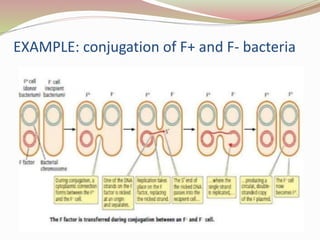
EXAMPLE: conjugation of F+ and F- bacteria
SYNTHESIS OF (+) STRAND
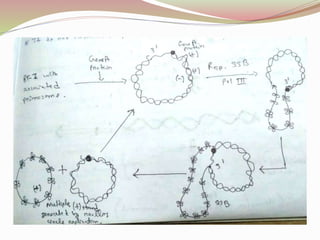
 Loop rolling replication.
 Begins with primosome added to gene A.
 Helicase attaches to (-) strand at gene A.
 Pol III extends the (+) strand from 3’-OH.
 Extension process generates a loop rolling structure.
 Old (+) strand is pelled off.
 Simultaneously newly formed 3’OH of old looped
strand attacks its 5’ phosphate terminus attaches to
5’protein A.
SYNTHESIS OF (-) STRAND
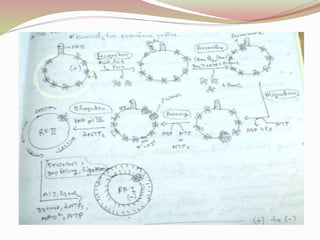
 The (+) strand is coated with SSB ,except for PAS.
 This recognized by pri A,pri B,pri C .
 Dna B and Dna C add to the DNA.
 Dna C then releases.
 Primose pro-pelled in 5’-3’direction along with (+)strand
by pri A.
 Pol III extends the primer.
 Pol I excises the primer.
 Fragments are joined by ligase and super coiled by
gyrase.
 Forms (-) strand.
Rolling circle model

Rolling circle model

  • 1.
    PRESENTED BY: SYEDA TAMANNAYASMIN DU2017MSC0130 M.Sc Microbiology,2nd sem
  • 2.
    INTRODUCTION  The rollingcircle model for DNA replication suggests that DNA must de circular.  It describes a process of unidirectional nucleic acid replication. Three basic steps: (i) Initiation (ii) elongation (iii) termination
  • 3.
    STEPS  Circular dsDNAwill be “nicked”.  3’ end is elongated- leading strand  5’ end is displaced- Lagging strand  Replication of both “unnicked” and displaced ssDNA.  Displaced DNA circulates and synthesis its own complementary strand.
  • 5.
    INITIATION Phosphate ends, byaction of (a) Helicase (b) Topoisomerase (c) SSB proteins
  • 6.
    ELONGATION  -OH groupof broken strand.  The polymerase will start to move in a circle for elongation  End will be displaced  It will grow like a waving thread.
  • 7.
    TERMINATION  The linearDNA molecule is cleaved from the circular resulting in a : (a) double stranded circular DNA molecule (b) single stranded linear DNA molecule.  the linear single stranded molecule is circularized by the action of ligase and then replication to double stranded circular plasmid molecule.
  • 8.
    EXAMPLE: conjugation ofF+ and F- bacteria
  • 9.
    SYNTHESIS OF (+)STRAND  Loop rolling replication.  Begins with primosome added to gene A.  Helicase attaches to (-) strand at gene A.  Pol III extends the (+) strand from 3’-OH.  Extension process generates a loop rolling structure.  Old (+) strand is pelled off.  Simultaneously newly formed 3’OH of old looped strand attacks its 5’ phosphate terminus attaches to 5’protein A.
  • 11.
    SYNTHESIS OF (-)STRAND  The (+) strand is coated with SSB ,except for PAS.  This recognized by pri A,pri B,pri C .  Dna B and Dna C add to the DNA.  Dna C then releases.  Primose pro-pelled in 5’-3’direction along with (+)strand by pri A.  Pol III extends the primer.  Pol I excises the primer.  Fragments are joined by ligase and super coiled by gyrase.  Forms (-) strand.