Mechanism of Rolling Circle
Mrs. Praveen Garg
Asst. Prof.,
VITS College, Satna, M.P.
Introduction
• Rolling circle replication is a process of
unidirectional nucleic acid replication.
• It can rapidly synthesize multiple copies of circular
molecules of DNA or RNA, such as plasmid.
• Eukaryotic also replicate their DNA/RNA via this
methods.
• Widely used in molecular biology & biochemical
nanotechnology, especially in the field of biosensing
(as a method of signal amplification).
DNA rolling circle replication has five Steps
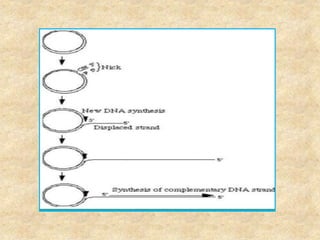
• Circular ds DNA will be nicked.
• 3’ end is elongated using unnicked DNA as leading
strand (template)
• 5’ end displaced is as a lagging strand and is made
double stranded DNA via a series of OKAZAKI
fragments.
• Replication of both unnicked and displaced ss DNA.
• Displaced DNA circulates and synthesis its own
complementary strand.
Thrre steps of Rolling Circle Replication
(1) Initiation
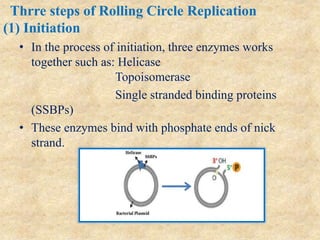
• In the process of initiation, three enzymes works
together such as: Helicase
Topoisomerase
Single stranded binding proteins
(SSBPs)
• These enzymes bind with phosphate ends of nick
strand.
(2) Elongation
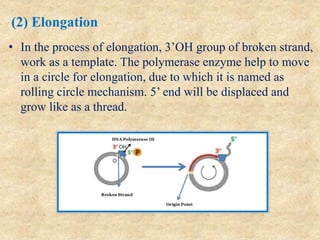
• In the process of elongation, 3’OH group of broken strand,
work as a template. The polymerase enzyme help to move
in a circle for elongation, due to which it is named as
rolling circle mechanism. 5’ end will be displaced and
grow like as a thread.
(3)Termination
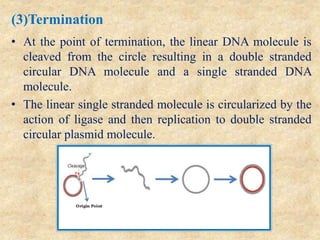
• At the point of termination, the linear DNA molecule is
cleaved from the circle resulting in a double stranded
circular DNA molecule and a single stranded DNA
molecule.
• The linear single stranded molecule is circularized by the
action of ligase and then replication to double stranded
circular plasmid molecule.
Rolling circle DNA replication
• Rolling circle replication is initiated by protein coded by the
plasmid or bacterial DNA, called initiator protein. This protein
nicks one strand of the double stranded DNA at a site called
double stranded origin or DSO. This protein bind to 5’ phosphate
end of the nicked strand and free 3’ OH end is serve as a primer
for DNA synthesis by DNA polymerase enzyme. 5’ end
displaced and grow like as a thread with the help of helicase and
single stranded binding proteins.
• Continued DNA synthesis can produce multiple single-stranded
linear copies of the original DNA in a continuous head-to-tail
series called a concatemer. These linear copies can be converted
to double-stranded circular molecules through the following
process:
• First, the initiator protein makes another nick in the DNA to
terminate synthesis of the first (leading) strand.
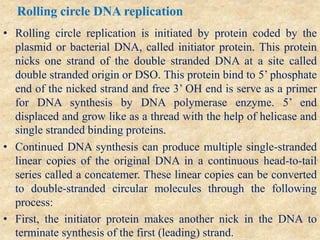
Replication starts at ORI region
by a initiator Rep A
Region bind with DNA polymerase and
Replication starts
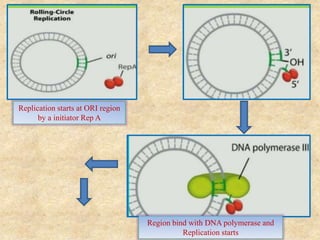
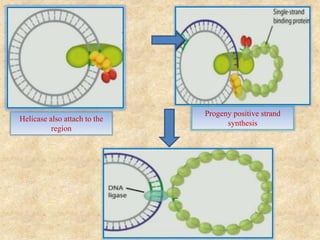
Helicase also attach to the
region
Progeny positive strand
synthesis
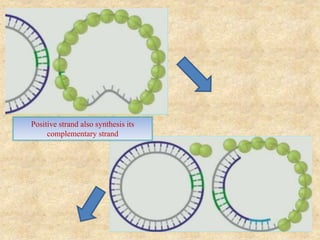
Positive strand also synthesis its
complementary strand
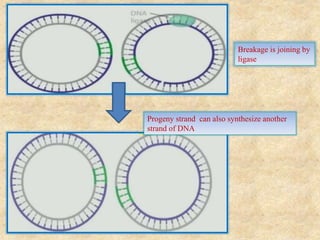
Breakage is joining by
ligase
Progeny strand can also synthesize another
strand of DNA
Various steps involve in this process:
 Firstly, Initiator protein Rep A bind to nicked 5’ OH end of
ssDNA at ori site.
 After that DNA Polymerase enzyme bind with 3’P end of ds
DNA or ori site.
 Then helicase enzyme attach with RepA protein and start
replication process. In this process 5’ end of ssDNA elongated
with the help of single stranded binding protein.
 After completing new ssDNA synthesis, new strand separate
with the single stranded binding protein from the nicked
region and nick place sealed by DNA ligase enzyme.
 At last single stranded DNA also synthesize its
complementory strands.
Example:
Viral DNA: Some DNA viruses replicate their genomic
information in host cells via rolling circle replication.
• Human herpes virus
• Human papilloma virus
• Gemini virus
Viral RNA: Some RNA viruses and viroids also replicate their
genome through rolling circle RNA replication.
• Pospiviridiae family
• Avsunviridiae family
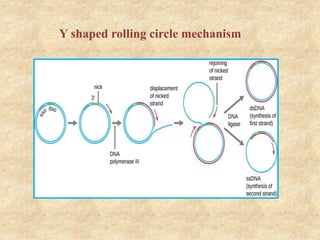
Y shaped rolling circle mechanism
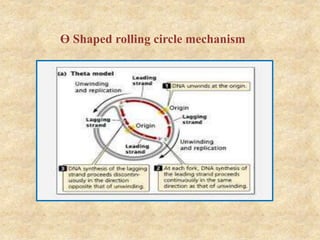
Ө Shaped rolling circle mechanism
Thank you

Rolling circle mechanism ppt

  • 1.
    Mechanism of RollingCircle Mrs. Praveen Garg Asst. Prof., VITS College, Satna, M.P.
  • 2.
    Introduction • Rolling circlereplication is a process of unidirectional nucleic acid replication. • It can rapidly synthesize multiple copies of circular molecules of DNA or RNA, such as plasmid. • Eukaryotic also replicate their DNA/RNA via this methods. • Widely used in molecular biology & biochemical nanotechnology, especially in the field of biosensing (as a method of signal amplification).
  • 3.
    DNA rolling circlereplication has five Steps • Circular ds DNA will be nicked. • 3’ end is elongated using unnicked DNA as leading strand (template) • 5’ end displaced is as a lagging strand and is made double stranded DNA via a series of OKAZAKI fragments. • Replication of both unnicked and displaced ss DNA. • Displaced DNA circulates and synthesis its own complementary strand.
  • 5.
    Thrre steps ofRolling Circle Replication (1) Initiation • In the process of initiation, three enzymes works together such as: Helicase Topoisomerase Single stranded binding proteins (SSBPs) • These enzymes bind with phosphate ends of nick strand.
  • 6.
    (2) Elongation • Inthe process of elongation, 3’OH group of broken strand, work as a template. The polymerase enzyme help to move in a circle for elongation, due to which it is named as rolling circle mechanism. 5’ end will be displaced and grow like as a thread.
  • 7.
    (3)Termination • At thepoint of termination, the linear DNA molecule is cleaved from the circle resulting in a double stranded circular DNA molecule and a single stranded DNA molecule. • The linear single stranded molecule is circularized by the action of ligase and then replication to double stranded circular plasmid molecule.
  • 8.
    Rolling circle DNAreplication • Rolling circle replication is initiated by protein coded by the plasmid or bacterial DNA, called initiator protein. This protein nicks one strand of the double stranded DNA at a site called double stranded origin or DSO. This protein bind to 5’ phosphate end of the nicked strand and free 3’ OH end is serve as a primer for DNA synthesis by DNA polymerase enzyme. 5’ end displaced and grow like as a thread with the help of helicase and single stranded binding proteins. • Continued DNA synthesis can produce multiple single-stranded linear copies of the original DNA in a continuous head-to-tail series called a concatemer. These linear copies can be converted to double-stranded circular molecules through the following process: • First, the initiator protein makes another nick in the DNA to terminate synthesis of the first (leading) strand.
  • 9.
    Replication starts atORI region by a initiator Rep A Region bind with DNA polymerase and Replication starts
  • 10.
    Helicase also attachto the region Progeny positive strand synthesis
  • 11.
    Positive strand alsosynthesis its complementary strand
  • 12.
    Breakage is joiningby ligase Progeny strand can also synthesize another strand of DNA
  • 13.
    Various steps involvein this process:  Firstly, Initiator protein Rep A bind to nicked 5’ OH end of ssDNA at ori site.  After that DNA Polymerase enzyme bind with 3’P end of ds DNA or ori site.  Then helicase enzyme attach with RepA protein and start replication process. In this process 5’ end of ssDNA elongated with the help of single stranded binding protein.  After completing new ssDNA synthesis, new strand separate with the single stranded binding protein from the nicked region and nick place sealed by DNA ligase enzyme.  At last single stranded DNA also synthesize its complementory strands.
  • 14.
    Example: Viral DNA: SomeDNA viruses replicate their genomic information in host cells via rolling circle replication. • Human herpes virus • Human papilloma virus • Gemini virus Viral RNA: Some RNA viruses and viroids also replicate their genome through rolling circle RNA replication. • Pospiviridiae family • Avsunviridiae family
  • 15.
    Y shaped rollingcircle mechanism
  • 16.
    Ө Shaped rollingcircle mechanism
  • 17.