Rolling Circle Model
By- Dr. Ema Sushan
DNA Replication…..
(Molecular Biology)
Rolling Circle Replication
• Watson & Crick (1990s)
• Replication that is seen in circular DNA
• Only one origin
• Unidirectional
• Synthesize many copies of DNA and RNA
• Example :-
▫ Plasmids
▫ Bacteriophages
▫ Viroids
1) Template is
circular duplex
DNA
4) Rejoining of nicked
strand
3) Elongation of
growing strand
displaces old
strand
RepA
Pol III
Pol III
3’OH
5’-P
5’-P
Growing Strand
Displaced Strand
2) Initiation occur
on one strand- nick
at origin
Displacement of nicked strand
DNA
Ligase
dsDNA
(synthesis of
first strand)
ssDNA
(synthesis of first
strand)
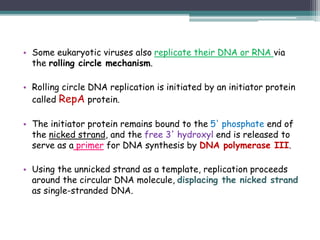
• Some eukaryotic viruses also replicate their DNA or RNA via
the rolling circle mechanism.
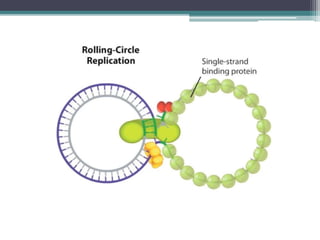
• Rolling circle DNA replication is initiated by an initiator protein
called RepA protein.
• The initiator protein remains bound to the 5' phosphate end of
the nicked strand, and the free 3' hydroxyl end is released to
serve as a primer for DNA synthesis by DNA polymerase III.
• Using the unnicked strand as a template, replication proceeds
around the circular DNA molecule, displacing the nicked strand
as single-stranded DNA.
• Helicase enzyme unwinds the strand and allows further
displacement of the nicked strand.
• SSB (single stranded DNA binding) proteins bind to the
displaced nicked strand.
• After displacement strand gets ligated by DNA ligase and
become circular.
• Later it form its complementary strand by forming loop and
removal of SSB protein takes place.
Summary of DNA rolling circle
Replication has five steps:
 Circular dsDNA will be "nicked".
 The 3' end is elongated using "unnicked" DNA as leading strand
(template); 5' end is displaced.
 Displaced DNA is a lagging strand and is made double stranded
via a series of Okazaki fragments.
 Replication of both "unnicked" and displaced ssDNA.
 Displaced DNA circularizes.
Thank you

Rolling Circle Replication

  • 1.
    Rolling Circle Model By-Dr. Ema Sushan DNA Replication….. (Molecular Biology)
  • 2.
    Rolling Circle Replication •Watson & Crick (1990s) • Replication that is seen in circular DNA • Only one origin • Unidirectional • Synthesize many copies of DNA and RNA • Example :- ▫ Plasmids ▫ Bacteriophages ▫ Viroids
  • 4.
    1) Template is circularduplex DNA 4) Rejoining of nicked strand 3) Elongation of growing strand displaces old strand RepA Pol III Pol III 3’OH 5’-P 5’-P Growing Strand Displaced Strand 2) Initiation occur on one strand- nick at origin Displacement of nicked strand DNA Ligase dsDNA (synthesis of first strand) ssDNA (synthesis of first strand)
  • 5.
    • Some eukaryoticviruses also replicate their DNA or RNA via the rolling circle mechanism. • Rolling circle DNA replication is initiated by an initiator protein called RepA protein. • The initiator protein remains bound to the 5' phosphate end of the nicked strand, and the free 3' hydroxyl end is released to serve as a primer for DNA synthesis by DNA polymerase III. • Using the unnicked strand as a template, replication proceeds around the circular DNA molecule, displacing the nicked strand as single-stranded DNA.
  • 6.
    • Helicase enzymeunwinds the strand and allows further displacement of the nicked strand. • SSB (single stranded DNA binding) proteins bind to the displaced nicked strand. • After displacement strand gets ligated by DNA ligase and become circular. • Later it form its complementary strand by forming loop and removal of SSB protein takes place.
  • 7.
    Summary of DNArolling circle Replication has five steps:  Circular dsDNA will be "nicked".  The 3' end is elongated using "unnicked" DNA as leading strand (template); 5' end is displaced.  Displaced DNA is a lagging strand and is made double stranded via a series of Okazaki fragments.  Replication of both "unnicked" and displaced ssDNA.  Displaced DNA circularizes.
  • 8.