ITM UNIVERSE
Institute of Technology & Management Universe
http://alltypeim.blogspot.in/
TOPIC :ROCKWELL HARDNESS TEST
http://alltypeim.blogspot.in/
ROCKWELL HARDNESS TEST
The differential depth hardness measurement was conceived in 1908 by a
Viennese professor Paul Ludwik in his book Die Kegelprobe (crudely, "the cone
test").
The differential-depth method subtracted out the errors associated with the
mechanical imperfections of the system, such as backlash and surface
imperfections.
The Brinell hardness test, invented in Sweden, was developed earlier – in 1900 –
but it was slow, not useful on fully hardened steel, and left too large an
impression to be considered nondestructive
http://alltypeim.blogspot.in/
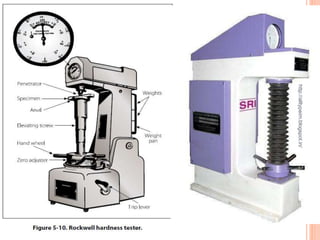
Hugh M. Rockwell (1890–1957) and Stanley P. Rockwell (1886–1940) from Connecticut in the United States co-invented
the "Rockwell hardness tester," a differential-depth machine.
They applied for a patent on July 15, 1914.
The requirement for this tester was to quickly determine the effects of heat treatment on steel bearing races.
The application was subsequently approved on February 11, 1919, and holds U.S. Patent 1,294,171.
At the time of invention, both Hugh and Stanley Rockwell worked for the New Departure Manufacturing Co. of Bristol,
CT. New
Departure was a major ball bearing manufacturer which in 1916 became part of United Motors and, shortly thereafter,
General Motors Corp
http://alltypeim.blogspot.in/
What is Rockwell Hardness?
Rockwell Hardness testing is a system for determining the hardness of metals and alloys of all kinds.
The American Society for Testing and Materials (ASTM) has established a standard recognized worldwide to help
manufacturers maintain the qualities they want in their products. ASTM Standards E-18 and E-110 defines the test method
and parameters for a valid test using portable hardness testers.
Rockwell is a way of measuring the hardness of materials. Hardness means the resistance to penetration. This test gets its
name from Stanley P. Rockwell who invented the test and the original hardness testing machines.
When testing metals, indentation hardness correlates with the strength of the material.
This important relation permits economically important nondestructive testing of bulk metal deliveries with
lightweight, portable equipment, such as hand-held Rockwell hardness testers, which are each individually calibrated for
accurate readings.
The advantage of Rockwell hardness is its ability to display hardness values directly. This reduces all the tedious
calculations involved in other ways used for the hardness measurement of materials.
 It has a massive following in the commercial arena because of its speed, reliability, robustness, resolution and tiny area
of indentation
http://alltypeim.blogspot.in/
Types of Rockwell Hardness Testing
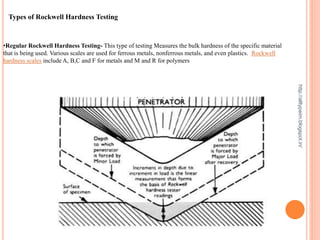
•Regular Rockwell Hardness Testing- This type of testing Measures the bulk hardness of the specific material
that is being used. Various scales are used for ferrous metals, nonferrous metals, and even plastics. Rockwell
hardness scales include A, B,C and F for metals and M and R for polymers
http://alltypeim.blogspot.in/
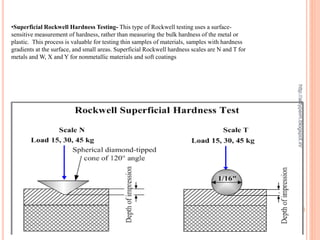
•Superficial Rockwell Hardness Testing- This type of Rockwell testing uses a surface-
sensitive measurement of hardness, rather than measuring the bulk hardness of the metal or
plastic. This process is valuable for testing thin samples of materials, samples with hardness
gradients at the surface, and small areas. Superficial Rockwell hardness scales are N and T for
metals and W, X and Y for nonmetallic materials and soft coatings
http://alltypeim.blogspot.in/
ROCKWELL SCALE
The Rockwell scale is a hardness scale based on indentation hardness of a material. The Rockwell test
determines the hardness by measuring the depth of penetration of an indenter under a large load
compared to the penetration made by a preload.
There are different scales, denoted by a single letter, that use different loads or indenters. The result is a
dimensionless number noted as HRA, HRB, HRC, etc.,
where the last letter is the respective Rockwell scale When testing metals, indentation hardness correlates
linearly with tensile strength.

This important relation permits economically important nondestructive testing of bulk metal deliveries
with lightweight, even portable equipment, such as hand-held Rockwell hardness testers.
http://alltypeim.blogspot.in/
OPERATION
The determination of the Rockwell hardness of a material involves the application of a minor load followed by a
major load.
The minor load establishes the zero position. The major load is applied, then removed while still maintaining the
minor load.
The depth of penetration from the zero datum is measured from a dial, on which a harder material gives a higher
number.
That is, the penetration depth and hardness are inversely proportional.
The chief advantage of Rockwell hardness is its ability to display hardness values directly, thus obviating tedious
calculations involved in other hardness measurement techniques
http://alltypeim.blogspot.in/
It is typically used in engineering and metallurgy.
Its commercial popularity arises from its speed, reliability, robustness, resolution and small area of indentation.
In order to get a reliable reading the thickness of the test-piece should be at least 10 times the depth of the
indentation.
Also, readings should be taken from a flat perpendicular surface, because convex surfaces give lower readings.
A correction factor can be used if the hardness of a convex surface is to be measured
http://alltypeim.blogspot.in/
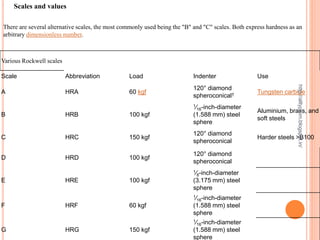
Various Rockwell scales
Scale Abbreviation Load Indenter Use
A HRA 60 kgf
120° diamond
spheroconical† Tungsten carbide
B HRB 100 kgf
1⁄16-inch-diameter
(1.588 mm) steel
sphere
Aluminium, brass, and
soft steels
C HRC 150 kgf
120° diamond
spheroconical
Harder steels >B100
D HRD 100 kgf
120° diamond
spheroconical
E HRE 100 kgf
1⁄8-inch-diameter
(3.175 mm) steel
sphere
F HRF 60 kgf
1⁄16-inch-diameter
(1.588 mm) steel
sphere
G HRG 150 kgf
1⁄16-inch-diameter
(1.588 mm) steel
sphere
.
Scales and values
There are several alternative scales, the most commonly used being the "B" and "C" scales. Both express hardness as an
arbitrary dimensionless number.
http://alltypeim.blogspot.in/
Except for testing thin materials in accordance with A623 the steel indenter balls have been
replaced by tungsten carbide balls of the varying diameters.
When a ball indenter is used, the letter "W" is used to indicate a tungsten carbide ball was
used, and the letter "S" indicates the use of a steel ball. E.g.: 70 HRBW indicates the reading
was 70 in the Rockwell B scale using a tungsten carbide indenter.
The superficial Rockwell scales use lower loads and shallower impressions on brittle and
very thin materials.
The 45N scale employs a 45-kgf load on a diamond cone-shaped Brale indenter, and can be
used on dense ceramics. The 15T scale employs a 15-kgf load on a 1⁄16-inch-diameter
(1.588 mm) hardened steel ball, and can be used on sheet metal.
The B and C scales overlap, such that readings below HRC 20 and those above HRB 100,
generally considered unreliable, need not be taken or specified.
http://alltypeim.blogspot.in/
TYPE OF VALUE
Very hard steel (e.g. chisels, quality knife blades): HRC 55–66 (Hardened High Speed Carbon and Tool Steels
such as M2, W2, O1, CPM-M4, and D2, as well as many of the newer powder metallurgy Stainless Steels such as
S30V, CPM-154, ZDP-189)
Axes: about HRC 45–55
Brass: HRB 55 (Low brass, UNS C24000, H01 Temper) to HRB 93 (Cartridge Brass, UNS C26000 (260 Brass),
H10 Temper)
Several other scales, including the extensive A-scale, are used for specialized applications. There are special scales
for measuring case-hardened specimens
http://alltypeim.blogspot.in/
REFERENCE
 WIKIPEDIA
 BOOKS INDIA
http://alltypeim.blogspot.in/

Rockwell hardness test

  • 1.
    ITM UNIVERSE Institute ofTechnology & Management Universe http://alltypeim.blogspot.in/
  • 2.
    TOPIC :ROCKWELL HARDNESSTEST http://alltypeim.blogspot.in/
  • 3.
    ROCKWELL HARDNESS TEST Thedifferential depth hardness measurement was conceived in 1908 by a Viennese professor Paul Ludwik in his book Die Kegelprobe (crudely, "the cone test"). The differential-depth method subtracted out the errors associated with the mechanical imperfections of the system, such as backlash and surface imperfections. The Brinell hardness test, invented in Sweden, was developed earlier – in 1900 – but it was slow, not useful on fully hardened steel, and left too large an impression to be considered nondestructive http://alltypeim.blogspot.in/
  • 4.
    Hugh M. Rockwell(1890–1957) and Stanley P. Rockwell (1886–1940) from Connecticut in the United States co-invented the "Rockwell hardness tester," a differential-depth machine. They applied for a patent on July 15, 1914. The requirement for this tester was to quickly determine the effects of heat treatment on steel bearing races. The application was subsequently approved on February 11, 1919, and holds U.S. Patent 1,294,171. At the time of invention, both Hugh and Stanley Rockwell worked for the New Departure Manufacturing Co. of Bristol, CT. New Departure was a major ball bearing manufacturer which in 1916 became part of United Motors and, shortly thereafter, General Motors Corp http://alltypeim.blogspot.in/
  • 5.
  • 6.
    What is RockwellHardness? Rockwell Hardness testing is a system for determining the hardness of metals and alloys of all kinds. The American Society for Testing and Materials (ASTM) has established a standard recognized worldwide to help manufacturers maintain the qualities they want in their products. ASTM Standards E-18 and E-110 defines the test method and parameters for a valid test using portable hardness testers. Rockwell is a way of measuring the hardness of materials. Hardness means the resistance to penetration. This test gets its name from Stanley P. Rockwell who invented the test and the original hardness testing machines. When testing metals, indentation hardness correlates with the strength of the material. This important relation permits economically important nondestructive testing of bulk metal deliveries with lightweight, portable equipment, such as hand-held Rockwell hardness testers, which are each individually calibrated for accurate readings. The advantage of Rockwell hardness is its ability to display hardness values directly. This reduces all the tedious calculations involved in other ways used for the hardness measurement of materials.  It has a massive following in the commercial arena because of its speed, reliability, robustness, resolution and tiny area of indentation http://alltypeim.blogspot.in/
  • 7.
    Types of RockwellHardness Testing •Regular Rockwell Hardness Testing- This type of testing Measures the bulk hardness of the specific material that is being used. Various scales are used for ferrous metals, nonferrous metals, and even plastics. Rockwell hardness scales include A, B,C and F for metals and M and R for polymers http://alltypeim.blogspot.in/
  • 8.
    •Superficial Rockwell HardnessTesting- This type of Rockwell testing uses a surface- sensitive measurement of hardness, rather than measuring the bulk hardness of the metal or plastic. This process is valuable for testing thin samples of materials, samples with hardness gradients at the surface, and small areas. Superficial Rockwell hardness scales are N and T for metals and W, X and Y for nonmetallic materials and soft coatings http://alltypeim.blogspot.in/
  • 9.
    ROCKWELL SCALE The Rockwellscale is a hardness scale based on indentation hardness of a material. The Rockwell test determines the hardness by measuring the depth of penetration of an indenter under a large load compared to the penetration made by a preload. There are different scales, denoted by a single letter, that use different loads or indenters. The result is a dimensionless number noted as HRA, HRB, HRC, etc., where the last letter is the respective Rockwell scale When testing metals, indentation hardness correlates linearly with tensile strength.  This important relation permits economically important nondestructive testing of bulk metal deliveries with lightweight, even portable equipment, such as hand-held Rockwell hardness testers. http://alltypeim.blogspot.in/
  • 10.
    OPERATION The determination ofthe Rockwell hardness of a material involves the application of a minor load followed by a major load. The minor load establishes the zero position. The major load is applied, then removed while still maintaining the minor load. The depth of penetration from the zero datum is measured from a dial, on which a harder material gives a higher number. That is, the penetration depth and hardness are inversely proportional. The chief advantage of Rockwell hardness is its ability to display hardness values directly, thus obviating tedious calculations involved in other hardness measurement techniques http://alltypeim.blogspot.in/
  • 11.
    It is typicallyused in engineering and metallurgy. Its commercial popularity arises from its speed, reliability, robustness, resolution and small area of indentation. In order to get a reliable reading the thickness of the test-piece should be at least 10 times the depth of the indentation. Also, readings should be taken from a flat perpendicular surface, because convex surfaces give lower readings. A correction factor can be used if the hardness of a convex surface is to be measured http://alltypeim.blogspot.in/
  • 12.
    Various Rockwell scales ScaleAbbreviation Load Indenter Use A HRA 60 kgf 120° diamond spheroconical† Tungsten carbide B HRB 100 kgf 1⁄16-inch-diameter (1.588 mm) steel sphere Aluminium, brass, and soft steels C HRC 150 kgf 120° diamond spheroconical Harder steels >B100 D HRD 100 kgf 120° diamond spheroconical E HRE 100 kgf 1⁄8-inch-diameter (3.175 mm) steel sphere F HRF 60 kgf 1⁄16-inch-diameter (1.588 mm) steel sphere G HRG 150 kgf 1⁄16-inch-diameter (1.588 mm) steel sphere . Scales and values There are several alternative scales, the most commonly used being the "B" and "C" scales. Both express hardness as an arbitrary dimensionless number. http://alltypeim.blogspot.in/
  • 13.
    Except for testingthin materials in accordance with A623 the steel indenter balls have been replaced by tungsten carbide balls of the varying diameters. When a ball indenter is used, the letter "W" is used to indicate a tungsten carbide ball was used, and the letter "S" indicates the use of a steel ball. E.g.: 70 HRBW indicates the reading was 70 in the Rockwell B scale using a tungsten carbide indenter. The superficial Rockwell scales use lower loads and shallower impressions on brittle and very thin materials. The 45N scale employs a 45-kgf load on a diamond cone-shaped Brale indenter, and can be used on dense ceramics. The 15T scale employs a 15-kgf load on a 1⁄16-inch-diameter (1.588 mm) hardened steel ball, and can be used on sheet metal. The B and C scales overlap, such that readings below HRC 20 and those above HRB 100, generally considered unreliable, need not be taken or specified. http://alltypeim.blogspot.in/
  • 14.
    TYPE OF VALUE Veryhard steel (e.g. chisels, quality knife blades): HRC 55–66 (Hardened High Speed Carbon and Tool Steels such as M2, W2, O1, CPM-M4, and D2, as well as many of the newer powder metallurgy Stainless Steels such as S30V, CPM-154, ZDP-189) Axes: about HRC 45–55 Brass: HRB 55 (Low brass, UNS C24000, H01 Temper) to HRB 93 (Cartridge Brass, UNS C26000 (260 Brass), H10 Temper) Several other scales, including the extensive A-scale, are used for specialized applications. There are special scales for measuring case-hardened specimens http://alltypeim.blogspot.in/
  • 15.
    REFERENCE  WIKIPEDIA  BOOKSINDIA http://alltypeim.blogspot.in/
  • 16.