MSE 2208
Materials Testing Sesssional
Presented by
Md. Abul Gofran Banna
Roll: 2027022
Department of Materials Science and Engineering
Khulna University of Engineering and Technology
1
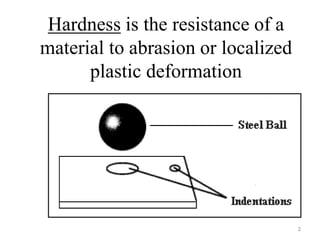
Hardness is the resistance of a
material to abrasion or localized
plastic deformation
2
Hardness
 Hardness is not necessarily an indication of
strength , although for some materials such as
steel, a harder steel is a stronger steel.
 Measure of a material’s ability to resist surface
indentation or scratching.
 A difficult property to describe in terms of first
principles Φ value depends greatly on
method of testing.
 Different testing methods Φ different scales and
values.
3
Hardness Testing
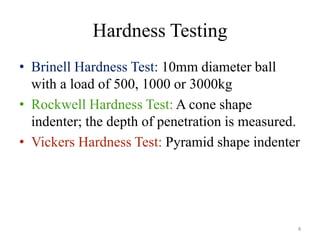
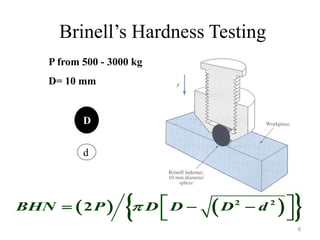
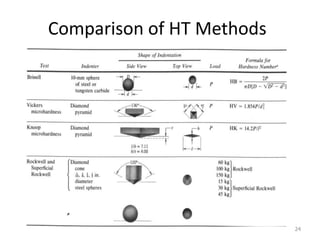
• Brinell Hardness Test: 10mm diameter ball
with a load of 500, 1000 or 3000kg
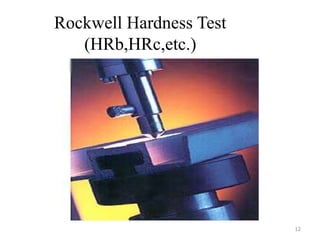
• Rockwell Hardness Test: A cone shape
indenter; the depth of penetration is measured.
• Vickers Hardness Test: Pyramid shape indenter
4
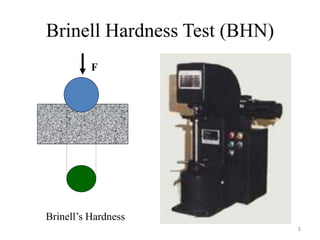
Brinell Hardness Test (BHN)
F
Brinell’s Hardness
5
Brinell’s Hardness Testing
P from 500 - 3000 kg
D= 10 mm
   
 
2 2
2
BHN P D D D d
  
  
 
 
d
D
6
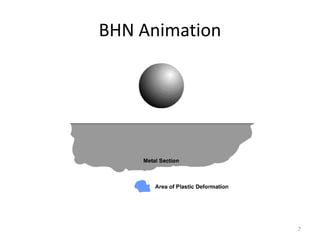
BHN Animation
7
Brinell Test Protocol
1. Press a 10mm (3/8") diameter ball into
material with a known amount of load.
2. Measure diameter of the indentation.
3. BHN = Load = 2L
Surface Area D[D-(D2-d2)1/2]
a) L = Load placed on ball, usually 3000 kg , but 1500 kg, and
500 kg can also be used.
b) D = Diameter of steel ball ( = 10 mm)
c) d = diameter of dent, measured by looking thru a Brinell
microscope.
8
Analysis of Plastic Deformation during
Brinell Hardness Test
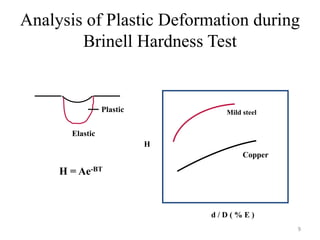
Elastic
Plastic
H = Ae-BT
Mild steel
Copper
d / D ( % E )
H
9
Limitations of the Brinell Hardness
Test
– Sample must be ten times thicker than the
indentation depth (sample usually should be at
least 3/8" thick).
– Test is most accurate if the indentation depth is 2.5
- 5.0 mm. Adjust load to achieve this.
– Test is no good if BHN > 650
10
BHN PROS & CONS
• Widely used and well
accepted
• Large ball gives good
average reading with a
single test.
• Accurate
• Easy to learn and use
• Destructive
• Non-portable
• High initial cost
($5,000)
• Error due to operator
reading Brinell
Microscope (10% max)
11
Rockwell Hardness Test
(HRb,HRc,etc.)
12
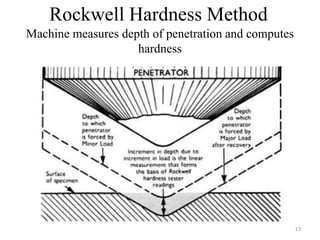
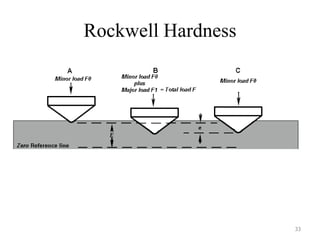
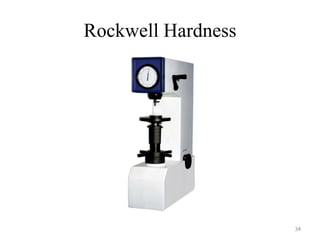
Rockwell Hardness Method
Machine measures depth of penetration and computes
hardness
13
Rockwell Hardness Method
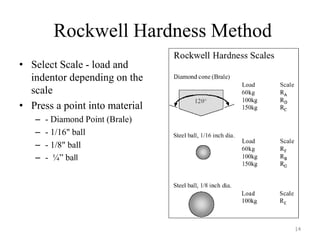
• Select Scale - load and
indentor depending on the
scale
• Press a point into material
– - Diamond Point (Brale)
– - 1/16" ball
– - 1/8" ball
– - ¼” ball
14
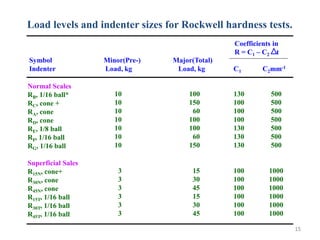
Symbol Minor(Pre-) Major(Total)
Indenter Load, kg Load, kg C1 C2mm-1
Coefficients in
R = C1 – C2 t
Normal Scales
RB, 1/16 ball*
RC, cone +
RA, cone
RD, cone
RE, 1/8 ball
RF, 1/16 ball
RG, 1/16 ball
Superficial Sales
R15N, cone+
R30N, cone
R45N, cone
R15T, 1/16 ball
R30T, 1/16 ball
R45T, 1/16 ball
10 100 130 500
10 150 100 500
10 60 100 500
10 100 100 500
10 100 130 500
10 60 130 500
10 150 130 500
3 15 100 1000
3 30 100 1000
3 45 100 1000
3 15 100 1000
3 30 100 1000
3 45 100 1000
Load levels and indenter sizes for Rockwell hardness tests.
15
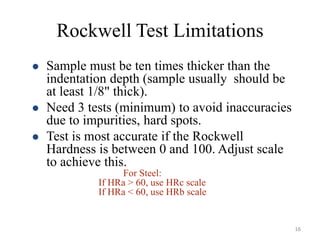
Rockwell Test Limitations
 Sample must be ten times thicker than the
indentation depth (sample usually should be
at least 1/8" thick).
 Need 3 tests (minimum) to avoid inaccuracies
due to impurities, hard spots.
 Test is most accurate if the Rockwell
Hardness is between 0 and 100. Adjust scale
to achieve this.
For Steel:
If HRa > 60, use HRc scale
If HRa < 60, use HRb scale
16
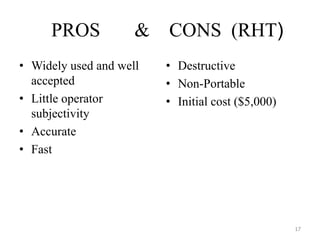
PROS & CONS (RHT)
• Widely used and well
accepted
• Little operator
subjectivity
• Accurate
• Fast
• Destructive
• Non-Portable
• Initial cost ($5,000)
17
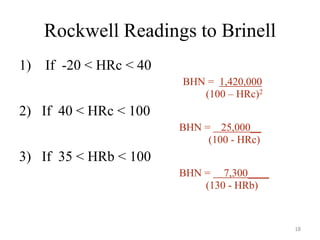
Rockwell Readings to Brinell
1) If -20 < HRc < 40
BHN = 1,420,000
(100 – HRc)2
2) If 40 < HRc < 100
BHN = 25,000__
(100 - HRc)
3) If 35 < HRb < 100
BHN = 7,300____
(130 - HRb)
18
Vickers Hardness Testing
Vickers Hardness = F/A = 3y
A
P
2
1.854P
HV
L

P: applied load in kg, 5-120 kg
L: average diagonal length, mm
(typically from a few µm to 1 mm)
q: angle between opposite faces of
indenter; 136°
Range: 5 (extremely soft metals) -
1500 (extremely hard materials)
q
DPH/VHN/VPH/VH = 2PSin(q/2)/L2
L
19
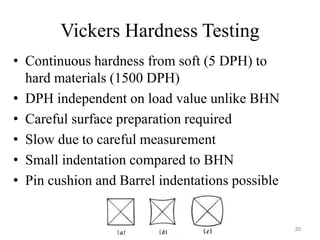
Vickers Hardness Testing
• Continuous hardness from soft (5 DPH) to
hard materials (1500 DPH)
• DPH independent on load value unlike BHN
• Careful surface preparation required
• Slow due to careful measurement
• Small indentation compared to BHN
• Pin cushion and Barrel indentations possible
20
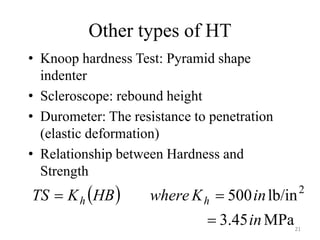
Other types of HT
• Knoop hardness Test: Pyramid shape
indenter
• Scleroscope: rebound height
• Durometer: The resistance to penetration
(elastic deformation)
• Relationship between Hardness and
Strength
 
MPa
45
.
3
lb/in
500 2
in
in
K
where
HB
K
TS h
h



21
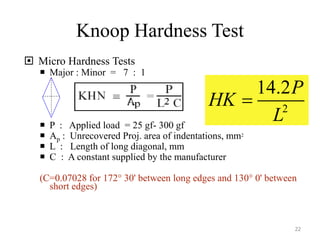
Knoop Hardness Test
 Micro Hardness Tests
 Major : Minor = 7 : 1
 P : Applied load = 25 gf- 300 gf
 Ap : Unrecovered Proj. area of indentations, mm2
 L : Length of long diagonal, mm
 C : A constant supplied by the manufacturer
(C=0.07028 for 172° 30' between long edges and 130° 0' between
short edges)
2
14.2P
HK
L

22
Pros & Cons (KHN)
• Accurate
• Useful for elongated
and anisotropic
constituents.
• Requires load to be
normal to surface plane
parallel surfaces.
• Can be done on
mounted specimens
• Slow
• Sensitive to surface
condition
• Subject to error in
diagonal measurement
23
Comparison of HT Methods
24
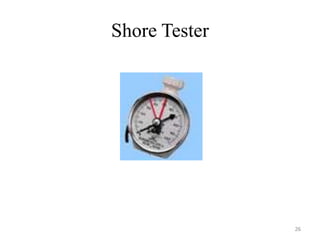
Shore (Durometer) Testing
 The Shore (Durometer) test provides an empirical hardness
value that doesn't correlate to other properties or fundamental
characteristics.
 Shore Hardness, using either the Shore A or Shore D scale, is
the preferred method for rubbers/elastomers and is also
commonly used for 'softer' plastics such as polyolefins,
fluoropolymers, and vinyls. The Shore A scale is used for
'softer' rubbers while the Shore D scale is used for 'harder'
ones.
 Because of the resilience of rubbers and plastics, the hardness
reading may change over time - so the indentation time is
sometimes reported along with the hardness number.
25
Shore Tester
26
Hardness Testing
• Indentation Hardness used for steel
– as opposed to scratch or rebound hardness
• It is indicative of ultimate tensile strength
– Atoms move out of the way to create indentation
• Two main types: Brinell and Rockwell
27
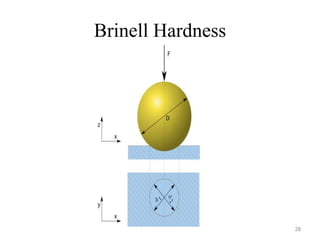
Brinell Hardness
28
Brinell Hardness
• A spherical indenter (1 cm diameter) is shot
with 29 kN force at the target
• Frequently the indenter is steel, but for harder
materials it is replaced with a tungsten carbide
sphere
• The diameter of the indentation is recorded
• The indentation diameter can be correlated
with the volume of the indentation.
29
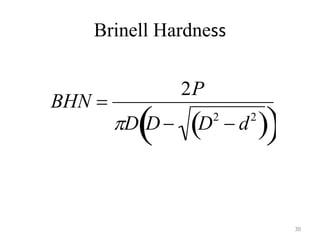
Brinell Hardness
BHN 
2P
D D D2
 d2
 
 
30
Brinell Hardness
• ASTM and ISO use the HB value. It can be HBS (Hardness,
Brinell, Steel) or the HBW (Hardness, Brinell, Tungsten)
• HBW = 0.102 BHN
• Sometimes written as HBW 10/3000 (Tungsten, 10 mm
diameter, 3,000 kg force)
31
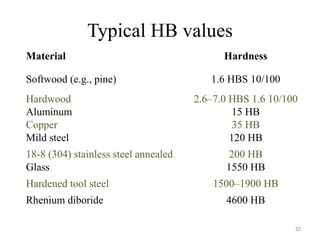
Typical HB values
Material Hardness
Softwood (e.g., pine) 1.6 HBS 10/100
Hardwood 2.6–7.0 HBS 1.6 10/100
Aluminum 15 HB
Copper 35 HB
Mild steel 120 HB
18-8 (304) stainless steel annealed 200 HB
Glass 1550 HB
Hardened tool steel 1500–1900 HB
Rhenium diboride 4600 HB
32
Rockwell Hardness
33
Rockwell Hardness
34
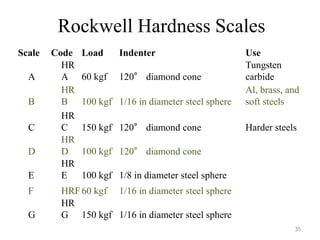
Rockwell Hardness Scales
Scale Code Load Indenter Use
A
HR
A 60 kgf 120° diamond cone
Tungsten
carbide
B
HR
B 100 kgf 1/16 in diameter steel sphere
Al, brass, and
soft steels
C
HR
C 150 kgf 120° diamond cone Harder steels
D
HR
D 100 kgf 120° diamond cone
E
HR
E 100 kgf 1/8 in diameter steel sphere
F HRF60 kgf 1/16 in diameter steel sphere
G
HR
G 150 kgf 1/16 in diameter steel sphere
35

Materials Testing Lab Presentation

  • 1.
    MSE 2208 Materials TestingSesssional Presented by Md. Abul Gofran Banna Roll: 2027022 Department of Materials Science and Engineering Khulna University of Engineering and Technology 1
  • 2.
    Hardness is theresistance of a material to abrasion or localized plastic deformation 2
  • 3.
    Hardness  Hardness isnot necessarily an indication of strength , although for some materials such as steel, a harder steel is a stronger steel.  Measure of a material’s ability to resist surface indentation or scratching.  A difficult property to describe in terms of first principles Φ value depends greatly on method of testing.  Different testing methods Φ different scales and values. 3
  • 4.
    Hardness Testing • BrinellHardness Test: 10mm diameter ball with a load of 500, 1000 or 3000kg • Rockwell Hardness Test: A cone shape indenter; the depth of penetration is measured. • Vickers Hardness Test: Pyramid shape indenter 4
  • 5.
    Brinell Hardness Test(BHN) F Brinell’s Hardness 5
  • 6.
    Brinell’s Hardness Testing Pfrom 500 - 3000 kg D= 10 mm       2 2 2 BHN P D D D d           d D 6
  • 7.
  • 8.
    Brinell Test Protocol 1.Press a 10mm (3/8") diameter ball into material with a known amount of load. 2. Measure diameter of the indentation. 3. BHN = Load = 2L Surface Area D[D-(D2-d2)1/2] a) L = Load placed on ball, usually 3000 kg , but 1500 kg, and 500 kg can also be used. b) D = Diameter of steel ball ( = 10 mm) c) d = diameter of dent, measured by looking thru a Brinell microscope. 8
  • 9.
    Analysis of PlasticDeformation during Brinell Hardness Test Elastic Plastic H = Ae-BT Mild steel Copper d / D ( % E ) H 9
  • 10.
    Limitations of theBrinell Hardness Test – Sample must be ten times thicker than the indentation depth (sample usually should be at least 3/8" thick). – Test is most accurate if the indentation depth is 2.5 - 5.0 mm. Adjust load to achieve this. – Test is no good if BHN > 650 10
  • 11.
    BHN PROS &CONS • Widely used and well accepted • Large ball gives good average reading with a single test. • Accurate • Easy to learn and use • Destructive • Non-portable • High initial cost ($5,000) • Error due to operator reading Brinell Microscope (10% max) 11
  • 12.
  • 13.
    Rockwell Hardness Method Machinemeasures depth of penetration and computes hardness 13
  • 14.
    Rockwell Hardness Method •Select Scale - load and indentor depending on the scale • Press a point into material – - Diamond Point (Brale) – - 1/16" ball – - 1/8" ball – - ¼” ball 14
  • 15.
    Symbol Minor(Pre-) Major(Total) IndenterLoad, kg Load, kg C1 C2mm-1 Coefficients in R = C1 – C2 t Normal Scales RB, 1/16 ball* RC, cone + RA, cone RD, cone RE, 1/8 ball RF, 1/16 ball RG, 1/16 ball Superficial Sales R15N, cone+ R30N, cone R45N, cone R15T, 1/16 ball R30T, 1/16 ball R45T, 1/16 ball 10 100 130 500 10 150 100 500 10 60 100 500 10 100 100 500 10 100 130 500 10 60 130 500 10 150 130 500 3 15 100 1000 3 30 100 1000 3 45 100 1000 3 15 100 1000 3 30 100 1000 3 45 100 1000 Load levels and indenter sizes for Rockwell hardness tests. 15
  • 16.
    Rockwell Test Limitations Sample must be ten times thicker than the indentation depth (sample usually should be at least 1/8" thick).  Need 3 tests (minimum) to avoid inaccuracies due to impurities, hard spots.  Test is most accurate if the Rockwell Hardness is between 0 and 100. Adjust scale to achieve this. For Steel: If HRa > 60, use HRc scale If HRa < 60, use HRb scale 16
  • 17.
    PROS & CONS(RHT) • Widely used and well accepted • Little operator subjectivity • Accurate • Fast • Destructive • Non-Portable • Initial cost ($5,000) 17
  • 18.
    Rockwell Readings toBrinell 1) If -20 < HRc < 40 BHN = 1,420,000 (100 – HRc)2 2) If 40 < HRc < 100 BHN = 25,000__ (100 - HRc) 3) If 35 < HRb < 100 BHN = 7,300____ (130 - HRb) 18
  • 19.
    Vickers Hardness Testing VickersHardness = F/A = 3y A P 2 1.854P HV L  P: applied load in kg, 5-120 kg L: average diagonal length, mm (typically from a few µm to 1 mm) q: angle between opposite faces of indenter; 136° Range: 5 (extremely soft metals) - 1500 (extremely hard materials) q DPH/VHN/VPH/VH = 2PSin(q/2)/L2 L 19
  • 20.
    Vickers Hardness Testing •Continuous hardness from soft (5 DPH) to hard materials (1500 DPH) • DPH independent on load value unlike BHN • Careful surface preparation required • Slow due to careful measurement • Small indentation compared to BHN • Pin cushion and Barrel indentations possible 20
  • 21.
    Other types ofHT • Knoop hardness Test: Pyramid shape indenter • Scleroscope: rebound height • Durometer: The resistance to penetration (elastic deformation) • Relationship between Hardness and Strength   MPa 45 . 3 lb/in 500 2 in in K where HB K TS h h    21
  • 22.
    Knoop Hardness Test Micro Hardness Tests  Major : Minor = 7 : 1  P : Applied load = 25 gf- 300 gf  Ap : Unrecovered Proj. area of indentations, mm2  L : Length of long diagonal, mm  C : A constant supplied by the manufacturer (C=0.07028 for 172° 30' between long edges and 130° 0' between short edges) 2 14.2P HK L  22
  • 23.
    Pros & Cons(KHN) • Accurate • Useful for elongated and anisotropic constituents. • Requires load to be normal to surface plane parallel surfaces. • Can be done on mounted specimens • Slow • Sensitive to surface condition • Subject to error in diagonal measurement 23
  • 24.
    Comparison of HTMethods 24
  • 25.
    Shore (Durometer) Testing The Shore (Durometer) test provides an empirical hardness value that doesn't correlate to other properties or fundamental characteristics.  Shore Hardness, using either the Shore A or Shore D scale, is the preferred method for rubbers/elastomers and is also commonly used for 'softer' plastics such as polyolefins, fluoropolymers, and vinyls. The Shore A scale is used for 'softer' rubbers while the Shore D scale is used for 'harder' ones.  Because of the resilience of rubbers and plastics, the hardness reading may change over time - so the indentation time is sometimes reported along with the hardness number. 25
  • 26.
  • 27.
    Hardness Testing • IndentationHardness used for steel – as opposed to scratch or rebound hardness • It is indicative of ultimate tensile strength – Atoms move out of the way to create indentation • Two main types: Brinell and Rockwell 27
  • 28.
  • 29.
    Brinell Hardness • Aspherical indenter (1 cm diameter) is shot with 29 kN force at the target • Frequently the indenter is steel, but for harder materials it is replaced with a tungsten carbide sphere • The diameter of the indentation is recorded • The indentation diameter can be correlated with the volume of the indentation. 29
  • 30.
    Brinell Hardness BHN  2P DD D2  d2     30
  • 31.
    Brinell Hardness • ASTMand ISO use the HB value. It can be HBS (Hardness, Brinell, Steel) or the HBW (Hardness, Brinell, Tungsten) • HBW = 0.102 BHN • Sometimes written as HBW 10/3000 (Tungsten, 10 mm diameter, 3,000 kg force) 31
  • 32.
    Typical HB values MaterialHardness Softwood (e.g., pine) 1.6 HBS 10/100 Hardwood 2.6–7.0 HBS 1.6 10/100 Aluminum 15 HB Copper 35 HB Mild steel 120 HB 18-8 (304) stainless steel annealed 200 HB Glass 1550 HB Hardened tool steel 1500–1900 HB Rhenium diboride 4600 HB 32
  • 33.
  • 34.
  • 35.
    Rockwell Hardness Scales ScaleCode Load Indenter Use A HR A 60 kgf 120° diamond cone Tungsten carbide B HR B 100 kgf 1/16 in diameter steel sphere Al, brass, and soft steels C HR C 150 kgf 120° diamond cone Harder steels D HR D 100 kgf 120° diamond cone E HR E 100 kgf 1/8 in diameter steel sphere F HRF60 kgf 1/16 in diameter steel sphere G HR G 150 kgf 1/16 in diameter steel sphere 35