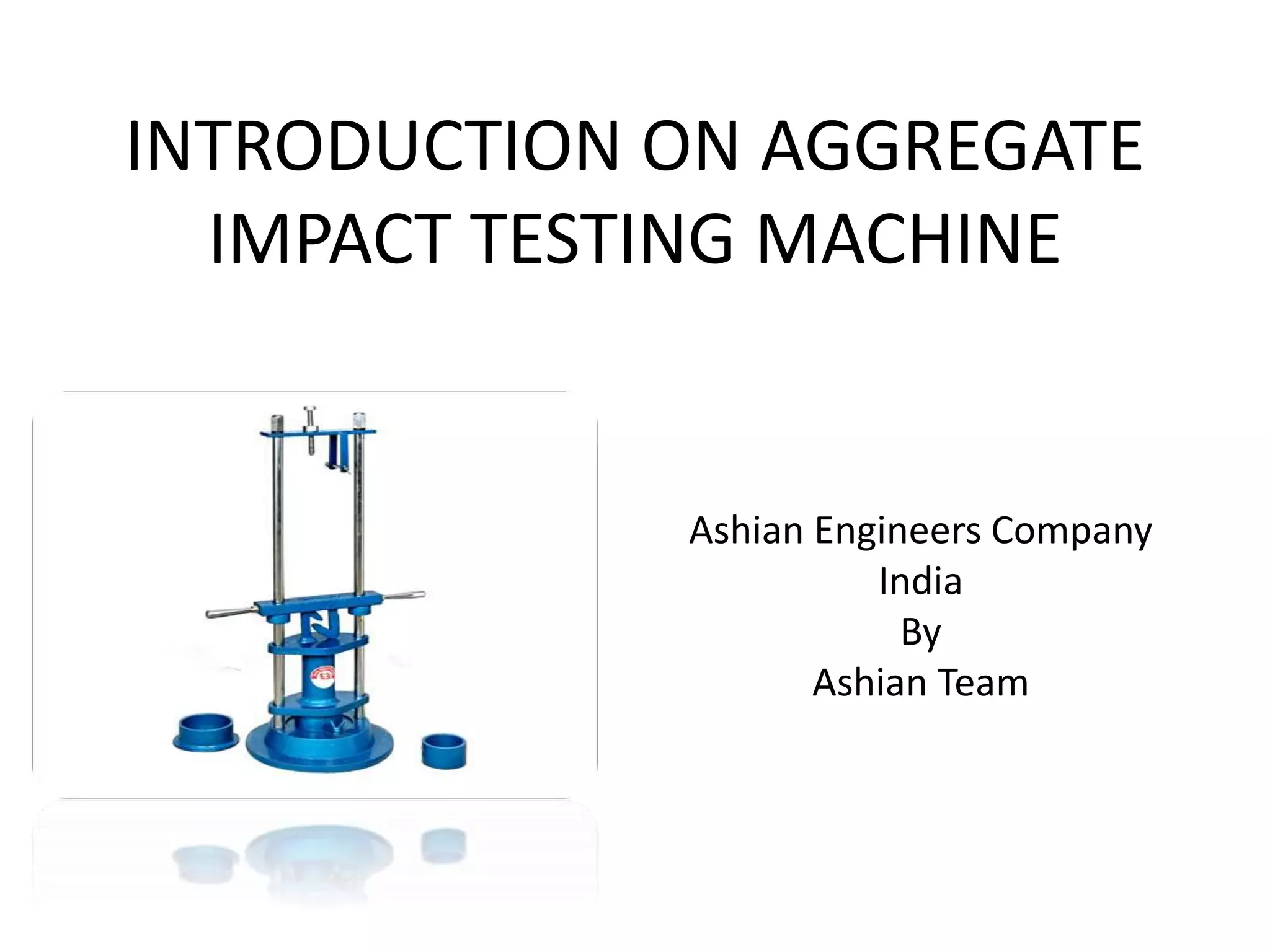
INTRODUCTION ON AGGREGATE
IMPACT TESTING MACHINE
Ashian Engineers Company
India
By
Ashian Team
Principal:
• Toughness is the property of a material to resist
impact. Due to traffic loads, the road stones are
subjected to the pounding action or impact and
there is possibility of stones breaking into smaller
pieces. The road stones should therefore be
tough enough to resist fracture under impact. A
test designed to evaluate the toughness of stones
i.e., the resistance of the stones to fracture under
repeated impacts may be called an impact test
for road stones.
Apparatus:
(a) Impact testing machine: The machine consists of a
metal base with a plane lower surface supported well
on a firm floor, without rocking.
(b) A cylindrical metal measure of 75mm dia. and 50mm
depth
(c) A tamping rod of 10mm circular cross section and
230mm length, rounded at one end
(d) IS Sieves of sizes - 12.5mm, 10mm and 2.36mm
(e) Oven: A thermostatically controlled drying oven
capable of maintaining constant temperature
between 100° c and 110° c
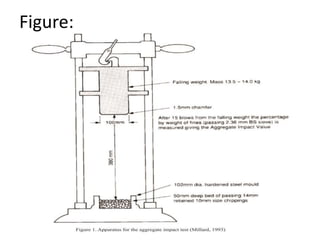
Figure:
Working
Preparation of sample
(i) The test sample should conform to the
following grading:
• Passing through 12.5mm IS Sieve 100%
• Retention on 10mm IS Sieve 100%
(ii) The sample should be oven-dried for 4hrs. at a
temperature of 100 to 110oC and cooled.
(iii) The measure should be about one-third full
with the prepared aggregates and tamped with
25 strokes of the tamping rod.
 Procedures
• The cup of the impact testing machine should be
fixed firmly in position on the base of the
machine and the whole of the test sample placed
in it and compacted by 25 strokes of the tamping
rod.
• The hammer should be raised to 380mm above
the upper surface of the aggregates in the cup
and allowed to fall freely onto the aggregates.
The test sample should be subjected to a total of
15 such blows, each being delivered at an interval
of not less than one second.
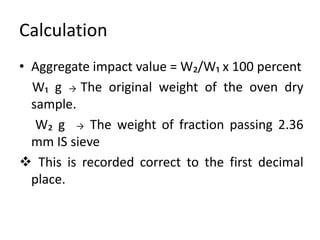
Calculation
• Aggregate impact value = W₂/W₁ x 100 percent
W₁ g → The original weight of the oven dry
sample.
W₂ g → The weight of fraction passing 2.36
mm IS sieve
 This is recorded correct to the first decimal
place.
THANK YOU

Introduction on aggregate impact testing machine ppt

  • 1.
    INTRODUCTION ON AGGREGATE IMPACTTESTING MACHINE Ashian Engineers Company India By Ashian Team
  • 2.
    Principal: • Toughness isthe property of a material to resist impact. Due to traffic loads, the road stones are subjected to the pounding action or impact and there is possibility of stones breaking into smaller pieces. The road stones should therefore be tough enough to resist fracture under impact. A test designed to evaluate the toughness of stones i.e., the resistance of the stones to fracture under repeated impacts may be called an impact test for road stones.
  • 3.
    Apparatus: (a) Impact testingmachine: The machine consists of a metal base with a plane lower surface supported well on a firm floor, without rocking. (b) A cylindrical metal measure of 75mm dia. and 50mm depth (c) A tamping rod of 10mm circular cross section and 230mm length, rounded at one end (d) IS Sieves of sizes - 12.5mm, 10mm and 2.36mm (e) Oven: A thermostatically controlled drying oven capable of maintaining constant temperature between 100° c and 110° c
  • 4.
  • 5.
    Working Preparation of sample (i)The test sample should conform to the following grading: • Passing through 12.5mm IS Sieve 100% • Retention on 10mm IS Sieve 100% (ii) The sample should be oven-dried for 4hrs. at a temperature of 100 to 110oC and cooled. (iii) The measure should be about one-third full with the prepared aggregates and tamped with 25 strokes of the tamping rod.
  • 6.
     Procedures • Thecup of the impact testing machine should be fixed firmly in position on the base of the machine and the whole of the test sample placed in it and compacted by 25 strokes of the tamping rod. • The hammer should be raised to 380mm above the upper surface of the aggregates in the cup and allowed to fall freely onto the aggregates. The test sample should be subjected to a total of 15 such blows, each being delivered at an interval of not less than one second.
  • 7.
    Calculation • Aggregate impactvalue = W₂/W₁ x 100 percent W₁ g → The original weight of the oven dry sample. W₂ g → The weight of fraction passing 2.36 mm IS sieve  This is recorded correct to the first decimal place.
  • 8.