HARDNESS TESTING M FACTS
SUMMER TOPIC
Follow us on
Facebook : www.facebook.com/metallurgical.f
Instagram: metallurgical facts
For any query mail us:
metallurgicalfacts@gmail.com
Incase of doubt you can message us on our facebook page.
Kindly give the feedback so that we can improve it more.
#STAY_CONNECTED
HARDNESS TESTING M FACTS
INTRODUCTION
 Hardness can be defined as the resistance of a material to indentation or abrasion by
another hard body.
 Hardness is resistance of material to plastic deformation caused by indentation.
 Good hardness generally means that the material is resistant to scratching and wear.
Types of quantitative hardness test
 Brinell Hardness Test
 Vickers Hardness Test
 Rockwell Hardness Test
 Meyer Hardness Test
 Micro Hardness Test
HARDNESS TESTING M FACTS
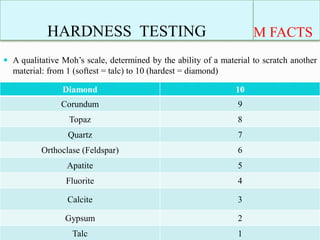
 A qualitative Moh’s scale, determined by the ability of a material to scratch another
material: from 1 (softest = talc) to 10 (hardest = diamond)
Diamond 10
Corundum 9
Topaz 8
Quartz 7
Orthoclase (Feldspar) 6
Apatite 5
Fluorite 4
Calcite 3
Gypsum 2
Talc 1
BRINELL HARDNESS TESTING M FACTS
 The Brinell hardness test consists in indenting the metal surface with a 10-mm
diameter steel ball at a load of 3,000 kg.
 For soft metals the load is reduced to 500 kg to avoid too deep an impression.
 For very hard metals Tungsten carbide ball can be used to minimize distortion of
the indenter.
 The load is applied for a standard time, usually 30 sec.
 The surface on which the indentation is made should be relatively smooth and free
from dirt or scale
BRINELL HARDNESS TESTING M FACTS
Brinell Test Method
 The indenter is pressed into the sample by an accurately controlled test force.
 It is important to choose the combination of load and ball size carefully so that the
indentation is free from distortion and suitable for measurement.
 The force is maintained for a specific time (max 30Sec.).
 After this time period, the indenter is removed leaving a round indent in the sample.
 The size of the indent is determined optically by measuring two diagonals of the
round indent using a optical microscope.
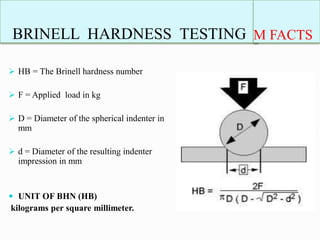
 The Brinell hardness number is a function of the test force divided by the curved
surface area of the indent.
BRINELL HARDNESS TESTING
 HB = The Brinell hardness number
 F = Applied load in kg
 D = Diameter of the spherical indenter in
mm
 d = Diameter of the resulting indenter
impression in mm
 UNIT OF BHN (HB)
kilograms per square millimeter.
M FACTS
BRINELL HARDNESS TESTING M FACTS
Advantages of Brinell hardness test
 Different loads are used to cover a wide range of hardness of commercial metals.
 Brinell hardness test is less influenced by surface scratches and roughness than other
hardness tests.
 A wide range of test forces and ball sizes to suit every application.
 Easy to operate the testing equipment.
BRINELL HARDNESS TESTING M FACTS
Limitations of Brinell hardness test
 The test has limitations on small specimens or in critically stressed parts where
indentation could be a possible site of failure.
 Error in Brinell hardness measurements occurs in measuring the diameter of the
impression.
 Indentation develops the residual stresses.
 Surface accuracy is needed for testing the metals.
VICKERS HARDNESS TESTING M FACTS
 The Vickers hardness test uses a square-base diamond pyramid as the indenter.
 This test is preferable to the Brinell test where hard materials are concerned, as it
uses a diamond indenter.
 The included angle between opposite faces of the pyramid is 136°
 The loads ordinarily used with this test range from 1 to 120 kg .
 Standard loads are 5, 10, 20, 30, 50 and 100 kg
 It is necessary to state the load when specifying a Vickers hardness number
For example, if the hardness number is found to be 200 when using a 50 kg load,
then the hardness number is written as HV (50) = 200.
VICKERS HARDNESS TESTING M FACTS
Vickers Hardness method
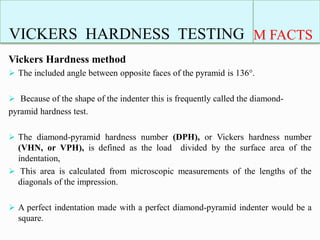
 The included angle between opposite faces of the pyramid is 136°.
 Because of the shape of the indenter this is frequently called the diamond-
pyramid hardness test.
 The diamond-pyramid hardness number (DPH), or Vickers hardness number
(VHN, or VPH), is defined as the load divided by the surface area of the
indentation,
 This area is calculated from microscopic measurements of the lengths of the
diagonals of the impression.
 A perfect indentation made with a perfect diamond-pyramid indenter would be a
square.
VICKERS HARDNESS TESTING M FACTS
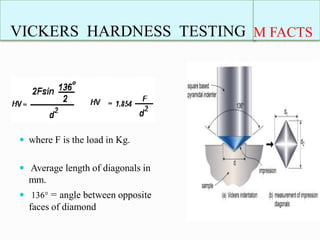
 where F is the load in Kg.
 Average length of diagonals in
mm.
 136° = angle between opposite
faces of diamond
VICKERS HARDNESS TESTING M FACTS
Advantages of Vickers hardness test
 The Vickers method can be used with any and all materials and test specimens, from
soft to hard.
 The procedure covers the entire hardness range.
 There is only one type of indenter, which can be used for all Vickers methods.
 Non-destructive testing is possible, so the test specimen can be used for other
purposes
VICKERS HARDNESS TESTING M FACTS
Limitations of Vickers hardness test
 The test location must be prepared (ground and polished), otherwise precise
evaluation is difficult.
 The process is rather slow (compared with the Rockwell method The test cycle takes
somewhere between 30 and 60 seconds, not including the time taken to prepare the
specimen.
 Allows greater chance for personal error in the determination of the diagonal length
ROCKWELL HARDNESS TESTING M FACTS
 This test utilizes the depth of indentation, under constant load, as a measure of
hardness.
 A 120° diamond cone with a slightly rounded point, called a Brale indenter, and
1/16 and 1/8 inch -diameter steel balls are generally used as indenters.
 Major loads of 60, 100, and 150 kg are used.
 The Rockwell hardness is dependent on the load and indenter, it is necessary to
specify the combination which is used.
 The hardness number is expressed by the symbol HR and the scale designation
 A Rockwell hardness number without the letter prefix is meaningless
ROCKWELL HARDNESS TESTING M FACTS
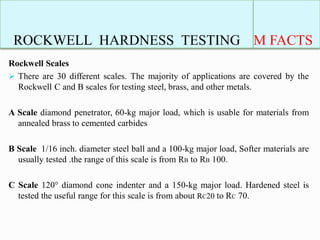
Rockwell Scales
 There are 30 different scales. The majority of applications are covered by the
Rockwell C and B scales for testing steel, brass, and other metals.
A Scale diamond penetrator, 60-kg major load, which is usable for materials from
annealed brass to cemented carbides
B Scale 1/16 inch. diameter steel ball and a 100-kg major load, Softer materials are
usually tested .the range of this scale is from RB to RB 100.
C Scale 120° diamond cone indenter and a 150-kg major load. Hardened steel is
tested the useful range for this scale is from about RC20 to RC 70.
ROCKWELL HARDNESS TESTING M FACTS
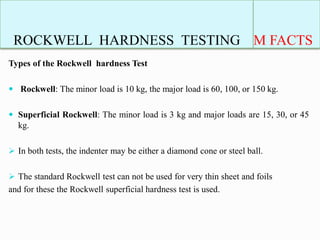
Types of the Rockwell hardness Test
 Rockwell: The minor load is 10 kg, the major load is 60, 100, or 150 kg.
 Superficial Rockwell: The minor load is 3 kg and major loads are 15, 30, or 45
kg.
 In both tests, the indenter may be either a diamond cone or steel ball.
 The standard Rockwell test can not be used for very thin sheet and foils
and for these the Rockwell superficial hardness test is used.
ROCKWELL HARDNESS TESTING M FACTS
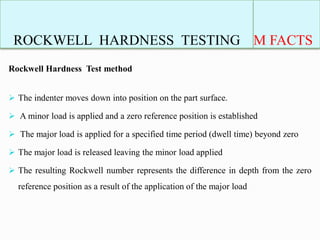
Rockwell Hardness Test method
 The indenter moves down into position on the part surface.
 A minor load is applied and a zero reference position is established
 The major load is applied for a specified time period (dwell time) beyond zero
 The major load is released leaving the minor load applied
 The resulting Rockwell number represents the difference in depth from the zero
reference position as a result of the application of the major load
ROCKWELL HARDNESS TESTING M FACTS
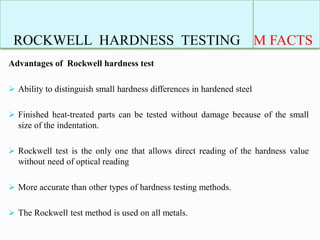
Advantages of Rockwell hardness test
 Ability to distinguish small hardness differences in hardened steel
 Finished heat-treated parts can be tested without damage because of the small
size of the indentation.
 Rockwell test is the only one that allows direct reading of the hardness value
without need of optical reading
 More accurate than other types of hardness testing methods.
 The Rockwell test method is used on all metals.
ROCKWELL HARDNESS TESTING M FACTS
Limitations of Rockwell hardness test
 The possibility of errors due to shifting of samples under test loads during the
test cycle.
 Rockwell scale suitable for testing of cast iron or of steel sheets having a
thickness lower than 0.15 mm does not exist.
 The tests should not be performed closer to the edge of the specimen.
 Quality of indenter influences the test results more.
MEYER HARDNESS TESTING M FACTS
 The Meyer hardness is a more fundamental measure of indentation hardness.
 Based on the 'projected area of the surface area.
 The principle is that the mean pressure required to test the material is the
measurement of the hardness of the material
 For a cold-worked material the Meyer hardness is essentially constant and
independent of load.
 For an annealed metal the Meyer hardness increases continuously with the load
because of strain hardening produced by the indentation.
MEYER HARDNESS TESTING
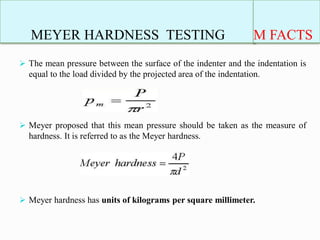
 The mean pressure between the surface of the indenter and the indentation is
equal to the load divided by the projected area of the indentation.
 Meyer proposed that this mean pressure should be taken as the measure of
hardness. It is referred to as the Meyer hardness.
 Meyer hardness has units of kilograms per square millimeter.
M FACTS
MICRO HARDNESS TESTING M FACTS
 Many metallurgical problems require the determination of hardness over very
small areas.
 The measurement of the hardness gradient at a carburized surface, the
determination of the hardness of individual constituents of a microstructure, or the
checking of the hardness of a delicate watch gear might be typical problems.
 For this purpose an indentation-hardness test has been found to be more useful.
 The development of the Knoop indenter and the introduction of the Tukon tester
for the controlled application of loads down to 25 g have made micro hardness
testing a routine laboratory procedure.
KNOOP HARDNESS TESTING M FACTS
 The Knoop indenter is a diamond ground to a pyramidal form(172°).
 Produces a diamond-shaped indentation with the long and short diagonals in the
approximate ratio of 7: 1.
 The depth of indentation is about one- thirtieth of the length of the longer
diagonal.
 The long diagonal of the Knoop impression is essentially unaffected by elastic
recovery for loads greater than about 300 g.
 It is usually observed that the Knoop hardness number increases as the load is
decreased below about 300 g.
KNOOP HARDNESS TESTING
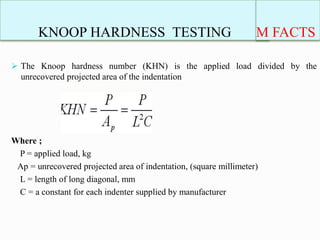
 The Knoop hardness number (KHN) is the applied load divided by the
unrecovered projected area of the indentation
Where ;
P = applied load, kg
Ap = unrecovered projected area of indentation, (square millimeter)
L = length of long diagonal, mm
C = a constant for each indenter supplied by manufacturer
M FACTS
Stay connected
Thank you
M FACTS

Hardness Testing

  • 1.
    HARDNESS TESTING MFACTS SUMMER TOPIC Follow us on Facebook : www.facebook.com/metallurgical.f Instagram: metallurgical facts For any query mail us: metallurgicalfacts@gmail.com Incase of doubt you can message us on our facebook page. Kindly give the feedback so that we can improve it more. #STAY_CONNECTED
  • 2.
    HARDNESS TESTING MFACTS INTRODUCTION  Hardness can be defined as the resistance of a material to indentation or abrasion by another hard body.  Hardness is resistance of material to plastic deformation caused by indentation.  Good hardness generally means that the material is resistant to scratching and wear. Types of quantitative hardness test  Brinell Hardness Test  Vickers Hardness Test  Rockwell Hardness Test  Meyer Hardness Test  Micro Hardness Test
  • 3.
    HARDNESS TESTING MFACTS  A qualitative Moh’s scale, determined by the ability of a material to scratch another material: from 1 (softest = talc) to 10 (hardest = diamond) Diamond 10 Corundum 9 Topaz 8 Quartz 7 Orthoclase (Feldspar) 6 Apatite 5 Fluorite 4 Calcite 3 Gypsum 2 Talc 1
  • 4.
    BRINELL HARDNESS TESTINGM FACTS  The Brinell hardness test consists in indenting the metal surface with a 10-mm diameter steel ball at a load of 3,000 kg.  For soft metals the load is reduced to 500 kg to avoid too deep an impression.  For very hard metals Tungsten carbide ball can be used to minimize distortion of the indenter.  The load is applied for a standard time, usually 30 sec.  The surface on which the indentation is made should be relatively smooth and free from dirt or scale
  • 5.
    BRINELL HARDNESS TESTINGM FACTS Brinell Test Method  The indenter is pressed into the sample by an accurately controlled test force.  It is important to choose the combination of load and ball size carefully so that the indentation is free from distortion and suitable for measurement.  The force is maintained for a specific time (max 30Sec.).  After this time period, the indenter is removed leaving a round indent in the sample.  The size of the indent is determined optically by measuring two diagonals of the round indent using a optical microscope.  The Brinell hardness number is a function of the test force divided by the curved surface area of the indent.
  • 6.
    BRINELL HARDNESS TESTING HB = The Brinell hardness number  F = Applied load in kg  D = Diameter of the spherical indenter in mm  d = Diameter of the resulting indenter impression in mm  UNIT OF BHN (HB) kilograms per square millimeter. M FACTS
  • 7.
    BRINELL HARDNESS TESTINGM FACTS Advantages of Brinell hardness test  Different loads are used to cover a wide range of hardness of commercial metals.  Brinell hardness test is less influenced by surface scratches and roughness than other hardness tests.  A wide range of test forces and ball sizes to suit every application.  Easy to operate the testing equipment.
  • 8.
    BRINELL HARDNESS TESTINGM FACTS Limitations of Brinell hardness test  The test has limitations on small specimens or in critically stressed parts where indentation could be a possible site of failure.  Error in Brinell hardness measurements occurs in measuring the diameter of the impression.  Indentation develops the residual stresses.  Surface accuracy is needed for testing the metals.
  • 9.
    VICKERS HARDNESS TESTINGM FACTS  The Vickers hardness test uses a square-base diamond pyramid as the indenter.  This test is preferable to the Brinell test where hard materials are concerned, as it uses a diamond indenter.  The included angle between opposite faces of the pyramid is 136°  The loads ordinarily used with this test range from 1 to 120 kg .  Standard loads are 5, 10, 20, 30, 50 and 100 kg  It is necessary to state the load when specifying a Vickers hardness number For example, if the hardness number is found to be 200 when using a 50 kg load, then the hardness number is written as HV (50) = 200.
  • 10.
    VICKERS HARDNESS TESTINGM FACTS Vickers Hardness method  The included angle between opposite faces of the pyramid is 136°.  Because of the shape of the indenter this is frequently called the diamond- pyramid hardness test.  The diamond-pyramid hardness number (DPH), or Vickers hardness number (VHN, or VPH), is defined as the load divided by the surface area of the indentation,  This area is calculated from microscopic measurements of the lengths of the diagonals of the impression.  A perfect indentation made with a perfect diamond-pyramid indenter would be a square.
  • 11.
    VICKERS HARDNESS TESTINGM FACTS  where F is the load in Kg.  Average length of diagonals in mm.  136° = angle between opposite faces of diamond
  • 12.
    VICKERS HARDNESS TESTINGM FACTS Advantages of Vickers hardness test  The Vickers method can be used with any and all materials and test specimens, from soft to hard.  The procedure covers the entire hardness range.  There is only one type of indenter, which can be used for all Vickers methods.  Non-destructive testing is possible, so the test specimen can be used for other purposes
  • 13.
    VICKERS HARDNESS TESTINGM FACTS Limitations of Vickers hardness test  The test location must be prepared (ground and polished), otherwise precise evaluation is difficult.  The process is rather slow (compared with the Rockwell method The test cycle takes somewhere between 30 and 60 seconds, not including the time taken to prepare the specimen.  Allows greater chance for personal error in the determination of the diagonal length
  • 14.
    ROCKWELL HARDNESS TESTINGM FACTS  This test utilizes the depth of indentation, under constant load, as a measure of hardness.  A 120° diamond cone with a slightly rounded point, called a Brale indenter, and 1/16 and 1/8 inch -diameter steel balls are generally used as indenters.  Major loads of 60, 100, and 150 kg are used.  The Rockwell hardness is dependent on the load and indenter, it is necessary to specify the combination which is used.  The hardness number is expressed by the symbol HR and the scale designation  A Rockwell hardness number without the letter prefix is meaningless
  • 15.
    ROCKWELL HARDNESS TESTINGM FACTS Rockwell Scales  There are 30 different scales. The majority of applications are covered by the Rockwell C and B scales for testing steel, brass, and other metals. A Scale diamond penetrator, 60-kg major load, which is usable for materials from annealed brass to cemented carbides B Scale 1/16 inch. diameter steel ball and a 100-kg major load, Softer materials are usually tested .the range of this scale is from RB to RB 100. C Scale 120° diamond cone indenter and a 150-kg major load. Hardened steel is tested the useful range for this scale is from about RC20 to RC 70.
  • 16.
    ROCKWELL HARDNESS TESTINGM FACTS Types of the Rockwell hardness Test  Rockwell: The minor load is 10 kg, the major load is 60, 100, or 150 kg.  Superficial Rockwell: The minor load is 3 kg and major loads are 15, 30, or 45 kg.  In both tests, the indenter may be either a diamond cone or steel ball.  The standard Rockwell test can not be used for very thin sheet and foils and for these the Rockwell superficial hardness test is used.
  • 17.
    ROCKWELL HARDNESS TESTINGM FACTS Rockwell Hardness Test method  The indenter moves down into position on the part surface.  A minor load is applied and a zero reference position is established  The major load is applied for a specified time period (dwell time) beyond zero  The major load is released leaving the minor load applied  The resulting Rockwell number represents the difference in depth from the zero reference position as a result of the application of the major load
  • 18.
    ROCKWELL HARDNESS TESTINGM FACTS Advantages of Rockwell hardness test  Ability to distinguish small hardness differences in hardened steel  Finished heat-treated parts can be tested without damage because of the small size of the indentation.  Rockwell test is the only one that allows direct reading of the hardness value without need of optical reading  More accurate than other types of hardness testing methods.  The Rockwell test method is used on all metals.
  • 19.
    ROCKWELL HARDNESS TESTINGM FACTS Limitations of Rockwell hardness test  The possibility of errors due to shifting of samples under test loads during the test cycle.  Rockwell scale suitable for testing of cast iron or of steel sheets having a thickness lower than 0.15 mm does not exist.  The tests should not be performed closer to the edge of the specimen.  Quality of indenter influences the test results more.
  • 20.
    MEYER HARDNESS TESTINGM FACTS  The Meyer hardness is a more fundamental measure of indentation hardness.  Based on the 'projected area of the surface area.  The principle is that the mean pressure required to test the material is the measurement of the hardness of the material  For a cold-worked material the Meyer hardness is essentially constant and independent of load.  For an annealed metal the Meyer hardness increases continuously with the load because of strain hardening produced by the indentation.
  • 21.
    MEYER HARDNESS TESTING The mean pressure between the surface of the indenter and the indentation is equal to the load divided by the projected area of the indentation.  Meyer proposed that this mean pressure should be taken as the measure of hardness. It is referred to as the Meyer hardness.  Meyer hardness has units of kilograms per square millimeter. M FACTS
  • 22.
    MICRO HARDNESS TESTINGM FACTS  Many metallurgical problems require the determination of hardness over very small areas.  The measurement of the hardness gradient at a carburized surface, the determination of the hardness of individual constituents of a microstructure, or the checking of the hardness of a delicate watch gear might be typical problems.  For this purpose an indentation-hardness test has been found to be more useful.  The development of the Knoop indenter and the introduction of the Tukon tester for the controlled application of loads down to 25 g have made micro hardness testing a routine laboratory procedure.
  • 23.
    KNOOP HARDNESS TESTINGM FACTS  The Knoop indenter is a diamond ground to a pyramidal form(172°).  Produces a diamond-shaped indentation with the long and short diagonals in the approximate ratio of 7: 1.  The depth of indentation is about one- thirtieth of the length of the longer diagonal.  The long diagonal of the Knoop impression is essentially unaffected by elastic recovery for loads greater than about 300 g.  It is usually observed that the Knoop hardness number increases as the load is decreased below about 300 g.
  • 24.
    KNOOP HARDNESS TESTING The Knoop hardness number (KHN) is the applied load divided by the unrecovered projected area of the indentation Where ; P = applied load, kg Ap = unrecovered projected area of indentation, (square millimeter) L = length of long diagonal, mm C = a constant for each indenter supplied by manufacturer M FACTS
  • 25.