HARDNESS TEST
HARDNESS TEST
What is Hardness Test ?
• One if the mechanical properties that may be important to consider is hardness
which is a measure of material’s resistance to localized plastic deformation
• There are two method of the most common Hardness Test Recently, Brinnel
Hardness Test and Rockwell Hardness Test.
Brinell Hardness Test
The brinell scale characterizes the
indentation hardness of materials
through the scale of penetration of
an indenter, loaded on the material
test pieces. It is one of several
definitions of hardness in material
science.
The typical test Uses a 10 milimeters
diameter steel ball as an indenter
Basic Principle Of Brinell
Hardness Test
•A spherical indenter (1 cm
diameter) is shot with desired
load force at the target
• Frequently the indenter is steel,
but for harder materials it is
replaced with a tungsten
carbide sphere
• After the indenter ball is
applied to the specimen, the
The diameter of the indentation
is recorded
• The indentation diameter can
be correlated with the Brinell
Hardness Number (BHN).
Basic Prinsiple Of Brinell
Hardness Test
• Large hardness means : resistance to plastic deformation or
cracking in compression
• Better wear properties
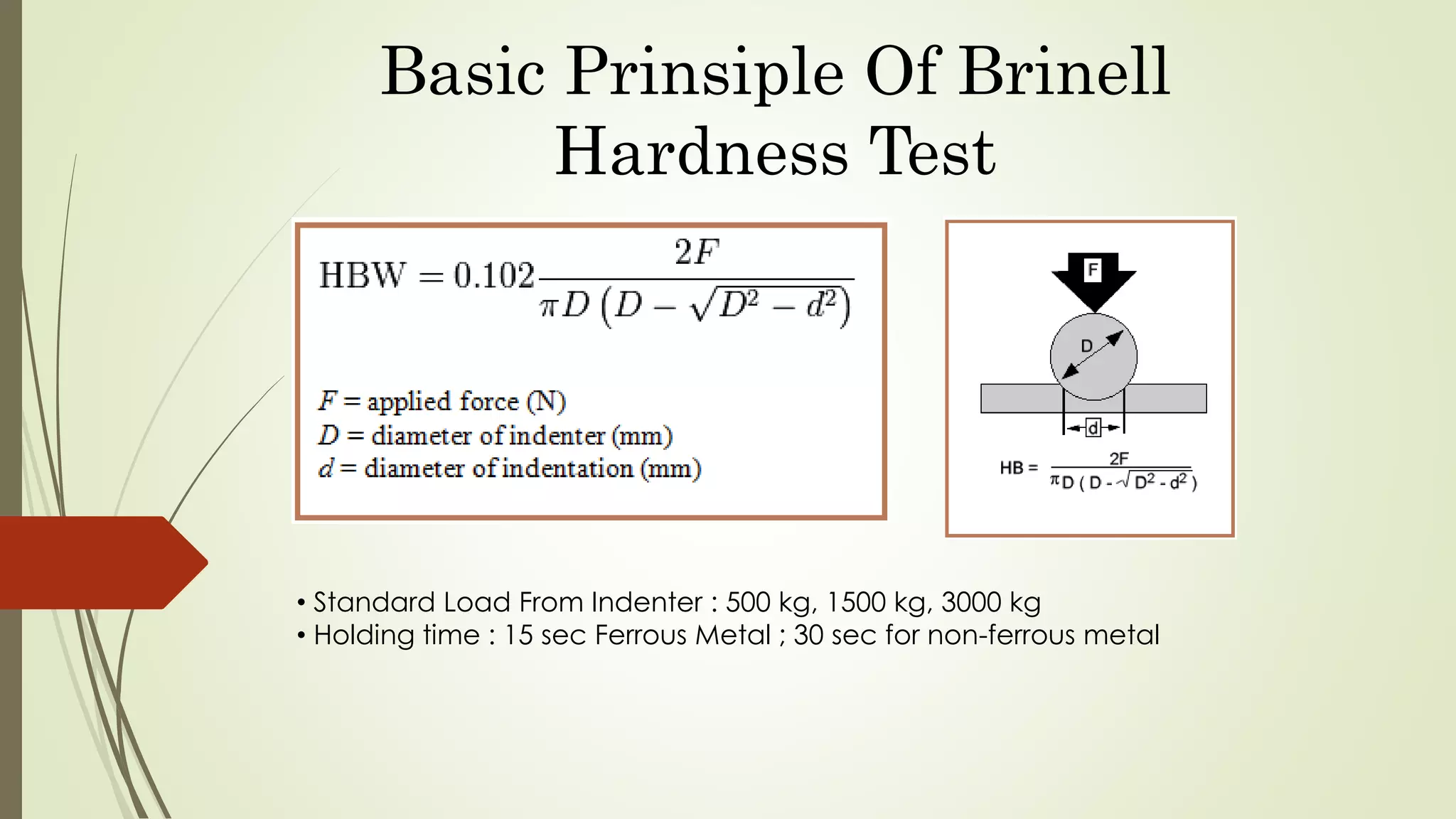
• Standard Load From Indenter : 500 kg, 1500 kg, 3000 kg
• Holding time : 15 sec Ferrous Metal ; 30 sec for non-ferrous metal
Basic Prinsiple Of Brinell
Hardness Test
Rockwell Hardness Test
• The rockwell scale is hardness
scale based on indentation
hardness of material.
• There are different scales,
denoted by single letter, that
use different loads or indenters
Basic Prinsiple of
Rockwell Hardness Test
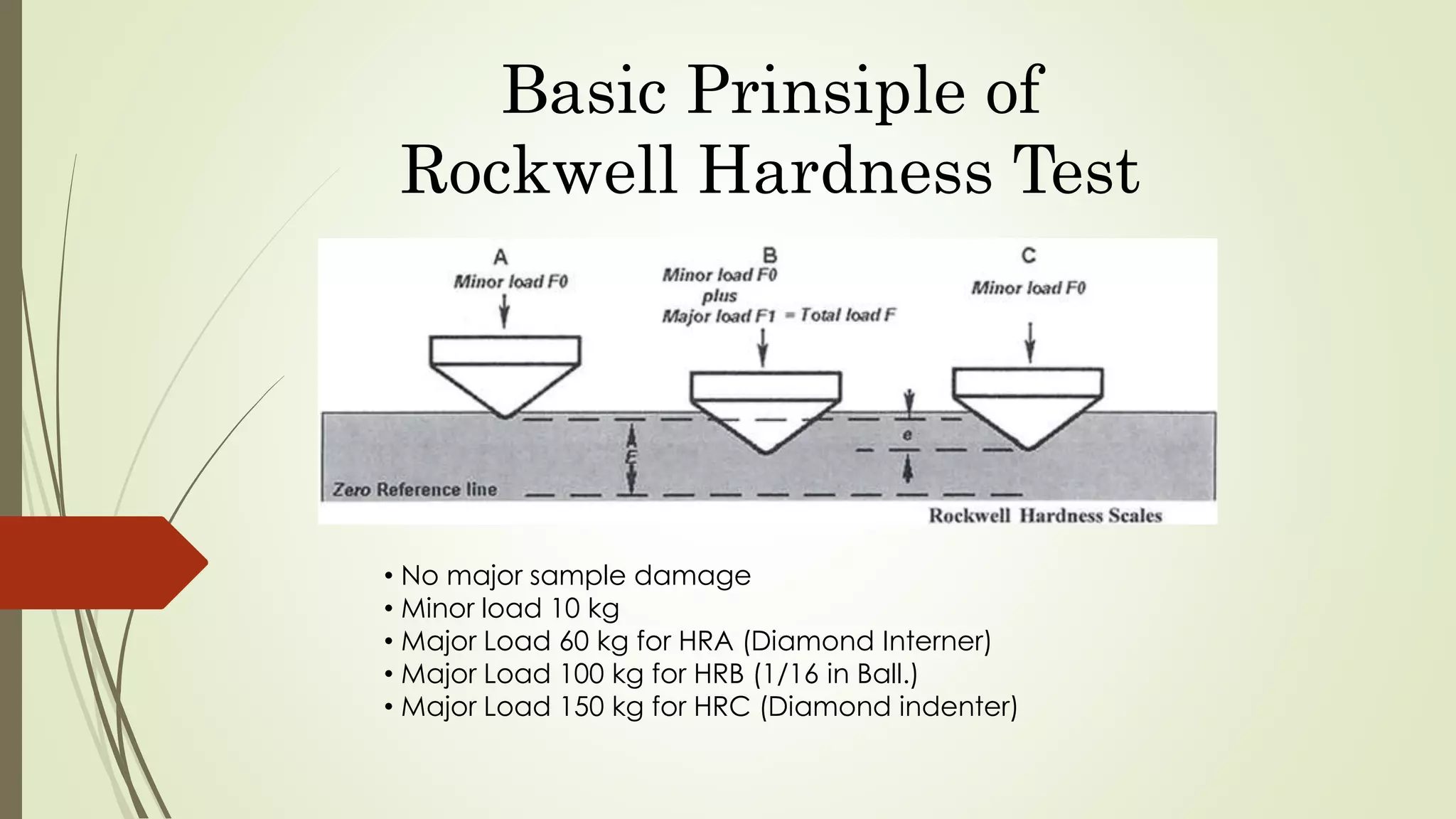
• No major sample damage
• Minor load 10 kg
• Major Load 60 kg for HRA (Diamond Interner)
• Major Load 100 kg for HRB (1/16 in Ball.)
• Major Load 150 kg for HRC (Diamond indenter)
Basic Principle of
Rockwell Hardness Test
• HR = E – e
• F0 = preliminary minor load in kgf
• F1 = additional major load in kgf
• F = total load in kgf
• e = permanent increase in depth of penetration due to major load F1
• E = a constant depending on form of indenter: 100 units for diamond
indenter, 130 units for steel ball indenter
• HR = Rockwell hardness number
• D = diameter of steel ball
Rockwell Hardness
Indenter Scale
ASTM 370
Thank You

Hardness test

  • 1.
  • 2.
    HARDNESS TEST What isHardness Test ? • One if the mechanical properties that may be important to consider is hardness which is a measure of material’s resistance to localized plastic deformation • There are two method of the most common Hardness Test Recently, Brinnel Hardness Test and Rockwell Hardness Test.
  • 3.
    Brinell Hardness Test Thebrinell scale characterizes the indentation hardness of materials through the scale of penetration of an indenter, loaded on the material test pieces. It is one of several definitions of hardness in material science. The typical test Uses a 10 milimeters diameter steel ball as an indenter
  • 4.
    Basic Principle OfBrinell Hardness Test •A spherical indenter (1 cm diameter) is shot with desired load force at the target • Frequently the indenter is steel, but for harder materials it is replaced with a tungsten carbide sphere • After the indenter ball is applied to the specimen, the The diameter of the indentation is recorded • The indentation diameter can be correlated with the Brinell Hardness Number (BHN).
  • 5.
    Basic Prinsiple OfBrinell Hardness Test • Large hardness means : resistance to plastic deformation or cracking in compression • Better wear properties
  • 6.
    • Standard LoadFrom Indenter : 500 kg, 1500 kg, 3000 kg • Holding time : 15 sec Ferrous Metal ; 30 sec for non-ferrous metal Basic Prinsiple Of Brinell Hardness Test
  • 7.
    Rockwell Hardness Test •The rockwell scale is hardness scale based on indentation hardness of material. • There are different scales, denoted by single letter, that use different loads or indenters
  • 8.
    Basic Prinsiple of RockwellHardness Test • No major sample damage • Minor load 10 kg • Major Load 60 kg for HRA (Diamond Interner) • Major Load 100 kg for HRB (1/16 in Ball.) • Major Load 150 kg for HRC (Diamond indenter)
  • 9.
    Basic Principle of RockwellHardness Test • HR = E – e • F0 = preliminary minor load in kgf • F1 = additional major load in kgf • F = total load in kgf • e = permanent increase in depth of penetration due to major load F1 • E = a constant depending on form of indenter: 100 units for diamond indenter, 130 units for steel ball indenter • HR = Rockwell hardness number • D = diameter of steel ball
  • 10.
  • 11.
  • 12.