PRESENTED BY ……..
Topi
c
Fabric Tensile Strength Test.
 Definition of Tensile Strength :
• Tensile strength is defined as a stress, which is measured as force
per unit area. Maximum load that a material can support without
fracture when being stretched, divided by the original cross -
sectional area of the material.
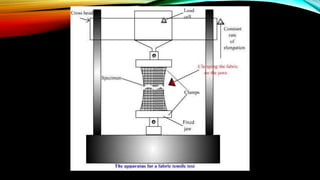
 MODES OF TENSILE TESTING MACHINE
There are two modes of tensile testing machine which are…
1. Constant- rate- of- extension (CRE)
2. Constant- rate- of- load (CRL)
 Constant- rate- of- extension (CRE) : Constant rate of extension is
the rate of increase of specimen length is uniform with time.
 Constant- rate- of- load (CRL) : Constant rate of load is the rate
of increase the load is uniform with time and the specimen is free
to elongate.
• The most commonly used mode is the CRE mode for tensile
strength test.
 Methods of measure Tensile Strength is…
• 1. STRIP TEST
• 2. GRAB TEST
 STRIP TEST :
• Sample size :
• Length = 8”
• Width = 2” (from 2.5” removing threads from both edges until the
width has been reduced to 2 inch).
• The specimen will be mounted centrally, securely gripped along the
full width to prevent slipping.
• The load is applied uniformly across the full specimen width.
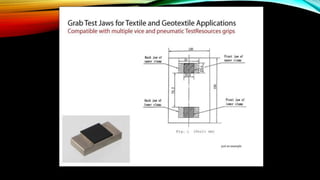
 GRAB TEST :
• Sample size :
• Length = 6” (150 mm)
• Width = 4” (100 mm)
• Jaws width = 1” (25 mm)
• Gauge length = 3” (75 mm)
The speed is adjusted so that the sample is broken in 20 +/- second.
 Factors affecting the Tensile strength :
• 1. Number of test specimen.
• 2. Gauge length.
• 3. Extension rate.
• 4. Jaws or Grips.
Fabric tensile strength test

Fabric tensile strength test

  • 2.
  • 3.
  • 4.
     Definition ofTensile Strength : • Tensile strength is defined as a stress, which is measured as force per unit area. Maximum load that a material can support without fracture when being stretched, divided by the original cross - sectional area of the material.
  • 5.
     MODES OFTENSILE TESTING MACHINE There are two modes of tensile testing machine which are… 1. Constant- rate- of- extension (CRE) 2. Constant- rate- of- load (CRL)
  • 6.
     Constant- rate-of- extension (CRE) : Constant rate of extension is the rate of increase of specimen length is uniform with time.  Constant- rate- of- load (CRL) : Constant rate of load is the rate of increase the load is uniform with time and the specimen is free to elongate. • The most commonly used mode is the CRE mode for tensile strength test.
  • 7.
     Methods ofmeasure Tensile Strength is… • 1. STRIP TEST • 2. GRAB TEST
  • 8.
     STRIP TEST: • Sample size : • Length = 8” • Width = 2” (from 2.5” removing threads from both edges until the width has been reduced to 2 inch). • The specimen will be mounted centrally, securely gripped along the full width to prevent slipping. • The load is applied uniformly across the full specimen width.
  • 10.
     GRAB TEST: • Sample size : • Length = 6” (150 mm) • Width = 4” (100 mm) • Jaws width = 1” (25 mm) • Gauge length = 3” (75 mm) The speed is adjusted so that the sample is broken in 20 +/- second.
  • 12.
     Factors affectingthe Tensile strength : • 1. Number of test specimen. • 2. Gauge length. • 3. Extension rate. • 4. Jaws or Grips.