VICKERS HARDNESS TEST
By
Dr. K. Senthilarasan,
Assistant professor ,
Department of Physics
E.G.S Pillay Arts & Science College,
Nagapattinam.
VICKERS HARDNESS TEST
 The test makes the use of a diamond square
based pyramid indenter with 136 angles between
the opposite faces.
 The load range is variable from 5 to 120 kg in
steps of 5 kg.
 It provides a continuous scale of hardness and
so it is widely accepted for research works.
 Vickers hardness testing machine is somewhat
similar to the Brinell hardness testing machine.
 A piston and dashpot of oil is used for
controlling the rate and duration of the loading.
 The test is performed by placing the specimen
on the anvil and is raised till it close to the
indenter point.
 The load is then gradually applied to the
indenter and then removed. The loading time is
about 20 seconds. After the anvil is lowered a
microscope is swung over the specimen.
 The diagonal of the square indentation is
measured to an accuracy of 0.001 mm.
Vickers hardness number
𝑉. 𝐻. 𝑁 =
𝑃
𝐴
=
2 𝑃 𝑆𝑖𝑛 /2
𝑑2
= 1.8544
𝑃
𝑑2
P= applied load in kg
A= surface area of indentation in sq.mm
D= length of diagonal in mm
= angle between opposite faces of diamond pyramid
(136)
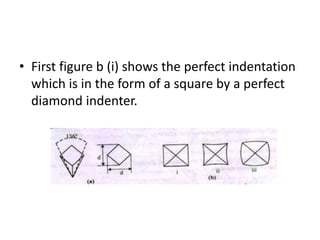
• First figure b (i) shows the perfect indentation
which is in the form of a square by a perfect
diamond indenter.
• The pincushion indentation is observed with
annealed metals and result in an overestimates of the
diagonal length. This is due to sinking in of the metal
around the flat faces of the pyramid.
• The barrel shaped indentation is found in cold
worked metals. It results from ridging or piling up of
the metal around the faces of the indenter. The
diagonal measurement in this case produces a low
value of the contact area so that hardness numbers are
higher than we expected. But empirical correction for
these effects is available.
Advantages:
The indentations always have the same shape whatever
be the load. This makes the measurement independent
of load
The hardness of hardened steel or soft materials can be
determined using large or small load respectively.
This test is very useful for testing hardness of polished
or nitrides surface due to small impression made on
the test.
This test is accurate and is suitable for metals as thin
as 0.15mm.
Hardness at elevated temperatures can be determined
using Vickers Hot hardness tester in which the indenter
is made of sapphire. Hardness is decreased
exponentially with absolute temperature of the
material H=Ae-BT where, A, B are constants.
Disadvantage:
It takes more time for each measurement and so it is not
suitable for industries.
When irregularities are present then the measurement taken
by Vickers shows more deviation than those of Brinell test.
Thank you

Vicker hardness test

  • 1.
    VICKERS HARDNESS TEST By Dr.K. Senthilarasan, Assistant professor , Department of Physics E.G.S Pillay Arts & Science College, Nagapattinam.
  • 2.
    VICKERS HARDNESS TEST The test makes the use of a diamond square based pyramid indenter with 136 angles between the opposite faces.  The load range is variable from 5 to 120 kg in steps of 5 kg.  It provides a continuous scale of hardness and so it is widely accepted for research works.  Vickers hardness testing machine is somewhat similar to the Brinell hardness testing machine.
  • 3.
     A pistonand dashpot of oil is used for controlling the rate and duration of the loading.  The test is performed by placing the specimen on the anvil and is raised till it close to the indenter point.  The load is then gradually applied to the indenter and then removed. The loading time is about 20 seconds. After the anvil is lowered a microscope is swung over the specimen.  The diagonal of the square indentation is measured to an accuracy of 0.001 mm.
  • 4.
    Vickers hardness number 𝑉.𝐻. 𝑁 = 𝑃 𝐴 = 2 𝑃 𝑆𝑖𝑛 /2 𝑑2 = 1.8544 𝑃 𝑑2 P= applied load in kg A= surface area of indentation in sq.mm D= length of diagonal in mm = angle between opposite faces of diamond pyramid (136)
  • 5.
    • First figureb (i) shows the perfect indentation which is in the form of a square by a perfect diamond indenter.
  • 6.
    • The pincushionindentation is observed with annealed metals and result in an overestimates of the diagonal length. This is due to sinking in of the metal around the flat faces of the pyramid. • The barrel shaped indentation is found in cold worked metals. It results from ridging or piling up of the metal around the faces of the indenter. The diagonal measurement in this case produces a low value of the contact area so that hardness numbers are higher than we expected. But empirical correction for these effects is available.
  • 7.
    Advantages: The indentations alwayshave the same shape whatever be the load. This makes the measurement independent of load The hardness of hardened steel or soft materials can be determined using large or small load respectively. This test is very useful for testing hardness of polished or nitrides surface due to small impression made on the test. This test is accurate and is suitable for metals as thin as 0.15mm. Hardness at elevated temperatures can be determined using Vickers Hot hardness tester in which the indenter is made of sapphire. Hardness is decreased exponentially with absolute temperature of the material H=Ae-BT where, A, B are constants.
  • 8.
    Disadvantage: It takes moretime for each measurement and so it is not suitable for industries. When irregularities are present then the measurement taken by Vickers shows more deviation than those of Brinell test.
  • 9.