Material Testing Lab Equipments
(nh.cvl.engineer@gmail.com)
Description
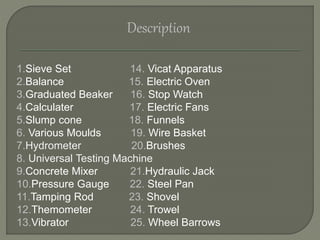
1.Sieve Set 14. Vicat Apparatus
2.Balance 15. Electric Oven
3.Graduated Beaker 16. Stop Watch
4.Calculater 17. Electric Fans
5.Slump cone 18. Funnels
6. Various Moulds 19. Wire Basket
7.Hydrometer 20.Brushes
8. Universal Testing Machine
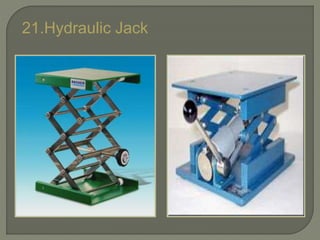
9.Concrete Mixer 21.Hydraulic Jack
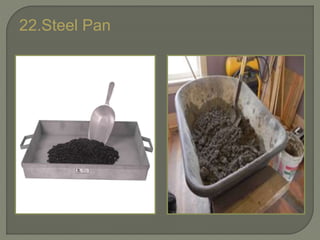
10.Pressure Gauge 22. Steel Pan
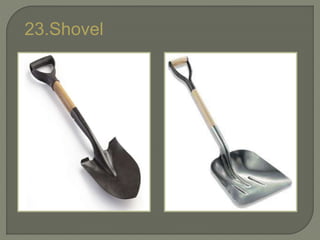
11.Tamping Rod 23. Shovel
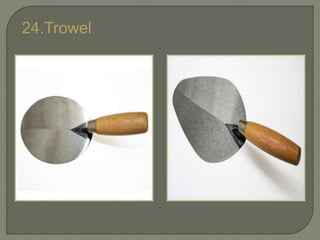
12.Themometer 24. Trowel
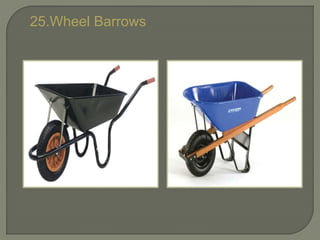
13.Vibrator 25. Wheel Barrows
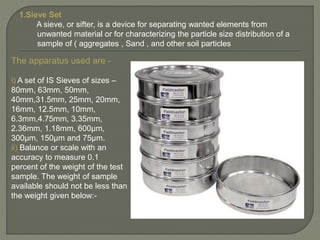
1.Sieve Set
A sieve, or sifter, is a device for separating wanted elements from
unwanted material or for characterizing the particle size distribution of a
sample of ( aggregates , Sand , and other soil particles
The apparatus used are -
i) A set of IS Sieves of sizes –
80mm, 63mm, 50mm,
40mm,31.5mm, 25mm, 20mm,
16mm, 12.5mm, 10mm,
6.3mm,4.75mm, 3.35mm,
2.36mm, 1.18mm, 600µm,
300µm, 150µm and 75µm.
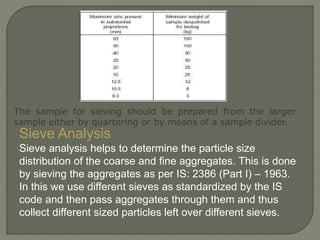
ii) Balance or scale with an
accuracy to measure 0.1
percent of the weight of the test
sample. The weight of sample
available should not be less than
the weight given below:-
Sieve Analysis
Sieve analysis helps to determine the particle size
distribution of the coarse and fine aggregates. This is done
by sieving the aggregates as per IS: 2386 (Part I) – 1963.
In this we use different sieves as standardized by the IS
code and then pass aggregates through them and thus
collect different sized particles left over different sieves.
The sample for sieving should be prepared from the larger
sample either by quartering or by means of a sample divider.
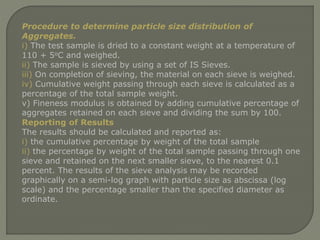
Procedure to determine particle size distribution of
Aggregates.
i) The test sample is dried to a constant weight at a temperature of
110 + 5oC and weighed.
ii) The sample is sieved by using a set of IS Sieves.
iii) On completion of sieving, the material on each sieve is weighed.
iv) Cumulative weight passing through each sieve is calculated as a
percentage of the total sample weight.
v) Fineness modulus is obtained by adding cumulative percentage of
aggregates retained on each sieve and dividing the sum by 100.
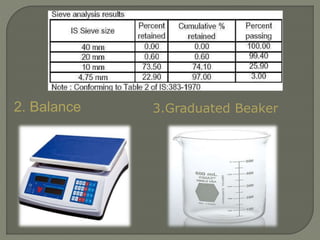
Reporting of Results
The results should be calculated and reported as:
i) the cumulative percentage by weight of the total sample
ii) the percentage by weight of the total sample passing through one
sieve and retained on the next smaller sieve, to the nearest 0.1
percent. The results of the sieve analysis may be recorded
graphically on a semi-log graph with particle size as abscissa (log
scale) and the percentage smaller than the specified diameter as
ordinate.
2. Balance 3.Graduated Beaker
4.calculater
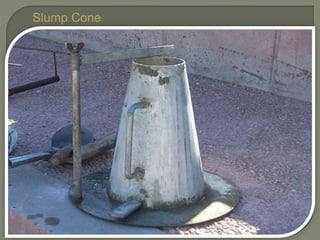
5.Slump Cone
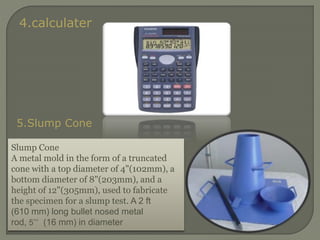
Slump Cone
A metal mold in the form of a truncated
cone with a top diameter of 4"(102mm), a
bottom diameter of 8"(203mm), and a
height of 12"(305mm), used to fabricate
the specimen for a slump test. A 2 ft
(610 mm) long bullet nosed metal
rod, 5’’’ (16 mm) in diameter
Concrete Slump Test
The concrete slump test is an empirical test that measures
the workability of fresh concrete
More specifically, it measures the consistency of the
concrete in that specific batch. This test is performed to
check the consistency of freshly made concrete.
Consistency is a term very closely related to workability. It
is a term which describes the state of fresh concrete. It
refers to the ease with which the concrete flows. It is used
to indicate the degree of wetness. Workability of concrete is
mainly affected by consistency i.e. wetter mixes will be
more workable than drier mixes, but concrete of the same
consistency may vary in workability.
Procedure
The test is carried out using a mould known as a slump
cone or Abrams cone. The cone is placed on a hard non-
absorbent surface. This cone is filled with fresh concrete
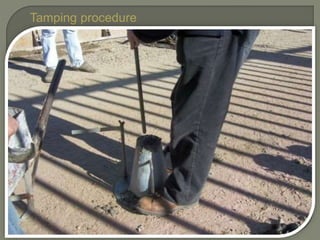
in three stages, each time it is tamped using a rod of
standard dimensions. At the end of the third stage,
concrete is struck off flush to the top of the mould. The
mould is carefully lifted vertically upwards, so as not to
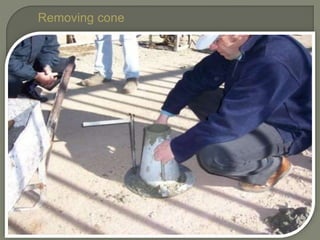
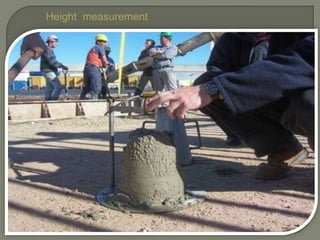
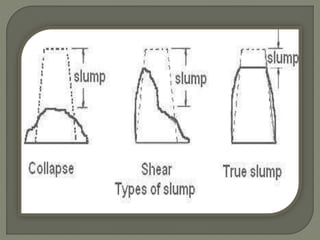
disturb the concrete cone. Concrete subsides. This
subsidence is termed as slump, and is measured in to the
nearest 5 mm if the slump is <100 mm and measured to
the nearest 10 mm if the slump is >100 mm.
Slump Cone
Tamping procedure
Removing cone
Height measurement
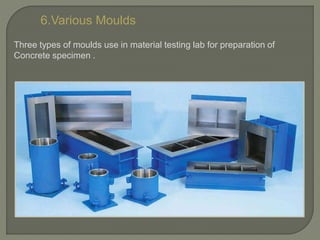
6.Various Moulds
Three types of moulds use in material testing lab for preparation of
Concrete specimen .
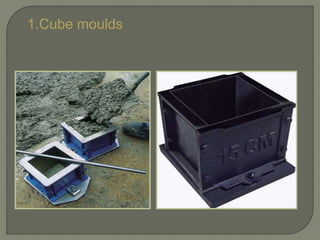
1.Cube moulds
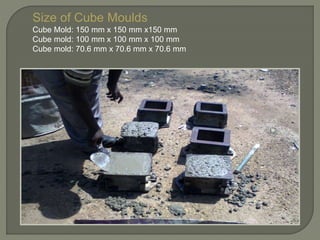
Size of Cube Moulds
Cube Mold: 150 mm x 150 mm x150 mm
Cube mold: 100 mm x 100 mm x 100 mm
Cube mold: 70.6 mm x 70.6 mm x 70.6 mm
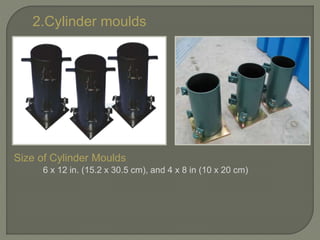
2.Cylinder moulds
Size of Cylinder Moulds
6 x 12 in. (15.2 x 30.5 cm), and 4 x 8 in (10 x 20 cm)
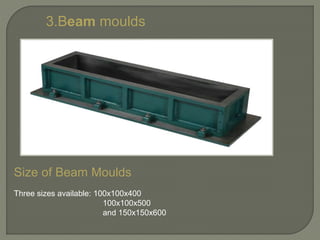
3.Beam moulds
Size of Beam Moulds
Three sizes available: 100x100x400
100x100x500
and 150x150x600
7. Hydrometer
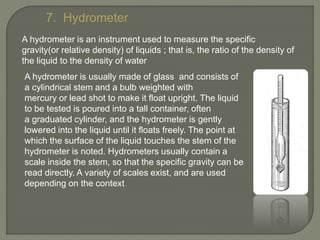
A hydrometer is an instrument used to measure the specific
gravity(or relative density) of liquids ; that is, the ratio of the density of
the liquid to the density of water
A hydrometer is usually made of glass and consists of
a cylindrical stem and a bulb weighted with
mercury or lead shot to make it float upright. The liquid
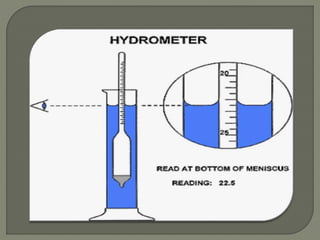
to be tested is poured into a tall container, often
a graduated cylinder, and the hydrometer is gently
lowered into the liquid until it floats freely. The point at
which the surface of the liquid touches the stem of the
hydrometer is noted. Hydrometers usually contain a
scale inside the stem, so that the specific gravity can be
read directly. A variety of scales exist, and are used
depending on the context
8.Universal Testing Machine
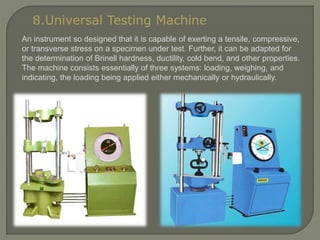
An instrument so designed that it is capable of exerting a tensile, compressive,
or transverse stress on a specimen under test. Further, it can be adapted for
the determination of Brinell hardness, ductility, cold bend, and other properties.
The machine consists essentially of three systems: loading, weighing, and
indicating, the loading being applied either mechanically or hydraulically.
DESCRIPTION OF UTM
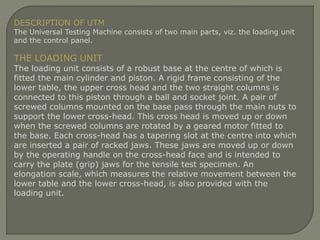
The Universal Testing Machine consists of two main parts, viz. the loading unit
and the control panel.
THE LOADING UNIT
The loading unit consists of a robust base at the centre of which is
fitted the main cylinder and piston. A rigid frame consisting of the
lower table, the upper cross head and the two straight columns is
connected to this piston through a ball and socket joint. A pair of
screwed columns mounted on the base pass through the main nuts to
support the lower cross-head. This cross head is moved up or down
when the screwed columns are rotated by a geared motor fitted to
the base. Each cross-head has a tapering slot at the centre into which
are inserted a pair of racked jaws. These jaws are moved up or down
by the operating handle on the cross-head face and is intended to
carry the plate (grip) jaws for the tensile test specimen. An
elongation scale, which measures the relative movement between the
lower table and the lower cross-head, is also provided with the
loading unit.
THE CONTROL PANEL
The control panel contains the hydraulic power
unit, the load measuring unit and the control
devices.
1. The Hydraulic Power Unit.
The Hydraulic Power Unit consists of an oil pump
driven by an electric motor and a sump for the
hydraulic oil. The pump is of the reciprocating
type, having a set of plungers which assures a
continuous non-pulsating oil flow into the main
cylinder for a smooth application of the test load
on the specimen. Hydraulic lines of the unit are of
a special design to enable them to perform
various functions.
2. The Load Measuring Unit.
The load measuring unit, in essence is a pendulum
dynamometer unit. It has a small cylinder in which a piston
moves in phase with the main piston under the same oil
pressure. A simple pendulum connected with this small piston
by a pivot lever thus deflects in accordance with the load on
the specimen and the pivot ratio. This deflection is transmitted
to the load pointer which indicates the test load on the dial.
The pivot lever has four fulcrum -knife-edges, giving fo4ir
ranges of test load, (viz. 0-100 kN ; 0-250 kN; 0-500 kN and
0-1000 kN). The required range can be selected by just
turning a knob provided for the purpose. The overall accuracy
of the machine depends mainly on the accuracy of the
measuring unit.
3. Control Devices.
These include the electric control devices, the hydraulic control
devices and the load indicating devices.
The Electric Control Devices
are in the form of four switches set on the left side of the panel face. The upper
and lower push switches are for moving the lower cross-head up and down
respectively. The remaining two are the ON and OFF switches for the hydraulic
pump.
The Hydraulic Control Devices
are a pair of control valves set on the table or the control panel. The right
control valve is the inlet valve. It is a pressure compensated flow control valve
and has a built-in overload relief valve. If this valve is in the closed position,
while the hydraulic system is on, oil flows back into the sump. Opening of the
valve now, cause the oil to flow into the main cylinder in a continuous non-
pulsating manner. The left control valve is the return valve. If this valve is in the
closed position, the oil pumped into the main cylinder causes the main piston to
move up. The specimen resists this, movement, as soon as it gets loaded up. Oil
pressure inside the main cylinder (and elsewhere in the line) then starts growing
up until either the specimen breaks or the load reaches the maximum value of
the range selected. A slow opening of this valve now causes the oil to drain back
into the sump and the main piston to descent.
The Load indicating Devices
consist of a range inflating dial placed behind a load indicating dial. The former
move and sets itself to the range selected when the range adjusting knob is
turned. The load .on the specimen at any stage is indicated by the load pointer
which moves over the load indicating dial and harries forward with it a dummy.
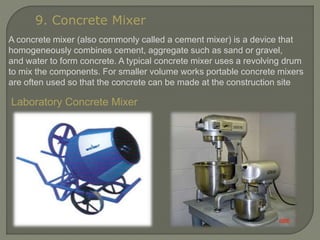
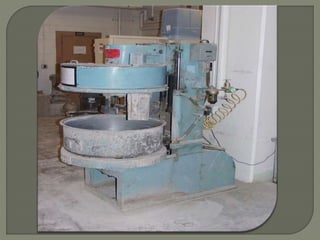
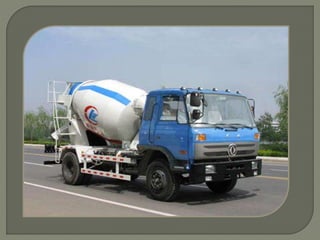
9. Concrete Mixer
A concrete mixer (also commonly called a cement mixer) is a device that
homogeneously combines cement, aggregate such as sand or gravel,
and water to form concrete. A typical concrete mixer uses a revolving drum
to mix the components. For smaller volume works portable concrete mixers
are often used so that the concrete can be made at the construction site
Laboratory Concrete Mixer
Two Different Types of Concrete Mixers
You may need to choose one from a variety of concrete mixers if you
have to do a job at home or at an outdoor construction site in your area.
You must choose the correct concrete mixer depending on what you need
it for. A concrete mixer can be used for many things, such as construction
and structure repair like fixing an eroded wall of a building or a broken
sidewalk. The two most common types are the mobile concrete mixer and
the stationary one.
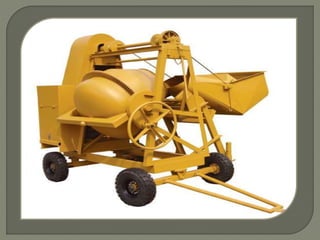
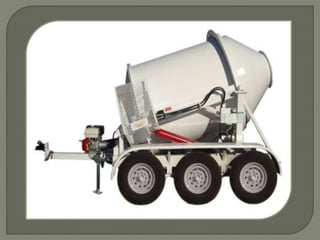
1. Mobile Concrete Mixers
This first type of concrete mixer is ideal for you if you need to use concrete
in more than one place in the same area. You can move this concrete mixer
around from place to place without any difficulty. These mixers are usually
used to make sidewalks and in projects where concrete needs to be used
in multiple locations. You can manipulate the dose of concrete required in
each area and there is no need to add more water to the mixture if you
decide to put more rocks and mix them up with the concrete.
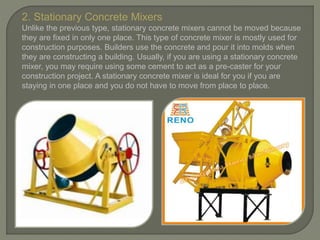
2. Stationary Concrete Mixers
Unlike the previous type, stationary concrete mixers cannot be moved because
they are fixed in only one place. This type of concrete mixer is mostly used for
construction purposes. Builders use the concrete and pour it into molds when
they are constructing a building. Usually, if you are using a stationary concrete
mixer, you may require using some cement to act as a pre-caster for your
construction project. A stationary concrete mixer is ideal for you if you are
staying in one place and you do not have to move from place to place.
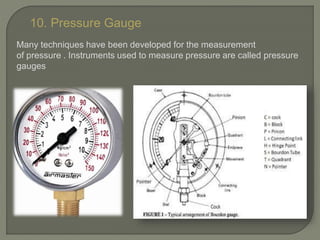
10. Pressure Gauge
Many techniques have been developed for the measurement
of pressure . Instruments used to measure pressure are called pressure
gauges
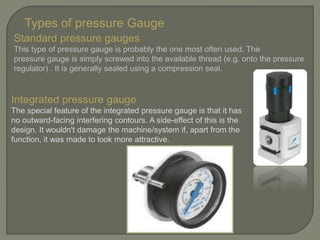
Types of pressure Gauge
Standard pressure gauges
This type of pressure gauge is probably the one most often used. The
pressure gauge is simply screwed into the available thread (e.g. onto the pressure
regulator) . It is generally sealed using a compression seal.
Integrated pressure gauge
The special feature of the integrated pressure gauge is that it has
no outward-facing interfering contours. A side-effect of this is the
design. It wouldn't damage the machine/system if, apart from the
function, it was made to look more attractive.
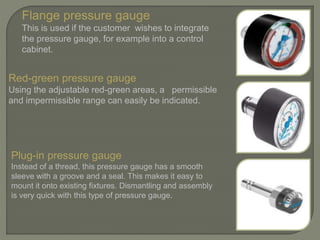
Flange pressure gauge
This is used if the customer wishes to integrate
the pressure gauge, for example into a control
cabinet.
Red-green pressure gauge
Using the adjustable red-green areas, a permissible
and impermissible range can easily be indicated.
Plug-in pressure gauge
Instead of a thread, this pressure gauge has a smooth
sleeve with a groove and a seal. This makes it easy to
mount it onto existing fixtures. Dismantling and assembly
is very quick with this type of pressure gauge.
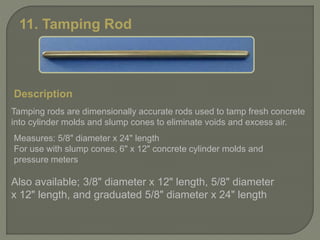
11. Tamping Rod
Description
Tamping rods are dimensionally accurate rods used to tamp fresh concrete
into cylinder molds and slump cones to eliminate voids and excess air.
Measures: 5/8" diameter x 24" length
For use with slump cones, 6" x 12" concrete cylinder molds and
pressure meters
Also available; 3/8" diameter x 12" length, 5/8" diameter
x 12" length, and graduated 5/8" diameter x 24" length
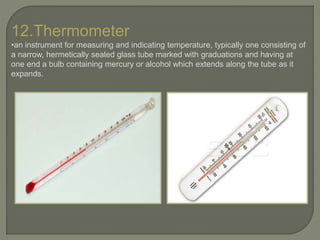
12.Thermometer
•an instrument for measuring and indicating temperature, typically one consisting of
a narrow, hermetically sealed glass tube marked with graduations and having at
one end a bulb containing mercury or alcohol which extends along the tube as it
expands.
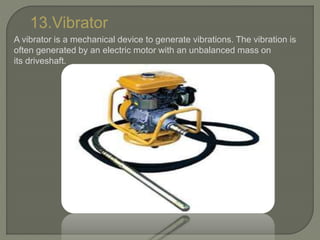
13.Vibrator
A vibrator is a mechanical device to generate vibrations. The vibration is
often generated by an electric motor with an unbalanced mass on
its driveshaft.
TYPES OF CONCRETE VIBRATORS FOR COMPACTION
Since concrete contains particles of varying sizes, the most satisfactory
compaction would perhaps be obtained by using vibrators with
different speeds of vibration. Poly frequency vibrators used for
compacting concrete of stiff consistency are being developed. The
vibrators for compacting concrete are manufactured with frequencies of
vibration from 2800 to 15000 rpm. The various types of vibrators used
are described below:
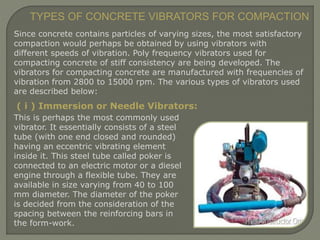
( i ) Immersion or Needle Vibrators:
This is perhaps the most commonly used
vibrator. It essentially consists of a steel
tube (with one end closed and rounded)
having an eccentric vibrating element
inside it. This steel tube called poker is
connected to an electric motor or a diesel
engine through a flexible tube. They are
available in size varying from 40 to 100
mm diameter. The diameter of the poker
is decided from the consideration of the
spacing between the reinforcing bars in
the form-work.
The frequency of vibration varies up to 15000 rpm. However a
range between 3000 to 6000 rpm is suggested as a desirable
minimum with an acceleration of 4g to 10g.
The normal radius of action of an immersion vibrator is 0.50 to
1.0m. However, it would be preferable to immerse the vibrator
into concrete at intervals of not more than 600mm or 8 to 10
times the diameter of the poker. The period of vibration
required may be of the order of 30 seconds to 2 minute. The
concrete should be placed in layers not more than 600mm
high.
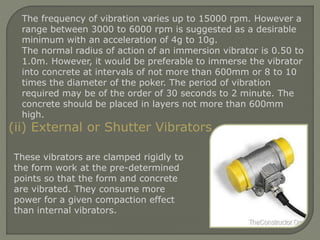
(ii) External or Shutter Vibrators
These vibrators are clamped rigidly to
the form work at the pre-determined
points so that the form and concrete
are vibrated. They consume more
power for a given compaction effect
than internal vibrators.
These vibrators can compact up to 450mm from the face but have
to be moved from one place to another as concrete progresses.
These vibrators operate at a frequency of 3000 to 9000 rpm at an
acceleration of 4g.
The external vibrators are more often used for pre-casting of thin
in-situ sections of such shape and thickness as can not be
compacted by internal vibrators.
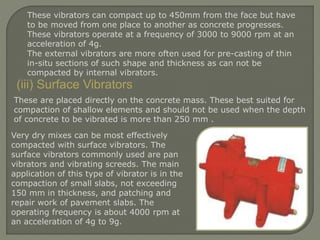
(iii) Surface Vibrators
Very dry mixes can be most effectively
compacted with surface vibrators. The
surface vibrators commonly used are pan
vibrators and vibrating screeds. The main
application of this type of vibrator is in the
compaction of small slabs, not exceeding
150 mm in thickness, and patching and
repair work of pavement slabs. The
operating frequency is about 4000 rpm at
an acceleration of 4g to 9g.
These are placed directly on the concrete mass. These best suited for
compaction of shallow elements and should not be used when the depth
of concrete to be vibrated is more than 250 mm .
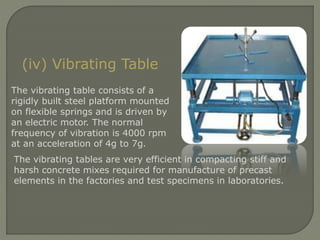
(iv) Vibrating Table
The vibrating table consists of a
rigidly built steel platform mounted
on flexible springs and is driven by
an electric motor. The normal
frequency of vibration is 4000 rpm
at an acceleration of 4g to 7g.
The vibrating tables are very efficient in compacting stiff and
harsh concrete mixes required for manufacture of precast
elements in the factories and test specimens in laboratories.
Vibrator Using At Site
14. Vicat Apparatus
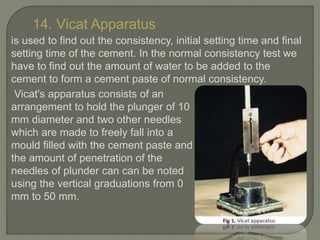
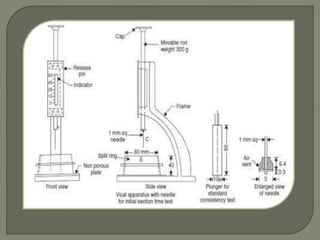
Vicat's apparatus consists of an
arrangement to hold the plunger of 10
mm diameter and two other needles
which are made to freely fall into a
mould filled with the cement paste and
the amount of penetration of the
needles of plunder can can be noted
using the vertical graduations from 0
mm to 50 mm.
is used to find out the consistency, initial setting time and final
setting time of the cement. In the normal consistency test we
have to find out the amount of water to be added to the
cement to form a cement paste of normal consistency.
Consistency Test:
To find out the consistency test you have to take a sample of dried
cement of about 400 g weight which must pass through the 90
micron IS Sieve. Then mix in it about 25% of water by weight a
form a uniform paste within 2 minutes of time.
Fill the Vicat's mould with this paste and make the 10 mm plunger
fixed to the arrangement to just touch the top surface of the
cement paste. Make it freely fall and note the amount of
penetration.
When the penetration is of about 42 to 45 mm or when the reading
on the vertical graduation is about 5 mm to 7 mm that means
cement is of normal consistency. Generally the water required to
form a paste of normal consistency is 30%.
Initial Setting Time:
Initial time of Cement is the time required by the cement for its early
setting. Cement must be applied to the place of its use before its initial
setting so it is necessary to find out the initial setting time that is
available with us.
Vicat's apparatus is the standard apparatus used to find out this initial
setting time. Look in the figure above, there is a needle of diameter 1
mm. This needle is fixed to the movable rod weight.
The cement paste of normal consistency is formed and is filled in the
mould. Now the needle is made just touch the top surface of the cement
paste and made freely fall in it. Initial setting time is the time from the
mixing of the cement and the water to the time when the penetration of
the needle is just above 5 mm from the bottom of the base plate or mold.
Generally the initial setting time of the ordinary Portland cement is 30
minutes. For Slow setting cement this time may be increased by adding
the admixtures or Gypsum up to 60 minutes.
Similarly, for the final setting time we have to use the third needle
which has a enlarged 5 mm hollow cylindrical base. The final setting
time is the time from the mixing of the water to the time when this needle
just makes the impression on the surface of the cement but do not
penetrate into it. Generally the final setting time of cement (OPC) is 10
hrs to 12 hrs
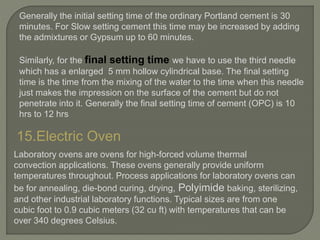
15.Electric Oven
Laboratory ovens are ovens for high-forced volume thermal
convection applications. These ovens generally provide uniform
temperatures throughout. Process applications for laboratory ovens can
be for annealing, die-bond curing, drying, Polyimide baking, sterilizing,
and other industrial laboratory functions. Typical sizes are from one
cubic foot to 0.9 cubic meters (32 cu ft) with temperatures that can be
over 340 degrees Celsius.
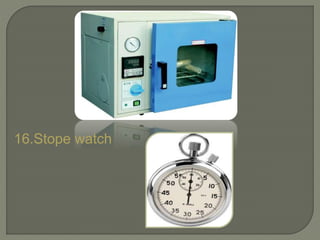
16.Stope watch
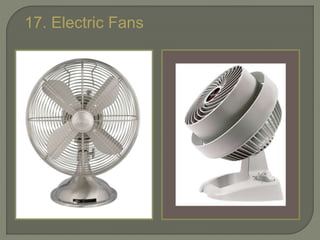
17. Electric Fans
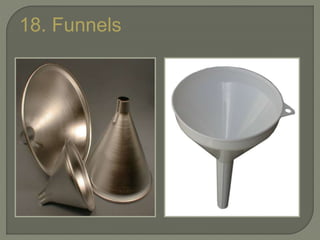
18. Funnels
19.Wire Basket
20.Brushes
21.Hydraulic Jack
22.Steel Pan
23.Shovel
24.Trowel
25.Wheel Barrows
26.First Aid Box
Material Testing Lab Equipments

Material Testing Lab Equipments

  • 1.
    Material Testing LabEquipments (nh.cvl.engineer@gmail.com)
  • 2.
    Description 1.Sieve Set 14.Vicat Apparatus 2.Balance 15. Electric Oven 3.Graduated Beaker 16. Stop Watch 4.Calculater 17. Electric Fans 5.Slump cone 18. Funnels 6. Various Moulds 19. Wire Basket 7.Hydrometer 20.Brushes 8. Universal Testing Machine 9.Concrete Mixer 21.Hydraulic Jack 10.Pressure Gauge 22. Steel Pan 11.Tamping Rod 23. Shovel 12.Themometer 24. Trowel 13.Vibrator 25. Wheel Barrows
  • 3.
    1.Sieve Set A sieve,or sifter, is a device for separating wanted elements from unwanted material or for characterizing the particle size distribution of a sample of ( aggregates , Sand , and other soil particles The apparatus used are - i) A set of IS Sieves of sizes – 80mm, 63mm, 50mm, 40mm,31.5mm, 25mm, 20mm, 16mm, 12.5mm, 10mm, 6.3mm,4.75mm, 3.35mm, 2.36mm, 1.18mm, 600µm, 300µm, 150µm and 75µm. ii) Balance or scale with an accuracy to measure 0.1 percent of the weight of the test sample. The weight of sample available should not be less than the weight given below:-
  • 4.
    Sieve Analysis Sieve analysishelps to determine the particle size distribution of the coarse and fine aggregates. This is done by sieving the aggregates as per IS: 2386 (Part I) – 1963. In this we use different sieves as standardized by the IS code and then pass aggregates through them and thus collect different sized particles left over different sieves. The sample for sieving should be prepared from the larger sample either by quartering or by means of a sample divider.
  • 5.
    Procedure to determineparticle size distribution of Aggregates. i) The test sample is dried to a constant weight at a temperature of 110 + 5oC and weighed. ii) The sample is sieved by using a set of IS Sieves. iii) On completion of sieving, the material on each sieve is weighed. iv) Cumulative weight passing through each sieve is calculated as a percentage of the total sample weight. v) Fineness modulus is obtained by adding cumulative percentage of aggregates retained on each sieve and dividing the sum by 100. Reporting of Results The results should be calculated and reported as: i) the cumulative percentage by weight of the total sample ii) the percentage by weight of the total sample passing through one sieve and retained on the next smaller sieve, to the nearest 0.1 percent. The results of the sieve analysis may be recorded graphically on a semi-log graph with particle size as abscissa (log scale) and the percentage smaller than the specified diameter as ordinate.
  • 6.
  • 7.
    4.calculater 5.Slump Cone Slump Cone Ametal mold in the form of a truncated cone with a top diameter of 4"(102mm), a bottom diameter of 8"(203mm), and a height of 12"(305mm), used to fabricate the specimen for a slump test. A 2 ft (610 mm) long bullet nosed metal rod, 5’’’ (16 mm) in diameter
  • 8.
    Concrete Slump Test Theconcrete slump test is an empirical test that measures the workability of fresh concrete More specifically, it measures the consistency of the concrete in that specific batch. This test is performed to check the consistency of freshly made concrete. Consistency is a term very closely related to workability. It is a term which describes the state of fresh concrete. It refers to the ease with which the concrete flows. It is used to indicate the degree of wetness. Workability of concrete is mainly affected by consistency i.e. wetter mixes will be more workable than drier mixes, but concrete of the same consistency may vary in workability.
  • 9.
    Procedure The test iscarried out using a mould known as a slump cone or Abrams cone. The cone is placed on a hard non- absorbent surface. This cone is filled with fresh concrete in three stages, each time it is tamped using a rod of standard dimensions. At the end of the third stage, concrete is struck off flush to the top of the mould. The mould is carefully lifted vertically upwards, so as not to disturb the concrete cone. Concrete subsides. This subsidence is termed as slump, and is measured in to the nearest 5 mm if the slump is <100 mm and measured to the nearest 10 mm if the slump is >100 mm.
  • 10.
  • 11.
  • 12.
  • 13.
  • 15.
    6.Various Moulds Three typesof moulds use in material testing lab for preparation of Concrete specimen .
  • 16.
  • 17.
    Size of CubeMoulds Cube Mold: 150 mm x 150 mm x150 mm Cube mold: 100 mm x 100 mm x 100 mm Cube mold: 70.6 mm x 70.6 mm x 70.6 mm
  • 18.
    2.Cylinder moulds Size ofCylinder Moulds 6 x 12 in. (15.2 x 30.5 cm), and 4 x 8 in (10 x 20 cm)
  • 19.
    3.Beam moulds Size ofBeam Moulds Three sizes available: 100x100x400 100x100x500 and 150x150x600
  • 20.
    7. Hydrometer A hydrometeris an instrument used to measure the specific gravity(or relative density) of liquids ; that is, the ratio of the density of the liquid to the density of water A hydrometer is usually made of glass and consists of a cylindrical stem and a bulb weighted with mercury or lead shot to make it float upright. The liquid to be tested is poured into a tall container, often a graduated cylinder, and the hydrometer is gently lowered into the liquid until it floats freely. The point at which the surface of the liquid touches the stem of the hydrometer is noted. Hydrometers usually contain a scale inside the stem, so that the specific gravity can be read directly. A variety of scales exist, and are used depending on the context
  • 22.
    8.Universal Testing Machine Aninstrument so designed that it is capable of exerting a tensile, compressive, or transverse stress on a specimen under test. Further, it can be adapted for the determination of Brinell hardness, ductility, cold bend, and other properties. The machine consists essentially of three systems: loading, weighing, and indicating, the loading being applied either mechanically or hydraulically.
  • 23.
    DESCRIPTION OF UTM TheUniversal Testing Machine consists of two main parts, viz. the loading unit and the control panel. THE LOADING UNIT The loading unit consists of a robust base at the centre of which is fitted the main cylinder and piston. A rigid frame consisting of the lower table, the upper cross head and the two straight columns is connected to this piston through a ball and socket joint. A pair of screwed columns mounted on the base pass through the main nuts to support the lower cross-head. This cross head is moved up or down when the screwed columns are rotated by a geared motor fitted to the base. Each cross-head has a tapering slot at the centre into which are inserted a pair of racked jaws. These jaws are moved up or down by the operating handle on the cross-head face and is intended to carry the plate (grip) jaws for the tensile test specimen. An elongation scale, which measures the relative movement between the lower table and the lower cross-head, is also provided with the loading unit.
  • 24.
    THE CONTROL PANEL Thecontrol panel contains the hydraulic power unit, the load measuring unit and the control devices. 1. The Hydraulic Power Unit. The Hydraulic Power Unit consists of an oil pump driven by an electric motor and a sump for the hydraulic oil. The pump is of the reciprocating type, having a set of plungers which assures a continuous non-pulsating oil flow into the main cylinder for a smooth application of the test load on the specimen. Hydraulic lines of the unit are of a special design to enable them to perform various functions.
  • 25.
    2. The LoadMeasuring Unit. The load measuring unit, in essence is a pendulum dynamometer unit. It has a small cylinder in which a piston moves in phase with the main piston under the same oil pressure. A simple pendulum connected with this small piston by a pivot lever thus deflects in accordance with the load on the specimen and the pivot ratio. This deflection is transmitted to the load pointer which indicates the test load on the dial. The pivot lever has four fulcrum -knife-edges, giving fo4ir ranges of test load, (viz. 0-100 kN ; 0-250 kN; 0-500 kN and 0-1000 kN). The required range can be selected by just turning a knob provided for the purpose. The overall accuracy of the machine depends mainly on the accuracy of the measuring unit. 3. Control Devices. These include the electric control devices, the hydraulic control devices and the load indicating devices.
  • 26.
    The Electric ControlDevices are in the form of four switches set on the left side of the panel face. The upper and lower push switches are for moving the lower cross-head up and down respectively. The remaining two are the ON and OFF switches for the hydraulic pump. The Hydraulic Control Devices are a pair of control valves set on the table or the control panel. The right control valve is the inlet valve. It is a pressure compensated flow control valve and has a built-in overload relief valve. If this valve is in the closed position, while the hydraulic system is on, oil flows back into the sump. Opening of the valve now, cause the oil to flow into the main cylinder in a continuous non- pulsating manner. The left control valve is the return valve. If this valve is in the closed position, the oil pumped into the main cylinder causes the main piston to move up. The specimen resists this, movement, as soon as it gets loaded up. Oil pressure inside the main cylinder (and elsewhere in the line) then starts growing up until either the specimen breaks or the load reaches the maximum value of the range selected. A slow opening of this valve now causes the oil to drain back into the sump and the main piston to descent. The Load indicating Devices consist of a range inflating dial placed behind a load indicating dial. The former move and sets itself to the range selected when the range adjusting knob is turned. The load .on the specimen at any stage is indicated by the load pointer which moves over the load indicating dial and harries forward with it a dummy.
  • 27.
    9. Concrete Mixer Aconcrete mixer (also commonly called a cement mixer) is a device that homogeneously combines cement, aggregate such as sand or gravel, and water to form concrete. A typical concrete mixer uses a revolving drum to mix the components. For smaller volume works portable concrete mixers are often used so that the concrete can be made at the construction site Laboratory Concrete Mixer
  • 29.
    Two Different Typesof Concrete Mixers You may need to choose one from a variety of concrete mixers if you have to do a job at home or at an outdoor construction site in your area. You must choose the correct concrete mixer depending on what you need it for. A concrete mixer can be used for many things, such as construction and structure repair like fixing an eroded wall of a building or a broken sidewalk. The two most common types are the mobile concrete mixer and the stationary one. 1. Mobile Concrete Mixers This first type of concrete mixer is ideal for you if you need to use concrete in more than one place in the same area. You can move this concrete mixer around from place to place without any difficulty. These mixers are usually used to make sidewalks and in projects where concrete needs to be used in multiple locations. You can manipulate the dose of concrete required in each area and there is no need to add more water to the mixture if you decide to put more rocks and mix them up with the concrete.
  • 33.
    2. Stationary ConcreteMixers Unlike the previous type, stationary concrete mixers cannot be moved because they are fixed in only one place. This type of concrete mixer is mostly used for construction purposes. Builders use the concrete and pour it into molds when they are constructing a building. Usually, if you are using a stationary concrete mixer, you may require using some cement to act as a pre-caster for your construction project. A stationary concrete mixer is ideal for you if you are staying in one place and you do not have to move from place to place.
  • 34.
    10. Pressure Gauge Manytechniques have been developed for the measurement of pressure . Instruments used to measure pressure are called pressure gauges
  • 35.
    Types of pressureGauge Standard pressure gauges This type of pressure gauge is probably the one most often used. The pressure gauge is simply screwed into the available thread (e.g. onto the pressure regulator) . It is generally sealed using a compression seal. Integrated pressure gauge The special feature of the integrated pressure gauge is that it has no outward-facing interfering contours. A side-effect of this is the design. It wouldn't damage the machine/system if, apart from the function, it was made to look more attractive.
  • 36.
    Flange pressure gauge Thisis used if the customer wishes to integrate the pressure gauge, for example into a control cabinet. Red-green pressure gauge Using the adjustable red-green areas, a permissible and impermissible range can easily be indicated. Plug-in pressure gauge Instead of a thread, this pressure gauge has a smooth sleeve with a groove and a seal. This makes it easy to mount it onto existing fixtures. Dismantling and assembly is very quick with this type of pressure gauge.
  • 37.
    11. Tamping Rod Description Tampingrods are dimensionally accurate rods used to tamp fresh concrete into cylinder molds and slump cones to eliminate voids and excess air. Measures: 5/8" diameter x 24" length For use with slump cones, 6" x 12" concrete cylinder molds and pressure meters Also available; 3/8" diameter x 12" length, 5/8" diameter x 12" length, and graduated 5/8" diameter x 24" length
  • 38.
    12.Thermometer •an instrument formeasuring and indicating temperature, typically one consisting of a narrow, hermetically sealed glass tube marked with graduations and having at one end a bulb containing mercury or alcohol which extends along the tube as it expands.
  • 39.
    13.Vibrator A vibrator isa mechanical device to generate vibrations. The vibration is often generated by an electric motor with an unbalanced mass on its driveshaft.
  • 40.
    TYPES OF CONCRETEVIBRATORS FOR COMPACTION Since concrete contains particles of varying sizes, the most satisfactory compaction would perhaps be obtained by using vibrators with different speeds of vibration. Poly frequency vibrators used for compacting concrete of stiff consistency are being developed. The vibrators for compacting concrete are manufactured with frequencies of vibration from 2800 to 15000 rpm. The various types of vibrators used are described below: ( i ) Immersion or Needle Vibrators: This is perhaps the most commonly used vibrator. It essentially consists of a steel tube (with one end closed and rounded) having an eccentric vibrating element inside it. This steel tube called poker is connected to an electric motor or a diesel engine through a flexible tube. They are available in size varying from 40 to 100 mm diameter. The diameter of the poker is decided from the consideration of the spacing between the reinforcing bars in the form-work.
  • 41.
    The frequency ofvibration varies up to 15000 rpm. However a range between 3000 to 6000 rpm is suggested as a desirable minimum with an acceleration of 4g to 10g. The normal radius of action of an immersion vibrator is 0.50 to 1.0m. However, it would be preferable to immerse the vibrator into concrete at intervals of not more than 600mm or 8 to 10 times the diameter of the poker. The period of vibration required may be of the order of 30 seconds to 2 minute. The concrete should be placed in layers not more than 600mm high. (ii) External or Shutter Vibrators These vibrators are clamped rigidly to the form work at the pre-determined points so that the form and concrete are vibrated. They consume more power for a given compaction effect than internal vibrators.
  • 42.
    These vibrators cancompact up to 450mm from the face but have to be moved from one place to another as concrete progresses. These vibrators operate at a frequency of 3000 to 9000 rpm at an acceleration of 4g. The external vibrators are more often used for pre-casting of thin in-situ sections of such shape and thickness as can not be compacted by internal vibrators. (iii) Surface Vibrators Very dry mixes can be most effectively compacted with surface vibrators. The surface vibrators commonly used are pan vibrators and vibrating screeds. The main application of this type of vibrator is in the compaction of small slabs, not exceeding 150 mm in thickness, and patching and repair work of pavement slabs. The operating frequency is about 4000 rpm at an acceleration of 4g to 9g. These are placed directly on the concrete mass. These best suited for compaction of shallow elements and should not be used when the depth of concrete to be vibrated is more than 250 mm .
  • 43.
    (iv) Vibrating Table Thevibrating table consists of a rigidly built steel platform mounted on flexible springs and is driven by an electric motor. The normal frequency of vibration is 4000 rpm at an acceleration of 4g to 7g. The vibrating tables are very efficient in compacting stiff and harsh concrete mixes required for manufacture of precast elements in the factories and test specimens in laboratories.
  • 44.
  • 45.
    14. Vicat Apparatus Vicat'sapparatus consists of an arrangement to hold the plunger of 10 mm diameter and two other needles which are made to freely fall into a mould filled with the cement paste and the amount of penetration of the needles of plunder can can be noted using the vertical graduations from 0 mm to 50 mm. is used to find out the consistency, initial setting time and final setting time of the cement. In the normal consistency test we have to find out the amount of water to be added to the cement to form a cement paste of normal consistency.
  • 46.
    Consistency Test: To findout the consistency test you have to take a sample of dried cement of about 400 g weight which must pass through the 90 micron IS Sieve. Then mix in it about 25% of water by weight a form a uniform paste within 2 minutes of time. Fill the Vicat's mould with this paste and make the 10 mm plunger fixed to the arrangement to just touch the top surface of the cement paste. Make it freely fall and note the amount of penetration. When the penetration is of about 42 to 45 mm or when the reading on the vertical graduation is about 5 mm to 7 mm that means cement is of normal consistency. Generally the water required to form a paste of normal consistency is 30%.
  • 48.
    Initial Setting Time: Initialtime of Cement is the time required by the cement for its early setting. Cement must be applied to the place of its use before its initial setting so it is necessary to find out the initial setting time that is available with us. Vicat's apparatus is the standard apparatus used to find out this initial setting time. Look in the figure above, there is a needle of diameter 1 mm. This needle is fixed to the movable rod weight. The cement paste of normal consistency is formed and is filled in the mould. Now the needle is made just touch the top surface of the cement paste and made freely fall in it. Initial setting time is the time from the mixing of the cement and the water to the time when the penetration of the needle is just above 5 mm from the bottom of the base plate or mold.
  • 49.
    Generally the initialsetting time of the ordinary Portland cement is 30 minutes. For Slow setting cement this time may be increased by adding the admixtures or Gypsum up to 60 minutes. Similarly, for the final setting time we have to use the third needle which has a enlarged 5 mm hollow cylindrical base. The final setting time is the time from the mixing of the water to the time when this needle just makes the impression on the surface of the cement but do not penetrate into it. Generally the final setting time of cement (OPC) is 10 hrs to 12 hrs 15.Electric Oven Laboratory ovens are ovens for high-forced volume thermal convection applications. These ovens generally provide uniform temperatures throughout. Process applications for laboratory ovens can be for annealing, die-bond curing, drying, Polyimide baking, sterilizing, and other industrial laboratory functions. Typical sizes are from one cubic foot to 0.9 cubic meters (32 cu ft) with temperatures that can be over 340 degrees Celsius.
  • 50.
  • 51.
  • 52.
  • 53.
  • 54.
  • 55.
  • 56.
  • 57.
  • 58.
  • 59.