Rolling process
Rolling Process
• Introduction
• Rolling mills
• Classification of rolling processes
• Hot rolling
• Cold rolling
• Forces and geometry relationships in rolling
• Simplified analysis of rolling load: Rolling variables
• Problems and defects in rolled products
• Rolling-mill control
• Theories of cold rolling
• Theories of hot rolling
• Torque and power
Introduction- Definition of rolling
process
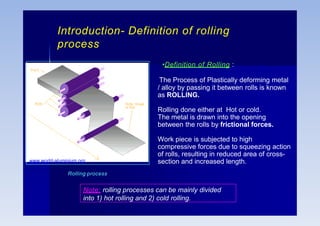
•Definition of Rolling :
Rolling process
www.world-aluminium.org
Note: rolling processes can be mainly divided
into 1) hot rolling and 2) cold rolling.
The Process of Plastically deforming metal
/ alloy by passing it between rolls is known
as ROLLING.
Rolling done either at Hot or cold.
The metal is drawn into the opening
between the rolls by frictional forces.
Work piece is subjected to high
compressive forces due to squeezing action
of rolls, resulting in reduced area of cross-
section and increased length.
Introduction- Hot and cold rolling
processes
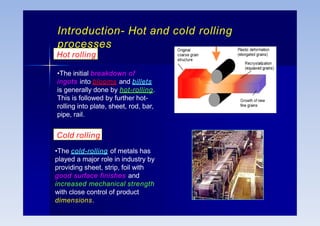
•The initial breakdown of
ingots into blooms and billets
is generally done by hot-rolling.
This is followed by further hot-
rolling into plate, sheet, rod, bar,
pipe, rail.
Hot rolling
Cold rolling
•The cold-rolling of metals has
played a major role in industry by
providing sheet, strip, foil with
good surface finishes and
increased mechanical strength
with close control of product
dimensions.
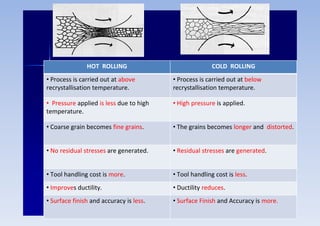
HOT ROLLING COLD ROLLING
• Process is carried out at above
recrystallisation temperature.
• Process is carried out at below
recrystallisation temperature.
• Pressure applied is less due to high
temperature.
• High pressure is applied.
• Coarse grain becomes fine grains. • The grains becomes longer and distorted.
• No residual stresses are generated. • Residual stresses are generated.
• Tool handling cost is more. • Tool handling cost is less.
• Improves ductility. • Ductility reduces.
• Surface finish and accuracy is less. • Surface Finish and Accuracy is more.
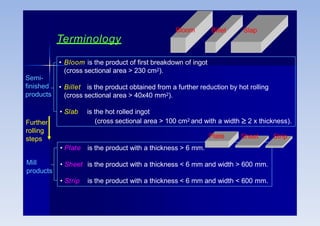
Terminology
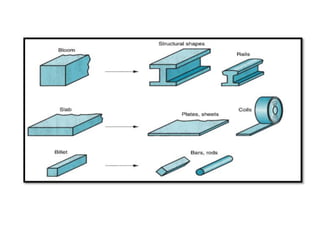
• Bloom is the product of first breakdown of ingot
(cross sectional area > 230 cm2).
• Billet is the product obtained from a further reduction by hot rolling
(cross sectional area > 40x40 mm2).
• Slab
Semi-
finished
products
• Plate is the product with a thickness > 6 mm.
• Sheet is the product with a thickness < 6 mm and width > 600 mm.
• Strip is the product with a thickness < 6 mm and width < 600 mm.
Mill
products
Further
rolling
steps
Bloom Billet Slap
is the hot rolled ingot
(cross sectional area > 100 cm2 and with a width  2 x thickness).
Plate Sheet Strip
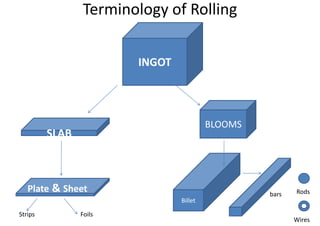
INGOT
SLAB
BLOOMS
Plate & Sheet
Billet
bars Rods
Wires
Terminology of Rolling
Strips Foils
Basic Definitions
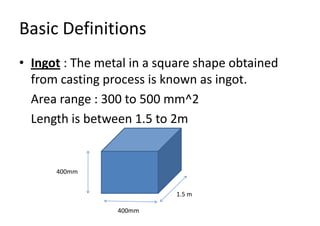
• Ingot : The metal in a square shape obtained
from casting process is known as ingot.
Area range : 300 to 500 mm^2
Length is between 1.5 to 2m
400mm
400mm
1.5 m
Basic Definitions
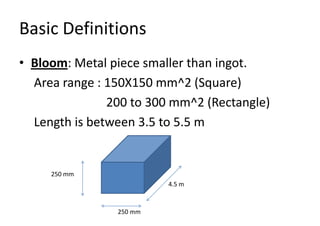
• Bloom: Metal piece smaller than ingot.
Area range : 150X150 mm^2 (Square)
200 to 300 mm^2 (Rectangle)
Length is between 3.5 to 5.5 m
250 mm
250 mm
4.5 m
Basic Definitions
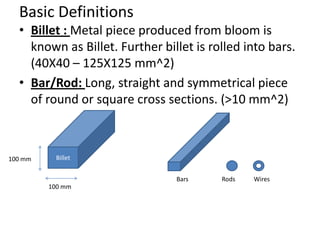
• Billet : Metal piece produced from bloom is
known as Billet. Further billet is rolled into bars.
(40X40 – 125X125 mm^2)
• Bar/Rod: Long, straight and symmetrical piece
of round or square cross sections. (>10 mm^2)
Billet
100 mm
100 mm
Bars Rods Wires
Basic Definitions
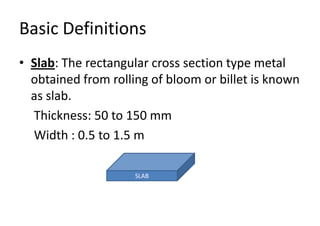
• Slab: The rectangular cross section type metal
obtained from rolling of bloom or billet is known
as slab.
Thickness: 50 to 150 mm
Width : 0.5 to 1.5 m
SLAB
Basic Definitions
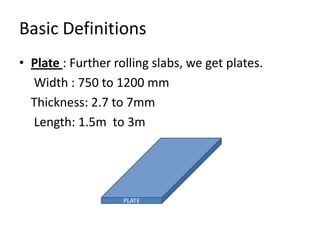
• Plate : Further rolling slabs, we get plates.
Width : 750 to 1200 mm
Thickness: 2.7 to 7mm
Length: 1.5m to 3m
PLATE
Basic Definitions
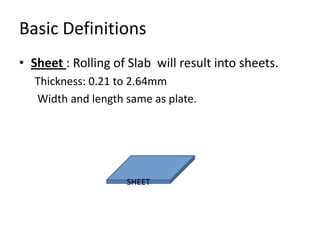
• Sheet : Rolling of Slab will result into sheets.
Thickness: 0.21 to 2.64mm
Width and length same as plate.
SHEET
Basic Definitions
• Flat : 2.5mm to 6mm thickness strip is known as
flat.
• Strip : 0.1 mm to 2.5 mm thickness is known as
strip. The width is very less compared to length.
• Foil: Maximum thickness = 1.5 mm,
Maximum width = 300 mm
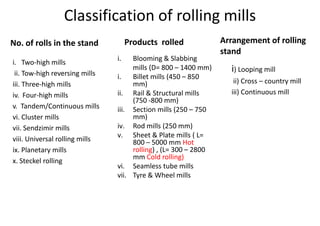
Classification of rolling mills
No. of rolls in the stand
i. Two-high mills
ii. Tow-high reversing mills
iii. Three-high mills
iv. Four-high mills
v. Tandem/Continuous mills
vi. Cluster mills
vii. Sendzimir mills
viii. Universal rolling mills
ix. Planetary mills
x. Steckel rolling
Products rolled
i. Blooming & Slabbing
mills (D= 800 – 1400 mm)
i. Billet mills (450 – 850
mm)
ii. Rail & Structural mills
(750 -800 mm)
iii. Section mills (250 – 750
mm)
iv. Rod mills (250 mm)
v. Sheet & Plate mills ( L=
800 – 5000 mm Hot
rolling) , (L= 300 – 2800
mm Cold rolling)
vi. Seamless tube mills
vii. Tyre & Wheel mills
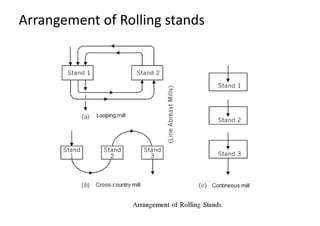
Arrangement of rolling
stand
i) Looping mill
ii) Cross – country mill
iii) Continuous mill
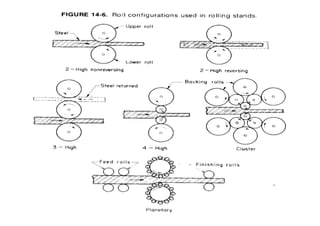
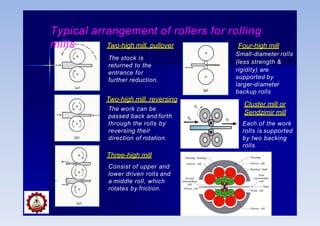
Typical arrangement of rollers for rolling
mills Two-high mill, pullover
The stock is
returned to the
entrance for
further reduction.
Two-high mill, reversing
The work can be
passed back and forth
through the rolls by
reversing their
direction of rotation.
Three-high mill
Consist of upper and
lower driven rolls and
a middle roll, which
rotates by friction.
Four-high mill
Small-diameter rolls
(less strength &
rigidity) are
supported by
larger-diameter
backup rolls
Cluster mill or
Sendzimir mill
Each of the work
rolls is supported
by two backing
rolls.
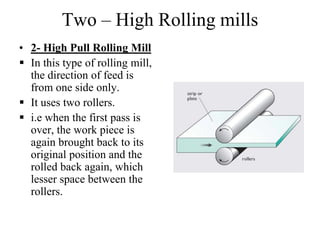
Two – High Rolling mills
• 2- High Pull Rolling Mill
 In this type of rolling mill,
the direction of feed is
from one side only.
 It uses two rollers.
 i.e when the first pass is
over, the work piece is
again brought back to its
original position and the
rolled back again, which
lesser space between the
rollers.
Two – High Rolling mills
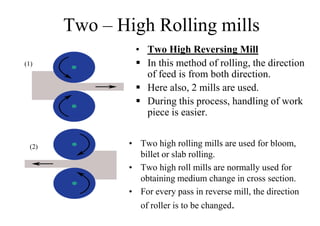
• Two High Reversing Mill
 In this method of rolling, the direction
of feed is from both direction.
 Here also, 2 mills are used.
 During this process, handling of work
piece is easier.
(1)
(2) • Two high rolling mills are used for bloom,
billet or slab rolling.
• Two high roll mills are normally used for
obtaining medium change in cross section.
• For every pass in reverse mill, the direction
of roller is to be changed.
Three – High Rolling mills
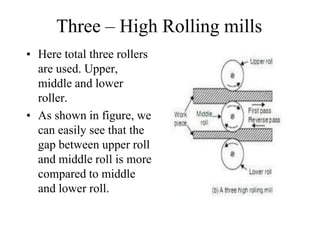
• Here total three rollers
are used. Upper,
middle and lower
roller.
• As shown in figure, we
can easily see that the
gap between upper roll
and middle roll is more
compared to middle
and lower roll.
Three – High Rolling mills
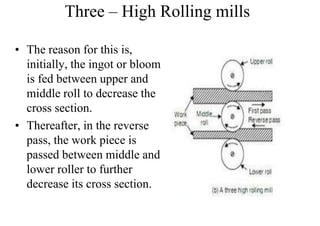
• The reason for this is,
initially, the ingot or bloom
is fed between upper and
middle roll to decrease the
cross section.
• Thereafter, in the reverse
pass, the work piece is
passed between middle and
lower roller to further
decrease its cross section.
Three – High Rolling mills
• In this process, there is no need to change the
direction of roller.
• Thus, minimum power is required.
• Bloom, billet, channel, rail can be
manufactured.
• It is cheaper.
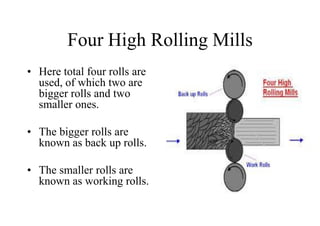
Four High Rolling Mills
• Here total four rolls are
used, of which two are
bigger rolls and two
smaller ones.
• The bigger rolls are
known as back up rolls.
• The smaller rolls are
known as working rolls.
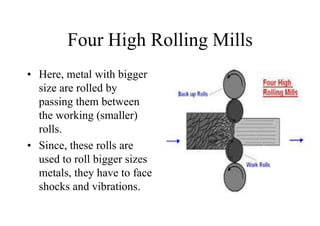
Four High Rolling Mills
• Here, metal with bigger
size are rolled by
passing them between
the working (smaller)
rolls.
• Since, these rolls are
used to roll bigger sizes
metals, they have to face
shocks and vibrations.
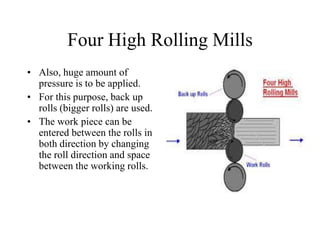
Four High Rolling Mills
• Also, huge amount of
pressure is to be applied.
• For this purpose, back up
rolls (bigger rolls) are used.
• The work piece can be
entered between the rolls in
both direction by changing
the roll direction and space
between the working rolls.
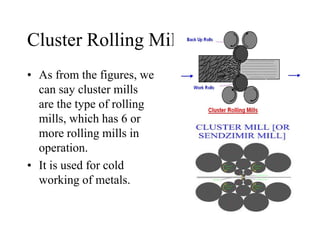
Cluster Rolling Mill
• As from the figures, we
can say cluster mills
are the type of rolling
mills, which has 6 or
more rolling mills in
operation.
• It is used for cold
working of metals.
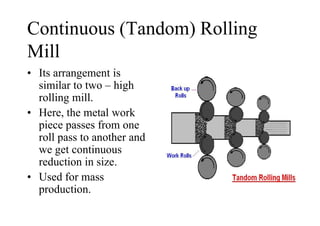
Continuous (Tandom) Rolling
Mill
• Its arrangement is
similar to two – high
rolling mill.
• Here, the metal work
piece passes from one
roll pass to another and
we get continuous
reduction in size.
• Used for mass
production.
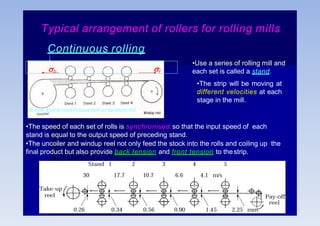
•Use a series of rolling mill and
each set is called a stand.
•The strip will be moving at
different velocities at each
stage in the mill.
A four stand continuous mill or tandem mil.
•The speed of each set of rolls is synchronised so that the input speed of each
stand is equal to the output speed of preceding stand.
•The uncoiler and windup reel not only feed the stock into the rolls and coiling up the
final product but also provide back tension and front tension to thestrip.
b f
Typical arrangement of rollers for rolling mills
Continuous rolling
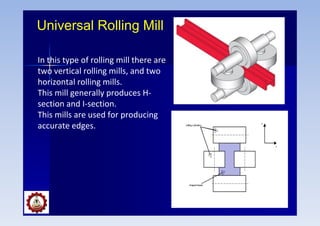
Universal Rolling Mill
In this type of rolling mill there are
two vertical rolling mills, and two
horizontal rolling mills.
This mill generally produces H-
section and I-section.
This mills are used for producing
accurate edges.
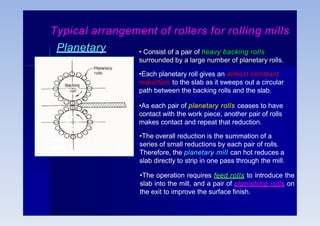
Planetary
mill
• Consist of a pair of heavy backing rolls
surrounded by a large number of planetary rolls.
•Each planetary roll gives an almost constant
reduction to the slab as it sweeps out a circular
path between the backing rolls and the slab.
•As each pair of planetary rolls ceases to have
contact with the work piece, another pair of rolls
makes contact and repeat that reduction.
•The overall reduction is the summation of a
series of small reductions by each pair of rolls.
Therefore, the planetary mill can hot reduces a
slab directly to strip in one pass through the mill.
•The operation requires feed rolls to introduce the
slab into the mill, and a pair of planishing rolls on
the exit to improve the surface finish.
Typical arrangement of rollers for rolling mills
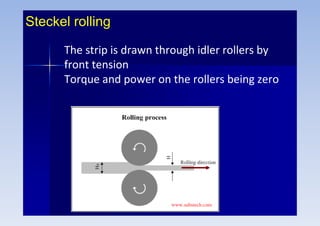
Steckel rolling
The strip is drawn through idler rollers by
front tension
Torque and power on the rollers being zero
Arrangement of Rolling stands
Different types of rolling processes
There are different types of rolling processes as listed below;
• Continuous rolling
• Transverse rolling
• Shaped rolling or section rolling
• Ring rolling
• Powder rolling
• Continuous casting and hot rolling
• Thread rolling
• Tube rolling
Conventional hot or cold-rolling
The objective is to decrease the thickness of the metal with an
increase in length and with little increase in width.
•The material in the centre of the sheet
is constrained in the z direction (across
the width of the sheet) and the
constraints of undeformed
shoulders of material on each side of
the rolls prevent extension of the sheet
in the width direction.
•This condition is known as plane
strain. The material therefore gets
longer and not wider.
•Otherwise we would need the width
of a football pitch to roll down a steel
ingot to make tin plate!
y
z
x
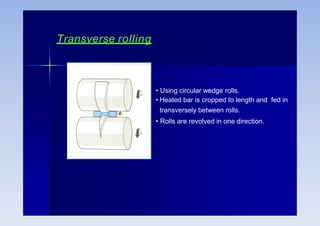
Transverse rolling
• Using circular wedge rolls.
• Heated bar is cropped to length and fed in
transversely between rolls.
• Rolls are revolved in one direction.
Roll Forging
• Also know as draw forging. In roll forging, a bar stock, round or flat is
placed between die rollers which reduces the cross-section and
increases the length to form parts such as axles, leaf springs etc.
Two examples of the roll-forging operation, also known as cross-rolling. Tapered leaf springs
and knives can be made by this process. Source: After J. Holub.
Shaped rolling or section rolling
•A special type of cold rolling in which flat
slap is progressively bent into complex
shapes by passing it through a series of
driven rolls.
•No appreciable change in the thickness
of the metal during this process.
•Suitable for producing moulded sections
such as irregular shaped channels and
trim.
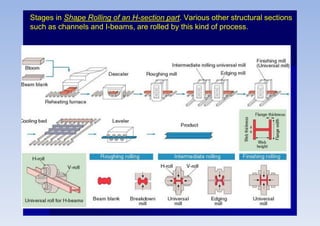
Stages in Shape Rolling of an H-section part. Various other structural sections
such as channels and I-beams, are rolled by this kind of process.
Shaped rolling or section rolling
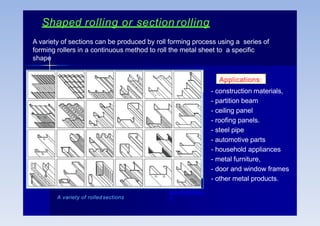
A variety of sections can be produced by roll forming process using a series of
forming rollers in a continuous method to roll the metal sheet to a specific
shape
- construction materials,
- partition beam
- ceiling panel
- roofing panels.
- steel pipe
- automotive parts
- household appliances
- metal furniture,
- door and window frames
- other metal products.
Applications:
www.formtak.co
m
A variety of rolledsections
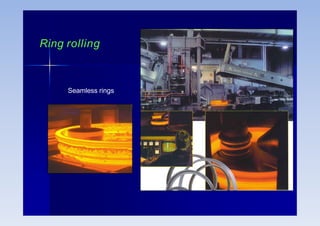
Seamless rings
Ring rolling
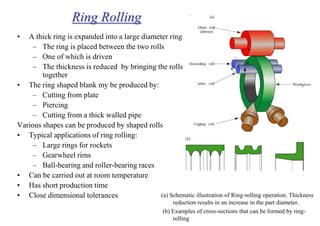
Ring Rolling
• A thick ring is expanded into a large diameter ring
– The ring is placed between the two rolls
– One of which is driven
– The thickness is reduced by bringing the rolls
together
• The ring shaped blank my be produced by:
– Cutting from plate
– Piercing
– Cutting from a thick walled pipe
Various shapes can be produced by shaped rolls
• Typical applications of ring rolling:
– Large rings for rockets
– Gearwheel rims
– Ball-bearing and roller-bearing races
• Can be carried out at room temperature
• Has short production time
• Close dimensional tolerances (a) Schematic illustration of Ring-rolling operation. Thickness
reduction results in an increase in the part diameter.
(b) Examples of cross-sections that can be formed by ring-
rolling
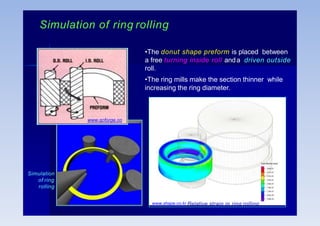
Simulation of ring rolling
www.rz.rwth-
aachen.de
Simulation
of ring
rolling
www.shape.co.kr Relative strain in ring rolling
•The donut shape preform is placed between
a free turning inside roll anda driven outside
roll.
•The ring mills make the section thinner while
increasing the ring diameter.
www.qcforge.co
m
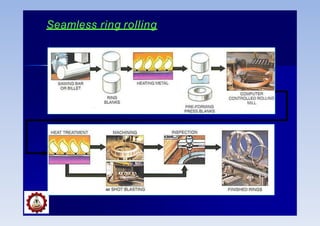
Seamless ring rolling
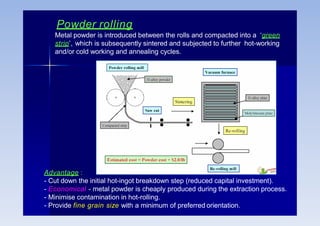
Powder rolling
Metal powder is introduced between the rolls and compacted into a ‘green
strip’, which is subsequently sintered and subjected to further hot-working
and/or cold working and annealing cycles.
Advantage :
- Cut down the initial hot-ingot breakdown step (reduced capital investment).
- Economical - metal powder is cheaply produced during the extraction process.
- Minimise contamination in hot-rolling.
- Provide fine grain size with a minimum of preferred orientation.
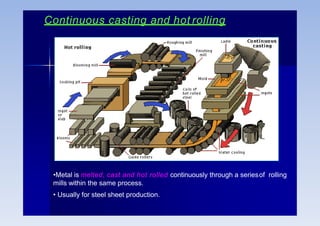
Continuous casting and hot rolling
•Metal is melted, cast and hot rolled continuously through a seriesof rolling
mills within the same process.
• Usually for steel sheet production.
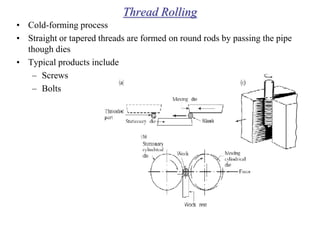
Thread Rolling
• Cold-forming process
• Straight or tapered threads are formed on round rods by passing the pipe
though dies
• Typical products include
– Screws
– Bolts
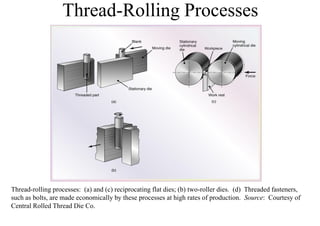
Thread-Rolling Processes
Thread-rolling processes: (a) and (c) reciprocating flat dies; (b) two-roller dies. (d) Threaded fasteners,
such as bolts, are made economically by these processes at high rates of production. Source: Courtesy of
Central Rolled Thread Die Co.
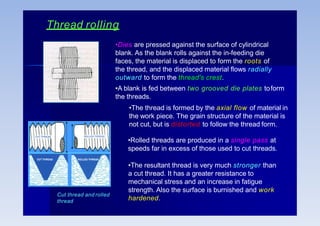
Thread rolling
•The resultant thread is very much stronger than
a cut thread. It has a greater resistance to
mechanical stress and an increase in fatigue
strength. Also the surface is burnished and work
hardened.
•Dies are pressed against the surface of cylindrical
blank. As the blank rolls against the in-feeding die
faces, the material is displaced to form the roots of
the thread, and the displaced material flows radially
outward to form the thread's crest.
•A blank is fed between two grooved die plates toform
the threads.
•The thread is formed by the axial flow of material in
the work piece. The grain structure of the material is
not cut, but is distorted to follow the thread form.
•Rolled threads are produced in a single pass at
speeds far in excess of those used to cut threads.
Cut thread and rolled
thread
Skew rolling
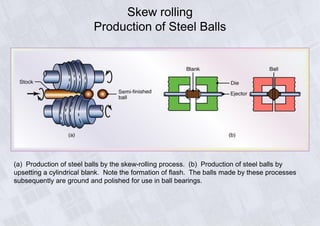
Production of Steel Balls
(a) Production of steel balls by the skew-rolling process. (b) Production of steel balls by
upsetting a cylindrical blank. Note the formation of flash. The balls made by these processes
subsequently are ground and polished for use in ball bearings.
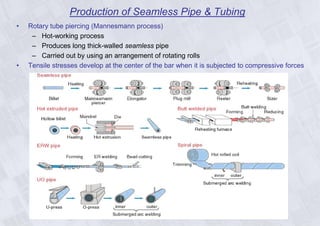
Production of Seamless Pipe & Tubing
• Rotary tube piercing (Mannesmann process)
– Hot-working process
– Produces long thick-walled seamless pipe
– Carried out by using an arrangement of rotating rolls
• Tensile stresses develop at the center of the bar when it is subjected to compressive forces
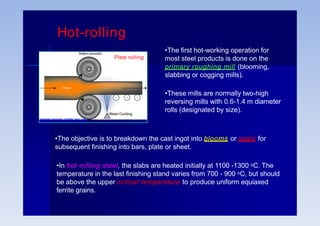
Hot-rolling
•The first hot-working operation for
most steel products is done on the
primary roughing mill (blooming,
slabbing or cogging mills).
•These mills are normally two-high
reversing mills with 0.6-1.4 m diameter
rolls (designated by size).
•The objective is to breakdown the cast ingot into blooms or slabs for
subsequent finishing into bars, plate or sheet.
•In hot-rolling steel, the slabs are heated initially at 1100 -1300 oC. The
temperature in the last finishing stand varies from 700 - 900 oC, but should
be above the upper critical temperature to produce uniform equiaxed
ferrite grains.
Plate rolling
www.msm.cam.ac.uk
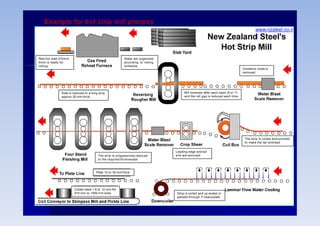
Example for hot strip mill process
www.nzsteel.co.n
z
Oxidation scale is
removed
Mill reverses after each pass (5 or 7)
and the roll gap is reduced each time
Slabs are organised
according to rolling
schedule
Red hot slab 210mm
thick is ready for
rolling
Slab is reduced to a long strip
approx 25 mm thick
The strip is coiled anduncoiled
to make the tail end lead
Leading edge and tail
end are removed
The strip is progressively reduced
to the required thicknesses
Strip is coiled and up ended or
passed through if heavyplate
Coiled steel 1.8 to 12 mm thk
910 mm to 1550 mm wide
Plate 12 to 30 mm thick
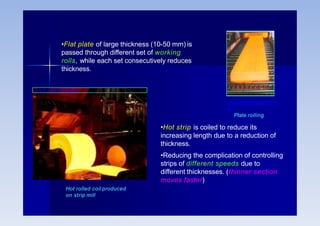
Hot rolled coil produced
on strip mill
www.uksteel.org.uk
•Hot strip is coiled to reduce its
increasing length due to a reduction of
thickness.
•Reducing the complication of controlling
strips of different speeds due to
different thicknesses. (thinner section
moves faster)
•Flat plate of large thickness (10-50 mm) is
passed through different set of working
rolls, while each set consecutively reduces
thickness.
www.reverecopper.co
m
Plate rolling
Cold-rolling
•The starting material for cold-rolled steel
sheet is pickled hot-rolled breakdown coil
from the continuous hot-strip mill.
• The total reduction achieved by cold-rolling generally will vary from about
50 to 90%.
• The reduction in each stand should be distributed uniformly without falling
much below the maximum reduction for each pass.
• Generally the lowest percentage reduction is taken place in the last pass
to permit better control of flatness, gage, and surface finish.
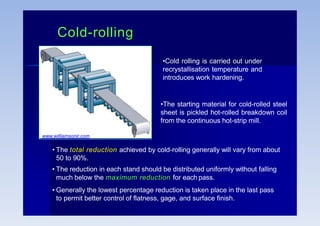
•Cold rolling is carried out under
recrystallisation temperature and
introduces work hardening.
www.williamsonir.com
Cold rolling mill
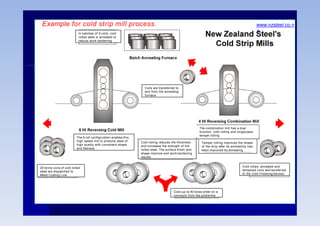
Example for cold strip mill process. www.nzsteel.co.n
z
In batches of 9 coils, cold
rolled steel is annealed to
reduce work hardening
Coils are transferred to
and from the annealing
furnace
The 6 roll configuration enables this
high speed mill to produce steel of
high quality with consistent shape
and flatness
The combination mill has a dual
function, cold rolling and singlepass
temper rolling
Temper rolling improves the shape
of the strip after its workability has
been improved by annealing
Cold rolled, annealed and
tempered coils are transferred
to the Cold Finishing Section
Cold rolling reduces the thickness
and increases the strength of hot
rolled steel. The surface finish and
shape improve and work hardening
results
Coils up to 40 tones enter on a
conveyor from the pickle line
20 tonne coils of cold rolled
steel are dispatched to
Metal Coating Line
Cold-rolling
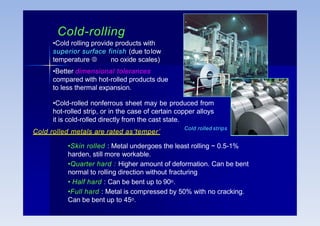
•Cold rolling provide products with
superior surface finish (due tolow
temperature  no oxide scales)
•Better dimensional tolerances
compared with hot-rolled products due
to less thermal expansion.
•Cold-rolled nonferrous sheet may be produced from
hot-rolled strip, or in the case of certain copper alloys
it is cold-rolled directly from the cast state.
Cold rolled strips
Cold rolled metals are rated as‘temper’
•Skin rolled : Metal undergoes the least rolling ~ 0.5-1%
harden, still more workable.
•Quarter hard : Higher amount of deformation. Can be bent
normal to rolling direction without fracturing
• Half hard : Can be bent up to 90o.
•Full hard : Metal is compressed by 50% with no cracking.
Can be bent up to 45o.
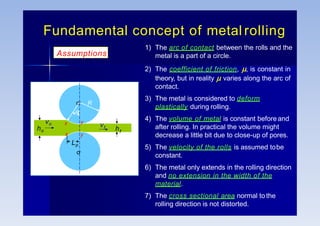
Fundamental concept of metal rolling
1) The arc of contact between the rolls and the
metal is a part of a circle.
2) The coefficient of friction, , is constant in
theory, but in reality  varies along the arc of
contact.
3) The metal is considered to deform
plastically during rolling.
4) The volume of metal is constant beforeand
after rolling. In practical the volume might
decrease a little bit due to close-up of pores.
5) The velocity of the rolls is assumed tobe
constant.
6) The metal only extends in the rolling direction
and no extension in the width of the
material.
7) The cross sectional area normal to the
rolling direction is not distorted.
Assumptions
hf
vo
ho
vf
Lp
o R
o

x
x
y
y
Forces and geometrical relationships in rolling
hf
ho
vo vf
Lp
R
o
o

x
x
y
y
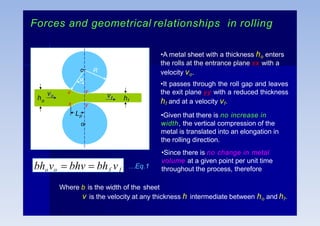
•A metal sheet with a thickness ho enters
the rolls at the entrance plane xx with a
velocity vo.
•It passes through the roll gap and leaves
the exit plane yy with a reduced thickness
hf and at a velocity vf.
•Given that there is no increase in
width, the vertical compression of the
metal is translated into an elongation in
the rolling direction.
•Since there is no change in metal
volume at a given point per unit time
throughout the process, therefore
bhovo  bhv  bhf vf
…Eq.1
Where b is the width of the sheet
v is the velocity at any thickness h intermediate between ho and hf.
hf
vo
ho
x’
x y
y’
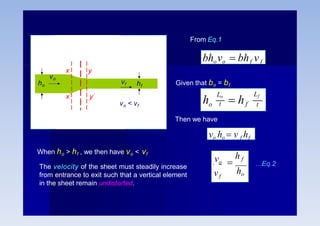
From Eq.1
bhovo  bhf vf
Given that bo = bf
o
Lf
f t
Lo
t
h  h
Then we have
vo ho  v f hf
vo
vf

h f
ho
…Eq.2
vf
vo < vf
When ho > hf , we then have vo < vf
The velocity of the sheet must steadily increase
from entrance to exit such that a vertical element
in the sheet remain undistorted.
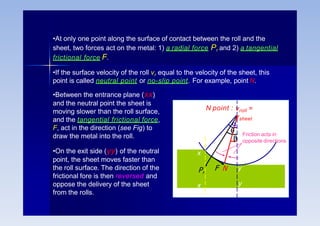
•Between the entrance plane (xx)
and the neutral point the sheet is
moving slower than the roll surface,
and the tangential frictional force,
F, act in the direction (see Fig) to
draw the metal into the roll.
•On the exit side (yy) of the neutral
point, the sheet moves faster than
the roll surface. The direction of the
frictional fore is then reversed and
oppose the delivery of the sheet
from the rolls.
•At only one point along the surface of contact between the roll and the
sheet, two forces act on the metal: 1) a radial force Pr and 2) a tangential
frictional force F.
•If the surface velocity of the roll vr equal to the velocity of the sheet, this
point is called neutral point or no-slip point. For example, point N.
x
Pr
x
y
y
vroll =
vsheet
F N
N point :



Friction acts in
opposite directions
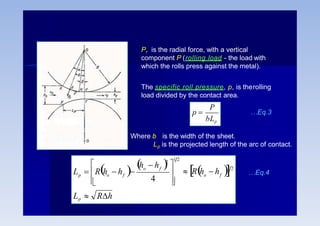
Pr is the radial force, with a vertical
component P (rolling load - the load with
which the rolls press against the metal).
The specific roll pressure, p, is therolling
load divided by the contact area.
P
bLp
p  …Eq.3
Where b is the width of the sheet.
Lp is the projected length of the arc of contact.
o f
o f
f
p o
Lp  Rh
 Rh  h 





 h  h 
L  R h  h  1 2
1 2
2
4
…Eq.4
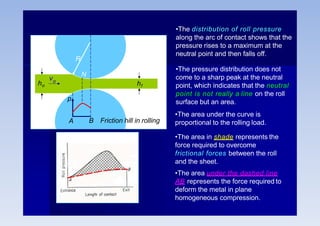
•The distribution of roll pressure
along the arc of contact shows that the
pressure rises to a maximum at the
neutral point and then falls off.
hf
ho
vo
A
p
N
R
B Friction hill in rolling
•The pressure distribution does not
come to a sharp peak at the neutral
point, which indicates that the neutral
point is not really a line on the roll
surface but an area.
•The area under the curve is
proportional to the rolling load.
•The area in shade represents the
force required to overcome
frictional forces between the roll
and the sheet.
•The area under the dashed line
AB represents the force required to
deform the metal in plane
homogeneous compression.
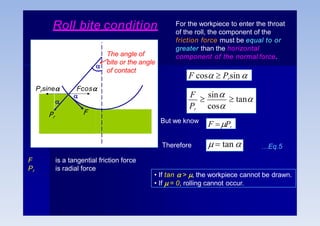
Roll bite condition For the workpiece to enter the throat
of the roll, the component of the
friction force must be equal to or
greater than the horizontal
component of the normal force.
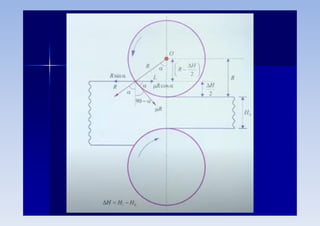
F cos  Prsin 
Pr cos
F

sin  tan
But we know
F Pr
  tan 
Therefore
F
Fcos

Prsine

Pr
F
Pr
is a tangential friction force
is radial force
…Eq.5
• If tan  > , the workpiece cannot be drawn.
• If  = 0, rolling cannot occur.
The angle of

bite or the angle
of contact
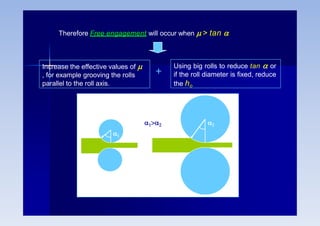
Therefore Free engagement will occur when  > tan 
Increase the effective values of 
, for example grooving the rolls
parallel to the roll axis.
Using big rolls to reduce tan  or
if the roll diameter is fixed, reduce
the ho
+



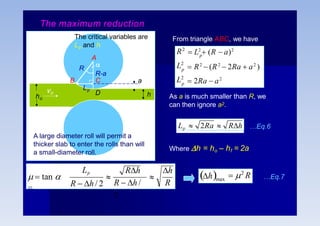
From triangle ABC, we have
L2
L2
R2
p
p
p
 R2
 (R2
 2Ra  a2
)
 2Ra  a2
 L2
 (R  a)2
As a is much smaller than R, we
can then ignore a2.
Lp  2Ra  Rh
Where h = ho – hf = 2a
…Eq.6
a
h
B
Lp

R-a
C
D
vo
ho
The critical variables are
Lp and h
A
R
A large diameter roll will permit a
thicker slab to enter the rolls than will
a small-diameter roll.
h
R


Rh
R  h/
2
Lp
R  h / 2
  tan 

…Eq.7
max
 2
R
h
The maximum reduction
Problem with roll flattening
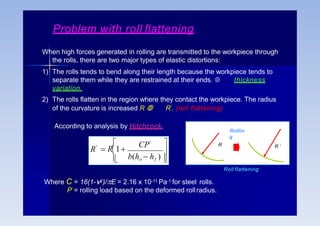
When high forces generated in rolling are transmitted to the workpiece through
the rolls, there are two major types of elastic distortions:
1) The rolls tends to bend along their length because the workpiece tends to
separate them while they are restrained at their ends.  thickness
variation.
2) The rolls flatten in the region where they contact the workpiece. The radius
of the curvature is increased R  R’. (roll flattening)
According to analysis by Hitchcock,

 
b(ho  hf )
CP'
 R1

R' R R ‘
Roll flattening
Where C = 16(1-2)/E = 2.16 x 10⁻¹¹ Pa-1 for steel rolls.
P’ = rolling load based on the deformed rollradius.
Rolllin
g
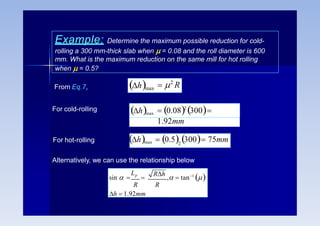
Example: Determine the maximum possible reduction for cold-
rolling a 300 mm-thick slab when  = 0.08 and the roll diameter is 600
mm. What is the maximum reduction on the same mill for hot rolling
when  = 0.5?
From Eq.7,  2
R
hmax
 0.082
300
1.92mm
hmax
For cold-rolling
For hot-rolling hmax  0.5 300 75mm
2
Alternatively, we can use the relationship below
sin  
Lp

Rh
,  tan1

R R
h  1.92mm
Simplified analysis of rolling load
The main variables in rolling are:
• The roll diameter.
• The deformation resistance of the metal as influenced by metallurgy,
temperature and strain rate.
• The friction between the rolls and the workpiece.
• The presence of the front tension and/or back tension in the plane of the
sheet.
We consider in three conditions:
1) No friction condition
2) Normal friction condition
3) Sticky friction condition
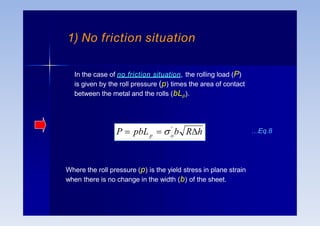
In the case of no friction situation, the rolling load (P)
is given by the roll pressure (p) times the area of contact
between the metal and the rolls (bLp).
o
p
'
P  pbL   b Rh
Where the roll pressure (p) is the yield stress in plane strain
when there is no change in the width (b) of the sheet.
…Eq.8
1) No friction situation
_
Q
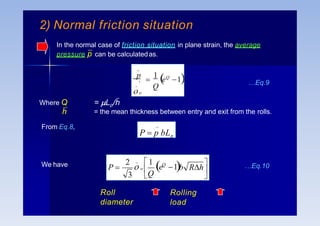
p

1
eQ
1
_ '
 o
…Eq.9
_
P  p bLp


b Rh

Q
P  Q
2  1
3
_
 o  e 1
We have …Eq.10
Roll
diameter
Rolling
load
Where Q
h
From Eq.8,
= Lp/h
= the mean thickness between entry and exit from the rolls.
2) Normal friction situation
In the normal case of friction situation in plane strain, the average
pressure p can be calculatedas.
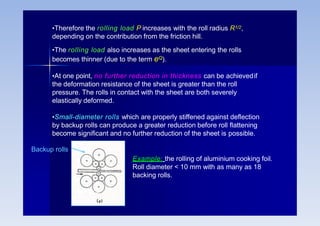
•Therefore the rolling load P increases with the roll radius R1/2,
depending on the contribution from the friction hill.
•The rolling load also increases as the sheet entering the rolls
becomes thinner (due to the term eQ).
•At one point, no further reduction in thickness can be achievedif
the deformation resistance of the sheet is greater than the roll
pressure. The rolls in contact with the sheet are both severely
elastically deformed.
•Small-diameter rolls which are properly stiffened against deflection
by backup rolls can produce a greater reduction before roll flattening
become significant and no further reduction of the sheet is possible.
Backup rolls
Example: the rolling of aluminium cooking foil.
Roll diameter < 10 mm with as many as 18
backing rolls.
•Frictional force is needed to
pull the metal into the rolls and
responsible for a large portion
of the rolling load.
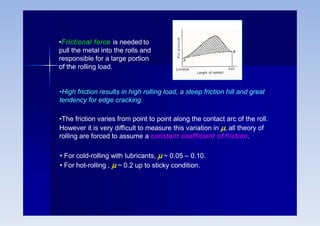
•High friction results in high rolling load, a steep friction hill and great
tendency for edge cracking.
•The friction varies from point to point along the contact arc of the roll.
However it is very difficult to measure this variation in , all theory of
rolling are forced to assume a constant coefficient of friction.
• For cold-rolling with lubricants,  ~ 0.05 – 0.10.
• For hot-rolling ,  ~ 0.2 up to sticky condition.
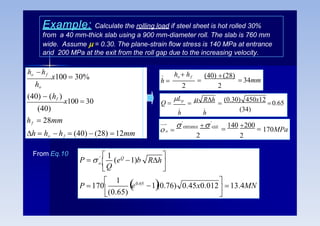
Example: Calculate the rolling load if steel sheet is hot rolled 30%
from a 40 mm-thick slab using a 900 mm-diameter roll. The slab is 760 mm
wide. Assume  = 0.30. The plane-strain flow stress is 140 MPa at entrance
and 200 MPa at the exit from the roll gap due to the increasing velocity.
ho hf
x100  30%
ho
(40)  (hf )
x100  30
(40)
hf  28mm
h  ho  hf  (40)  (28) 12mm
 34mm
(40) (28)
2

ho  hf
2
_
h 
(34)
_
h
_
h

 Rh

(0.30) 450x12
0.65
Q 
Lp
exit
o 170MPa
entrance
2
'
'
'  
140 200

2

 
Q
1


0.45x0.012

 13.4MN
(0.65)

e0.65
1(0.76)
P 170



o 

Rh

P   '  1
(eQ
1)b
From Eq.10
_
P  p bLp
From Eq.8,
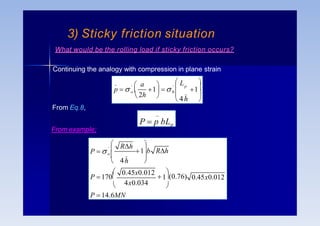
What would be the rolling load if sticky friction occurs?
Continuing the analogy with compression in plane strain



 



 
1
_
'
0
_
 4h 
L
a
2h
p
'
o 1 
p  
0.45x0.012
4x0.034
_
'
P  14.6MN
1

 0.45x0.012


(0.76)
P 170



o

 4h 
 

1 b Rh
Rh
P  
3) Sticky friction situation
From example;
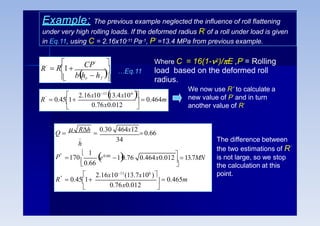
Example: The previous example neglected the influence of roll flattening
under very high rolling loads. If the deformed radius R’ of a roll under load is given
in Eq.11, using C = 2.16x10⁻¹¹ Pa-1, P’ =13.4 MPa from previous example.


 
bho  hf
CP'
R'
 R1

…Eq.11
Where C = 16(1-2)/E ,P’ = Rolling
load based on the deformed roll
radius.
0.76x0.012
'
  0.464m



R  0.451
2.16x1011

13.4x10⁶

We now use R’ to calculate a
new value of P’ and in turn
another value of R’
0.76x0.012
''
P''
_
h
  0.465m



R  0.451

0.66
 1

34
e0.66
1
0.76 0.464x0.012
  13.7MN
170
2.16x1011
(13.7x10⁶
)
Q 
 Rh

0.30 464x12
0.66
The difference between
the two estimations of R’
is not large, so we stop
the calculation at this
point.
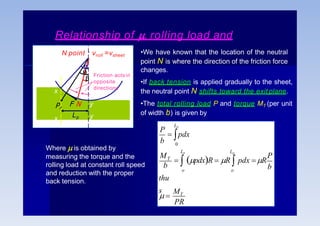
Relationship of , rolling load and
torque •We have known that the location of the neutral
point N is where the direction of the friction force
changes.
•If back tension is applied gradually to the sheet,
the neutral point N shifts toward the exit plane.
•The total rolling load P and torque MT (per unit
of width b) is given by


x
Pr
x
y
y
N point : vroll =vsheet

Friction acts in
opposite
directions
PR
P
b
b
thu
s
P
b
M
o o
T
L
L Lp
p
p
 pdx
 
MT
  pdxR  R  pdx R
0
Where  is obtained by
measuring the torque and the
rolling load at constant roll speed
and reduction with the proper
back tension.
F N
Lp
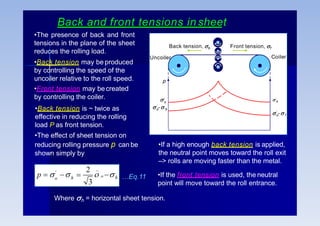
Back and front tensions in sheet
’
o
’
o
’ -
o b
’ -
o f
p
Back tension, b
Uncoiler
Front tension, f
Coiler
h  o 

p   
_
'
o
2
3
h …Eq.11
Where h = horizontal sheet tension.
•If a high enough back tension is applied,
the neutral point moves toward the roll exit
–> rolls are moving faster than the metal.
•If the front tension is used, the neutral
point will move toward the roll entrance.
•The presence of back and front
tensions in the plane of the sheet
reduces the rolling load.
•Back tension may be produced
by controlling the speed of the
uncoiler relative to the roll speed.
•Front tension may becreated
by controlling the coiler.
•Back tension is ~ twice as
effective in reducing the rolling
load P as front tension.
•The effect of sheet tension on
reducing rolling pressure p can be
shown simply by
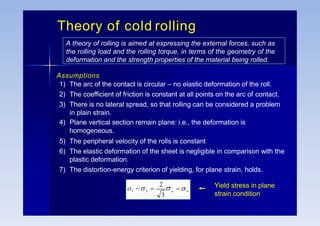
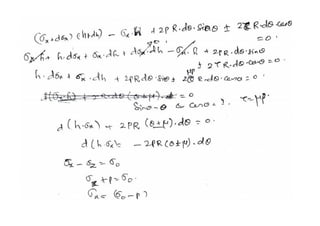
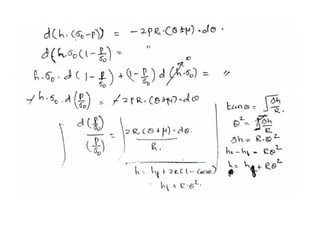
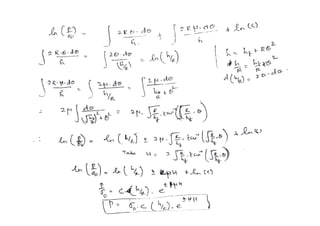
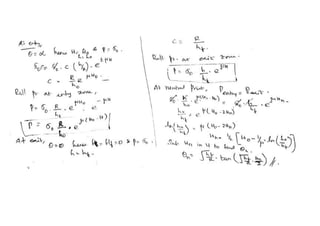
Theory of cold rolling
A theory of rolling is aimed at expressing the external forces, such as
the rolling load and the rolling torque, in terms of the geometry of the
deformation and the strength properties of the material being rolled.
Assumptions
1) The arc of the contact is circular – no elastic deformation of the roll.
2) The coefficient of friction is constant at all points on the arc of contact.
3) There is no lateral spread, so that rolling can be considered a problem
in plain strain.
4) Plane vertical section remain plane: i.e., the deformation is
homogeneous.
5) The peripheral velocity of the rolls is constant
6) The elastic deformation of the sheet is negligible in comparison with the
plastic deformation.
7) The distortion-energy criterion of yielding, for plane strain, holds.
3
1
'
o
o
2

3

   Yield stress in plane
strain condition
hf
B
h
ho h+dh
d

o
x+dx x

P
r
cos

Prsin
Pr
Prcos
Pr

P
r
sin

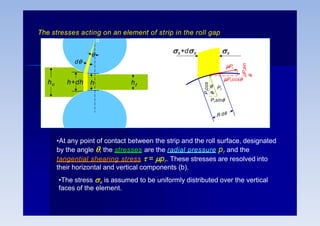
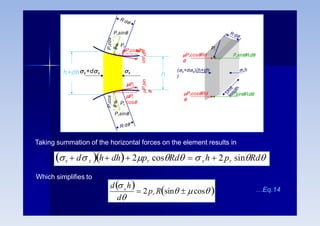
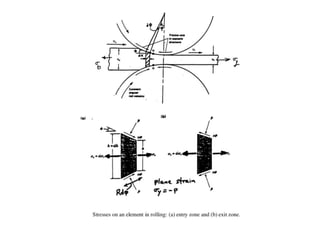
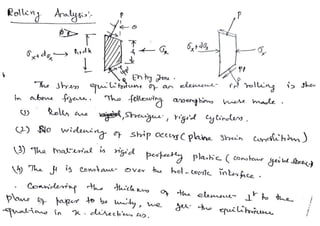
The stresses acting on an element of strip in the roll gap
•At any point of contact between the strip and the roll surface, designated
by the angle , the stresses are the radial pressure pr and the
tangential shearing stress  = pr. These stresses are resolved into
their horizontal and vertical components (b).
•The stress x is assumed to be uniformly distributed over the vertical
faces of the element.
x
Pr

P
r
sin


P
r
cos

Prsin
Pr
Prcos

P
r
sin

h+dhx+dx h

P
r
cos

Prsin
Pr
r
P
cos
xh
(x+dx)(h+dh
)
Pr
PrsinRd
PrsinRd
PrcosRd

PrcosRd

d
d h
 2pr Rsin  cos 
x
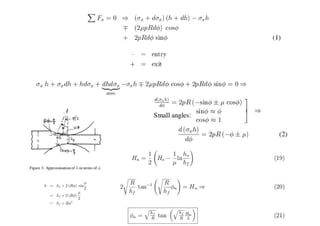
Taking summation of the horizontal forces on the element results in
x  d x h dh 2pr cosRd   x h  2pr sinRd
Which simplifies to
…Eq.14
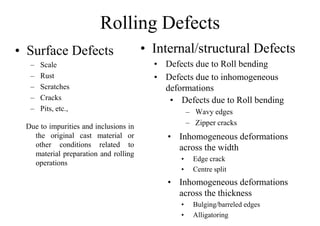
Rolling Defects
• Surface Defects
– Scale
– Rust
– Scratches
– Cracks
– Pits, etc.,
• Defects due to Roll bending
– Wavy edges
– Zipper cracks
• Inhomogeneous deformations
across the width
• Edge crack
• Centre split
• Internal/structural Defects
• Defects due to Roll bending
• Defects due to inhomogeneous
deformations
• Inhomogeneous deformations
across the thickness
• Bulging/barreled edges
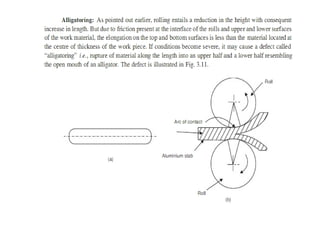
• Alligatoring
Due to impurities and inclusions in
the original cast material or
other conditions related to
material preparation and rolling
operations
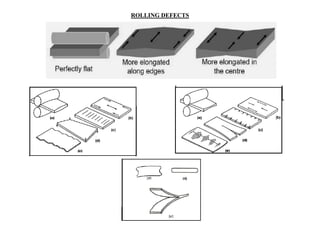
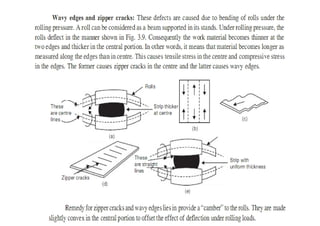
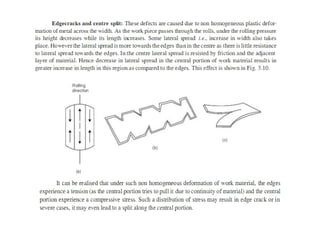
ROLLING DEFECTS
Problems and defects in rolled
products
Defects from cast ingot beforerolling
Defects other than cracks can result from defects introduced during the
ingot stage of production.
•Porosity, cavity, blow hole occurred in the cast ingot will be closedup
during the rolling process.
•Longitudinal stringers of non-metallic inclusions or pearlite banding
are related to melting and solidification practices. In severe cases, these
defects can lead to laminations which drastically reduce the strength in the
thickness direction.
Defects during rolling
There are two aspects to the problem of the shape of a sheet.
1) Uniform thickness over the width and thickness – can be precisely
controlled with modern gage control system.
2) Flatness – difficult to measure accurately.
h h
•Under high rolling forces, the rolls flatten
and bend, and the entire mill is elastically
distorted.
•Mill spring causes the thickness of the
sheet exiting from the rolling mill to be
greater than the roll gap set under no-load
conditions.
•Precise thickness rolling requires the
elastic constant of the mill. Calibration
curves are needed, see Fig.
(1–3 GNm-1 for screw-loaded rolling mills, 4
GNm-1 for hydraulically loaded mills).
Uniform thickness
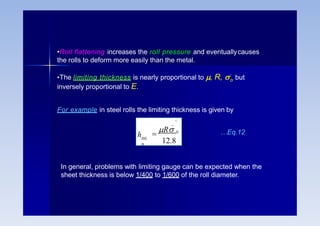
•Roll flattening increases the roll pressure and eventuallycauses
the rolls to deform more easily than the metal.
o
•The limiting thickness is nearly proportional to , R, ’ but
inversely proportional to E.
For example in steel rolls the limiting thickness is given by
_ '
mi
n
h 
R o
12.8
…Eq.12
In general, problems with limiting gauge can be expected when the
sheet thickness is below 1/400 to 1/600 of the roll diameter.
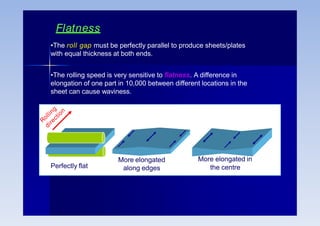
Flatness
•The roll gap must be perfectly parallel to produce sheets/plates
with equal thickness at both ends.
•The rolling speed is very sensitive to flatness. A difference in
elongation of one part in 10,000 between different locations in the
sheet can cause waviness.
Perfectly flat
More elongated
along edges
More elongated in
the centre
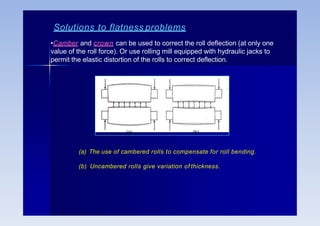
•Camber and crown can be used to correct the roll deflection (at only one
value of the roll force). Or use rolling mill equipped with hydraulic jacks to
permit the elastic distortion of the rolls to correct deflection.
(a) (b)
(a) The use of cambered rolls to compensate for roll bending.
(b) Uncambered rolls give variation of thickness.
Solutions to flatness problems
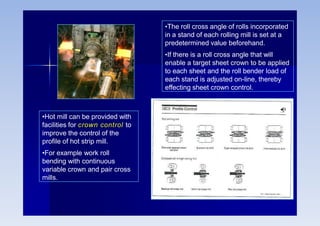
•Hot mill can be provided with
facilities for crown control to
improve the control of the
profile of hot strip mill.
•For example work roll
bending with continuous
variable crown and pair cross
mills.
•The roll cross angle of rolls incorporated
in a stand of each rolling mill is set at a
predetermined value beforehand.
•If there is a roll cross angle that will
enable a target sheet crown to be applied
to each sheet and the roll bender load of
each stand is adjusted on-line, thereby
effecting sheet crown control.
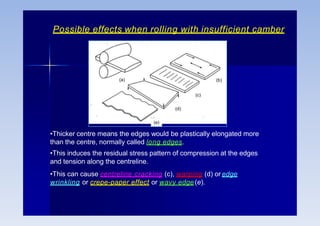
Possible effects when rolling with insufficient camber
•Thicker centre means the edges would be plastically elongated more
than the centre, normally called long edges.
•This induces the residual stress pattern of compression at the edges
and tension along the centreline.
•This can cause centreline cracking (c), warping (d) or edge
wrinkling or crepe-paper effect or wavy edge(e).
(a) (b)
(c)
(d)
(e)
Possible effects when rolls areover-cambered.
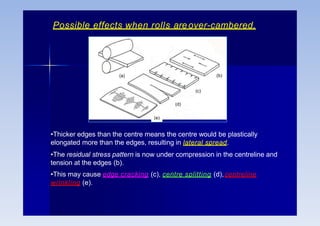
•Thicker edges than the centre means the centre would be plastically
elongated more than the edges, resulting in lateral spread.
•The residual stress pattern is now under compression in the centreline and
tension at the edges (b).
•This may cause edge cracking (c), centre splitting (d),centreline
wrinkling (e).
(a) (b)
(c)
(d)
(e)
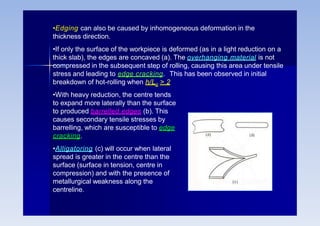
•Edging can also be caused by inhomogeneous deformation in the
thickness direction.
•If only the surface of the workpiece is deformed (as in a light reduction on a
thick slab), the edges are concaved (a). The overhanging material is not
compressed in the subsequent step of rolling, causing this area under tensile
stress and leading to edge cracking. This has been observed in initial
breakdown of hot-rolling when h/Lp > 2
•With heavy reduction, the centre tends
to expand more laterally than the surface
to produced barrelled edges (b). This
causes secondary tensile stresses by
barrelling, which are susceptible to edge
cracking.
•Alligatoring (c) will occur when lateral
spread is greater in the centre than the
surface (surface in tension, centre in
compression) and with the presence of
metallurgical weakness along the
centreline.
•Surface defects are more easily in rolling due to high surface to
volume ratio. Grinding , chipping or descaling of defects on the
surface of cast ingots or billets are recommended before being
rolled.
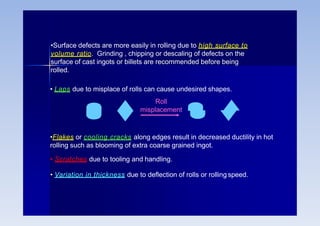
• Laps due to misplace of rolls can cause undesired shapes.
Roll
misplacement
•Flakes or cooling cracks along edges result in decreased ductility in hot
rolling such as blooming of extra coarse grained ingot.
• Scratches due to tooling and handling.
• Variation in thickness due to deflection of rolls or rolling speed.
References
•Dieter, G.E., Mechanical metallurgy, 1988, SI metric edition,
McGraw-Hill, ISBN 0-07-100406-8.
•Edwards, L. and Endean, M., Manufacturing with materials, 1990,
Butterworth Heinemann, ISBN 0-7506-2754-9.
•Beddoes, J. and Bibbly M.J., Principles of metal manufacturing
process, 1999, Arnold, ISBN 0-470-35241-8.
• Lecture note, 2003.
• Firth Rixson leavelets.
• Metal forming processes, Prof Manas.
• Metal forming lecture, Ass Prof. P. Srichareonchai.

Rolling Process.pdf

  • 1.
  • 2.
    Rolling Process • Introduction •Rolling mills • Classification of rolling processes • Hot rolling • Cold rolling • Forces and geometry relationships in rolling • Simplified analysis of rolling load: Rolling variables • Problems and defects in rolled products • Rolling-mill control • Theories of cold rolling • Theories of hot rolling • Torque and power
  • 3.
    Introduction- Definition ofrolling process •Definition of Rolling : Rolling process www.world-aluminium.org Note: rolling processes can be mainly divided into 1) hot rolling and 2) cold rolling. The Process of Plastically deforming metal / alloy by passing it between rolls is known as ROLLING. Rolling done either at Hot or cold. The metal is drawn into the opening between the rolls by frictional forces. Work piece is subjected to high compressive forces due to squeezing action of rolls, resulting in reduced area of cross- section and increased length.
  • 4.
    Introduction- Hot andcold rolling processes •The initial breakdown of ingots into blooms and billets is generally done by hot-rolling. This is followed by further hot- rolling into plate, sheet, rod, bar, pipe, rail. Hot rolling Cold rolling •The cold-rolling of metals has played a major role in industry by providing sheet, strip, foil with good surface finishes and increased mechanical strength with close control of product dimensions.
  • 5.
    HOT ROLLING COLDROLLING • Process is carried out at above recrystallisation temperature. • Process is carried out at below recrystallisation temperature. • Pressure applied is less due to high temperature. • High pressure is applied. • Coarse grain becomes fine grains. • The grains becomes longer and distorted. • No residual stresses are generated. • Residual stresses are generated. • Tool handling cost is more. • Tool handling cost is less. • Improves ductility. • Ductility reduces. • Surface finish and accuracy is less. • Surface Finish and Accuracy is more.
  • 6.
    Terminology • Bloom isthe product of first breakdown of ingot (cross sectional area > 230 cm2). • Billet is the product obtained from a further reduction by hot rolling (cross sectional area > 40x40 mm2). • Slab Semi- finished products • Plate is the product with a thickness > 6 mm. • Sheet is the product with a thickness < 6 mm and width > 600 mm. • Strip is the product with a thickness < 6 mm and width < 600 mm. Mill products Further rolling steps Bloom Billet Slap is the hot rolled ingot (cross sectional area > 100 cm2 and with a width  2 x thickness). Plate Sheet Strip
  • 7.
    INGOT SLAB BLOOMS Plate & Sheet Billet barsRods Wires Terminology of Rolling Strips Foils
  • 9.
    Basic Definitions • Ingot: The metal in a square shape obtained from casting process is known as ingot. Area range : 300 to 500 mm^2 Length is between 1.5 to 2m 400mm 400mm 1.5 m
  • 10.
    Basic Definitions • Bloom:Metal piece smaller than ingot. Area range : 150X150 mm^2 (Square) 200 to 300 mm^2 (Rectangle) Length is between 3.5 to 5.5 m 250 mm 250 mm 4.5 m
  • 11.
    Basic Definitions • Billet: Metal piece produced from bloom is known as Billet. Further billet is rolled into bars. (40X40 – 125X125 mm^2) • Bar/Rod: Long, straight and symmetrical piece of round or square cross sections. (>10 mm^2) Billet 100 mm 100 mm Bars Rods Wires
  • 12.
    Basic Definitions • Slab:The rectangular cross section type metal obtained from rolling of bloom or billet is known as slab. Thickness: 50 to 150 mm Width : 0.5 to 1.5 m SLAB
  • 13.
    Basic Definitions • Plate: Further rolling slabs, we get plates. Width : 750 to 1200 mm Thickness: 2.7 to 7mm Length: 1.5m to 3m PLATE
  • 14.
    Basic Definitions • Sheet: Rolling of Slab will result into sheets. Thickness: 0.21 to 2.64mm Width and length same as plate. SHEET
  • 15.
    Basic Definitions • Flat: 2.5mm to 6mm thickness strip is known as flat. • Strip : 0.1 mm to 2.5 mm thickness is known as strip. The width is very less compared to length. • Foil: Maximum thickness = 1.5 mm, Maximum width = 300 mm
  • 16.
    Classification of rollingmills No. of rolls in the stand i. Two-high mills ii. Tow-high reversing mills iii. Three-high mills iv. Four-high mills v. Tandem/Continuous mills vi. Cluster mills vii. Sendzimir mills viii. Universal rolling mills ix. Planetary mills x. Steckel rolling Products rolled i. Blooming & Slabbing mills (D= 800 – 1400 mm) i. Billet mills (450 – 850 mm) ii. Rail & Structural mills (750 -800 mm) iii. Section mills (250 – 750 mm) iv. Rod mills (250 mm) v. Sheet & Plate mills ( L= 800 – 5000 mm Hot rolling) , (L= 300 – 2800 mm Cold rolling) vi. Seamless tube mills vii. Tyre & Wheel mills Arrangement of rolling stand i) Looping mill ii) Cross – country mill iii) Continuous mill
  • 18.
    Typical arrangement ofrollers for rolling mills Two-high mill, pullover The stock is returned to the entrance for further reduction. Two-high mill, reversing The work can be passed back and forth through the rolls by reversing their direction of rotation. Three-high mill Consist of upper and lower driven rolls and a middle roll, which rotates by friction. Four-high mill Small-diameter rolls (less strength & rigidity) are supported by larger-diameter backup rolls Cluster mill or Sendzimir mill Each of the work rolls is supported by two backing rolls.
  • 19.
    Two – HighRolling mills • 2- High Pull Rolling Mill  In this type of rolling mill, the direction of feed is from one side only.  It uses two rollers.  i.e when the first pass is over, the work piece is again brought back to its original position and the rolled back again, which lesser space between the rollers.
  • 20.
    Two – HighRolling mills • Two High Reversing Mill  In this method of rolling, the direction of feed is from both direction.  Here also, 2 mills are used.  During this process, handling of work piece is easier. (1) (2) • Two high rolling mills are used for bloom, billet or slab rolling. • Two high roll mills are normally used for obtaining medium change in cross section. • For every pass in reverse mill, the direction of roller is to be changed.
  • 21.
    Three – HighRolling mills • Here total three rollers are used. Upper, middle and lower roller. • As shown in figure, we can easily see that the gap between upper roll and middle roll is more compared to middle and lower roll.
  • 22.
    Three – HighRolling mills • The reason for this is, initially, the ingot or bloom is fed between upper and middle roll to decrease the cross section. • Thereafter, in the reverse pass, the work piece is passed between middle and lower roller to further decrease its cross section.
  • 23.
    Three – HighRolling mills • In this process, there is no need to change the direction of roller. • Thus, minimum power is required. • Bloom, billet, channel, rail can be manufactured. • It is cheaper.
  • 24.
    Four High RollingMills • Here total four rolls are used, of which two are bigger rolls and two smaller ones. • The bigger rolls are known as back up rolls. • The smaller rolls are known as working rolls.
  • 25.
    Four High RollingMills • Here, metal with bigger size are rolled by passing them between the working (smaller) rolls. • Since, these rolls are used to roll bigger sizes metals, they have to face shocks and vibrations.
  • 26.
    Four High RollingMills • Also, huge amount of pressure is to be applied. • For this purpose, back up rolls (bigger rolls) are used. • The work piece can be entered between the rolls in both direction by changing the roll direction and space between the working rolls.
  • 27.
    Cluster Rolling Mill •As from the figures, we can say cluster mills are the type of rolling mills, which has 6 or more rolling mills in operation. • It is used for cold working of metals.
  • 28.
    Continuous (Tandom) Rolling Mill •Its arrangement is similar to two – high rolling mill. • Here, the metal work piece passes from one roll pass to another and we get continuous reduction in size. • Used for mass production.
  • 29.
    •Use a seriesof rolling mill and each set is called a stand. •The strip will be moving at different velocities at each stage in the mill. A four stand continuous mill or tandem mil. •The speed of each set of rolls is synchronised so that the input speed of each stand is equal to the output speed of preceding stand. •The uncoiler and windup reel not only feed the stock into the rolls and coiling up the final product but also provide back tension and front tension to thestrip. b f Typical arrangement of rollers for rolling mills Continuous rolling
  • 30.
    Universal Rolling Mill Inthis type of rolling mill there are two vertical rolling mills, and two horizontal rolling mills. This mill generally produces H- section and I-section. This mills are used for producing accurate edges.
  • 31.
    Planetary mill • Consist ofa pair of heavy backing rolls surrounded by a large number of planetary rolls. •Each planetary roll gives an almost constant reduction to the slab as it sweeps out a circular path between the backing rolls and the slab. •As each pair of planetary rolls ceases to have contact with the work piece, another pair of rolls makes contact and repeat that reduction. •The overall reduction is the summation of a series of small reductions by each pair of rolls. Therefore, the planetary mill can hot reduces a slab directly to strip in one pass through the mill. •The operation requires feed rolls to introduce the slab into the mill, and a pair of planishing rolls on the exit to improve the surface finish. Typical arrangement of rollers for rolling mills
  • 32.
    Steckel rolling The stripis drawn through idler rollers by front tension Torque and power on the rollers being zero
  • 33.
  • 34.
    Different types ofrolling processes There are different types of rolling processes as listed below; • Continuous rolling • Transverse rolling • Shaped rolling or section rolling • Ring rolling • Powder rolling • Continuous casting and hot rolling • Thread rolling • Tube rolling
  • 35.
    Conventional hot orcold-rolling The objective is to decrease the thickness of the metal with an increase in length and with little increase in width. •The material in the centre of the sheet is constrained in the z direction (across the width of the sheet) and the constraints of undeformed shoulders of material on each side of the rolls prevent extension of the sheet in the width direction. •This condition is known as plane strain. The material therefore gets longer and not wider. •Otherwise we would need the width of a football pitch to roll down a steel ingot to make tin plate! y z x
  • 36.
    Transverse rolling • Usingcircular wedge rolls. • Heated bar is cropped to length and fed in transversely between rolls. • Rolls are revolved in one direction.
  • 37.
    Roll Forging • Alsoknow as draw forging. In roll forging, a bar stock, round or flat is placed between die rollers which reduces the cross-section and increases the length to form parts such as axles, leaf springs etc. Two examples of the roll-forging operation, also known as cross-rolling. Tapered leaf springs and knives can be made by this process. Source: After J. Holub.
  • 38.
    Shaped rolling orsection rolling •A special type of cold rolling in which flat slap is progressively bent into complex shapes by passing it through a series of driven rolls. •No appreciable change in the thickness of the metal during this process. •Suitable for producing moulded sections such as irregular shaped channels and trim.
  • 39.
    Stages in ShapeRolling of an H-section part. Various other structural sections such as channels and I-beams, are rolled by this kind of process.
  • 40.
    Shaped rolling orsection rolling A variety of sections can be produced by roll forming process using a series of forming rollers in a continuous method to roll the metal sheet to a specific shape - construction materials, - partition beam - ceiling panel - roofing panels. - steel pipe - automotive parts - household appliances - metal furniture, - door and window frames - other metal products. Applications: www.formtak.co m A variety of rolledsections
  • 41.
  • 42.
    Ring Rolling • Athick ring is expanded into a large diameter ring – The ring is placed between the two rolls – One of which is driven – The thickness is reduced by bringing the rolls together • The ring shaped blank my be produced by: – Cutting from plate – Piercing – Cutting from a thick walled pipe Various shapes can be produced by shaped rolls • Typical applications of ring rolling: – Large rings for rockets – Gearwheel rims – Ball-bearing and roller-bearing races • Can be carried out at room temperature • Has short production time • Close dimensional tolerances (a) Schematic illustration of Ring-rolling operation. Thickness reduction results in an increase in the part diameter. (b) Examples of cross-sections that can be formed by ring- rolling
  • 43.
    Simulation of ringrolling www.rz.rwth- aachen.de Simulation of ring rolling www.shape.co.kr Relative strain in ring rolling •The donut shape preform is placed between a free turning inside roll anda driven outside roll. •The ring mills make the section thinner while increasing the ring diameter. www.qcforge.co m
  • 44.
  • 45.
    Powder rolling Metal powderis introduced between the rolls and compacted into a ‘green strip’, which is subsequently sintered and subjected to further hot-working and/or cold working and annealing cycles. Advantage : - Cut down the initial hot-ingot breakdown step (reduced capital investment). - Economical - metal powder is cheaply produced during the extraction process. - Minimise contamination in hot-rolling. - Provide fine grain size with a minimum of preferred orientation.
  • 46.
    Continuous casting andhot rolling •Metal is melted, cast and hot rolled continuously through a seriesof rolling mills within the same process. • Usually for steel sheet production.
  • 47.
    Thread Rolling • Cold-formingprocess • Straight or tapered threads are formed on round rods by passing the pipe though dies • Typical products include – Screws – Bolts
  • 48.
    Thread-Rolling Processes Thread-rolling processes:(a) and (c) reciprocating flat dies; (b) two-roller dies. (d) Threaded fasteners, such as bolts, are made economically by these processes at high rates of production. Source: Courtesy of Central Rolled Thread Die Co.
  • 49.
    Thread rolling •The resultantthread is very much stronger than a cut thread. It has a greater resistance to mechanical stress and an increase in fatigue strength. Also the surface is burnished and work hardened. •Dies are pressed against the surface of cylindrical blank. As the blank rolls against the in-feeding die faces, the material is displaced to form the roots of the thread, and the displaced material flows radially outward to form the thread's crest. •A blank is fed between two grooved die plates toform the threads. •The thread is formed by the axial flow of material in the work piece. The grain structure of the material is not cut, but is distorted to follow the thread form. •Rolled threads are produced in a single pass at speeds far in excess of those used to cut threads. Cut thread and rolled thread
  • 50.
    Skew rolling Production ofSteel Balls (a) Production of steel balls by the skew-rolling process. (b) Production of steel balls by upsetting a cylindrical blank. Note the formation of flash. The balls made by these processes subsequently are ground and polished for use in ball bearings.
  • 51.
    Production of SeamlessPipe & Tubing • Rotary tube piercing (Mannesmann process) – Hot-working process – Produces long thick-walled seamless pipe – Carried out by using an arrangement of rotating rolls • Tensile stresses develop at the center of the bar when it is subjected to compressive forces
  • 52.
    Hot-rolling •The first hot-workingoperation for most steel products is done on the primary roughing mill (blooming, slabbing or cogging mills). •These mills are normally two-high reversing mills with 0.6-1.4 m diameter rolls (designated by size). •The objective is to breakdown the cast ingot into blooms or slabs for subsequent finishing into bars, plate or sheet. •In hot-rolling steel, the slabs are heated initially at 1100 -1300 oC. The temperature in the last finishing stand varies from 700 - 900 oC, but should be above the upper critical temperature to produce uniform equiaxed ferrite grains. Plate rolling www.msm.cam.ac.uk
  • 53.
    Example for hotstrip mill process www.nzsteel.co.n z Oxidation scale is removed Mill reverses after each pass (5 or 7) and the roll gap is reduced each time Slabs are organised according to rolling schedule Red hot slab 210mm thick is ready for rolling Slab is reduced to a long strip approx 25 mm thick The strip is coiled anduncoiled to make the tail end lead Leading edge and tail end are removed The strip is progressively reduced to the required thicknesses Strip is coiled and up ended or passed through if heavyplate Coiled steel 1.8 to 12 mm thk 910 mm to 1550 mm wide Plate 12 to 30 mm thick
  • 54.
    Hot rolled coilproduced on strip mill www.uksteel.org.uk •Hot strip is coiled to reduce its increasing length due to a reduction of thickness. •Reducing the complication of controlling strips of different speeds due to different thicknesses. (thinner section moves faster) •Flat plate of large thickness (10-50 mm) is passed through different set of working rolls, while each set consecutively reduces thickness. www.reverecopper.co m Plate rolling
  • 55.
    Cold-rolling •The starting materialfor cold-rolled steel sheet is pickled hot-rolled breakdown coil from the continuous hot-strip mill. • The total reduction achieved by cold-rolling generally will vary from about 50 to 90%. • The reduction in each stand should be distributed uniformly without falling much below the maximum reduction for each pass. • Generally the lowest percentage reduction is taken place in the last pass to permit better control of flatness, gage, and surface finish. •Cold rolling is carried out under recrystallisation temperature and introduces work hardening. www.williamsonir.com
  • 56.
    Cold rolling mill Examplefor cold strip mill process. www.nzsteel.co.n z In batches of 9 coils, cold rolled steel is annealed to reduce work hardening Coils are transferred to and from the annealing furnace The 6 roll configuration enables this high speed mill to produce steel of high quality with consistent shape and flatness The combination mill has a dual function, cold rolling and singlepass temper rolling Temper rolling improves the shape of the strip after its workability has been improved by annealing Cold rolled, annealed and tempered coils are transferred to the Cold Finishing Section Cold rolling reduces the thickness and increases the strength of hot rolled steel. The surface finish and shape improve and work hardening results Coils up to 40 tones enter on a conveyor from the pickle line 20 tonne coils of cold rolled steel are dispatched to Metal Coating Line
  • 57.
    Cold-rolling •Cold rolling provideproducts with superior surface finish (due tolow temperature  no oxide scales) •Better dimensional tolerances compared with hot-rolled products due to less thermal expansion. •Cold-rolled nonferrous sheet may be produced from hot-rolled strip, or in the case of certain copper alloys it is cold-rolled directly from the cast state. Cold rolled strips Cold rolled metals are rated as‘temper’ •Skin rolled : Metal undergoes the least rolling ~ 0.5-1% harden, still more workable. •Quarter hard : Higher amount of deformation. Can be bent normal to rolling direction without fracturing • Half hard : Can be bent up to 90o. •Full hard : Metal is compressed by 50% with no cracking. Can be bent up to 45o.
  • 58.
    Fundamental concept ofmetal rolling 1) The arc of contact between the rolls and the metal is a part of a circle. 2) The coefficient of friction, , is constant in theory, but in reality  varies along the arc of contact. 3) The metal is considered to deform plastically during rolling. 4) The volume of metal is constant beforeand after rolling. In practical the volume might decrease a little bit due to close-up of pores. 5) The velocity of the rolls is assumed tobe constant. 6) The metal only extends in the rolling direction and no extension in the width of the material. 7) The cross sectional area normal to the rolling direction is not distorted. Assumptions hf vo ho vf Lp o R o  x x y y
  • 59.
    Forces and geometricalrelationships in rolling hf ho vo vf Lp R o o  x x y y •A metal sheet with a thickness ho enters the rolls at the entrance plane xx with a velocity vo. •It passes through the roll gap and leaves the exit plane yy with a reduced thickness hf and at a velocity vf. •Given that there is no increase in width, the vertical compression of the metal is translated into an elongation in the rolling direction. •Since there is no change in metal volume at a given point per unit time throughout the process, therefore bhovo  bhv  bhf vf …Eq.1 Where b is the width of the sheet v is the velocity at any thickness h intermediate between ho and hf.
  • 60.
    hf vo ho x’ x y y’ From Eq.1 bhovo bhf vf Given that bo = bf o Lf f t Lo t h  h Then we have vo ho  v f hf vo vf  h f ho …Eq.2 vf vo < vf When ho > hf , we then have vo < vf The velocity of the sheet must steadily increase from entrance to exit such that a vertical element in the sheet remain undistorted.
  • 61.
    •Between the entranceplane (xx) and the neutral point the sheet is moving slower than the roll surface, and the tangential frictional force, F, act in the direction (see Fig) to draw the metal into the roll. •On the exit side (yy) of the neutral point, the sheet moves faster than the roll surface. The direction of the frictional fore is then reversed and oppose the delivery of the sheet from the rolls. •At only one point along the surface of contact between the roll and the sheet, two forces act on the metal: 1) a radial force Pr and 2) a tangential frictional force F. •If the surface velocity of the roll vr equal to the velocity of the sheet, this point is called neutral point or no-slip point. For example, point N. x Pr x y y vroll = vsheet F N N point :    Friction acts in opposite directions
  • 63.
    Pr is theradial force, with a vertical component P (rolling load - the load with which the rolls press against the metal). The specific roll pressure, p, is therolling load divided by the contact area. P bLp p  …Eq.3 Where b is the width of the sheet. Lp is the projected length of the arc of contact. o f o f f p o Lp  Rh  Rh  h        h  h  L  R h  h  1 2 1 2 2 4 …Eq.4
  • 64.
    •The distribution ofroll pressure along the arc of contact shows that the pressure rises to a maximum at the neutral point and then falls off. hf ho vo A p N R B Friction hill in rolling •The pressure distribution does not come to a sharp peak at the neutral point, which indicates that the neutral point is not really a line on the roll surface but an area. •The area under the curve is proportional to the rolling load. •The area in shade represents the force required to overcome frictional forces between the roll and the sheet. •The area under the dashed line AB represents the force required to deform the metal in plane homogeneous compression.
  • 65.
    Roll bite conditionFor the workpiece to enter the throat of the roll, the component of the friction force must be equal to or greater than the horizontal component of the normal force. F cos  Prsin  Pr cos F  sin  tan But we know F Pr   tan  Therefore F Fcos  Prsine  Pr F Pr is a tangential friction force is radial force …Eq.5 • If tan  > , the workpiece cannot be drawn. • If  = 0, rolling cannot occur. The angle of  bite or the angle of contact
  • 66.
    Therefore Free engagementwill occur when  > tan  Increase the effective values of  , for example grooving the rolls parallel to the roll axis. Using big rolls to reduce tan  or if the roll diameter is fixed, reduce the ho +   
  • 67.
    From triangle ABC,we have L2 L2 R2 p p p  R2  (R2  2Ra  a2 )  2Ra  a2  L2  (R  a)2 As a is much smaller than R, we can then ignore a2. Lp  2Ra  Rh Where h = ho – hf = 2a …Eq.6 a h B Lp  R-a C D vo ho The critical variables are Lp and h A R A large diameter roll will permit a thicker slab to enter the rolls than will a small-diameter roll. h R   Rh R  h/ 2 Lp R  h / 2   tan   …Eq.7 max  2 R h The maximum reduction
  • 68.
    Problem with rollflattening When high forces generated in rolling are transmitted to the workpiece through the rolls, there are two major types of elastic distortions: 1) The rolls tends to bend along their length because the workpiece tends to separate them while they are restrained at their ends.  thickness variation. 2) The rolls flatten in the region where they contact the workpiece. The radius of the curvature is increased R  R’. (roll flattening) According to analysis by Hitchcock,    b(ho  hf ) CP'  R1  R' R R ‘ Roll flattening Where C = 16(1-2)/E = 2.16 x 10⁻¹¹ Pa-1 for steel rolls. P’ = rolling load based on the deformed rollradius. Rolllin g
  • 69.
    Example: Determine themaximum possible reduction for cold- rolling a 300 mm-thick slab when  = 0.08 and the roll diameter is 600 mm. What is the maximum reduction on the same mill for hot rolling when  = 0.5? From Eq.7,  2 R hmax  0.082 300 1.92mm hmax For cold-rolling For hot-rolling hmax  0.5 300 75mm 2 Alternatively, we can use the relationship below sin   Lp  Rh ,  tan1  R R h  1.92mm
  • 70.
    Simplified analysis ofrolling load The main variables in rolling are: • The roll diameter. • The deformation resistance of the metal as influenced by metallurgy, temperature and strain rate. • The friction between the rolls and the workpiece. • The presence of the front tension and/or back tension in the plane of the sheet. We consider in three conditions: 1) No friction condition 2) Normal friction condition 3) Sticky friction condition
  • 71.
    In the caseof no friction situation, the rolling load (P) is given by the roll pressure (p) times the area of contact between the metal and the rolls (bLp). o p ' P  pbL   b Rh Where the roll pressure (p) is the yield stress in plane strain when there is no change in the width (b) of the sheet. …Eq.8 1) No friction situation
  • 72.
    _ Q p  1 eQ 1 _ '  o …Eq.9 _ P p bLp   b Rh  Q P  Q 2  1 3 _  o  e 1 We have …Eq.10 Roll diameter Rolling load Where Q h From Eq.8, = Lp/h = the mean thickness between entry and exit from the rolls. 2) Normal friction situation In the normal case of friction situation in plane strain, the average pressure p can be calculatedas.
  • 73.
    •Therefore the rollingload P increases with the roll radius R1/2, depending on the contribution from the friction hill. •The rolling load also increases as the sheet entering the rolls becomes thinner (due to the term eQ). •At one point, no further reduction in thickness can be achievedif the deformation resistance of the sheet is greater than the roll pressure. The rolls in contact with the sheet are both severely elastically deformed. •Small-diameter rolls which are properly stiffened against deflection by backup rolls can produce a greater reduction before roll flattening become significant and no further reduction of the sheet is possible. Backup rolls Example: the rolling of aluminium cooking foil. Roll diameter < 10 mm with as many as 18 backing rolls.
  • 74.
    •Frictional force isneeded to pull the metal into the rolls and responsible for a large portion of the rolling load. •High friction results in high rolling load, a steep friction hill and great tendency for edge cracking. •The friction varies from point to point along the contact arc of the roll. However it is very difficult to measure this variation in , all theory of rolling are forced to assume a constant coefficient of friction. • For cold-rolling with lubricants,  ~ 0.05 – 0.10. • For hot-rolling ,  ~ 0.2 up to sticky condition.
  • 75.
    Example: Calculate therolling load if steel sheet is hot rolled 30% from a 40 mm-thick slab using a 900 mm-diameter roll. The slab is 760 mm wide. Assume  = 0.30. The plane-strain flow stress is 140 MPa at entrance and 200 MPa at the exit from the roll gap due to the increasing velocity. ho hf x100  30% ho (40)  (hf ) x100  30 (40) hf  28mm h  ho  hf  (40)  (28) 12mm  34mm (40) (28) 2  ho  hf 2 _ h  (34) _ h _ h   Rh  (0.30) 450x12 0.65 Q  Lp exit o 170MPa entrance 2 ' ' '   140 200  2    Q 1   0.45x0.012   13.4MN (0.65)  e0.65 1(0.76) P 170    o   Rh  P   '  1 (eQ 1)b From Eq.10
  • 76.
    _ P  pbLp From Eq.8, What would be the rolling load if sticky friction occurs? Continuing the analogy with compression in plane strain           1 _ ' 0 _  4h  L a 2h p ' o 1  p   0.45x0.012 4x0.034 _ ' P  14.6MN 1   0.45x0.012   (0.76) P 170    o   4h     1 b Rh Rh P   3) Sticky friction situation From example;
  • 77.
    Example: The previousexample neglected the influence of roll flattening under very high rolling loads. If the deformed radius R’ of a roll under load is given in Eq.11, using C = 2.16x10⁻¹¹ Pa-1, P’ =13.4 MPa from previous example.     bho  hf CP' R'  R1  …Eq.11 Where C = 16(1-2)/E ,P’ = Rolling load based on the deformed roll radius. 0.76x0.012 '   0.464m    R  0.451 2.16x1011  13.4x10⁶  We now use R’ to calculate a new value of P’ and in turn another value of R’ 0.76x0.012 '' P'' _ h   0.465m    R  0.451  0.66  1  34 e0.66 1 0.76 0.464x0.012   13.7MN 170 2.16x1011 (13.7x10⁶ ) Q   Rh  0.30 464x12 0.66 The difference between the two estimations of R’ is not large, so we stop the calculation at this point.
  • 78.
    Relationship of ,rolling load and torque •We have known that the location of the neutral point N is where the direction of the friction force changes. •If back tension is applied gradually to the sheet, the neutral point N shifts toward the exit plane. •The total rolling load P and torque MT (per unit of width b) is given by   x Pr x y y N point : vroll =vsheet  Friction acts in opposite directions PR P b b thu s P b M o o T L L Lp p p  pdx   MT   pdxR  R  pdx R 0 Where  is obtained by measuring the torque and the rolling load at constant roll speed and reduction with the proper back tension. F N Lp
  • 79.
    Back and fronttensions in sheet ’ o ’ o ’ - o b ’ - o f p Back tension, b Uncoiler Front tension, f Coiler h  o   p    _ ' o 2 3 h …Eq.11 Where h = horizontal sheet tension. •If a high enough back tension is applied, the neutral point moves toward the roll exit –> rolls are moving faster than the metal. •If the front tension is used, the neutral point will move toward the roll entrance. •The presence of back and front tensions in the plane of the sheet reduces the rolling load. •Back tension may be produced by controlling the speed of the uncoiler relative to the roll speed. •Front tension may becreated by controlling the coiler. •Back tension is ~ twice as effective in reducing the rolling load P as front tension. •The effect of sheet tension on reducing rolling pressure p can be shown simply by
  • 80.
    Theory of coldrolling A theory of rolling is aimed at expressing the external forces, such as the rolling load and the rolling torque, in terms of the geometry of the deformation and the strength properties of the material being rolled. Assumptions 1) The arc of the contact is circular – no elastic deformation of the roll. 2) The coefficient of friction is constant at all points on the arc of contact. 3) There is no lateral spread, so that rolling can be considered a problem in plain strain. 4) Plane vertical section remain plane: i.e., the deformation is homogeneous. 5) The peripheral velocity of the rolls is constant 6) The elastic deformation of the sheet is negligible in comparison with the plastic deformation. 7) The distortion-energy criterion of yielding, for plane strain, holds. 3 1 ' o o 2  3     Yield stress in plane strain condition
  • 81.
    hf B h ho h+dh d  o x+dx x  P r cos  Prsin Pr Prcos Pr  P r sin  Thestresses acting on an element of strip in the roll gap •At any point of contact between the strip and the roll surface, designated by the angle , the stresses are the radial pressure pr and the tangential shearing stress  = pr. These stresses are resolved into their horizontal and vertical components (b). •The stress x is assumed to be uniformly distributed over the vertical faces of the element.
  • 82.
    x Pr  P r sin   P r cos  Prsin Pr Prcos  P r sin  h+dhx+dx h  P r cos  Prsin Pr r P cos xh (x+dx)(h+dh ) Pr PrsinRd PrsinRd PrcosRd  PrcosRd  d d h 2pr Rsin  cos  x Taking summation of the horizontal forces on the element results in x  d x h dh 2pr cosRd   x h  2pr sinRd Which simplifies to …Eq.14
  • 90.
    Rolling Defects • SurfaceDefects – Scale – Rust – Scratches – Cracks – Pits, etc., • Defects due to Roll bending – Wavy edges – Zipper cracks • Inhomogeneous deformations across the width • Edge crack • Centre split • Internal/structural Defects • Defects due to Roll bending • Defects due to inhomogeneous deformations • Inhomogeneous deformations across the thickness • Bulging/barreled edges • Alligatoring Due to impurities and inclusions in the original cast material or other conditions related to material preparation and rolling operations
  • 91.
  • 96.
    Problems and defectsin rolled products Defects from cast ingot beforerolling Defects other than cracks can result from defects introduced during the ingot stage of production. •Porosity, cavity, blow hole occurred in the cast ingot will be closedup during the rolling process. •Longitudinal stringers of non-metallic inclusions or pearlite banding are related to melting and solidification practices. In severe cases, these defects can lead to laminations which drastically reduce the strength in the thickness direction.
  • 97.
    Defects during rolling Thereare two aspects to the problem of the shape of a sheet. 1) Uniform thickness over the width and thickness – can be precisely controlled with modern gage control system. 2) Flatness – difficult to measure accurately. h h
  • 98.
    •Under high rollingforces, the rolls flatten and bend, and the entire mill is elastically distorted. •Mill spring causes the thickness of the sheet exiting from the rolling mill to be greater than the roll gap set under no-load conditions. •Precise thickness rolling requires the elastic constant of the mill. Calibration curves are needed, see Fig. (1–3 GNm-1 for screw-loaded rolling mills, 4 GNm-1 for hydraulically loaded mills). Uniform thickness
  • 99.
    •Roll flattening increasesthe roll pressure and eventuallycauses the rolls to deform more easily than the metal. o •The limiting thickness is nearly proportional to , R, ’ but inversely proportional to E. For example in steel rolls the limiting thickness is given by _ ' mi n h  R o 12.8 …Eq.12 In general, problems with limiting gauge can be expected when the sheet thickness is below 1/400 to 1/600 of the roll diameter.
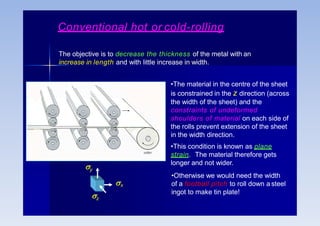
  • 100.
    Flatness •The roll gapmust be perfectly parallel to produce sheets/plates with equal thickness at both ends. •The rolling speed is very sensitive to flatness. A difference in elongation of one part in 10,000 between different locations in the sheet can cause waviness. Perfectly flat More elongated along edges More elongated in the centre
  • 101.
    •Camber and crowncan be used to correct the roll deflection (at only one value of the roll force). Or use rolling mill equipped with hydraulic jacks to permit the elastic distortion of the rolls to correct deflection. (a) (b) (a) The use of cambered rolls to compensate for roll bending. (b) Uncambered rolls give variation of thickness. Solutions to flatness problems
  • 102.
    •Hot mill canbe provided with facilities for crown control to improve the control of the profile of hot strip mill. •For example work roll bending with continuous variable crown and pair cross mills. •The roll cross angle of rolls incorporated in a stand of each rolling mill is set at a predetermined value beforehand. •If there is a roll cross angle that will enable a target sheet crown to be applied to each sheet and the roll bender load of each stand is adjusted on-line, thereby effecting sheet crown control.
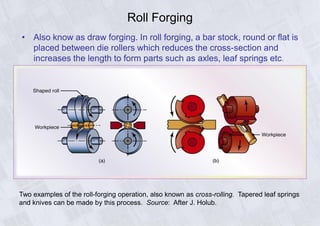
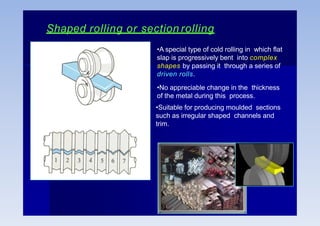
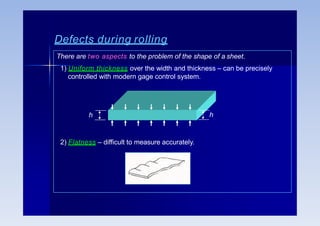
  • 103.
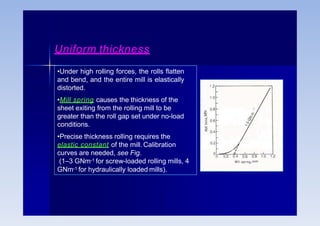
    Possible effects whenrolling with insufficient camber •Thicker centre means the edges would be plastically elongated more than the centre, normally called long edges. •This induces the residual stress pattern of compression at the edges and tension along the centreline. •This can cause centreline cracking (c), warping (d) or edge wrinkling or crepe-paper effect or wavy edge(e). (a) (b) (c) (d) (e)
  • 104.
    Possible effects whenrolls areover-cambered. •Thicker edges than the centre means the centre would be plastically elongated more than the edges, resulting in lateral spread. •The residual stress pattern is now under compression in the centreline and tension at the edges (b). •This may cause edge cracking (c), centre splitting (d),centreline wrinkling (e). (a) (b) (c) (d) (e)
  • 105.
    •Edging can alsobe caused by inhomogeneous deformation in the thickness direction. •If only the surface of the workpiece is deformed (as in a light reduction on a thick slab), the edges are concaved (a). The overhanging material is not compressed in the subsequent step of rolling, causing this area under tensile stress and leading to edge cracking. This has been observed in initial breakdown of hot-rolling when h/Lp > 2 •With heavy reduction, the centre tends to expand more laterally than the surface to produced barrelled edges (b). This causes secondary tensile stresses by barrelling, which are susceptible to edge cracking. •Alligatoring (c) will occur when lateral spread is greater in the centre than the surface (surface in tension, centre in compression) and with the presence of metallurgical weakness along the centreline.
  • 106.
    •Surface defects aremore easily in rolling due to high surface to volume ratio. Grinding , chipping or descaling of defects on the surface of cast ingots or billets are recommended before being rolled. • Laps due to misplace of rolls can cause undesired shapes. Roll misplacement •Flakes or cooling cracks along edges result in decreased ductility in hot rolling such as blooming of extra coarse grained ingot. • Scratches due to tooling and handling. • Variation in thickness due to deflection of rolls or rolling speed.
  • 107.
    References •Dieter, G.E., Mechanicalmetallurgy, 1988, SI metric edition, McGraw-Hill, ISBN 0-07-100406-8. •Edwards, L. and Endean, M., Manufacturing with materials, 1990, Butterworth Heinemann, ISBN 0-7506-2754-9. •Beddoes, J. and Bibbly M.J., Principles of metal manufacturing process, 1999, Arnold, ISBN 0-470-35241-8. • Lecture note, 2003. • Firth Rixson leavelets. • Metal forming processes, Prof Manas. • Metal forming lecture, Ass Prof. P. Srichareonchai.