RICKETS
BY Dr.
HAMDY ABO HAGAR
ASSISTANT PROFESSOR OF
PEDIATRICS
 Defective mineralization of growing bones,
due to vitamine D deficiency or abnormal
metabolism.
Sources:
 A: Diets such as fats and
oils.
 B: Vitamin D supplements.
 C: Ultraviolet sunrays effect
on a precursor in the skin (7-
dehydrocholesterol).
Types:
 Vitamin D2 of plant origin
 Vitamin D3 of animal origin
and that naturally formed in
the skin.
Metabolism:
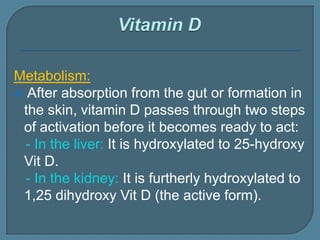
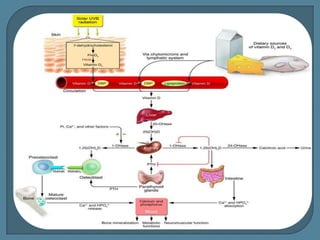
 After absorption from the gut or formation in
the skin, vitamin D passes through two steps
of activation before it becomes ready to act:
- In the liver: It is hydroxylated to 25-hydroxy
Vit D.
- In the kidney: It is furtherly hydroxylated to
1,25 dihydroxy Vit D (the active form).
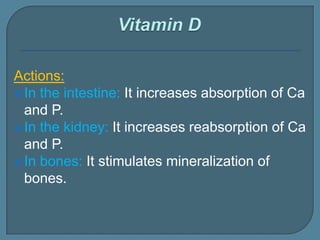
Actions:
In the intestine: It increases absorption of Ca
and P.
In the kidney: It increases reabsorption of Ca
and P.
In bones: It stimulates mineralization of
bones.
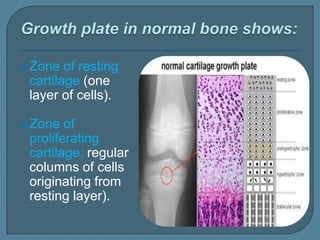
 Zone of resting
cartilage (one
layer of cells).
 Zone of
proliferating
cartilage: regular
columns of cells
originating from
resting layer).
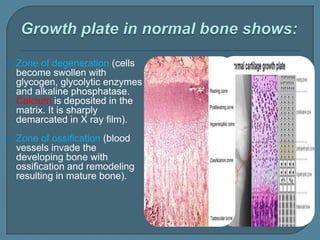
 Zone of degeneration (cells
become swollen with
glycogen, glycolytic enzymes
and alkaline phosphatase.
Calcium is deposited in the
matrix. It is sharply
demarcated in X ray film).
 Zone of ossification (blood
vessels invade the
developing bone with
ossification and remodeling
resulting in mature bone).
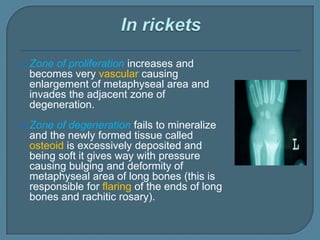
 Zone of proliferation increases and
becomes very vascular causing
enlargement of metaphyseal area and
invades the adjacent zone of
degeneration.
 Zone of degeneration fails to mineralize
and the newly formed tissue called
osteoid is excessively deposited and
being soft it gives way with pressure
causing bulging and deformity of
metaphyseal area of long bones (this is
responsible for flaring of the ends of long
bones and rachitic rosary).
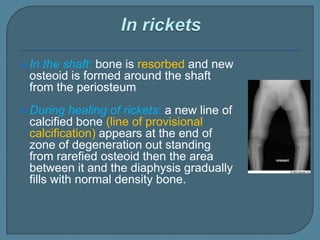
 In the shaft: bone is resorbed and new
osteoid is formed around the shaft
from the periosteum
 During healing of rickets: a new line of
calcified bone (line of provisional
calcification) appears at the end of
zone of degeneration out standing
from rarefied osteoid then the area
between it and the diaphysis gradually
fills with normal density bone.
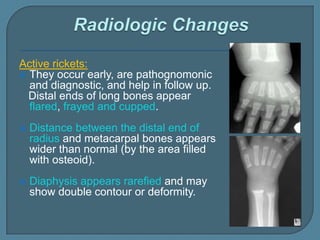
Active rickets:
 They occur early, are pathognomonic
and diagnostic, and help in follow up.
Distal ends of long bones appear
flared, frayed and cupped.
 Distance between the distal end of
radius and metacarpal bones appears
wider than normal (by the area filled
with osteoid).
 Diaphysis appears rarefied and may
show double contour or deformity.
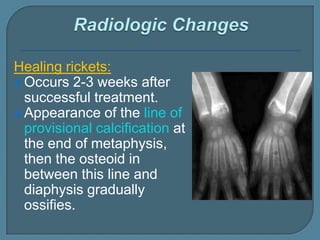
Healing rickets:
Occurs 2-3 weeks after
successful treatment.
Appearance of the line of
provisional calcification at
the end of metaphysis,
then the osteoid in
between this line and
diaphysis gradually
ossifies.
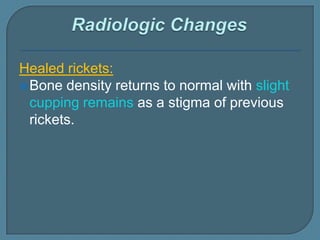
Healed rickets:
Bone density returns to normal with slight
cupping remains as a stigma of previous
rickets.
 Serum alkaline phosphatase is elevated due to
over activity of osteoblasts during the formation of
excessive osteoid (normal 5-15 Bodansky units
/dl).
 Serum inorganic phosphorus is decreased (normal
4.5-6.5 mg/dl).
 Serum calcium is maintained within normal values
(9-11 mg/dl) due to compensatory hyperactivity of
parathyroid gland.
 Vitamin D and its metabolites are decreased.
Vitamin D deficiency rickets most
commonly occurs at the end of the first
year and during the second year of life.
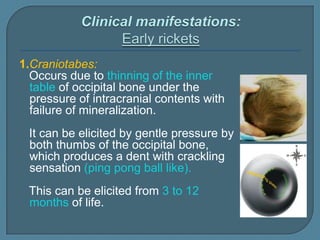
1.Craniotabes:
Occurs due to thinning of the inner
table of occipital bone under the
pressure of intracranial contents with
failure of mineralization.
It can be elicited by gentle pressure by
both thumbs of the occipital bone,
which produces a dent with crackling
sensation (ping pong ball like).
This can be elicited from 3 to 12
months of life.
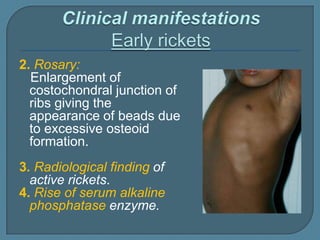
2. Rosary:
Enlargement of
costochondral junction of
ribs giving the
appearance of beads due
to excessive osteoid
formation.
3. Radiological finding of
active rickets.
4. Rise of serum alkaline
phosphatase enzyme.
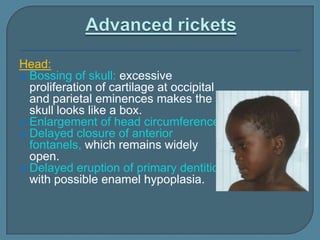
Head:
 Bossing of skull: excessive
proliferation of cartilage at occipital
and parietal eminences makes the
skull looks like a box.
 Enlargement of head circumference.
 Delayed closure of anterior
fontanels, which remains widely
open.
 Delayed eruption of primary dentition
with possible enamel hypoplasia.
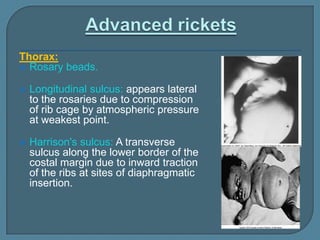
Thorax:
 Rosary beads.
 Longitudinal sulcus: appears lateral
to the rosaries due to compression
of rib cage by atmospheric pressure
at weakest point.
 Harrison's sulcus: A transverse
sulcus along the lower border of the
costal margin due to inward traction
of the ribs at sites of diaphragmatic
insertion.
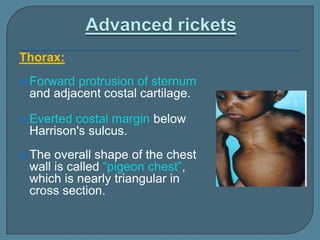
Thorax:
 Forward protrusion of sternum
and adjacent costal cartilage.
 Everted costal margin below
Harrison's sulcus.
 The overall shape of the chest
wall is called “pigeon chest”,
which is nearly triangular in
cross section.
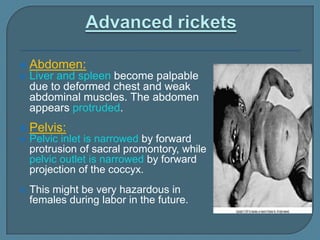
 Abdomen:
 Liver and spleen become palpable
due to deformed chest and weak
abdominal muscles. The abdomen
appears protruded.
 Pelvis:
 Pelvic inlet is narrowed by forward
protrusion of sacral promontory, while
pelvic outlet is narrowed by forward
projection of the coccyx.
 This might be very hazardous in
females during labor in the future.
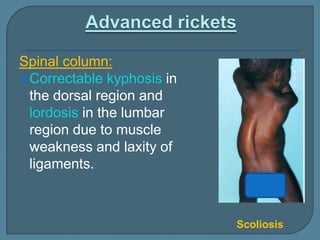
Spinal column:
Correctable kyphosis in
the dorsal region and
lordosis in the lumbar
region due to muscle
weakness and laxity of
ligaments.
Scoliosis
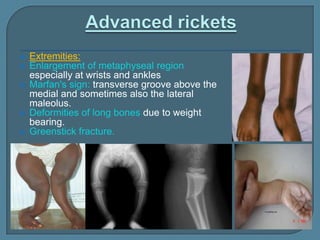
 Extremities:
 Enlargement of metaphyseal region
especially at wrists and ankles
 Marfan's sign: transverse groove above the
medial and sometimes also the lateral

maleolus.
 Deformities of long bones due to weight
bearing.
 Greenstick fracture.
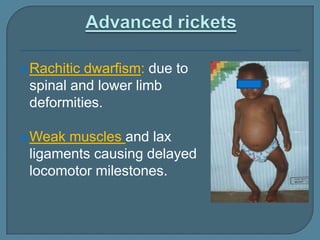
Rachitic dwarfism: due to
spinal and lower limb
deformities.
Weak muscles and lax
ligaments causing delayed
locomotor milestones.
 Respiratory: infections or atelectasis due to
chest deformities.
 GIT: diarrhea or constipation.
 Bony deformities or fractures.
 Anemia: due to chronic infection or
deficiencies.
 Tetany: due to hypocalcaemia in late cases
after exhaustion of parathyroids.
Usually good with improvement after
exposure to sun light in the morning or
afternoon or after administration of Vitamin
D.
Deformities improve with normal growth
but very slowly.
Sometimes, severe skeletal deformities
require orthopedic correction.
 Exposure to ultraviolet rays in
sunshine (10 to 20 minutes/day).
 Daily requirements of vitamin D are
400-800 i.u /day.
 For low birth weight infants, and
patients of malnutrition or
hypothyroidism during receiving
their specific treatment, 1000-1500
i.u /day are needed for the
accelerated rate of growth.
Oral Vitamin D in a dose of 1500-5000
i.u/day for 6-8 weeks.
Shock therapy: Vit D 600,000 i.u by I.M.
injection or orally single dose.
After 2-4 weeks, if no radiologic or
laboratory evidence of complete healing
occurs, the dose can be repeated.
 Vitamin D dependent type: due to defective 1-
alpha-hydroxylase in the kidney or failure of
end organ response to it.
 Familial hypophophatemic resistant rickets:
affects girls more, there is tubular defect in
phosphate retention resulting in excessive
urinary phosphate losses.
 Tubular defects such as Fanconi syndrome
with urinary loss of
phosphate, glucose, amino acids and
bicarbonates.
Chronic renal failure.
Acquired renal tubular damage, e.g. drugs.
Malabsorption syndromes: such as celiac
disease, cystic fibrosis of the pancreas,
cholestasis.
Anticonvulsant therapy causing increased
metabolism of Vitamin D.
THANK YOU

Rickets lecture

  • 1.
    RICKETS BY Dr. HAMDY ABOHAGAR ASSISTANT PROFESSOR OF PEDIATRICS
  • 2.
     Defective mineralizationof growing bones, due to vitamine D deficiency or abnormal metabolism.
  • 3.
    Sources:  A: Dietssuch as fats and oils.  B: Vitamin D supplements.  C: Ultraviolet sunrays effect on a precursor in the skin (7- dehydrocholesterol). Types:  Vitamin D2 of plant origin  Vitamin D3 of animal origin and that naturally formed in the skin.
  • 4.
    Metabolism:  After absorptionfrom the gut or formation in the skin, vitamin D passes through two steps of activation before it becomes ready to act: - In the liver: It is hydroxylated to 25-hydroxy Vit D. - In the kidney: It is furtherly hydroxylated to 1,25 dihydroxy Vit D (the active form).
  • 5.
    Actions: In the intestine:It increases absorption of Ca and P. In the kidney: It increases reabsorption of Ca and P. In bones: It stimulates mineralization of bones.
  • 8.
     Zone ofresting cartilage (one layer of cells).  Zone of proliferating cartilage: regular columns of cells originating from resting layer).
  • 9.
     Zone ofdegeneration (cells become swollen with glycogen, glycolytic enzymes and alkaline phosphatase. Calcium is deposited in the matrix. It is sharply demarcated in X ray film).  Zone of ossification (blood vessels invade the developing bone with ossification and remodeling resulting in mature bone).
  • 10.
     Zone ofproliferation increases and becomes very vascular causing enlargement of metaphyseal area and invades the adjacent zone of degeneration.  Zone of degeneration fails to mineralize and the newly formed tissue called osteoid is excessively deposited and being soft it gives way with pressure causing bulging and deformity of metaphyseal area of long bones (this is responsible for flaring of the ends of long bones and rachitic rosary).
  • 11.
     In theshaft: bone is resorbed and new osteoid is formed around the shaft from the periosteum  During healing of rickets: a new line of calcified bone (line of provisional calcification) appears at the end of zone of degeneration out standing from rarefied osteoid then the area between it and the diaphysis gradually fills with normal density bone.
  • 12.
    Active rickets:  Theyoccur early, are pathognomonic and diagnostic, and help in follow up. Distal ends of long bones appear flared, frayed and cupped.  Distance between the distal end of radius and metacarpal bones appears wider than normal (by the area filled with osteoid).  Diaphysis appears rarefied and may show double contour or deformity.
  • 13.
    Healing rickets: Occurs 2-3weeks after successful treatment. Appearance of the line of provisional calcification at the end of metaphysis, then the osteoid in between this line and diaphysis gradually ossifies.
  • 14.
    Healed rickets: Bone densityreturns to normal with slight cupping remains as a stigma of previous rickets.
  • 16.
     Serum alkalinephosphatase is elevated due to over activity of osteoblasts during the formation of excessive osteoid (normal 5-15 Bodansky units /dl).  Serum inorganic phosphorus is decreased (normal 4.5-6.5 mg/dl).  Serum calcium is maintained within normal values (9-11 mg/dl) due to compensatory hyperactivity of parathyroid gland.  Vitamin D and its metabolites are decreased.
  • 17.
    Vitamin D deficiencyrickets most commonly occurs at the end of the first year and during the second year of life.
  • 18.
    1.Craniotabes: Occurs due tothinning of the inner table of occipital bone under the pressure of intracranial contents with failure of mineralization. It can be elicited by gentle pressure by both thumbs of the occipital bone, which produces a dent with crackling sensation (ping pong ball like). This can be elicited from 3 to 12 months of life.
  • 19.
    2. Rosary: Enlargement of costochondraljunction of ribs giving the appearance of beads due to excessive osteoid formation. 3. Radiological finding of active rickets. 4. Rise of serum alkaline phosphatase enzyme.
  • 20.
    Head:  Bossing ofskull: excessive proliferation of cartilage at occipital and parietal eminences makes the skull looks like a box.  Enlargement of head circumference.  Delayed closure of anterior fontanels, which remains widely open.  Delayed eruption of primary dentition with possible enamel hypoplasia.
  • 21.
    Thorax:  Rosary beads. Longitudinal sulcus: appears lateral to the rosaries due to compression of rib cage by atmospheric pressure at weakest point.  Harrison's sulcus: A transverse sulcus along the lower border of the costal margin due to inward traction of the ribs at sites of diaphragmatic insertion.
  • 22.
    Thorax:  Forward protrusionof sternum and adjacent costal cartilage.  Everted costal margin below Harrison's sulcus.  The overall shape of the chest wall is called “pigeon chest”, which is nearly triangular in cross section.
  • 23.
     Abdomen:  Liverand spleen become palpable due to deformed chest and weak abdominal muscles. The abdomen appears protruded.  Pelvis:  Pelvic inlet is narrowed by forward protrusion of sacral promontory, while pelvic outlet is narrowed by forward projection of the coccyx.  This might be very hazardous in females during labor in the future.
  • 24.
    Spinal column: Correctable kyphosisin the dorsal region and lordosis in the lumbar region due to muscle weakness and laxity of ligaments. Scoliosis
  • 25.
     Extremities:  Enlargementof metaphyseal region especially at wrists and ankles  Marfan's sign: transverse groove above the medial and sometimes also the lateral maleolus.  Deformities of long bones due to weight bearing.  Greenstick fracture.
  • 26.
    Rachitic dwarfism: dueto spinal and lower limb deformities. Weak muscles and lax ligaments causing delayed locomotor milestones.
  • 27.
     Respiratory: infectionsor atelectasis due to chest deformities.  GIT: diarrhea or constipation.  Bony deformities or fractures.  Anemia: due to chronic infection or deficiencies.  Tetany: due to hypocalcaemia in late cases after exhaustion of parathyroids.
  • 28.
    Usually good withimprovement after exposure to sun light in the morning or afternoon or after administration of Vitamin D. Deformities improve with normal growth but very slowly. Sometimes, severe skeletal deformities require orthopedic correction.
  • 29.
     Exposure toultraviolet rays in sunshine (10 to 20 minutes/day).  Daily requirements of vitamin D are 400-800 i.u /day.  For low birth weight infants, and patients of malnutrition or hypothyroidism during receiving their specific treatment, 1000-1500 i.u /day are needed for the accelerated rate of growth.
  • 30.
    Oral Vitamin Din a dose of 1500-5000 i.u/day for 6-8 weeks. Shock therapy: Vit D 600,000 i.u by I.M. injection or orally single dose. After 2-4 weeks, if no radiologic or laboratory evidence of complete healing occurs, the dose can be repeated.
  • 32.
     Vitamin Ddependent type: due to defective 1- alpha-hydroxylase in the kidney or failure of end organ response to it.  Familial hypophophatemic resistant rickets: affects girls more, there is tubular defect in phosphate retention resulting in excessive urinary phosphate losses.  Tubular defects such as Fanconi syndrome with urinary loss of phosphate, glucose, amino acids and bicarbonates.
  • 33.
    Chronic renal failure. Acquiredrenal tubular damage, e.g. drugs. Malabsorption syndromes: such as celiac disease, cystic fibrosis of the pancreas, cholestasis. Anticonvulsant therapy causing increased metabolism of Vitamin D.
  • 34.