Dr.Singaram.A
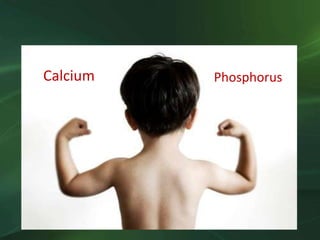
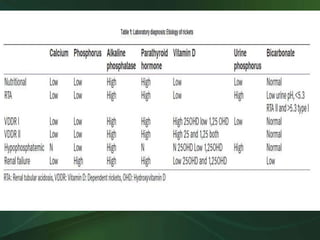
Calcium Phosphorus
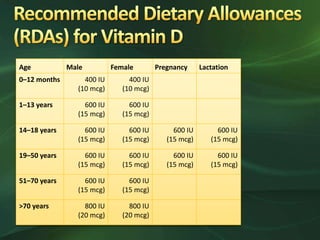
Age Male Female Pregnancy Lactation
0–12 months 400 IU
(10 mcg)
400 IU
(10 mcg)
1–13 years 600 IU
(15 mcg)
600 IU
(15 mcg)
14–18 years 600 IU
(15 mcg)
600 IU
(15 mcg)
600 IU
(15 mcg)
600 IU
(15 mcg)
19–50 years 600 IU
(15 mcg)
600 IU
(15 mcg)
600 IU
(15 mcg)
600 IU
(15 mcg)
51–70 years 600 IU
(15 mcg)
600 IU
(15 mcg)
>70 years 800 IU
(20 mcg)
800 IU
(20 mcg)
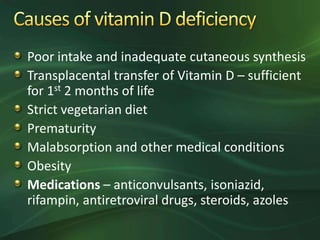
Poor intake and inadequate cutaneous synthesis
Transplacental transfer of Vitamin D – sufficient
for 1st 2 months of life
Strict vegetarian diet
Prematurity
Malabsorption and other medical conditions
Obesity
Medications – anticonvulsants, isoniazid,
rifampin, antiretroviral drugs, steroids, azoles
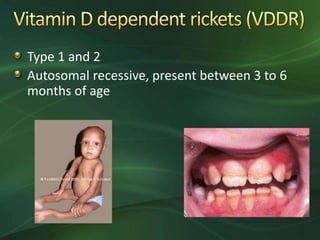
Type 1 and 2
Autosomal recessive, present between 3 to 6
months of age
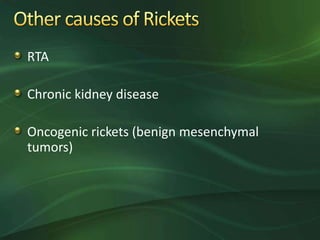
RTA
Chronic kidney disease
Oncogenic rickets (benign mesenchymal
tumors)
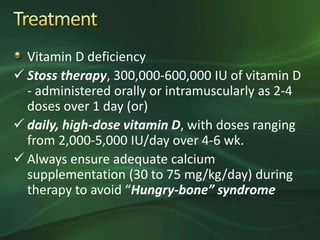
Vitamin D deficiency
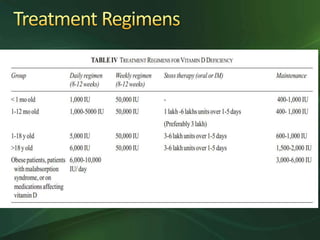
 Stoss therapy, 300,000-600,000 IU of vitamin D
- administered orally or intramuscularly as 2-4
doses over 1 day (or)
 daily, high-dose vitamin D, with doses ranging
from 2,000-5,000 IU/day over 4-6 wk.
 Always ensure adequate calcium
supplementation (30 to 75 mg/kg/day) during
therapy to avoid “Hungry-bone” syndrome
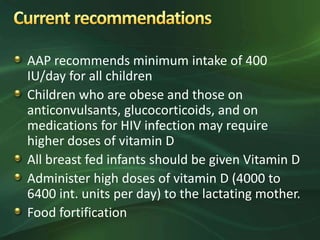
AAP recommends minimum intake of 400
IU/day for all children
Children who are obese and those on
anticonvulsants, glucocorticoids, and on
medications for HIV infection may require
higher doses of vitamin D
All breast fed infants should be given Vitamin D
Administer high doses of vitamin D (4000 to
6400 int. units per day) to the lactating mother.
Food fortification
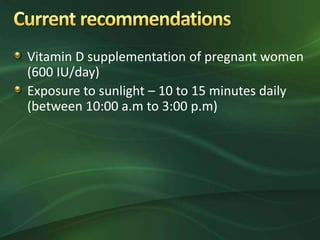
Vitamin D supplementation of pregnant women
(600 IU/day)
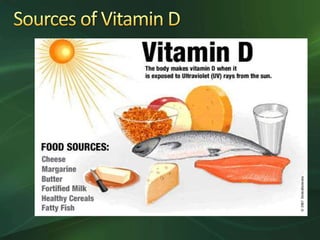
Exposure to sunlight – 10 to 15 minutes daily
(between 10:00 a.m to 3:00 p.m)
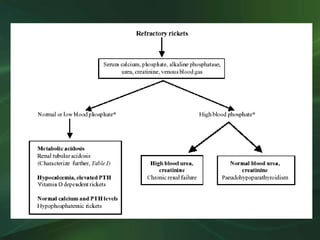
Approach to childhood rickets

Approach to childhood rickets

  • 1.
  • 2.
  • 6.
    Age Male FemalePregnancy Lactation 0–12 months 400 IU (10 mcg) 400 IU (10 mcg) 1–13 years 600 IU (15 mcg) 600 IU (15 mcg) 14–18 years 600 IU (15 mcg) 600 IU (15 mcg) 600 IU (15 mcg) 600 IU (15 mcg) 19–50 years 600 IU (15 mcg) 600 IU (15 mcg) 600 IU (15 mcg) 600 IU (15 mcg) 51–70 years 600 IU (15 mcg) 600 IU (15 mcg) >70 years 800 IU (20 mcg) 800 IU (20 mcg)
  • 8.
    Poor intake andinadequate cutaneous synthesis Transplacental transfer of Vitamin D – sufficient for 1st 2 months of life Strict vegetarian diet Prematurity Malabsorption and other medical conditions Obesity Medications – anticonvulsants, isoniazid, rifampin, antiretroviral drugs, steroids, azoles
  • 9.
    Type 1 and2 Autosomal recessive, present between 3 to 6 months of age
  • 11.
    RTA Chronic kidney disease Oncogenicrickets (benign mesenchymal tumors)
  • 16.
    Vitamin D deficiency Stoss therapy, 300,000-600,000 IU of vitamin D - administered orally or intramuscularly as 2-4 doses over 1 day (or)  daily, high-dose vitamin D, with doses ranging from 2,000-5,000 IU/day over 4-6 wk.  Always ensure adequate calcium supplementation (30 to 75 mg/kg/day) during therapy to avoid “Hungry-bone” syndrome
  • 20.
    AAP recommends minimumintake of 400 IU/day for all children Children who are obese and those on anticonvulsants, glucocorticoids, and on medications for HIV infection may require higher doses of vitamin D All breast fed infants should be given Vitamin D Administer high doses of vitamin D (4000 to 6400 int. units per day) to the lactating mother. Food fortification
  • 21.
    Vitamin D supplementationof pregnant women (600 IU/day) Exposure to sunlight – 10 to 15 minutes daily (between 10:00 a.m to 3:00 p.m)