Rickets
Prof. Abdulmoein Al-Agha, FRCPCH(UK)
Pediatric Endocrinologist, KAUH, Jeddah
Rickets & Osteomalacia
• Rickets is a disease of the growing bones in which
defective mineralization occurs in both bone & cartilage
of the epiphyseal growth plates
• It is associated with growth retardation & skeletal
deformities
• Osteomalacia is a disorder of the mature bone in which
mineralization of new osteoid bone is inadequate or
delayed
• Skeletal muscles have a vitamin D receptor and may
require vitamin D for maximum function
• Vitamin D deficiency causes muscle weakness
• Brain, parathyroid glands, breast, and colon tissues,
others, as well as immune cells have vitamin D receptors
and respond to 1, 25-dihydroxyvitamin D
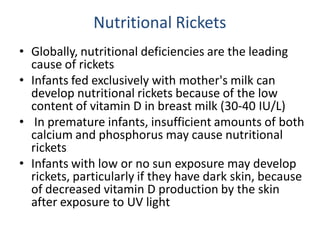
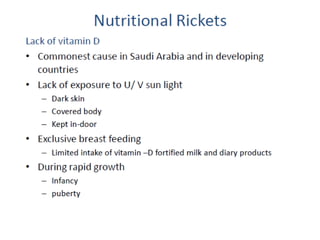
Nutritional Rickets
• Globally, nutritional deficiencies are the leading
cause of rickets
• Infants fed exclusively with mother's milk can
develop nutritional rickets because of the low
content of vitamin D in breast milk (30-40 IU/L)
• In premature infants, insufficient amounts of both
calcium and phosphorus may cause nutritional
rickets
• Infants with low or no sun exposure may develop
rickets, particularly if they have dark skin, because
of decreased vitamin D production by the skin
after exposure to UV light
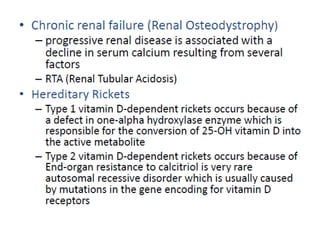
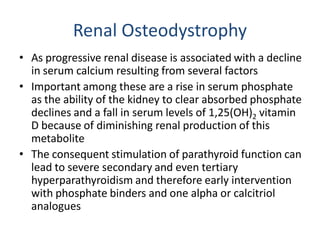
Renal Osteodystrophy
• As progressive renal disease is associated with a decline
in serum calcium resulting from several factors
• Important among these are a rise in serum phosphate
as the ability of the kidney to clear absorbed phosphate
declines and a fall in serum levels of 1,25(OH)2 vitamin
D because of diminishing renal production of this
metabolite
• The consequent stimulation of parathyroid function can
lead to severe secondary and even tertiary
hyperparathyroidism and therefore early intervention
with phosphate binders and one alpha or calcitriol
analogues
Renal Osteodystrophy (Renal Rickets)
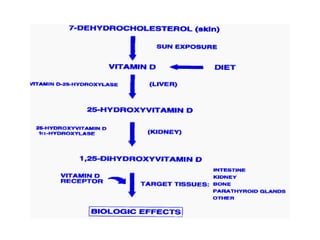
• In end-stage renal disease, renal 1-hydroxylase is
diminished or lost, and excretion of phosphate is
defective.
• This leads to low levels of 1, 25(OH)2 vitamin D,
hypocalcaemia, and failure of osteoid calcification
Osteodystrophy (renal rickets) is the only type of
rickets with a high serum phosphate level.
• It can be dynamic (a reduction in osteoblastic activity)
or hyper dynamic (increased bone turnover)
• Treatment of these patients includes phosphate
binders, a low phosphate intake & calcitriol / one Alpha
vitamin D
Fanconi's Syndrome
• Is a disease of the proximal renal tubules of the kidney in
which glucose, amino acids, uric acid, phosphate and
bicarbonate are passed into the urine, instead of being
reabsorbed. It may be inherited, or caused by drugs or
heavy metals. The loss of bicarbonate results in Type 2 or
proximal renal tubular acidosis. The loss of phosphate
results in the bone disease rickets (even with adequate
vitamin D and calcium). The clinical features of proximal
renal tubular acidosis include; polyuria, polydipsia and
dehydration, hypophosphatemic rickets , growth failure,
acidosis, hypokalemia, hyperchloremia, hypophosphatemia,
phosphaturia, glycosuria, Proteinuria/ aminoaciduria and
hyperuricosuria
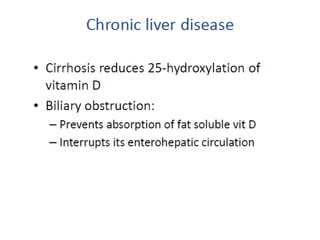
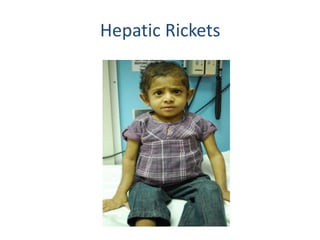
Hepatic Rickets
Hepatic Rickets
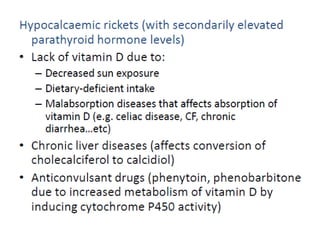
• Vitamin D is hydroxylated in the liver to form
25-hydroxyvitamin D
• Patients with severe parenchymal or
obstructive hepatic disease may have reduced
production of 25-hydroxyvitamin D
• Occurs in cholestatic liver disease because of
decreased intestinal absorption of & impaired
hepatic hydroxylation of vitamin D
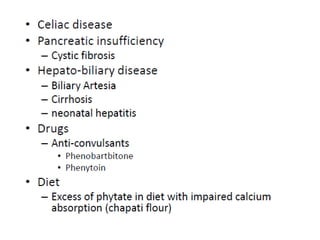
Malabsorption Rickets
• Malabsorption of vitamin D is suggested by a
history of liver or intestinal disease
• Undiagnosed liver or intestinal disease should be
suspected if the child has gastrointestinal
symptoms, although occasionally, rickets may be
the presenting complaint
• Fat Malabsorption is often associated with
diarrhea or oily stools, and there may be signs or
symptoms suggestive of deficiencies of other fat-
soluble vitamins (A, D, E, and K)
Congenital Rickets
• Onset of this type happens in the first six months of
life
• It is quite rare in industrialized countries; however, it
is common in developing countries, including Saudi
Arabia
• It occurs when there is maternal vitamin D deficiency
during pregnancy
• Maternal risk factors include poor dietary intake of
vitamin D, lack of adequate sun exposure, and closely
spaced pregnancies
Vitamin D – Dependant Rickets
• Type 1 vitamin D-dependent rickets occurs
because of inherited deficiency of one-alpha
hydroxylase enzyme which is responsible for
the conversion of 25-OH vitamin D into the
active metabolite 1,25- dihydroxy vitamin D
• Type 2 vitamin D-dependent rickets occurs
due to end-organ resistance to 1,25- dihydroxy
vitamin D (calcitriol)
• Both types are autosomal recessive disorders
Vitamin D–Dependent Rickets (type 1)
• This disorder results from a genetic deficiency in one- alpha
hydroxylase enzyme that converts calcidiol to calcitriol in the
kidney.
• It is inherited as an autosomal recessive, and the gene is
located in band 12q13.3.
• Clinical and laboratory examination findings are similar to
those associated with nutritional rickets, with low levels of 1,
25(OH)2 vitamin D with normal values of 25- hydroxyl vitamin
D3.
• These patients develop rickets despite receiving vitamin D at
the recommended preventive doses
• Medical treatment consists of oral calcitriol (0.5-1.5 mcg/day)
or one alpha (dose 1 mcg/day)
Vitamin D-Resistant Rickets (Type 2 Vitamin D–
Dependent Rickets)
• It is a rare autosomal recessive disorder, most often
caused by mutations in the vitamin D receptor gene
• It usually presents with rachitic changes not responsive
to vitamin D treatment and the circulating levels of both
25 (OH) vitamin D3 and 1,25 (OH)2 vitamin D3 are
normal or elevated, differentiating it from vitamin D
dependent rickets type 1
• Alopecia capitis or alopecia totalis is seen in some
families with vitamin D-dependent rickets type 2
• This is usually associated with a more severe
phenotype
Vitamin D-Resistant Rickets (Type 2 Vitamin D–
Dependent Rickets)
• The clinical picture is evident early in life, and consists
of rickets with very severe hypocalcaemia, although a
variant without alopecia has been reported
• Patients without alopecia appear to respond better to
treatment
• Serum levels of 1, 25(OH)2 vitamin D3 are typically
normal or elevated
• It can be lethal in the perinatal period
• Several mutant forms of receptor defect rickets are
recognized, with a wide range of severity & response to
calcitriol therapy
Vitamin D-Resistant Rickets (Type2 Vitamin D–
Dependent Rickets)
• Patients are benefiting from continuous high
dose of intravenous calcium and phosphate
through central line followed by oral therapy
with high doses of calcium & phosphate (with
secondary risk of nephrocalcinosis,
hypercalciuria, nephrolithiasis, and cardiac
arrhythmias)
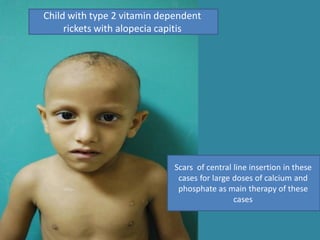
Child with type 2 vitamin dependent
rickets with alopecia capitis
Scars of central line insertion in these
cases for large doses of calcium and
phosphate as main therapy of these
cases
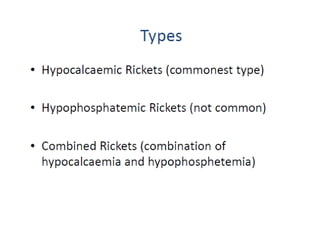
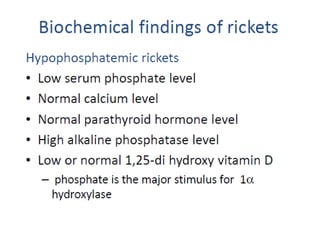
Hypophosphatemic Rickets
• Hypophosphatemic rickets is less common than
hypocalcemic rickets
• Pediatrician should be aware of its occurrences
• Characterized by rickets associated with
Hypophosphatemia
• Skeletal deformities are present but
hypocalcaemia, myopathy, and tetany are absent
& serum parathyroid hormone is normal
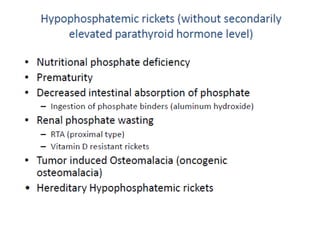
Hypophosphatemic Rickets
• Poor dietary intake
• Malabsorption diseases
• Prematurity
• Renal phosphate wasting
• Hereditary hypophosphatemic rickets
• Renal tubular acidosis (type II proximal)
• Oncogenic Hypophosphatemia due to production
of PTH-related peptides from solid tumors
McCune-Albright Syndrome
• Patients with this syndrome may have
hypophosphatemia secondary to urinary
phosphate leak, which may cause
osteomalacia
• Fasting phosphate levels should always be
monitored in these patients, and phosphate
supplements prescribed when indicated.
Hypophosphatemic Ricket
• Mutations of PHEX (phosphate regulating gene with
homologies to endopeptidases on the X chromosome) and
DMP1 (dentin matrix protein 1) result in X-linked
hypophosphatemic rickets and autosomal recessive
hypophosphatemic rickets, respectively.
• Most families of patients with familial hypophosphatemia
exhibit an X-linked dominant inheritance.
• FGF-23 (fibroblast growth factor 23) has been implicated in
the renal phosphate wasting in tumor-induced
Osteomalacia and autosomal dominant hypophosphatemic
rickets.
• Because calcium levels remain normal, neither tetany nor
secondary hyperparathyroidism are present.
Oncogenic Osteomalacia
• Is a paraneoplastic syndrome with
hypophosphatemia secondary to decreased renal
phosphate reabsorption, normal or low serum 1,
25-dihydroxyvitamin D concentration and
osteomalacia
• Several mesenchymal tumors of bone or
connective tissue (e.g. fibroangioma, and giant
cell tumors) secrete a phosphaturic substance
(parathyroid like protein) that results in rickets.
• The age of onset has been late childhood,
adolescence, or young adulthood.
Oncogenic Osteomalacia
• The clinical characteristics are similar to those
associated with familial hypophosphatemia.
• FGF-23 causes renal phosphate wasting in
tumor-induced osteomalacia.
• Treatment is surgical removal of the tumor (if
it can be located), with excellent results.
Congenital Rickets
• These newborns may have symptomatic hypocalcaemia,
intrauterine growth retardation, and decreased bone
ossification, along with classic rachitic changes
• Subtle maternal vitamin D deficiency may have an
adverse effect on neonatal bone density and birth weight
• It can also cause a defect in dental enamel, and
predispose infants to neonatal hypocalcaemic tetany
• Use of prenatal vitamins containing vitamin D prevents
this entity as well prophylactic vitamin D
supplementation from birth dose of 500 to 1000 unit/day
will prevent this entity
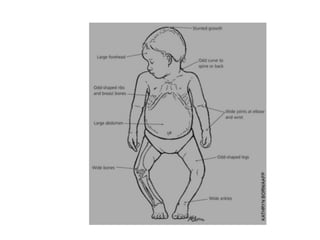
Clinical Features
• In infants, clinical features of hypocalcaemia include
– seizures, apnea, and tetany.
• In children, clinical features of rickets include
– delayed motor milestones
– Hypotonia
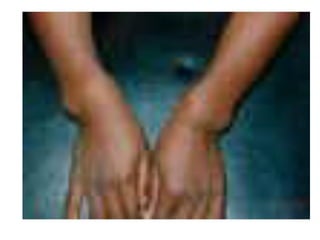
– enlargement of wrists
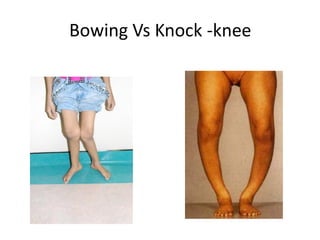
– progressive bowing of long bones, rachitic rosary, Harrison
sulcus, late closure of anterior fontanel, parietal and frontal
bossing, craniotabes
– delay in teeth eruption, enamel hypoplasia, decreased
bone mineral density, myopathy with normal deep tendon
reflexes,
– propensity for infections (as a consequence of impaired
phagocytosis and neutrophil motility).
Bowing Vs Knock -knee
Therapy of vitamin D dependent
rickets type 2
• The use of continuous daily of calcium intravenous
infusion / high oral dose of elemental calcium (some
reported cases as high as 14 -to-20 gram per day)
supplemented with oral phosphate is an effective
method of treatment of vitamin D dependent rickets
type II.
• The treatment is more effective when is started early in
the course of the disease and lead to early healing and
better growth with prevention of bone deformities as
well early treatment may also lead to improvement in
alopecia, the mechanism for which needs to be
elucidated.
Treatment of hypophosphatemic
rickets
• Optimal therapy consists of oral phosphate in
a dose of 40-60 mg/kg/day (1-2 mmol/kg/day)
in 5 divided doses plus oral calcitriol (15-25
ng/kg/day).
• Calcitriol (Rocaltrol) prevents increases in
parathyroid hormone caused by phosphate
therapy.
Hungary bone syndrome
• This is a phenomenon due to vitamin D therapy” which
is the worsening of hypocalcaemia after the starting of
vitamin D therapy for hypocalcaemia rickets may occur.
• it is important to consider supplementing calcium
during the first two weeks of therapy, to prevent the
possibility of hypocalcaemia and seizures attributed to
hungry bones
• Untreated or neglected rickets can cause permanent
bone deformity and lead to stunted growth. Surgical
intervention may be necessary to repair severe bony
abnormalities
Conclusion
• Rickets is deficient mineralization at the growth plate of long bones,
resulting in growth retardation. If the underlying condition is not
treated, bone deformity occurs, typically causing bowed legs and
thickening of the ends of long bones.
• Only occurs in growing children before fusion of the epiphyses,
typically affecting wrists, knees, and costochondral junctions.
• Occurs primarily because of a nutritional deficiency of vitamin D,
but can be associated with deficiencies of calcium or phosphorus.
• Mainstay of treatment is to correct vitamin D deficiency and to
ensure adequate calcium intake.
• Can be prevented in many cases by ensuring that children and
pregnant women have sufficient vitamin D and calcium intake.
Thanks

Rickets in children

  • 1.
    Rickets Prof. Abdulmoein Al-Agha,FRCPCH(UK) Pediatric Endocrinologist, KAUH, Jeddah
  • 2.
    Rickets & Osteomalacia •Rickets is a disease of the growing bones in which defective mineralization occurs in both bone & cartilage of the epiphyseal growth plates • It is associated with growth retardation & skeletal deformities • Osteomalacia is a disorder of the mature bone in which mineralization of new osteoid bone is inadequate or delayed • Skeletal muscles have a vitamin D receptor and may require vitamin D for maximum function • Vitamin D deficiency causes muscle weakness • Brain, parathyroid glands, breast, and colon tissues, others, as well as immune cells have vitamin D receptors and respond to 1, 25-dihydroxyvitamin D
  • 9.
    Nutritional Rickets • Globally,nutritional deficiencies are the leading cause of rickets • Infants fed exclusively with mother's milk can develop nutritional rickets because of the low content of vitamin D in breast milk (30-40 IU/L) • In premature infants, insufficient amounts of both calcium and phosphorus may cause nutritional rickets • Infants with low or no sun exposure may develop rickets, particularly if they have dark skin, because of decreased vitamin D production by the skin after exposure to UV light
  • 13.
    Renal Osteodystrophy • Asprogressive renal disease is associated with a decline in serum calcium resulting from several factors • Important among these are a rise in serum phosphate as the ability of the kidney to clear absorbed phosphate declines and a fall in serum levels of 1,25(OH)2 vitamin D because of diminishing renal production of this metabolite • The consequent stimulation of parathyroid function can lead to severe secondary and even tertiary hyperparathyroidism and therefore early intervention with phosphate binders and one alpha or calcitriol analogues
  • 14.
    Renal Osteodystrophy (RenalRickets) • In end-stage renal disease, renal 1-hydroxylase is diminished or lost, and excretion of phosphate is defective. • This leads to low levels of 1, 25(OH)2 vitamin D, hypocalcaemia, and failure of osteoid calcification Osteodystrophy (renal rickets) is the only type of rickets with a high serum phosphate level. • It can be dynamic (a reduction in osteoblastic activity) or hyper dynamic (increased bone turnover) • Treatment of these patients includes phosphate binders, a low phosphate intake & calcitriol / one Alpha vitamin D
  • 15.
    Fanconi's Syndrome • Isa disease of the proximal renal tubules of the kidney in which glucose, amino acids, uric acid, phosphate and bicarbonate are passed into the urine, instead of being reabsorbed. It may be inherited, or caused by drugs or heavy metals. The loss of bicarbonate results in Type 2 or proximal renal tubular acidosis. The loss of phosphate results in the bone disease rickets (even with adequate vitamin D and calcium). The clinical features of proximal renal tubular acidosis include; polyuria, polydipsia and dehydration, hypophosphatemic rickets , growth failure, acidosis, hypokalemia, hyperchloremia, hypophosphatemia, phosphaturia, glycosuria, Proteinuria/ aminoaciduria and hyperuricosuria
  • 16.
  • 17.
    Hepatic Rickets • VitaminD is hydroxylated in the liver to form 25-hydroxyvitamin D • Patients with severe parenchymal or obstructive hepatic disease may have reduced production of 25-hydroxyvitamin D • Occurs in cholestatic liver disease because of decreased intestinal absorption of & impaired hepatic hydroxylation of vitamin D
  • 18.
    Malabsorption Rickets • Malabsorptionof vitamin D is suggested by a history of liver or intestinal disease • Undiagnosed liver or intestinal disease should be suspected if the child has gastrointestinal symptoms, although occasionally, rickets may be the presenting complaint • Fat Malabsorption is often associated with diarrhea or oily stools, and there may be signs or symptoms suggestive of deficiencies of other fat- soluble vitamins (A, D, E, and K)
  • 19.
    Congenital Rickets • Onsetof this type happens in the first six months of life • It is quite rare in industrialized countries; however, it is common in developing countries, including Saudi Arabia • It occurs when there is maternal vitamin D deficiency during pregnancy • Maternal risk factors include poor dietary intake of vitamin D, lack of adequate sun exposure, and closely spaced pregnancies
  • 22.
    Vitamin D –Dependant Rickets • Type 1 vitamin D-dependent rickets occurs because of inherited deficiency of one-alpha hydroxylase enzyme which is responsible for the conversion of 25-OH vitamin D into the active metabolite 1,25- dihydroxy vitamin D • Type 2 vitamin D-dependent rickets occurs due to end-organ resistance to 1,25- dihydroxy vitamin D (calcitriol) • Both types are autosomal recessive disorders
  • 23.
    Vitamin D–Dependent Rickets(type 1) • This disorder results from a genetic deficiency in one- alpha hydroxylase enzyme that converts calcidiol to calcitriol in the kidney. • It is inherited as an autosomal recessive, and the gene is located in band 12q13.3. • Clinical and laboratory examination findings are similar to those associated with nutritional rickets, with low levels of 1, 25(OH)2 vitamin D with normal values of 25- hydroxyl vitamin D3. • These patients develop rickets despite receiving vitamin D at the recommended preventive doses • Medical treatment consists of oral calcitriol (0.5-1.5 mcg/day) or one alpha (dose 1 mcg/day)
  • 24.
    Vitamin D-Resistant Rickets(Type 2 Vitamin D– Dependent Rickets) • It is a rare autosomal recessive disorder, most often caused by mutations in the vitamin D receptor gene • It usually presents with rachitic changes not responsive to vitamin D treatment and the circulating levels of both 25 (OH) vitamin D3 and 1,25 (OH)2 vitamin D3 are normal or elevated, differentiating it from vitamin D dependent rickets type 1 • Alopecia capitis or alopecia totalis is seen in some families with vitamin D-dependent rickets type 2 • This is usually associated with a more severe phenotype
  • 25.
    Vitamin D-Resistant Rickets(Type 2 Vitamin D– Dependent Rickets) • The clinical picture is evident early in life, and consists of rickets with very severe hypocalcaemia, although a variant without alopecia has been reported • Patients without alopecia appear to respond better to treatment • Serum levels of 1, 25(OH)2 vitamin D3 are typically normal or elevated • It can be lethal in the perinatal period • Several mutant forms of receptor defect rickets are recognized, with a wide range of severity & response to calcitriol therapy
  • 26.
    Vitamin D-Resistant Rickets(Type2 Vitamin D– Dependent Rickets) • Patients are benefiting from continuous high dose of intravenous calcium and phosphate through central line followed by oral therapy with high doses of calcium & phosphate (with secondary risk of nephrocalcinosis, hypercalciuria, nephrolithiasis, and cardiac arrhythmias)
  • 27.
    Child with type2 vitamin dependent rickets with alopecia capitis Scars of central line insertion in these cases for large doses of calcium and phosphate as main therapy of these cases
  • 28.
    Hypophosphatemic Rickets • Hypophosphatemicrickets is less common than hypocalcemic rickets • Pediatrician should be aware of its occurrences • Characterized by rickets associated with Hypophosphatemia • Skeletal deformities are present but hypocalcaemia, myopathy, and tetany are absent & serum parathyroid hormone is normal
  • 30.
    Hypophosphatemic Rickets • Poordietary intake • Malabsorption diseases • Prematurity • Renal phosphate wasting • Hereditary hypophosphatemic rickets • Renal tubular acidosis (type II proximal) • Oncogenic Hypophosphatemia due to production of PTH-related peptides from solid tumors
  • 31.
    McCune-Albright Syndrome • Patientswith this syndrome may have hypophosphatemia secondary to urinary phosphate leak, which may cause osteomalacia • Fasting phosphate levels should always be monitored in these patients, and phosphate supplements prescribed when indicated.
  • 33.
    Hypophosphatemic Ricket • Mutationsof PHEX (phosphate regulating gene with homologies to endopeptidases on the X chromosome) and DMP1 (dentin matrix protein 1) result in X-linked hypophosphatemic rickets and autosomal recessive hypophosphatemic rickets, respectively. • Most families of patients with familial hypophosphatemia exhibit an X-linked dominant inheritance. • FGF-23 (fibroblast growth factor 23) has been implicated in the renal phosphate wasting in tumor-induced Osteomalacia and autosomal dominant hypophosphatemic rickets. • Because calcium levels remain normal, neither tetany nor secondary hyperparathyroidism are present.
  • 34.
    Oncogenic Osteomalacia • Isa paraneoplastic syndrome with hypophosphatemia secondary to decreased renal phosphate reabsorption, normal or low serum 1, 25-dihydroxyvitamin D concentration and osteomalacia • Several mesenchymal tumors of bone or connective tissue (e.g. fibroangioma, and giant cell tumors) secrete a phosphaturic substance (parathyroid like protein) that results in rickets. • The age of onset has been late childhood, adolescence, or young adulthood.
  • 35.
    Oncogenic Osteomalacia • Theclinical characteristics are similar to those associated with familial hypophosphatemia. • FGF-23 causes renal phosphate wasting in tumor-induced osteomalacia. • Treatment is surgical removal of the tumor (if it can be located), with excellent results.
  • 36.
    Congenital Rickets • Thesenewborns may have symptomatic hypocalcaemia, intrauterine growth retardation, and decreased bone ossification, along with classic rachitic changes • Subtle maternal vitamin D deficiency may have an adverse effect on neonatal bone density and birth weight • It can also cause a defect in dental enamel, and predispose infants to neonatal hypocalcaemic tetany • Use of prenatal vitamins containing vitamin D prevents this entity as well prophylactic vitamin D supplementation from birth dose of 500 to 1000 unit/day will prevent this entity
  • 37.
    Clinical Features • Ininfants, clinical features of hypocalcaemia include – seizures, apnea, and tetany. • In children, clinical features of rickets include – delayed motor milestones – Hypotonia – enlargement of wrists – progressive bowing of long bones, rachitic rosary, Harrison sulcus, late closure of anterior fontanel, parietal and frontal bossing, craniotabes – delay in teeth eruption, enamel hypoplasia, decreased bone mineral density, myopathy with normal deep tendon reflexes, – propensity for infections (as a consequence of impaired phagocytosis and neutrophil motility).
  • 39.
  • 53.
    Therapy of vitaminD dependent rickets type 2 • The use of continuous daily of calcium intravenous infusion / high oral dose of elemental calcium (some reported cases as high as 14 -to-20 gram per day) supplemented with oral phosphate is an effective method of treatment of vitamin D dependent rickets type II. • The treatment is more effective when is started early in the course of the disease and lead to early healing and better growth with prevention of bone deformities as well early treatment may also lead to improvement in alopecia, the mechanism for which needs to be elucidated.
  • 54.
    Treatment of hypophosphatemic rickets •Optimal therapy consists of oral phosphate in a dose of 40-60 mg/kg/day (1-2 mmol/kg/day) in 5 divided doses plus oral calcitriol (15-25 ng/kg/day). • Calcitriol (Rocaltrol) prevents increases in parathyroid hormone caused by phosphate therapy.
  • 55.
    Hungary bone syndrome •This is a phenomenon due to vitamin D therapy” which is the worsening of hypocalcaemia after the starting of vitamin D therapy for hypocalcaemia rickets may occur. • it is important to consider supplementing calcium during the first two weeks of therapy, to prevent the possibility of hypocalcaemia and seizures attributed to hungry bones • Untreated or neglected rickets can cause permanent bone deformity and lead to stunted growth. Surgical intervention may be necessary to repair severe bony abnormalities
  • 56.
    Conclusion • Rickets isdeficient mineralization at the growth plate of long bones, resulting in growth retardation. If the underlying condition is not treated, bone deformity occurs, typically causing bowed legs and thickening of the ends of long bones. • Only occurs in growing children before fusion of the epiphyses, typically affecting wrists, knees, and costochondral junctions. • Occurs primarily because of a nutritional deficiency of vitamin D, but can be associated with deficiencies of calcium or phosphorus. • Mainstay of treatment is to correct vitamin D deficiency and to ensure adequate calcium intake. • Can be prevented in many cases by ensuring that children and pregnant women have sufficient vitamin D and calcium intake. Thanks