Introduction
Achondroplasia :
• The term achondroplasia, implying absent cartilage formation .
• Is a genetic disorder of bone growth and it is the commonest form of
abnormally short stature ; (dwarfism) .
• It occurs in about 1 in 30,000 births .
• It occurs in all races and in both sexes.
• Adult height is usually around 122 cm ( 48 inches ).
• Disproportionate shortening of the limb bones is detectable in utero by
ultrasound scan .
• Achondroplasia is essentially an abnormality of endochondral longitudinal
growth (longitudinal growth occurs at epiphyseal plate) resulting in
diminished length of the tubular bones . Membrane bone formation is
unaffected , hence the normal growth of the skull vault and the periosteal
contribution to bone width .
• In achondroplasia, the extremity involvement is rhizomelic( proximal ),
with the arms and thighs more severely involved than the forearms, legs,
hands, and feet.
Genetic basis :
• A single gene mapped to the short arm of chromosome 4 (band 4p16.3)
is responsible for achondroplasia and is transmitted as an autosomal
dominant trait.
• When one parent has achondroplasia, the chance of transmitting this
gene to each child is 50%.
• When both parents have achondroplasia, 50% of their offspring are
heterozygous and affected, 25% are homozygous, which is ordinarily fatal
in the first few months of life, and 25% are unaffected.
Over 80% of cases are sporadic , because few achondroplastic people
have children .
Molecular basis :
 Fibroblast growth factors (FGFs) are structurally related proteins associated
with cell growth, migration, wound healing, and angiogenesis. At the cellular
level, their function is mediated by transmembrane tyrosine kinase
receptors, known as FGF receptors (FGFRs).
• Mutation in FGFR3 on chromosome 4 is responsible for achondroplasia .
• The primary function of FGFR3 is to limit osteogenesis.
• Mutation causes enhancement in its function of limiting endochondral
ossification. ( ↓ growth of proliferative zone of physis , ↓ thickness of
hypertrophic cell zone → diminution in endochondral bone growth ) .
Clinical Features
• Delayed motor milestones
• Normal cognitive function
Clinical Features
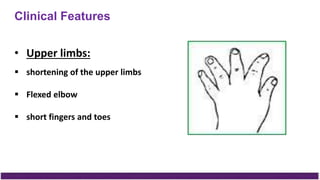
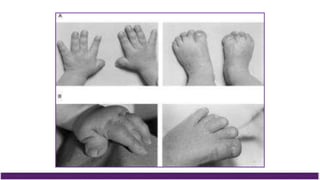
• Upper limbs:
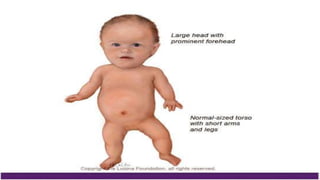
 shortening of the upper limbs
 Flexed elbow
 short fingers and toes
 Skull:
 a large head with prominent forehead
 small mid face with a flattened nasal bridge
 hydrocephalus
 Recurrent otitis media(due to Eustachian tube blockages)
 sleep apnea (which can be central or obstructive)
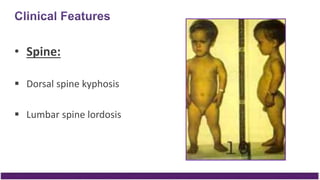
• Spine:
 Dorsal spine kyphosis
 Lumbar spine lordosis
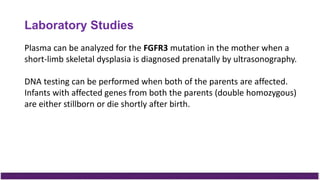
Plasma can be analyzed for the FGFR3 mutation in the mother when a
short-limb skeletal dysplasia is diagnosed prenatally by ultrasonography.
DNA testing can be performed when both of the parents are affected.
Infants with affected genes from both the parents (double homozygous)
are either stillborn or die shortly after birth.
Laboratory Studies
Imaging Studies
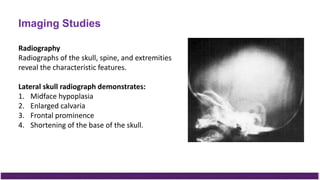
Radiography
Radiographs of the skull, spine, and extremities
reveal the characteristic features.
Lateral skull radiograph demonstrates:
1. Midface hypoplasia
2. Enlarged calvaria
3. Frontal prominence
4. Shortening of the base of the skull.
A lumbar spine (anteroposterior [AP]) view
reveals distinct narrowing on the interpedicular
distances from proximal to distal (see the
image).
Normally, the interpedicular distance from the
cephalocaudad direction should increase.
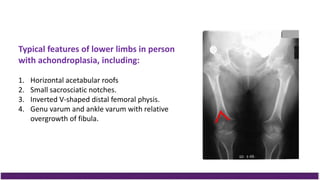
Typical features of lower limbs in person
with achondroplasia, including:
1. Horizontal acetabular roofs
2. Small sacrosciatic notches.
3. Inverted V-shaped distal femoral physis.
4. Genu varum and ankle varum with relative
overgrowth of fibula.
Computed tomography
The size of the foramen magnum can be measured most accurately by means of CT.
The spinal canal is narrowed developmentally, particularly in the lower lumbar
segments.
CT can be used to develop a 3D image of the rib cage, which can be used to calculate
lung volumes and can substantiate a successful surgical chest expansion.
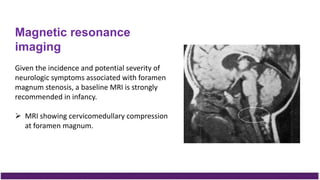
Magnetic resonance
imaging
Given the incidence and potential severity of
neurologic symptoms associated with foramen
magnum stenosis, a baseline MRI is strongly
recommended in infancy.
 MRI showing cervicomedullary compression
at foramen magnum.
Ultrasonography
In the neonate, ultrasonography can be used to detect ventricle size and other
abnormalities. It cannot be used once the sutures and fontanelles close.
 MRI is the imaging modality of choice at that time.
Other Tests:
 Somatosensory evoked potential (SSEP) abnormalities have been reported for 44%
of neurologically intact persons with achondroplasia and are probably related to
brainstem compression at the level of the foramen magnum.
 Pulmonary function tests are useful for preoperative evaluation when respiratory
symptoms are present.
Prognosis
• The standardized mortality ratio is increased for all age
groups by a factor of 2.27 over that of the general population.
• In children 4 years , death most commonly occurs as a
consequence of brainstem compression.
• In individuals aged 5-24 years, (CNS) and respiratory
abnormalities.
• aged 25-54 years, cardiovascular problems
Morbidity associated with achondroplasia may include:
• Otitis media
• Neurologic complications
• Obstructive and restrictive respiratory complications
• Hydrocephalus
• Spinal deformities (eg, kyphosis, lordosis, scoliosis)
• Obesity
• Spinal canal stenosis
• Genu varum
• Cardiovascular complications
• Treatments
currently, there is no way to prevent or treat Achondroplasia, since
the majority of cases result from unexpected new mutations.
• Medical Care
• The availability of somatotropin (recombinant human growth
hormone) has revolutionized the treatment of short stature.
• For maximum benefit, it is recommended that therapy be intiated at
a young age (1-6 years).
Surgical Care
• All treatments are supportive.
• Most of the orthopedic problems encountered in patients with
achondroplasia are related to the spine.
• Craniocervical stenosis, thoracolumbar kyphosis, spinal
stenosis, angular deformities of the lower extremities, so treat
of all associated abnormality .
Newborns and children:
 because of the large head and weak neck muscles, positions that could block
breathing must be avoided.
 Treatment of otitis media.
 Prevent to occur sleep apnea
Adult
 Orthopedic surgery to elongate limb bones 2- 5 ml / day
Achondroplasia

Achondroplasia

  • 3.
    Introduction Achondroplasia : • Theterm achondroplasia, implying absent cartilage formation . • Is a genetic disorder of bone growth and it is the commonest form of abnormally short stature ; (dwarfism) . • It occurs in about 1 in 30,000 births . • It occurs in all races and in both sexes.
  • 4.
    • Adult heightis usually around 122 cm ( 48 inches ). • Disproportionate shortening of the limb bones is detectable in utero by ultrasound scan .
  • 5.
    • Achondroplasia isessentially an abnormality of endochondral longitudinal growth (longitudinal growth occurs at epiphyseal plate) resulting in diminished length of the tubular bones . Membrane bone formation is unaffected , hence the normal growth of the skull vault and the periosteal contribution to bone width . • In achondroplasia, the extremity involvement is rhizomelic( proximal ), with the arms and thighs more severely involved than the forearms, legs, hands, and feet.
  • 6.
    Genetic basis : •A single gene mapped to the short arm of chromosome 4 (band 4p16.3) is responsible for achondroplasia and is transmitted as an autosomal dominant trait. • When one parent has achondroplasia, the chance of transmitting this gene to each child is 50%. • When both parents have achondroplasia, 50% of their offspring are heterozygous and affected, 25% are homozygous, which is ordinarily fatal in the first few months of life, and 25% are unaffected.
  • 7.
    Over 80% ofcases are sporadic , because few achondroplastic people have children . Molecular basis :  Fibroblast growth factors (FGFs) are structurally related proteins associated with cell growth, migration, wound healing, and angiogenesis. At the cellular level, their function is mediated by transmembrane tyrosine kinase receptors, known as FGF receptors (FGFRs).
  • 8.
    • Mutation inFGFR3 on chromosome 4 is responsible for achondroplasia . • The primary function of FGFR3 is to limit osteogenesis. • Mutation causes enhancement in its function of limiting endochondral ossification. ( ↓ growth of proliferative zone of physis , ↓ thickness of hypertrophic cell zone → diminution in endochondral bone growth ) .
  • 10.
    Clinical Features • Delayedmotor milestones • Normal cognitive function
  • 11.
    Clinical Features • Upperlimbs:  shortening of the upper limbs  Flexed elbow  short fingers and toes
  • 13.
     Skull:  alarge head with prominent forehead  small mid face with a flattened nasal bridge  hydrocephalus  Recurrent otitis media(due to Eustachian tube blockages)  sleep apnea (which can be central or obstructive)
  • 15.
    • Spine:  Dorsalspine kyphosis  Lumbar spine lordosis
  • 17.
    Plasma can beanalyzed for the FGFR3 mutation in the mother when a short-limb skeletal dysplasia is diagnosed prenatally by ultrasonography. DNA testing can be performed when both of the parents are affected. Infants with affected genes from both the parents (double homozygous) are either stillborn or die shortly after birth. Laboratory Studies
  • 18.
    Imaging Studies Radiography Radiographs ofthe skull, spine, and extremities reveal the characteristic features. Lateral skull radiograph demonstrates: 1. Midface hypoplasia 2. Enlarged calvaria 3. Frontal prominence 4. Shortening of the base of the skull.
  • 19.
    A lumbar spine(anteroposterior [AP]) view reveals distinct narrowing on the interpedicular distances from proximal to distal (see the image). Normally, the interpedicular distance from the cephalocaudad direction should increase.
  • 20.
    Typical features oflower limbs in person with achondroplasia, including: 1. Horizontal acetabular roofs 2. Small sacrosciatic notches. 3. Inverted V-shaped distal femoral physis. 4. Genu varum and ankle varum with relative overgrowth of fibula.
  • 21.
    Computed tomography The sizeof the foramen magnum can be measured most accurately by means of CT. The spinal canal is narrowed developmentally, particularly in the lower lumbar segments. CT can be used to develop a 3D image of the rib cage, which can be used to calculate lung volumes and can substantiate a successful surgical chest expansion.
  • 22.
    Magnetic resonance imaging Given theincidence and potential severity of neurologic symptoms associated with foramen magnum stenosis, a baseline MRI is strongly recommended in infancy.  MRI showing cervicomedullary compression at foramen magnum.
  • 23.
    Ultrasonography In the neonate,ultrasonography can be used to detect ventricle size and other abnormalities. It cannot be used once the sutures and fontanelles close.  MRI is the imaging modality of choice at that time.
  • 24.
    Other Tests:  Somatosensoryevoked potential (SSEP) abnormalities have been reported for 44% of neurologically intact persons with achondroplasia and are probably related to brainstem compression at the level of the foramen magnum.  Pulmonary function tests are useful for preoperative evaluation when respiratory symptoms are present.
  • 26.
    Prognosis • The standardizedmortality ratio is increased for all age groups by a factor of 2.27 over that of the general population. • In children 4 years , death most commonly occurs as a consequence of brainstem compression. • In individuals aged 5-24 years, (CNS) and respiratory abnormalities. • aged 25-54 years, cardiovascular problems
  • 27.
    Morbidity associated withachondroplasia may include: • Otitis media • Neurologic complications • Obstructive and restrictive respiratory complications • Hydrocephalus • Spinal deformities (eg, kyphosis, lordosis, scoliosis) • Obesity • Spinal canal stenosis • Genu varum • Cardiovascular complications
  • 28.
    • Treatments currently, thereis no way to prevent or treat Achondroplasia, since the majority of cases result from unexpected new mutations. • Medical Care • The availability of somatotropin (recombinant human growth hormone) has revolutionized the treatment of short stature. • For maximum benefit, it is recommended that therapy be intiated at a young age (1-6 years).
  • 29.
    Surgical Care • Alltreatments are supportive. • Most of the orthopedic problems encountered in patients with achondroplasia are related to the spine. • Craniocervical stenosis, thoracolumbar kyphosis, spinal stenosis, angular deformities of the lower extremities, so treat of all associated abnormality .
  • 30.
    Newborns and children: because of the large head and weak neck muscles, positions that could block breathing must be avoided.  Treatment of otitis media.  Prevent to occur sleep apnea Adult  Orthopedic surgery to elongate limb bones 2- 5 ml / day