Revolution & Enlightenment
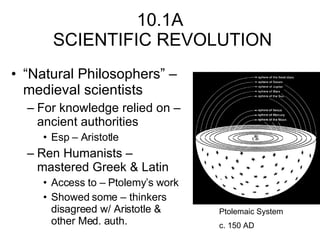
10.1A  SCIENTIFIC REVOLUTION “ Natural Philosophers” – medieval scientists For knowledge relied on – ancient authorities  Esp – Aristotle Ren Humanists – mastered Greek & Latin Access to – Ptolemy’s work Showed some – thinkers disagreed w/ Aristotle & other Med. auth. Ptolemaic System  c. 150 AD
New Inventions – telescope & microscope  Printing Press – helped spread new ideas quickly Mathematicians believed – secrets of nature were found in math Sci Rev aka – Age of Reason
Revolution in Astronomy Rev in Astronomy – overturned ideas about universe  Ptolemy greatest – astronomer of antiquity Ptolemaic system, called –  geocentric b/c – it places Earth at center of the universe Universe is – series of concentric spheres one inside the other Earth – is fixed (motionless) At – center Beyond spheres – was Heaven where God & saved souls resided
Nicolas Copernicus felt – geocentric system was too complicated Believed –  heliocentric  Sun – not Earth was at the center of the universe  Planets – revolved around the Sun Moon – revolved around the Earth Problems?
Johannes Kepler – German mathematician  Arrived at – his law of planetary motion Confirmed – that the Sun was at the center Orbits were – elliptical (egg-shaped) Sun – towards end of ellipse instead of at the center Known as – Kepler’s First Law
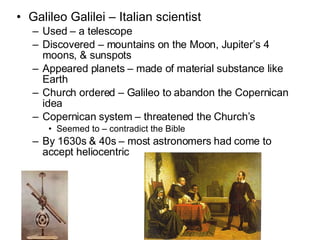
Galileo Galilei – Italian scientist Used – a telescope Discovered – mountains on the Moon, Jupiter’s 4 moons, & sunspots Appeared planets – made of material substance like Earth Church ordered – Galileo to abandon the Copernican idea Copernican system – threatened the Church’s  Seemed to – contradict the Bible By 1630s & 40s – most astronomers had come to accept heliocentric
Isaac Newton Defined – 3 laws of motion Universal law of gravitation – explains why planets move in elliptical orbits  around the Sun States every – object is attracted to other objects by gravity  Fact or Fiction?
10-1 B Medicine & Chemistry  Medicine & Chemistry- information based on Galen’s work w/ animals anatomy  Andreas Vesalius – discussed findings from dissecting human bodies –  On the  Fabric of the Human Body Presented – careful & accurate of individual organs & body Wm Harvey showed – heart (not liver) was the beginning point for circulation of blood –  On the Motion of the Heart and Blood Also proved – same blood flows in both veins and arteries Showed – blood makes a complete circuit through body
Andreas Vesalius On the Fabric of the Human Body … he offered detailed instructions (including a list of tools) that a student could use to perform their own dissections and “arrive at an independent conclusion” from either himself or Galenic dogma. http://primatediaries.blogspot
Robert Boyle- Boyle’s Law - properties of gas Antoine Lavoisier – invented a system of naming chemical elements
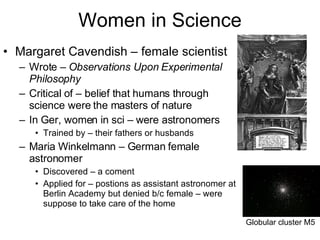
Women in Science Margaret Cavendish – female scientist  Wrote –  Observations Upon Experimental Philosophy Critical of – belief that humans through science were the masters of nature In Ger, women in sci – were astronomers Trained by – their fathers or husbands Maria Winkelmann – German female astronomer Discovered – a coment  Applied for – postions as assistant astronomer at Berlin Academy but denied b/c female – were suppose to take care of the home Globular cluster M5
Rene Descartes French philosopher Wrote about – doubt, uncertainty & confusion of 17th C Beyond doubt – his own existence Emphasized – the importance of his own mind  1st principle – “I think, therefore I am” Separation of – mind & matter (mind & body) Father of – modern rationalism (reason is the chief source of knowledge)
Scientific Method – systematic procedure for collecting & analyzing evidence Crucial to – the evolution (change) of science in the modern world Dev by – English philosopher Francis Bacon Believed should use – inductive reasoning to learn about nature Proceed from – particular to the general

Rev&Enl10_1AB

  • 1.
  • 2.
    10.1A SCIENTIFICREVOLUTION “ Natural Philosophers” – medieval scientists For knowledge relied on – ancient authorities Esp – Aristotle Ren Humanists – mastered Greek & Latin Access to – Ptolemy’s work Showed some – thinkers disagreed w/ Aristotle & other Med. auth. Ptolemaic System c. 150 AD
  • 3.
    New Inventions –telescope & microscope Printing Press – helped spread new ideas quickly Mathematicians believed – secrets of nature were found in math Sci Rev aka – Age of Reason
  • 4.
    Revolution in AstronomyRev in Astronomy – overturned ideas about universe Ptolemy greatest – astronomer of antiquity Ptolemaic system, called – geocentric b/c – it places Earth at center of the universe Universe is – series of concentric spheres one inside the other Earth – is fixed (motionless) At – center Beyond spheres – was Heaven where God & saved souls resided
  • 5.
    Nicolas Copernicus felt– geocentric system was too complicated Believed – heliocentric Sun – not Earth was at the center of the universe Planets – revolved around the Sun Moon – revolved around the Earth Problems?
  • 6.
    Johannes Kepler –German mathematician Arrived at – his law of planetary motion Confirmed – that the Sun was at the center Orbits were – elliptical (egg-shaped) Sun – towards end of ellipse instead of at the center Known as – Kepler’s First Law
  • 7.
    Galileo Galilei –Italian scientist Used – a telescope Discovered – mountains on the Moon, Jupiter’s 4 moons, & sunspots Appeared planets – made of material substance like Earth Church ordered – Galileo to abandon the Copernican idea Copernican system – threatened the Church’s Seemed to – contradict the Bible By 1630s & 40s – most astronomers had come to accept heliocentric
  • 8.
    Isaac Newton Defined– 3 laws of motion Universal law of gravitation – explains why planets move in elliptical orbits around the Sun States every – object is attracted to other objects by gravity Fact or Fiction?
  • 9.
    10-1 B Medicine& Chemistry Medicine & Chemistry- information based on Galen’s work w/ animals anatomy Andreas Vesalius – discussed findings from dissecting human bodies – On the Fabric of the Human Body Presented – careful & accurate of individual organs & body Wm Harvey showed – heart (not liver) was the beginning point for circulation of blood – On the Motion of the Heart and Blood Also proved – same blood flows in both veins and arteries Showed – blood makes a complete circuit through body
  • 10.
    Andreas Vesalius Onthe Fabric of the Human Body … he offered detailed instructions (including a list of tools) that a student could use to perform their own dissections and “arrive at an independent conclusion” from either himself or Galenic dogma. http://primatediaries.blogspot
  • 11.
    Robert Boyle- Boyle’sLaw - properties of gas Antoine Lavoisier – invented a system of naming chemical elements
  • 12.
    Women in ScienceMargaret Cavendish – female scientist Wrote – Observations Upon Experimental Philosophy Critical of – belief that humans through science were the masters of nature In Ger, women in sci – were astronomers Trained by – their fathers or husbands Maria Winkelmann – German female astronomer Discovered – a coment Applied for – postions as assistant astronomer at Berlin Academy but denied b/c female – were suppose to take care of the home Globular cluster M5
  • 13.
    Rene Descartes Frenchphilosopher Wrote about – doubt, uncertainty & confusion of 17th C Beyond doubt – his own existence Emphasized – the importance of his own mind 1st principle – “I think, therefore I am” Separation of – mind & matter (mind & body) Father of – modern rationalism (reason is the chief source of knowledge)
  • 14.
    Scientific Method –systematic procedure for collecting & analyzing evidence Crucial to – the evolution (change) of science in the modern world Dev by – English philosopher Francis Bacon Believed should use – inductive reasoning to learn about nature Proceed from – particular to the general