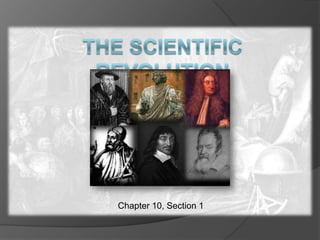
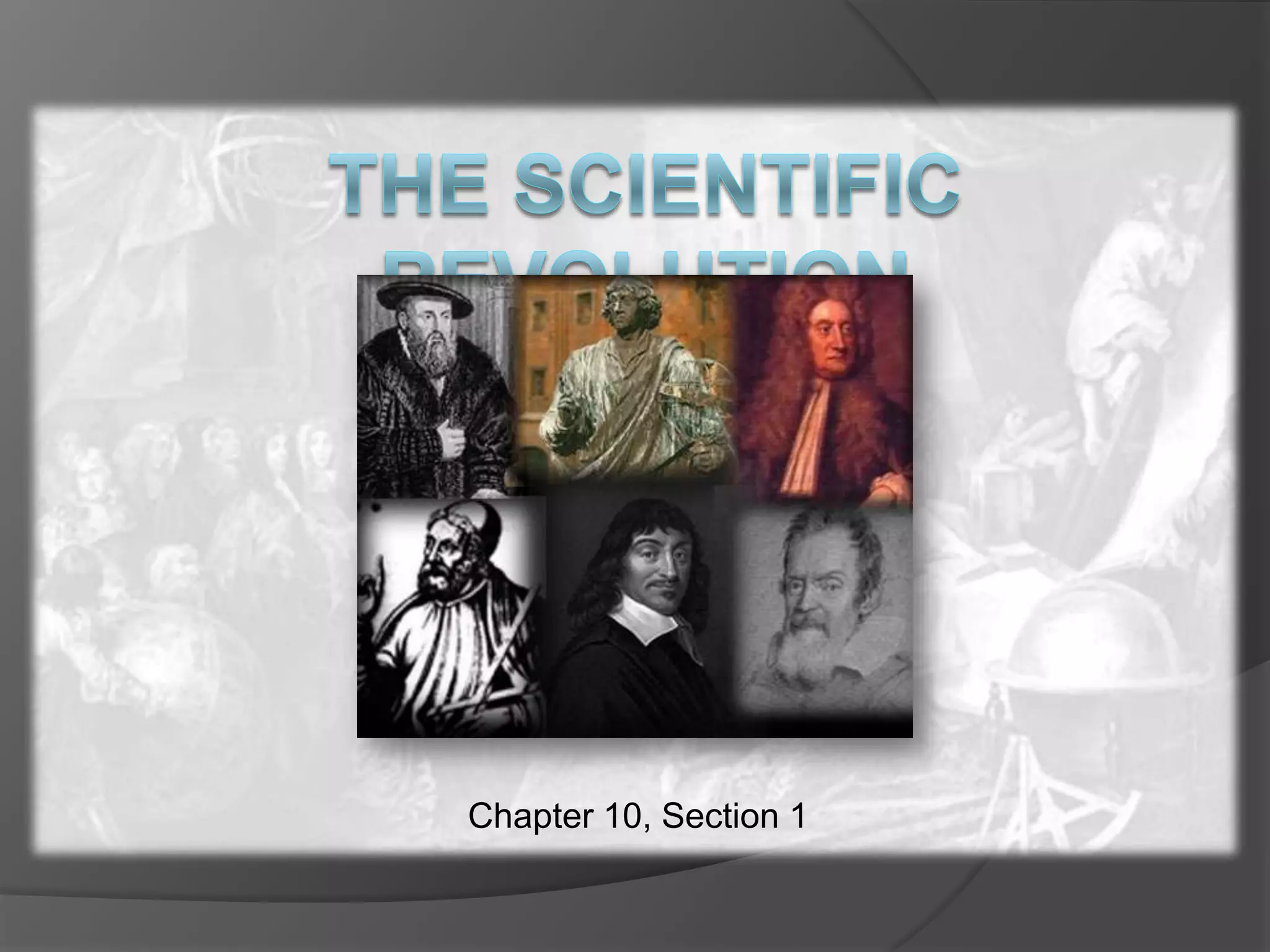
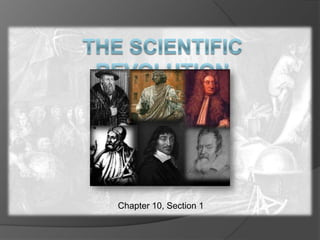
The Scientific RevolutionChapter 10, Section 1
The Scientific Revolution
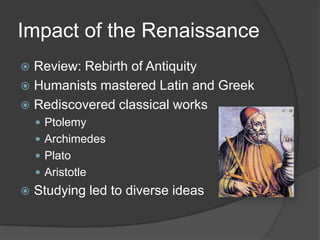
Impact of the RenaissanceReview: Rebirth of AntiquityHumanists mastered Latin and GreekRediscovered classical worksPtolemyArchimedesPlatoAristotleStudying led to diverse ideas
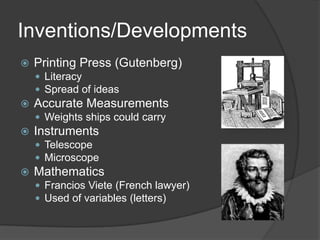
Inventions/DevelopmentsPrinting Press (Gutenberg) LiteracySpread of ideasAccurate MeasurementsWeights ships could carryInstrumentsTelescopeMicroscopeMathematicsFranciosViete (French lawyer)Used of variables (letters)
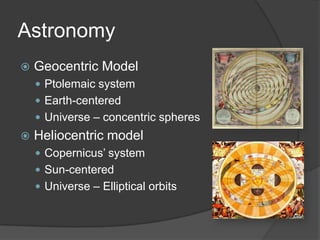
AstronomyGeocentric ModelPtolemaic systemEarth-centeredUniverse – concentric spheresHeliocentric modelCopernicus’ systemSun-centeredUniverse – Elliptical orbits
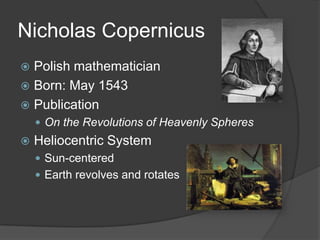
Nicholas CopernicusPolish mathematicianBorn: May 1543PublicationOn the Revolutions of Heavenly Spheres Heliocentric SystemSun-centeredEarth revolves and rotates
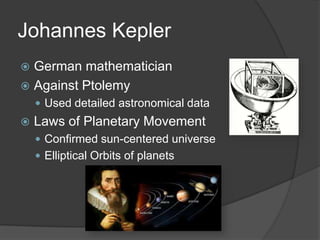
Johannes KeplerGerman mathematicianAgainst Ptolemy Used detailed astronomical dataLaws of Planetary MovementConfirmed sun-centered universeElliptical Orbits of planets
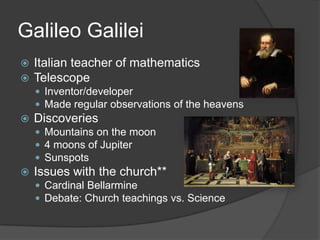
Galileo GalileiItalian teacher of mathematicsTelescopeInventor/developerMade regular observations of the heavens DiscoveriesMountains on the moon4 moons of JupiterSunspotsIssues with the church**Cardinal BellarmineDebate: Church teachings vs. Science
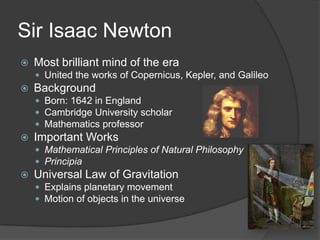
Sir Isaac NewtonMost brilliant mind of the eraUnited the works of Copernicus, Kepler, and Galileo BackgroundBorn: 1642 in EnglandCambridge University scholarMathematics professor Important WorksMathematical Principles of Natural PhilosophyPrincipiaUniversal Law of GravitationExplains planetary movementMotion of objects in the universe
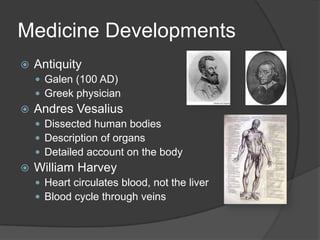
Medicine DevelopmentsAntiquityGalen (100 AD)Greek physician Andres VesaliusDissected human bodiesDescription of organsDetailed account on the bodyWilliam Harvey Heart circulates blood, not the liverBlood cycle through veins
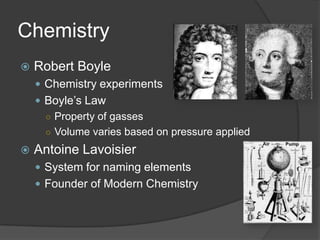
ChemistryRobert BoyleChemistry experimentsBoyle’s LawProperty of gassesVolume varies based on pressure appliedAntoine LavoisierSystem for naming elements Founder of Modern Chemistry
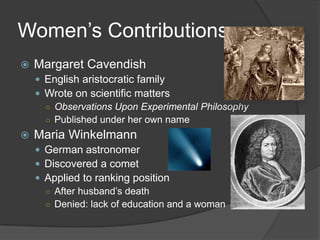
Women’s ContributionsMargaret CavendishEnglish aristocratic familyWrote on scientific matters Observations Upon Experimental PhilosophyPublished under her own nameMaria WinkelmannGerman astronomer Discovered a cometApplied to ranking positionAfter husband’s deathDenied: lack of education and a woman
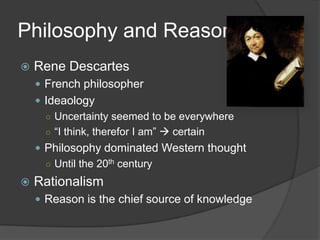
Philosophy and ReasonRene DescartesFrench philosopherIdeaologyUncertainty seemed to be everywhere“I think, therefor I am”  certain Philosophy dominated Western thoughtUntil the 20th century RationalismReason is the chief source of knowledge
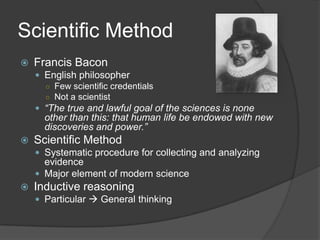
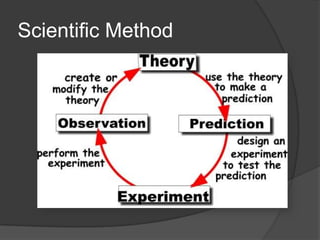
Scientific MethodFrancis BaconEnglish philosopher Few scientific credentialsNot a scientist “The true and lawful goal of the sciences is none other than this: that human life be endowed with new discoveries and power.”Scientific MethodSystematic procedure for collecting and analyzing evidenceMajor element of modern scienceInductive reasoningParticular  General thinking
Scientific Method
The Scientific RevolutionChapter 10, Section 1

10 1 ppt

  • 1.
  • 2.
  • 3.
    Impact of theRenaissanceReview: Rebirth of AntiquityHumanists mastered Latin and GreekRediscovered classical worksPtolemyArchimedesPlatoAristotleStudying led to diverse ideas
  • 4.
    Inventions/DevelopmentsPrinting Press (Gutenberg)LiteracySpread of ideasAccurate MeasurementsWeights ships could carryInstrumentsTelescopeMicroscopeMathematicsFranciosViete (French lawyer)Used of variables (letters)
  • 5.
    AstronomyGeocentric ModelPtolemaic systemEarth-centeredUniverse– concentric spheresHeliocentric modelCopernicus’ systemSun-centeredUniverse – Elliptical orbits
  • 6.
    Nicholas CopernicusPolish mathematicianBorn:May 1543PublicationOn the Revolutions of Heavenly Spheres Heliocentric SystemSun-centeredEarth revolves and rotates
  • 7.
    Johannes KeplerGerman mathematicianAgainstPtolemy Used detailed astronomical dataLaws of Planetary MovementConfirmed sun-centered universeElliptical Orbits of planets
  • 8.
    Galileo GalileiItalian teacherof mathematicsTelescopeInventor/developerMade regular observations of the heavens DiscoveriesMountains on the moon4 moons of JupiterSunspotsIssues with the church**Cardinal BellarmineDebate: Church teachings vs. Science
  • 9.
    Sir Isaac NewtonMostbrilliant mind of the eraUnited the works of Copernicus, Kepler, and Galileo BackgroundBorn: 1642 in EnglandCambridge University scholarMathematics professor Important WorksMathematical Principles of Natural PhilosophyPrincipiaUniversal Law of GravitationExplains planetary movementMotion of objects in the universe
  • 10.
    Medicine DevelopmentsAntiquityGalen (100AD)Greek physician Andres VesaliusDissected human bodiesDescription of organsDetailed account on the bodyWilliam Harvey Heart circulates blood, not the liverBlood cycle through veins
  • 11.
    ChemistryRobert BoyleChemistry experimentsBoyle’sLawProperty of gassesVolume varies based on pressure appliedAntoine LavoisierSystem for naming elements Founder of Modern Chemistry
  • 12.
    Women’s ContributionsMargaret CavendishEnglisharistocratic familyWrote on scientific matters Observations Upon Experimental PhilosophyPublished under her own nameMaria WinkelmannGerman astronomer Discovered a cometApplied to ranking positionAfter husband’s deathDenied: lack of education and a woman
  • 13.
    Philosophy and ReasonReneDescartesFrench philosopherIdeaologyUncertainty seemed to be everywhere“I think, therefor I am”  certain Philosophy dominated Western thoughtUntil the 20th century RationalismReason is the chief source of knowledge
  • 14.
    Scientific MethodFrancis BaconEnglishphilosopher Few scientific credentialsNot a scientist “The true and lawful goal of the sciences is none other than this: that human life be endowed with new discoveries and power.”Scientific MethodSystematic procedure for collecting and analyzing evidenceMajor element of modern scienceInductive reasoningParticular  General thinking
  • 15.
  • 16.