Scientific Revolution
  Turning the Universe On Its Head
Objectives


❖   Students will explain how new discoveries in astronomy
    changed the way people viewed the universe.

❖   Students will analyze the changes in European thought and
    culture resulting from the Renaissance.
Vocabulary
❖   heliocentric: based on the belief that the sun is the center of the
    universe.

❖   scientific method: careful, step-by-step process used to confirm
    findings and confirm findings and to prove or disprove a hypothesis.

❖   hypothesis: an unproved theory accepted for the purposes of
    explaining certain facts or to proved a basis for further
    investigation.

❖   gravity: force that pulls objects in Earth's sphere to the center of
    the Earth.

❖   calculus: a branch of mathematics in which calculations are made
    using special symbolic notations; developed by Isaac Newton
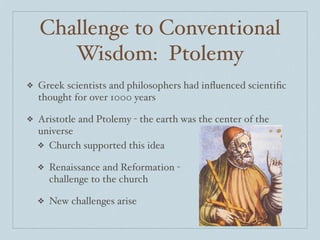
Challenge to Conventional
       Wisdom: Ptolemy
❖   Greek scientists and philosophers had influenced scientific
    thought for over 1000 years

❖   Aristotle and Ptolemy - the earth was the center of the
    universe
    ❖ Church supported this idea

    ❖   Renaissance and Reformation -
        challenge to the church

    ❖   New challenges arise
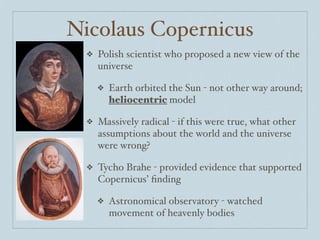
Nicolaus Copernicus
  ❖   Polish scientist who proposed a new view of the
      universe

      ❖   Earth orbited the Sun - not other way around;
          heliocentric model

  ❖   Massively radical - if this were true, what other
      assumptions about the world and the universe
      were wrong?

  ❖   Tycho Brahe - provided evidence that supported
      Copernicus’ finding

      ❖   Astronomical observatory - watched
          movement of heavenly bodies
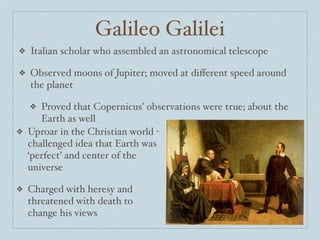
Galileo Galilei
❖   Italian scholar who assembled an astronomical telescope

❖   Observed moons of Jupiter; moved at different speed around
    the planet

    ❖Proved that Copernicus’ observations were true; about the
     Earth as well
❖ Uproar in the Christian world -
  challenged idea that Earth was
  ‘perfect’ and center of the
  universe

❖   Charged with heresy and
    threatened with death to
    change his views
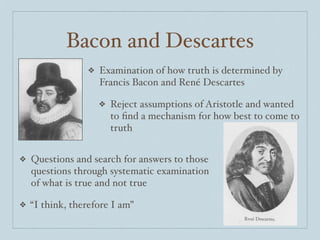
Bacon and Descartes
                 ❖   Examination of how truth is determined by
                     Francis Bacon and René Descartes

                     ❖   Reject assumptions of Aristotle and wanted
                         to find a mechanism for how best to come to
                         truth


❖   Questions and search for answers to those
    questions through systematic examination
    of what is true and not true

❖   “I think, therefore I am”
Scientific Method
❖   Step-by-step process of discovery

❖   Collection of data and evidence that is measurable

    ❖   To explain data, form a hypothesis

    ❖   Test and retest these assumptions

    ❖   Use mathematical calculations to quantify information
        and finally form an expression of understanding to
        establish scientific laws
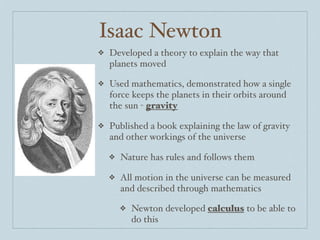
Isaac Newton
❖   Developed a theory to explain the way that
    planets moved

❖   Used mathematics, demonstrated how a single
    force keeps the planets in their orbits around
    the sun - gravity

❖   Published a book explaining the law of gravity
    and other workings of the universe

    ❖   Nature has rules and follows them

    ❖   All motion in the universe can be measured
        and described through mathematics

        ❖   Newton developed calculus to be able to
            do this

Scientific Revolution

  • 1.
    Scientific Revolution Turning the Universe On Its Head
  • 2.
    Objectives ❖ Students will explain how new discoveries in astronomy changed the way people viewed the universe. ❖ Students will analyze the changes in European thought and culture resulting from the Renaissance.
  • 3.
    Vocabulary ❖ heliocentric: based on the belief that the sun is the center of the universe. ❖ scientific method: careful, step-by-step process used to confirm findings and confirm findings and to prove or disprove a hypothesis. ❖ hypothesis: an unproved theory accepted for the purposes of explaining certain facts or to proved a basis for further investigation. ❖ gravity: force that pulls objects in Earth's sphere to the center of the Earth. ❖ calculus: a branch of mathematics in which calculations are made using special symbolic notations; developed by Isaac Newton
  • 4.
    Challenge to Conventional Wisdom: Ptolemy ❖ Greek scientists and philosophers had influenced scientific thought for over 1000 years ❖ Aristotle and Ptolemy - the earth was the center of the universe ❖ Church supported this idea ❖ Renaissance and Reformation - challenge to the church ❖ New challenges arise
  • 5.
    Nicolaus Copernicus ❖ Polish scientist who proposed a new view of the universe ❖ Earth orbited the Sun - not other way around; heliocentric model ❖ Massively radical - if this were true, what other assumptions about the world and the universe were wrong? ❖ Tycho Brahe - provided evidence that supported Copernicus’ finding ❖ Astronomical observatory - watched movement of heavenly bodies
  • 6.
    Galileo Galilei ❖ Italian scholar who assembled an astronomical telescope ❖ Observed moons of Jupiter; moved at different speed around the planet ❖Proved that Copernicus’ observations were true; about the Earth as well ❖ Uproar in the Christian world - challenged idea that Earth was ‘perfect’ and center of the universe ❖ Charged with heresy and threatened with death to change his views
  • 7.
    Bacon and Descartes ❖ Examination of how truth is determined by Francis Bacon and René Descartes ❖ Reject assumptions of Aristotle and wanted to find a mechanism for how best to come to truth ❖ Questions and search for answers to those questions through systematic examination of what is true and not true ❖ “I think, therefore I am”
  • 8.
    Scientific Method ❖ Step-by-step process of discovery ❖ Collection of data and evidence that is measurable ❖ To explain data, form a hypothesis ❖ Test and retest these assumptions ❖ Use mathematical calculations to quantify information and finally form an expression of understanding to establish scientific laws
  • 9.
    Isaac Newton ❖ Developed a theory to explain the way that planets moved ❖ Used mathematics, demonstrated how a single force keeps the planets in their orbits around the sun - gravity ❖ Published a book explaining the law of gravity and other workings of the universe ❖ Nature has rules and follows them ❖ All motion in the universe can be measured and described through mathematics ❖ Newton developed calculus to be able to do this

Editor's Notes