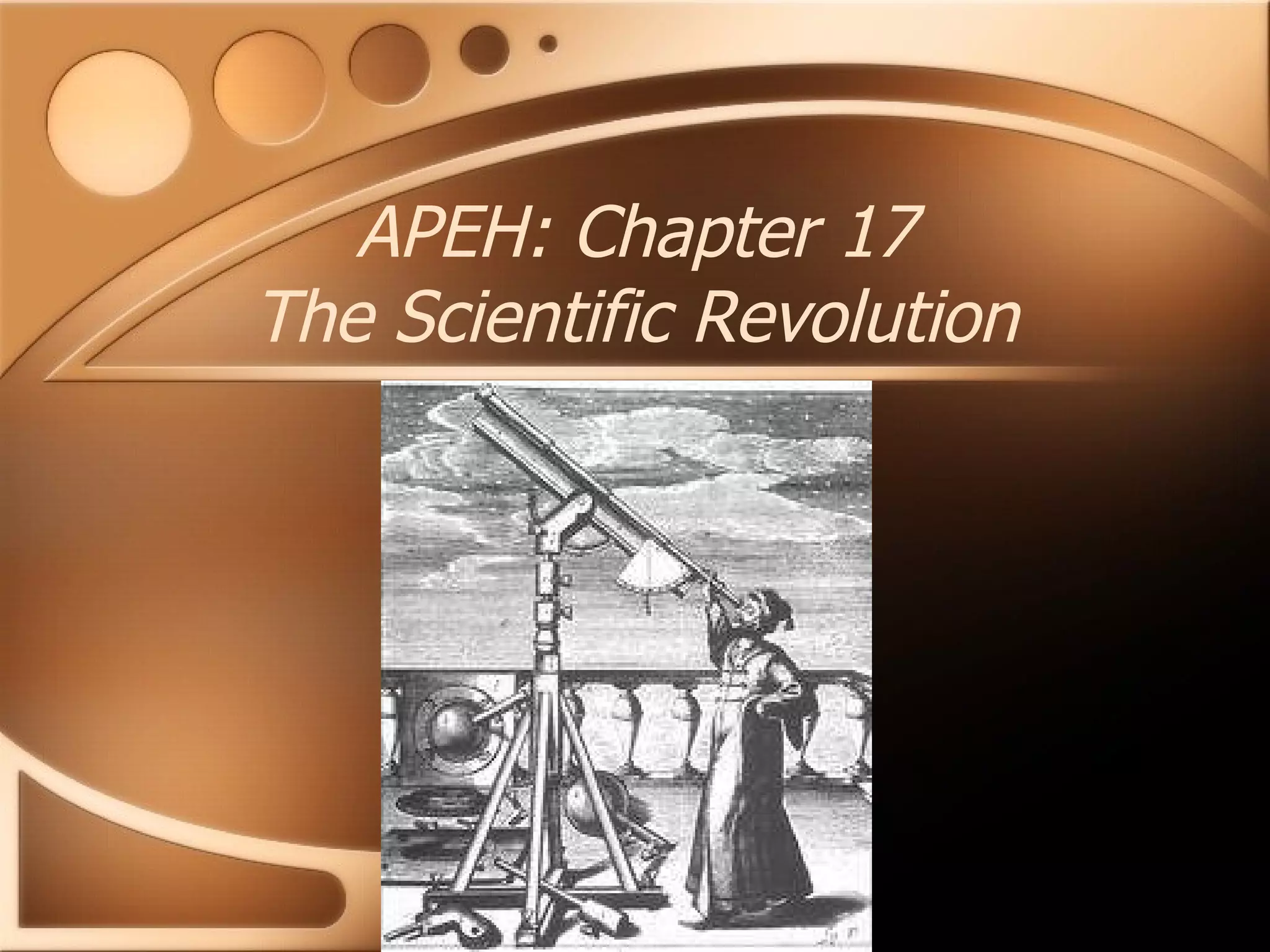
APEH: Chapter 17 The Scientific Revolution
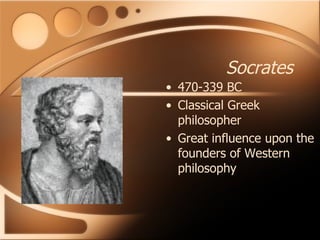
Socrates 470-339 BC Classical Greek philosopher Great influence upon the founders of Western philosophy
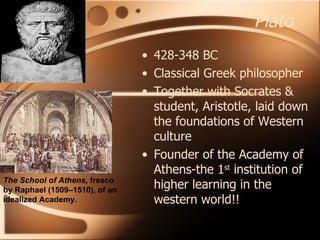
Plato 428-348 BC Classical Greek philosopher Together with Socrates & student, Aristotle, laid down the foundations of Western culture  Founder of the Academy of Athens-the 1 st  institution of higher learning in the western world!! The School of Athens , fresco by Raphael (1509–1510), of an idealized Academy.
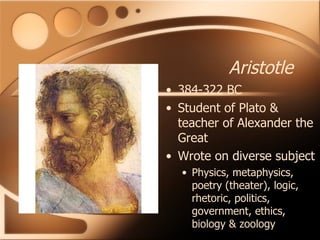
Aristotle 384-322 BC Student of Plato & teacher of Alexander the Great Wrote on diverse subject Physics, metaphysics, poetry (theater), logic, rhetoric, politics, government, ethics, biology & zoology
Aristotle’s ideas Ideas about astronomy & physics accepted with minor revisions Offered understandable, common sense explanation for what eye saw Science fit neatly with Christian doctrines Humans are center of universe “ Great chain of being” Science was branch of theology
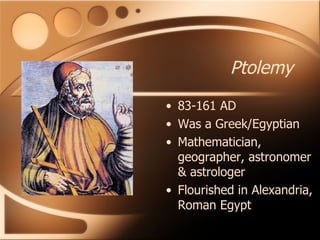
Ptolemy 83-161 AD Was a Greek/Egyptian Mathematician, geographer, astronomer & astrologer Flourished in Alexandria, Roman Egypt
Causes of the Scientific Revolution: Newton-If I have seen further(than others) it is by standing on the shoulders of Giants!” This period was a product of towering genius! 1.Medieval Universities provided the frame-work for the new view Renaissance stimulated science by rediscovering ancient mathematics. 3.  Better ways of obtaining knowledge about the world including improved tools such as telescopes, sextants, improved the scientific method. Astronomy and physics were at the heart of the Scientific Revolution
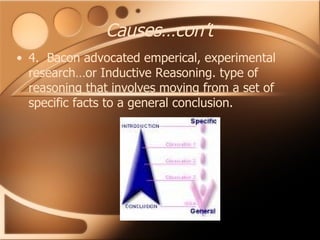
Causes…con’t 4.  Bacon advocated emperical, experimental research…or Inductive Reasoning. type of reasoning that involves moving from a set of specific facts to a general conclusion.
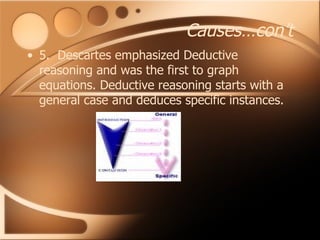
Causes…con’t 5.  Descartes emphasized Deductive reasoning and was the first to graph equations. Deductive reasoning starts with a general case and deduces specific instances.
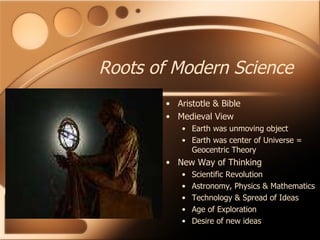
Roots of Modern Science Aristotle & Bible Medieval View Earth was unmoving object Earth was center of Universe = Geocentric Theory New Way of Thinking Scientific Revolution Astronomy, Physics & Mathematics Technology & Spread of Ideas Age of Exploration  Desire of new ideas
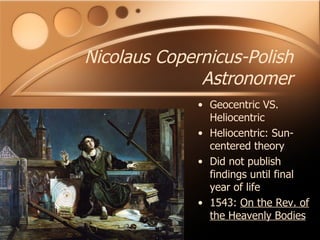
Nicolaus Copernicus-Polish Astronomer Geocentric VS. Heliocentric Heliocentric: Sun-centered theory Did not publish findings until final year of life 1543:  On the Rev. of the Heavenly Bodies
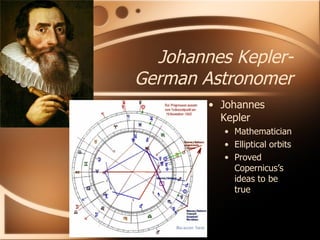
Johannes Kepler-German Astronomer Johannes Kepler Mathematician Elliptical orbits Proved Copernicus’s ideas to be true
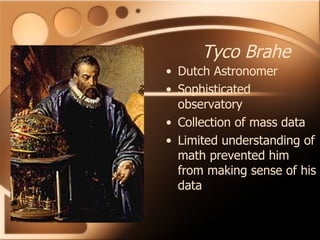
Tyco Brahe Dutch Astronomer Sophisticated observatory Collection of mass data Limited understanding of math prevented him from making sense of his data
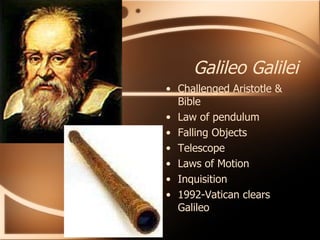
Galileo Galilei Challenged Aristotle & Bible Law of pendulum Falling Objects Telescope Laws of Motion Inquisition 1992-Vatican clears Galileo
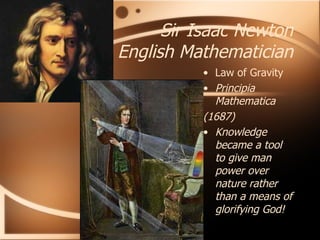
Sir Isaac Newton English Mathematician Law of Gravity Principia Mathematica (1687) Knowledge became a tool to give man power over nature rather than a means of glorifying God!
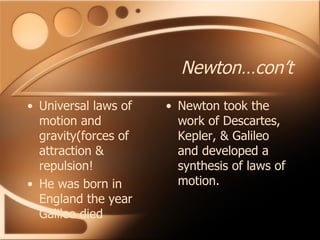
Newton…con’t Universal laws of motion and gravity(forces of attraction & repulsion! He was born in England the year Galileo died Newton took the work of Descartes, Kepler, & Galileo and developed a synthesis of laws of motion.
Connection to Today Vatican clears Galileo 1992: Pope John Paul II 13-year study Church acted in “good faith”
Scientific Method Logical procedure for gathering & testing ideas 5 steps… Observation Hypothesis Experiment Analyze/Interpret data Conclusion
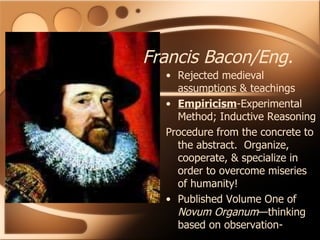
Rejected medieval assumptions & teachings Empiricism -Experimental Method; Inductive Reasoning Procedure from the concrete to the abstract.  Organize, cooperate, & specialize in order to overcome miseries of humanity! Published Volume One of  Novum Organum —thinking based on observation- Francis Bacon/Eng.
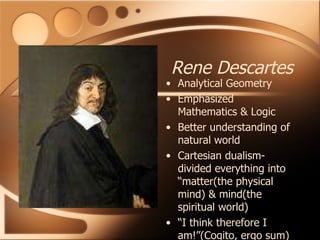
Rene Descartes Analytical Geometry Emphasized Mathematics & Logic Better understanding of natural world Cartesian dualism-divided everything into “matter(the physical mind) & mind(the spiritual world) “ I think therefore I am!”(Cogito, ergo sum)
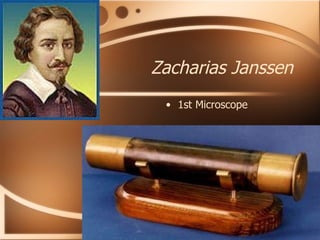
Zacharias Janssen 1st Microscope
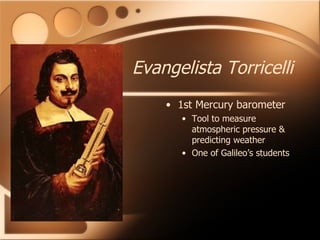
Evangelista Torricelli 1st Mercury barometer Tool to measure atmospheric pressure & predicting weather One of Galileo’s students
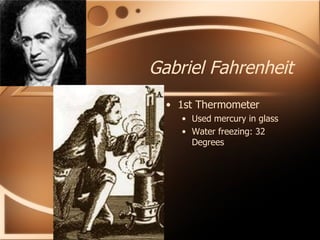
Gabriel Fahrenheit 1st Thermometer  Used mercury in glass Water freezing: 32 Degrees
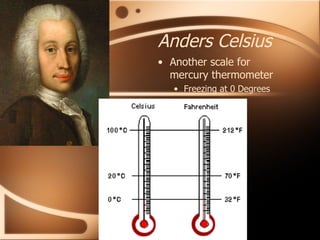
Anders Celsius Another scale for mercury thermometer Freezing at 0 Degrees
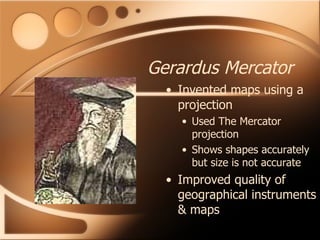
Gerardus Mercator Invented maps using a projection Used The Mercator projection Shows shapes accurately but size is not accurate Improved quality of geographical instruments & maps
The Scientific Revolution Science and Society  1. Rise of the International Scientific Community  2. Gender and Science  3. Religion and Science
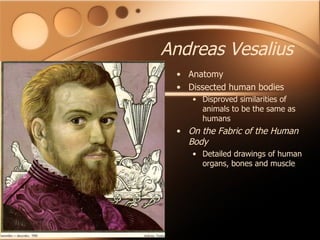
Andreas Vesalius Anatomy Dissected human bodies Disproved similarities of animals to be the same as humans On the Fabric of the Human Body Detailed drawings of human organs, bones and muscle
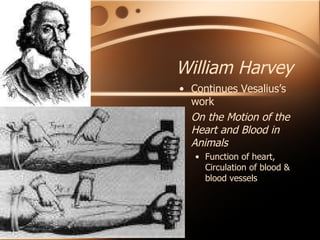
William Harvey Continues Vesalius’s work On the Motion of the Heart and Blood in Animals Function of heart, Circulation of blood & blood vessels
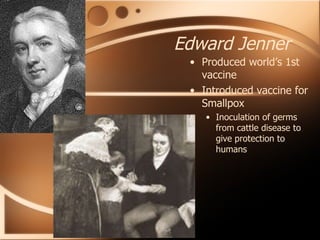
Edward Jenner Produced world’s 1st vaccine Introduced vaccine for Smallpox Inoculation of germs from cattle disease to give protection to humans
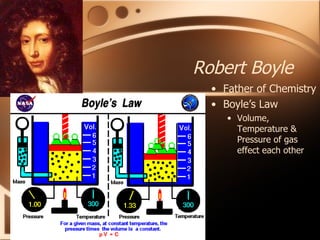
Robert Boyle Father of Chemistry Boyle’s Law Volume, Temperature & Pressure of gas effect each other
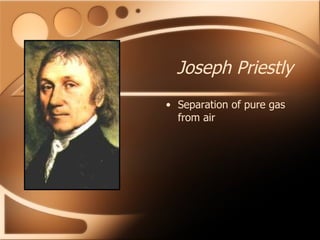
Joseph Priestly Separation of pure gas from air
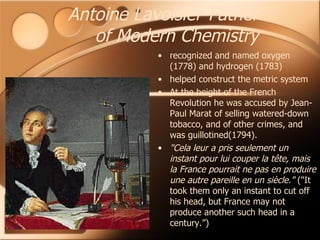
Antoine Lavoisier-Father of Modern Chemistry recognized and named oxygen (1778) and hydrogen (1783) helped construct the metric system At the height of the French Revolution he was accused by Jean-Paul Marat of selling watered-down tobacco, and of other crimes, and was guillotined(1794). "Cela leur a pris seulement un instant pour lui couper la tête, mais la France pourrait ne pas en produire une autre pareille en un siècle."  ("It took them only an instant to cut off his head, but France may not produce another such head in a century.”)
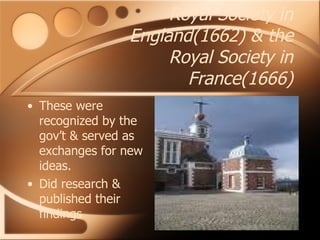
Royal Society in England(1662) & the Royal Society in France(1666) These were recognized by the gov’t & served as exchanges for new ideas. Did research & published their findings
Royal Societies…con’t Generally, women were exluded, because they were believed to be less capable than men,though many female scientists worked on their own! Most scientific thinkers did not see a contradiction between religion & science, but there did develop a current of skepticism!
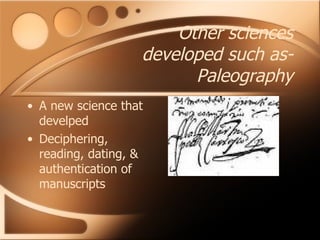
Other sciences developed such as-Paleography A new science that develped Deciphering, reading, dating, & authentication of manuscripts
AGE OF REASON!!!!!! All in all, natural laws could be discovered through the application of reason, which led to the 18 th  C conception of  The human mind as “rational” and the period as the “Age of Reason!” The Sc. Rev.  led to the Enlightenment!
The Age of Reason represented a genesis in the way man viewed himself, the pursuit of knowledge, and the universe.
Apeh ch. 17-sc.rev.teacher-sc.rev

  • 1.
    APEH: Chapter 17The Scientific Revolution
  • 2.
    Socrates 470-339 BCClassical Greek philosopher Great influence upon the founders of Western philosophy
  • 3.
    Plato 428-348 BCClassical Greek philosopher Together with Socrates & student, Aristotle, laid down the foundations of Western culture Founder of the Academy of Athens-the 1 st institution of higher learning in the western world!! The School of Athens , fresco by Raphael (1509–1510), of an idealized Academy.
  • 4.
    Aristotle 384-322 BCStudent of Plato & teacher of Alexander the Great Wrote on diverse subject Physics, metaphysics, poetry (theater), logic, rhetoric, politics, government, ethics, biology & zoology
  • 5.
    Aristotle’s ideas Ideasabout astronomy & physics accepted with minor revisions Offered understandable, common sense explanation for what eye saw Science fit neatly with Christian doctrines Humans are center of universe “ Great chain of being” Science was branch of theology
  • 6.
    Ptolemy 83-161 ADWas a Greek/Egyptian Mathematician, geographer, astronomer & astrologer Flourished in Alexandria, Roman Egypt
  • 7.
    Causes of theScientific Revolution: Newton-If I have seen further(than others) it is by standing on the shoulders of Giants!” This period was a product of towering genius! 1.Medieval Universities provided the frame-work for the new view Renaissance stimulated science by rediscovering ancient mathematics. 3. Better ways of obtaining knowledge about the world including improved tools such as telescopes, sextants, improved the scientific method. Astronomy and physics were at the heart of the Scientific Revolution
  • 8.
    Causes…con’t 4. Bacon advocated emperical, experimental research…or Inductive Reasoning. type of reasoning that involves moving from a set of specific facts to a general conclusion.
  • 9.
    Causes…con’t 5. Descartes emphasized Deductive reasoning and was the first to graph equations. Deductive reasoning starts with a general case and deduces specific instances.
  • 10.
    Roots of ModernScience Aristotle & Bible Medieval View Earth was unmoving object Earth was center of Universe = Geocentric Theory New Way of Thinking Scientific Revolution Astronomy, Physics & Mathematics Technology & Spread of Ideas Age of Exploration Desire of new ideas
  • 11.
    Nicolaus Copernicus-Polish AstronomerGeocentric VS. Heliocentric Heliocentric: Sun-centered theory Did not publish findings until final year of life 1543: On the Rev. of the Heavenly Bodies
  • 12.
    Johannes Kepler-German AstronomerJohannes Kepler Mathematician Elliptical orbits Proved Copernicus’s ideas to be true
  • 13.
    Tyco Brahe DutchAstronomer Sophisticated observatory Collection of mass data Limited understanding of math prevented him from making sense of his data
  • 14.
    Galileo Galilei ChallengedAristotle & Bible Law of pendulum Falling Objects Telescope Laws of Motion Inquisition 1992-Vatican clears Galileo
  • 15.
    Sir Isaac NewtonEnglish Mathematician Law of Gravity Principia Mathematica (1687) Knowledge became a tool to give man power over nature rather than a means of glorifying God!
  • 16.
    Newton…con’t Universal lawsof motion and gravity(forces of attraction & repulsion! He was born in England the year Galileo died Newton took the work of Descartes, Kepler, & Galileo and developed a synthesis of laws of motion.
  • 17.
    Connection to TodayVatican clears Galileo 1992: Pope John Paul II 13-year study Church acted in “good faith”
  • 18.
    Scientific Method Logicalprocedure for gathering & testing ideas 5 steps… Observation Hypothesis Experiment Analyze/Interpret data Conclusion
  • 19.
    Rejected medieval assumptions& teachings Empiricism -Experimental Method; Inductive Reasoning Procedure from the concrete to the abstract. Organize, cooperate, & specialize in order to overcome miseries of humanity! Published Volume One of Novum Organum —thinking based on observation- Francis Bacon/Eng.
  • 20.
    Rene Descartes AnalyticalGeometry Emphasized Mathematics & Logic Better understanding of natural world Cartesian dualism-divided everything into “matter(the physical mind) & mind(the spiritual world) “ I think therefore I am!”(Cogito, ergo sum)
  • 21.
  • 22.
    Evangelista Torricelli 1stMercury barometer Tool to measure atmospheric pressure & predicting weather One of Galileo’s students
  • 23.
    Gabriel Fahrenheit 1stThermometer Used mercury in glass Water freezing: 32 Degrees
  • 24.
    Anders Celsius Anotherscale for mercury thermometer Freezing at 0 Degrees
  • 25.
    Gerardus Mercator Inventedmaps using a projection Used The Mercator projection Shows shapes accurately but size is not accurate Improved quality of geographical instruments & maps
  • 26.
    The Scientific RevolutionScience and Society 1. Rise of the International Scientific Community 2. Gender and Science 3. Religion and Science
  • 27.
    Andreas Vesalius AnatomyDissected human bodies Disproved similarities of animals to be the same as humans On the Fabric of the Human Body Detailed drawings of human organs, bones and muscle
  • 28.
    William Harvey ContinuesVesalius’s work On the Motion of the Heart and Blood in Animals Function of heart, Circulation of blood & blood vessels
  • 29.
    Edward Jenner Producedworld’s 1st vaccine Introduced vaccine for Smallpox Inoculation of germs from cattle disease to give protection to humans
  • 30.
    Robert Boyle Fatherof Chemistry Boyle’s Law Volume, Temperature & Pressure of gas effect each other
  • 31.
    Joseph Priestly Separationof pure gas from air
  • 32.
    Antoine Lavoisier-Father ofModern Chemistry recognized and named oxygen (1778) and hydrogen (1783) helped construct the metric system At the height of the French Revolution he was accused by Jean-Paul Marat of selling watered-down tobacco, and of other crimes, and was guillotined(1794). "Cela leur a pris seulement un instant pour lui couper la tête, mais la France pourrait ne pas en produire une autre pareille en un siècle." ("It took them only an instant to cut off his head, but France may not produce another such head in a century.”)
  • 33.
    Royal Society inEngland(1662) & the Royal Society in France(1666) These were recognized by the gov’t & served as exchanges for new ideas. Did research & published their findings
  • 34.
    Royal Societies…con’t Generally,women were exluded, because they were believed to be less capable than men,though many female scientists worked on their own! Most scientific thinkers did not see a contradiction between religion & science, but there did develop a current of skepticism!
  • 35.
    Other sciences developedsuch as-Paleography A new science that develped Deciphering, reading, dating, & authentication of manuscripts
  • 36.
    AGE OF REASON!!!!!!All in all, natural laws could be discovered through the application of reason, which led to the 18 th C conception of The human mind as “rational” and the period as the “Age of Reason!” The Sc. Rev.  led to the Enlightenment!
  • 37.
    The Age ofReason represented a genesis in the way man viewed himself, the pursuit of knowledge, and the universe.

Editor's Notes

  • #27 I. The Scientific Revolution G. Science and Society 1. Rise of the International Scientific Community – A new and expanding social community linked by shared values, journals, and learned scientific societies such as the National Academy of Sciences. 2. Gender and Science – Scientists used gendered categories in the scientific revolution (nature was often depicted as a female whose veil of secrecy needed to be stripped away). Barriers arose for women in the scientific professions, even though there were many women involved in scientific endeavor. 3. Religion and Science – A complicated relationship, since all Western religious authorities opposed the Copernican system until about 1630. The Catholic church was initially less hostile but after the trial of Galileo in 1633, the Counter-Reformation church became much more hostile and certain Protestant countries (the Netherlands and Denmark) became quite “pro-science.” H. Medicine, the Body, and Chemistry 1. Paracelsus (1493–1541) – Swiss physician, alchemist and early proponent of experimental method in medicine who helped pioneer the use of chemicals and drugs to address chemical (not humoral) imbalances 2.Andreas Vesalius (1516–1564) – Flemish physician who studied anatomy by dissecting corpses and published “On the Structure of the Human Body,” which featured 200 precise drawings. 3. William Harvey (1578–1657) – English royal physician who discovered the circulation of blood through veins and arteries and described the function of the heart. 4. Robert Boyle (1627–1691) – Founder of the modern science of chemistry (first to create a vacuum, disproving Descartes’ belief that a vacuum could not exist in nature).