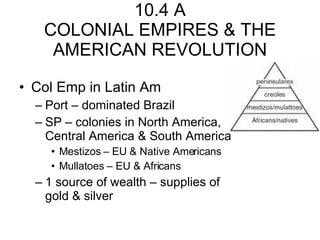
10.4 A COLONIAL EMPIRES & THE AMERICAN REVOLUTION Col Emp in Latin Am  Port – dominated Brazil SP – colonies in North America, Central America & South America Mestizos – EU & Native Americans  Mullatoes – EU & Africans  1 source of wealth – supplies of gold & silver
Farming – source of prosperity Large landowners – created immense estates Native Am – worked on large estates or on marginal (small) farms Trade – another source of profit # of – natural products were shipped to EU (sugar, tobacco, diamonds, animal hides) Mother countries – supplied colonists with manufactured goods SP & Port – closely regulated the trade of American colonies BR & FR – wanted in Latin American markets
SP & Port determined to – Christianize the native peoples Gave – Catholic Church an important role in the Americas Missionaries – brought Native Americans together into villages, converted them, taught them a trade, and encouraged them to grow crops Cath Church built – cathedrals, hospitals, orphanages & schools Allowed women – enter convents and become nuns
BRITAIN & NORTH AMERICA 1707 –  England & Scotland were united  BR – refer to both the English & Scots BR monarch – shared power with Parliament  Parl – gradually gained more power Had power – to make laws, levy taxes, pass the budget, influence ministers of the monarch 1714 – new dynasty - Hanoverians
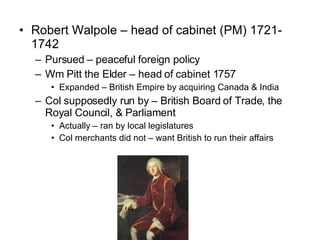
Robert Walpole – head of cabinet (PM) 1721-1742 Pursued – peaceful foreign policy Wm Pitt the Elder – head of cabinet 1757 Expanded – British Empire by acquiring Canada & India Col supposedly run by – British Board of Trade, the Royal Council, & Parliament Actually – ran by local legislatures  Col merchants did not – want British to run their affairs
10-4B American Revolution  After 7 Years War – British leaders wanted new $ from colonies Used to – cover war cost, army to defend the colonies 1765 – Parliament imposed the Stamp Act on colonies Required – printed materials carry a stamp showing tax had been paid Opposition – was widespread and often violent  1766 – act was repealed
1770s – crisis after crisis Col org – First Continental Congress Met – Philadelphia Urged col 1. take up arms 2. organize militias April 1775 – colonist vs British army – Lexington & Concord 2nd Cont Congress – met  Formed – army – Continental Army With – George Washington as commander in chief
July 4, 1776 – 2nd Cont Congress approved declaration of independence  Written by – Thomas Jefferson Based on – John Locke’s ideas Am Rev – has begun War – with Great Britain was a huge gamble  FR – supplied arms & money to rebels – also FR soldiers served in Wash. army 1778 – following a BR defeat FR recognize American state
SP & Dutch – also enter war against Great Britain  BR faced – war against much of EU and America Yorktown – General Cornwallis surrender to American & French forces under Washington BR – decided to end the war Treaty of Paris 1783 – recognized independence of the American colonies Granted Am – control of western territory from Appalachians to Mississippi River
Birth of a New Nation Former col – were now states Feared – concentrated power  Little enthusiasm – for creating a united nation with a strong central gov’t Articles of Confederation – nation’s first constitution Lacked – power to deal with new nation’s problems
Summer of 1787 – delegates met to revise the Articles Known as – Constitutional Convention Decided to – write a plan for an entirely new national gov’t The Constitution Created – a federal system (share of power between national and state governments)
Nat’l powers 1. levy taxes 2. raise army 3. regulate trade & national currency Divided into – 3 branches 1st – executive branch Pres – chief executive Power to 1. execute laws   2. veto legislature’s act   3. supervise foreign affairs   4. direct military forces 2nd – legislative branch Consisted of – 2 houses (Senate & House of Representatives) 3rd – judicial branch Courts would – enforce the Constitution (supreme law  of the land) Must be ratified – approved by 9 of 13 states
Bill of Rights – 1789  Guarantee:- freedom of religion, speech, press, petition, assembly - right to bear arms - protection against unreasonable searches & arrest- guaranteed trail by jury & due process of law- protection of property rights Many derived – rights came from natural rights  Eur intellectuals – saw the American Revolution as the picture of the Enlightenment’s political dreams

10-4

  • 1.
    10.4 A COLONIALEMPIRES & THE AMERICAN REVOLUTION Col Emp in Latin Am Port – dominated Brazil SP – colonies in North America, Central America & South America Mestizos – EU & Native Americans Mullatoes – EU & Africans 1 source of wealth – supplies of gold & silver
  • 2.
    Farming – sourceof prosperity Large landowners – created immense estates Native Am – worked on large estates or on marginal (small) farms Trade – another source of profit # of – natural products were shipped to EU (sugar, tobacco, diamonds, animal hides) Mother countries – supplied colonists with manufactured goods SP & Port – closely regulated the trade of American colonies BR & FR – wanted in Latin American markets
  • 3.
    SP & Portdetermined to – Christianize the native peoples Gave – Catholic Church an important role in the Americas Missionaries – brought Native Americans together into villages, converted them, taught them a trade, and encouraged them to grow crops Cath Church built – cathedrals, hospitals, orphanages & schools Allowed women – enter convents and become nuns
  • 4.
    BRITAIN & NORTHAMERICA 1707 – England & Scotland were united BR – refer to both the English & Scots BR monarch – shared power with Parliament Parl – gradually gained more power Had power – to make laws, levy taxes, pass the budget, influence ministers of the monarch 1714 – new dynasty - Hanoverians
  • 5.
    Robert Walpole –head of cabinet (PM) 1721-1742 Pursued – peaceful foreign policy Wm Pitt the Elder – head of cabinet 1757 Expanded – British Empire by acquiring Canada & India Col supposedly run by – British Board of Trade, the Royal Council, & Parliament Actually – ran by local legislatures Col merchants did not – want British to run their affairs
  • 6.
    10-4B American Revolution After 7 Years War – British leaders wanted new $ from colonies Used to – cover war cost, army to defend the colonies 1765 – Parliament imposed the Stamp Act on colonies Required – printed materials carry a stamp showing tax had been paid Opposition – was widespread and often violent 1766 – act was repealed
  • 7.
    1770s – crisisafter crisis Col org – First Continental Congress Met – Philadelphia Urged col 1. take up arms 2. organize militias April 1775 – colonist vs British army – Lexington & Concord 2nd Cont Congress – met Formed – army – Continental Army With – George Washington as commander in chief
  • 8.
    July 4, 1776– 2nd Cont Congress approved declaration of independence Written by – Thomas Jefferson Based on – John Locke’s ideas Am Rev – has begun War – with Great Britain was a huge gamble FR – supplied arms & money to rebels – also FR soldiers served in Wash. army 1778 – following a BR defeat FR recognize American state
  • 9.
    SP & Dutch– also enter war against Great Britain BR faced – war against much of EU and America Yorktown – General Cornwallis surrender to American & French forces under Washington BR – decided to end the war Treaty of Paris 1783 – recognized independence of the American colonies Granted Am – control of western territory from Appalachians to Mississippi River
  • 10.
    Birth of aNew Nation Former col – were now states Feared – concentrated power Little enthusiasm – for creating a united nation with a strong central gov’t Articles of Confederation – nation’s first constitution Lacked – power to deal with new nation’s problems
  • 11.
    Summer of 1787– delegates met to revise the Articles Known as – Constitutional Convention Decided to – write a plan for an entirely new national gov’t The Constitution Created – a federal system (share of power between national and state governments)
  • 12.
    Nat’l powers 1.levy taxes 2. raise army 3. regulate trade & national currency Divided into – 3 branches 1st – executive branch Pres – chief executive Power to 1. execute laws 2. veto legislature’s act 3. supervise foreign affairs 4. direct military forces 2nd – legislative branch Consisted of – 2 houses (Senate & House of Representatives) 3rd – judicial branch Courts would – enforce the Constitution (supreme law of the land) Must be ratified – approved by 9 of 13 states
  • 13.
    Bill of Rights– 1789 Guarantee:- freedom of religion, speech, press, petition, assembly - right to bear arms - protection against unreasonable searches & arrest- guaranteed trail by jury & due process of law- protection of property rights Many derived – rights came from natural rights Eur intellectuals – saw the American Revolution as the picture of the Enlightenment’s political dreams