RESPIRATORY SYSTEM
RESPIRATORY SYSTEM
FUNCTIONS
Gas Exchange (pick-up O2, eliminate CO2)
Filter, Warm & Humidify Air
Protection
Speech
Regulate pH
RESPIRATORY SYTEM
ORGANIZATION
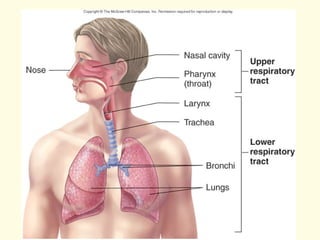
Upper Respiratory Tract (Outside Thorax)
- Nose
- Pharynx
Lower Respiratory Tract (Inside Thorax)
- Larynx
- Trachea
- Bronchial Tree
- Lungs
UPPER RESPIRATORY
TRACT
Nose
- External Nares/Anterior Nasal Aperture
(nostril)
- Nasal Cavity
*Hairs, Mucus (Trap Debris)
*Mucosa (Warm, Moisten)
*Cilia (Transport)
*Nasal Conchae Bones (Turbulence)
*Olfactory Receptors (Smell)
*Tear Drainage
UPPER RESPIRATORY
TRACT continued
- Paranasal Sinuses (4)
*Spaces in Bone
*Lined with Mucous Membrane
*Empty into Nasal Cavity
*Light Bone, Resonation
- Internal Nares/Posterior Nasal Aperture
UPPER RESPIRATORY
TRACT continued
Pharynx (Throat)
- Between Nasal Cavity & Larynx
- Passageway for Air & Food
- 3 Divisions:
*Nasopharynx
*Oropharynx
*Laryngopharynx
UPPER RESPIRATORY
TRACT continued
- Protected by Tonsils:
*Pharyngeal Tonsil (“Adenoids”,
Nasopharynx)
*Tubal Tonsils (Nasopharynx, Entrance
to Auditory Tubes)
*Palatine Tonsils (Oropharynx)
*Lingual Tonsils (Oropharynx)
LOWER RESPIRATORY
TRACT
Larynx (Hyoid → Cricoid Cartilage)
- 2 Functions:
*Keep Movement of Food & Air
Separate
*Provide Sound for Speech
- Glottis
*Slit-like Opening into Larynx
*Produces Speech with Vocal Cords
LOWER RESPIRATORY
TRACT continued
- Cartilages:
*Epiglottis
Covers Glottis (opening of larynx)
Prevents food from Entering Trachea
*Thyroid (“Adam’s Apple”)
*Cricoid (Inferior, Encircles Vocal
Cords)
LOWER RESPIRATORY
TRACT continued
Trachea (“Windpipe”)
- “C”-Shaped Tracheal Cartilage Prevents
Collapse
- No Cartilage Posterior, Allows Swallowing
Bronchial Tree
- Branching Airway
- Carina (Ridge at Bifurcation of Trachea)
- Supported by Cartilage
LUNGS
Paired (“spongy”) Organs
Surfaces
- Apex (Superior extension, above
clavicle)
- Hilum (Vertical slit on medial surface)
- Cardiac Notch (Recess on left lung)
- Base (Inferior, rests on diaphragm)
LOWER RESPIRATORY
TRACT/Lungs continued
Located in thoracic cavity, lateral to heart,
superior to diaphragm
Protected by pleura (serous membrane)
- Visceral (inner, covers lung surface)
- Parietal (outer, lines thoracic cavity)
LOWER RESPIRATORY
TRACT/Lungs continued
- Lobes
* Right Lung - 3 Lobes: Superior, Middle,
Inferior
* Left Lung - 2 Lobes: Superior, Inferior
- Fissures
* Horizontal Fissure (Between Superior & Middle
Lobes, Right Lung)
* Right Oblique Fissure (Middle & Inferior)
* Left Oblique Fissure (Superior & Inferior)
LOWER RESPIRATORY
TRACT/Lungs continued
- Alveoli
*Microscopic, Membranous Air Sacs
*Functional Unit of Lungs, Main Site of
Gas Exchange Between Respiratory &
Circulatory Systems (by diffusion)
*Simple Squamous E.T.
*Surfactant Reduces Surface Tension,
Prevents Collapse

Respiratory system

  • 1.
  • 2.
    RESPIRATORY SYSTEM FUNCTIONS Gas Exchange(pick-up O2, eliminate CO2) Filter, Warm & Humidify Air Protection Speech Regulate pH
  • 3.
    RESPIRATORY SYTEM ORGANIZATION Upper RespiratoryTract (Outside Thorax) - Nose - Pharynx Lower Respiratory Tract (Inside Thorax) - Larynx - Trachea - Bronchial Tree - Lungs
  • 5.
    UPPER RESPIRATORY TRACT Nose - ExternalNares/Anterior Nasal Aperture (nostril) - Nasal Cavity *Hairs, Mucus (Trap Debris) *Mucosa (Warm, Moisten) *Cilia (Transport) *Nasal Conchae Bones (Turbulence) *Olfactory Receptors (Smell) *Tear Drainage
  • 6.
    UPPER RESPIRATORY TRACT continued -Paranasal Sinuses (4) *Spaces in Bone *Lined with Mucous Membrane *Empty into Nasal Cavity *Light Bone, Resonation - Internal Nares/Posterior Nasal Aperture
  • 7.
    UPPER RESPIRATORY TRACT continued Pharynx(Throat) - Between Nasal Cavity & Larynx - Passageway for Air & Food - 3 Divisions: *Nasopharynx *Oropharynx *Laryngopharynx
  • 8.
    UPPER RESPIRATORY TRACT continued -Protected by Tonsils: *Pharyngeal Tonsil (“Adenoids”, Nasopharynx) *Tubal Tonsils (Nasopharynx, Entrance to Auditory Tubes) *Palatine Tonsils (Oropharynx) *Lingual Tonsils (Oropharynx)
  • 9.
    LOWER RESPIRATORY TRACT Larynx (Hyoid→ Cricoid Cartilage) - 2 Functions: *Keep Movement of Food & Air Separate *Provide Sound for Speech - Glottis *Slit-like Opening into Larynx *Produces Speech with Vocal Cords
  • 10.
    LOWER RESPIRATORY TRACT continued -Cartilages: *Epiglottis Covers Glottis (opening of larynx) Prevents food from Entering Trachea *Thyroid (“Adam’s Apple”) *Cricoid (Inferior, Encircles Vocal Cords)
  • 11.
    LOWER RESPIRATORY TRACT continued Trachea(“Windpipe”) - “C”-Shaped Tracheal Cartilage Prevents Collapse - No Cartilage Posterior, Allows Swallowing Bronchial Tree - Branching Airway - Carina (Ridge at Bifurcation of Trachea) - Supported by Cartilage
  • 12.
    LUNGS Paired (“spongy”) Organs Surfaces -Apex (Superior extension, above clavicle) - Hilum (Vertical slit on medial surface) - Cardiac Notch (Recess on left lung) - Base (Inferior, rests on diaphragm)
  • 13.
    LOWER RESPIRATORY TRACT/Lungs continued Locatedin thoracic cavity, lateral to heart, superior to diaphragm Protected by pleura (serous membrane) - Visceral (inner, covers lung surface) - Parietal (outer, lines thoracic cavity)
  • 14.
    LOWER RESPIRATORY TRACT/Lungs continued -Lobes * Right Lung - 3 Lobes: Superior, Middle, Inferior * Left Lung - 2 Lobes: Superior, Inferior - Fissures * Horizontal Fissure (Between Superior & Middle Lobes, Right Lung) * Right Oblique Fissure (Middle & Inferior) * Left Oblique Fissure (Superior & Inferior)
  • 15.
    LOWER RESPIRATORY TRACT/Lungs continued -Alveoli *Microscopic, Membranous Air Sacs *Functional Unit of Lungs, Main Site of Gas Exchange Between Respiratory & Circulatory Systems (by diffusion) *Simple Squamous E.T. *Surfactant Reduces Surface Tension, Prevents Collapse