Respiratory System
Dr. Mrs. Deepa K. Ingawale (Mandlik)
Department of Pharmacology
Poona College of Pharmacy, Pune
Learning Objectives
• To study the classification & functions of respiratory system.
• To describe the anatomy & physiology of nose, pharynx,
larynx, trachea, bronchi and lungs.
• To describe the mechanism of external & internal respiration.
• To study the physiology of voice production.
• To describe the transports of oxygen & carbon dioxide.
• To explain the different lung volumes & capacities.
• To describe the various respiratory disorders.
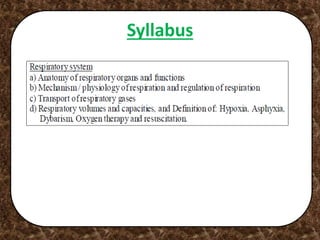
Syllabus
Terminology
• Otorhinolaryngology:
• The branch of medicine that deals with the diagnosis
& treatment of diseases of ears, nose & throat.
Respiration
• The exchange of gases between atmosphere, blood and cells
is called as respiration.
• The process of respiration is divided into 3;
• Pulmonary ventilation: It is the inspiration (inflow) and
expiration (outflow) of air between the atmosphere and
lungs.
• External respiration: It is the exchange of gases between the
lungs and the blood.
• Internal respiration: It is the exchange of gases between the
blood and cells.
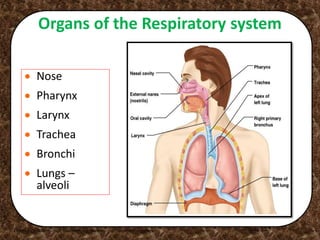
Organs of the Respiratory system
Copyright © 2003 Pearson Education, Inc. publishing as Benjamin Cummings
 Nose
 Pharynx
 Larynx
 Trachea
 Bronchi
 Lungs –
alveoli
Figure 13.1
23-
7
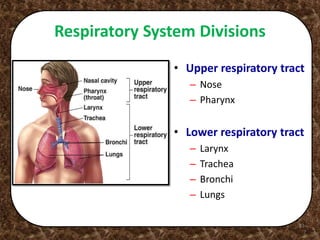
Respiratory System Divisions
• Upper respiratory tract
– Nose
– Pharynx
• Lower respiratory tract
– Larynx
– Trachea
– Bronchi
– Lungs
 Passageway for air
 Receptors for smell
 Filtration of incoming air to remove larger foreign
material
 Moistens & warms the incoming air
Upper Respiratory Tract Functions
 Larynx: Helps in sound production
 Trachea: Passageway for air to & from lungs
 Bronchi: Transports air from trachea to lungs
 Lungs: Transport air to alveoli for gas exchange
Lower Respiratory Tract functions
Respiratory System Functions
• Gas exchange: Oxygen enters blood & carbon dioxide
leaves the blood
• Regulation of blood pH: Altered by changing blood
CO2 levels by Carbonic acid Buffer system
• Sound production: Movement of air through vocal
folds produces sound & speech
• Olfaction: Smell receptors are located into nose
• Thermoregulation: Heating and cooling of body
• Protection: Against m.o. by preventing entry &
removing them
Nose (Nasal Cavity)
• External portion of respiratory system
• Opens through the nostrils
• Divided into left & right portion by a septum
• It is made of cartilage, bone, muscle & skin
• Nasal cavity is a hollow space lined by hairs & mucus
membrane
• The nose is lined by ciliated columnar epithelium cells
containing mucus secreting goblet cells
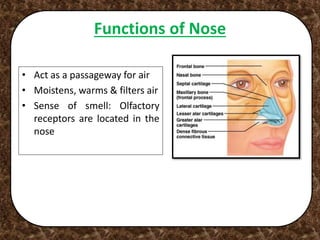
Functions of Nose
• Act as a passageway for air
• Moistens, warms & filters air
• Sense of smell: Olfactory
receptors are located in the
nose
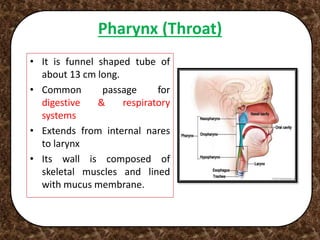
Pharynx (Throat)
• It is funnel shaped tube of
about 13 cm long.
• Common passage for
digestive & respiratory
systems
• Extends from internal nares
to larynx
• Its wall is composed of
skeletal muscles and lined
with mucus membrane.
Division of Pharynx
• It is divided into 3 parts;
• Nasopharynx: The upper most part of pharynx, lies just
posterior to nasal cavity.
• Oropharynx: The middle part of pharynx lies just posterior
to oral cavity.
• Laryngopharynx: The lowest portion of pharynx lies just
superior to larynx.
Functions
• Passageway for air & food:
• Common organ involved in both respiratory & digestive system, air & food
enters from nasal & oral section into pharynx
• Warming and humidifying the air:
• The air is further warmed & moistened as it passes through the pharynx.
• Taste:
• The olfactory receptors for taste are located in the pharynx.
• Protection:
• The lymphatic tissue (tonsils) produces antibodies in response to
antigens. e. g microbes.
• Speech:
• It plays important role in speech by acting as a resonating chamber for
sound.
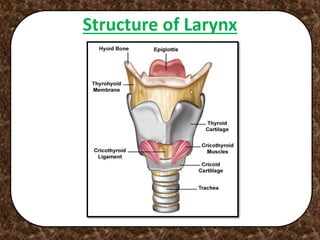
Larynx
• Also called as voice box.
• It is short passage that connects the pharynx with the
trachea.
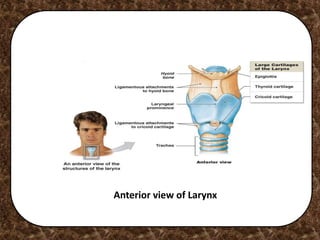
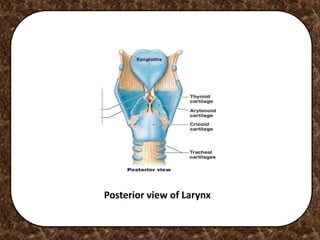
• The larynx is composed of irregular shaped cartilages.
• The main cartilages are
• 1 Thyroid cartilages
• 1 Cricoid cartilage Hyaline cartilage
• 2 Arytenoid cartilage
• 1 Epiglottis: Elastic cartilage
Structure of Larynx
Anterior view of Larynx
Posterior view of Larynx
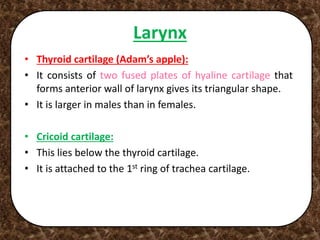
Larynx
• Thyroid cartilage (Adam’s apple):
• It consists of two fused plates of hyaline cartilage that
forms anterior wall of larynx gives its triangular shape.
• It is larger in males than in females.
• Cricoid cartilage:
• This lies below the thyroid cartilage.
• It is attached to the 1st ring of trachea cartilage.
Larynx
• Arytenoid cartilage:
• These are made up of hyaline cartilage located
posterior to thyroid cartilage.
• They provide attachment to the vocal cords.
• Epiglottis:
• It is a large leaf shaped piece of elastic cartilage.
• The stem of epiglottis is attached to thyroid cartilage
but the leaf portion is unattached & free to open &
close like a trap door.
Functions of larynx
• Production of sound:
• Responsible for production of sound.
• Protection of lower respiratory tract:
• During swallowing the larynx moves upward
opens the pharynx & epiglottis closes the larynx.
• This ensures that food passes into the esophagus
not into lower respiratory tract.
Functions of larynx
• Passageway for air:
• It acts as passageway for air.
• Humidifying, filtering & warming:
• It produces humidification, filtration & warming
of air as it travels through the larynx.
Voice Production
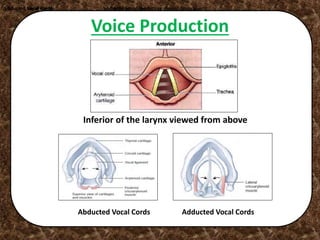
• Vocal cords = two folds of mucus membrane with
thyroid cartilage anteriorly & arytenoid cartilage
posteriorly.
• When the muscles controlling vocal cords are relaxed
the vocal cords open & passage way of air through
larynx is clear, the vocal cords are called as abducted
(open vocal cords).
• The pitch of sound produced by vibrating vocal cords is
low.
• When the muscle controlling the vocal cords contracts,
vocal cords are closed & the vocal cords are called as
adducted (closed vocal cords).
Voice Production
• The pitch of sound produced by vocal cord is high.
• The pitch of voice is determined by tension applied to
the vocal cords through appropriate set of muscles.
• Higher sound results by increasing the tension on the
vocal cords.
• Lower sound results by decreasing the tension on the
vocal cords.
Voice Production
Inferior of the larynx viewed from aboveInferior of the larynx viewed from above
Inferior of the larynx viewed from above
Abducted Vocal Cords Adducted vocal cords
Abducted Vocal Cords
Adducted vocal cordsAdducted vocal cordsAdducted vocal cords
Adducted Vocal Cords
Trachea (Wind pipe)
• Tubular passageway for air.
• It is 12 cm long & 2.5 cm in diameter.
• It extends from larynx to 5th thoracic vertebrae where it
divides into left & right primary bronchi.
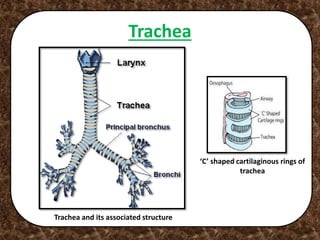
• It is located anterior to esophagus & has ‘C’ shaped
cartilaginous rings within the wall.
• The trachea is made up of 4 layers.
• Adventitia
• Hyaline cartilage
• Sub mucosa
• Mucosa
Trachea (Wind pipe)
• The mucosa is made up of pseudo-stratified ciliated
columnar epithelium containing ciliated columnar cells,
goblet cells & basal cells.
• The cilia move in a single direction thereby keeping the
tract dust free & particles.
• The single ‘C’ shaped cartilage rings provide a rigid
support to tracheal wall.
• The point at which the trachea divides into right & left
primary bronchi called as carina.
Trachea
‘C’ shaped cartilaginous rings of
trachea
Trachea and its associated structure
Functions of trachea
• Warming, humidifying & filtering: It produces
humidification, filtration & warming of air as it travels
through trachea.
• Support: ‘C’ shaped cartilage rings gives support to
trachea.
• Mucociliary escalator: Mucus secreted by goblet cells
moistens the air & traps the dust particles.
• Cough reflex: A nerve ending in trachea & bronchi are
sensitive to irritation produces cough response.
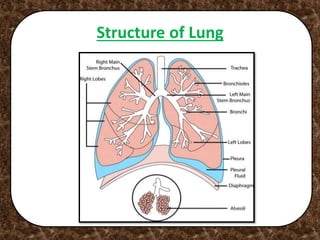
Lungs
• Two lungs, lying on each side of the midline
• Cone shaped organs
• They are separated from each other by heart &
present in the thoracic cavity.
• The lungs are divided into,
• Apex
• Base
• Coastal surface
• Medial surface
Lungs
• Apex:
• Narrow superior portion
• Base:
• Broad inferior portion
• Coastal surface:
• Surface of lung lying against the ribs
• Medial surface:
• It contains a region hilus through which bronchi,
pulmonary blood vessels, lymphatic vessels & nerves
enters & exit.
Structure of Lung
Pleura & Pleural Cavities
• The outer surface of each lung is covered by a serous
membrane called as pleura.
• Pleura is divided into;
• Visceral pleura
• Parietal pleura
• The space between them is called as pleural cavity.
• The pleural membranes produce a pleural fluid that circulates
in pleural cavity & acts as a lubricant, ensuring minimal friction
of lung during breathing.
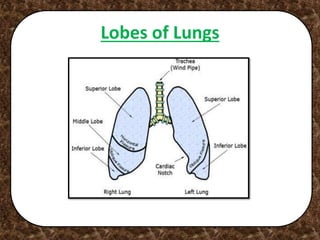
Lobes of lungs
• The right lung is subdivided into 3 lobes:
• Superior lobe
• Middle lobe
• Inferior lobe
• The left lung is subdivided into 2 lobes;
• Superior lobe
• Inferior lobe
• The right lung is thicker & broader than left lung.
Lobes of Lungs
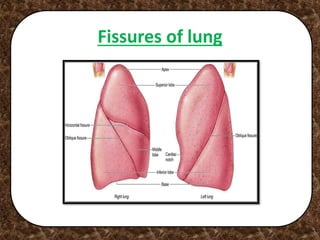
Fissures of lung
• Right lung: It has two fissures
• Oblique fissure
• Horizontal fissure
• Left lung: It has one fissure
• Oblique fissure: It separates superior lobe & inferior
lobe.
Fissures of lung
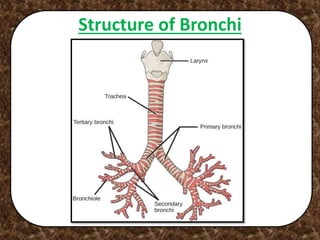
Bronchi
• At the carina point, the trachea divides into right
pulmonary bronchus for right lung & left pulmonary
bronchus for left lung.
• Right bronchus:
• It is wider & shorter than left bronchus.
• It is 2.5 cm long.
• After entering into right lung, primary bronchi is divided into 3
secondary bronchi, one for each lobe of lung.
• Left bronchus:
• It is 5 cm long & narrower than the right bronchus.
• After entering the left lung left primary bronchi is divided into 2
secondary bronchi, one for each lobe of lung.
Bronchi
• The secondary bronchi further divided into tertiary
bronchi that divides into bronchioles.
• Bronchioles further divided into tube like structure called
as terminal bronchioles.
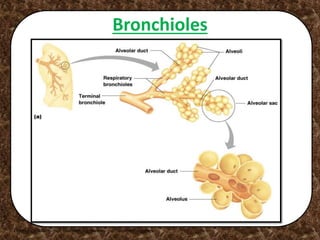
• Terminal bronchioles are further divided into respiratory
bronchioles.
Structure of Bronchi
Lobules
• Each lobe of lung is divided into many small
compartments called as lobules.
• Each lobule contains lymphatic vessels, an arteriole, a
venule & a branch from a terminal bronchiole.
• Terminal bronchioles are subdivided into small branches
called as respiratory bronchioles.
• Respiratory bronchioles are subdivided into 2-11 alveolar
ducts.
• The alveolar ducts are surrounded by alveoli & alveoli
sacs.
• The alveoli are cup-shaped structure & surrounded by
capillary network.
Lobules
• The alveolar wall consisting of 2 types of cells.
• Type 1 alveolar cells: It forms a lining of alveolar
wall.
• Type 2 alveolar cells: It secretes alveolar fluid
(mixture of phospholipids & lipoproteins), which
keeps the alveolar cells moist.
Alveolar duct and sacAlveolar duct and sacAlveolar duct and sacAlveolar duct and sacAlveolar duct and sac
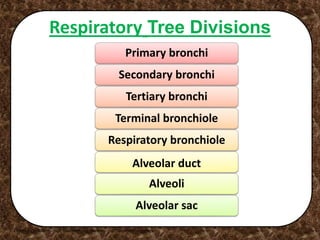
Respiratory Tree Divisions
Copyright © 2003 Pearson Education, Inc. publishing as Benjamin Cummings
Primary bronchi
Secondary bronchi
Tertiary bronchi
Terminal bronchiole
Respiratory bronchiole
Alveolar duct
Alveoli
Alveolar sac
Bronchioles
Copyright © 2003 Pearson Education, Inc. publishing as Benjamin Cummings
Physiology of respiration
• Divided into 2 phases:
• External respiration
• Internal respiration
External respiration
(Pulmonary gas exchange)
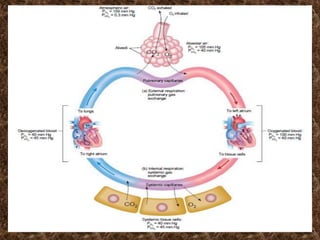
• It is the exchange of gases between the lungs & blood in
pulmonary capillaries.
• It is the diffusion of O2 from lung alveoli to blood in
pulmonary capillaries & CO2 in opposite direction.
• In this process, pulmonary capillary gains O2 & loses CO2.
• Right ventricle: It pumps deoxygenated blood to lungs for
purification.
• Left ventricle: It pumps oxygenated blood to all other parts
of body.
External respiration
(Pulmonary gas exchange)
• External respiration convert deoxygenated blood into
oxygenated blood.
• O2 diffuses from lungs alveoli into blood in pulmonary
capillaries, where its partial pressure is 105 mm Hg, PCO2 is
40 mm Hg in resting person.
External respiration
(Pulmonary gas exchange)
• When the person doing exercise the PO2 will be even lower
because contracting muscle fibres are using more O2.
• Diffusion continues until the PO2 of pulmonary capillary
blood increases to match the PO2 of alveolar air, 105 mm
Hg.
• While O2 is diffusing from alveolar air into deoxygenated
blood, CO2 is diffusing in opposite direction.
• The PCO2 of deoxygenated blood is 45 mm Hg in a resting
person, whereas PCO2, alveolar air is 40 mm Hg.
External respiration
(Pulmonary gas exchange)
• Because of this difference in PCO2, carbon dioxide diffuses
from deoxygenated blood into the alveoli until the PCO2 of
the blood decreases to 40 mm Hg.
• Thus the PO2 & PCO2 of oxygenated blood leaving the
lungs are same as in alveolar air.
• The CO2 that diffuses into the alveoli is eliminated from
the lungs during expiration.
Internal respiration
(Systemic gas exchange)
• The exchange of gases between the blood in systemic
capillary & systemic tissue cells.
• In this process the systemic capillary gains CO2 & loses
O2.
• Internal respiration results in conversion of oxygenated
blood to deoxygenated blood.
• Oxygenated blood entering the tissue capillaries has a
PO2 of 100 mm Hg, whereas tissue cells have an average
of PO2 of 40 mm Hg.
• Because of this difference in PO2, oxygen diffuses from
the oxygenated blood through interstitial fluid & into
tissue cells until the PO2 in the blood decreases to 40 mm
Hg.
• This is average PO2 of deoxygenated blood entering tissue
when you are at rest.
• While O2 diffuses from the tissue blood capillaries into
tissue cells, CO2 diffuses in the opposite direction.
Internal respiration
(Systemic gas exchange)
Internal respiration
(Systemic gas exchange)
• The average PCO2 of tissue cells is 45 mm Hg whereas,
tissue capillary oxygenated blood is 40 mm Hg.
• As a result CO2 diffuses from tissue cells through interstitial
fluid into the oxygenated blood until the PCO2 in the blood
increases to 45 mm Hg the PCO2 tissue capillary
deoxygenated blood.
• From here the deoxygenated blood returns to the heart
and it is pumped to the lungs for another cycle of external
respiration.
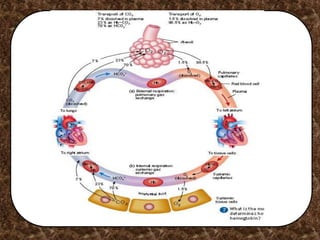
Transport of oxygen & carbon dioxide
• Transport of gases between the lungs & body tissues is a
function of blood.
• Oxygen:
• O2 does not dissolve easily in water; only about 1.5 % is
dissolved in blood plasma.
• About 98.5 of O2 is transported to Hb & combines with it
inside RBCs.
• Each 100 ml of oxygenated blood contains about 20 ml of
oxygen, 0.3 ml dissolved in plasma & 19.7 ml bound to
haemoglobin.
Transport of O2 & CO2
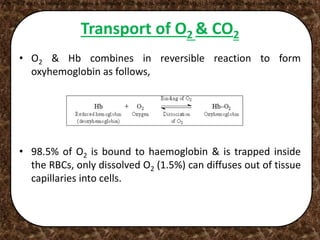
• O2 & Hb combines in reversible reaction to form
oxyhemoglobin as follows,
• 98.5% of O2 is bound to haemoglobin & is trapped inside
the RBCs, only dissolved O2 (1.5%) can diffuses out of tissue
capillaries into cells.
•98.5% of the O2 is bound to haemoglobin & is trapped inside the RBCs, only dissolved O2 (1.5%) can diffuses out of tissue capillaries into cells.
Transport of O2& CO2
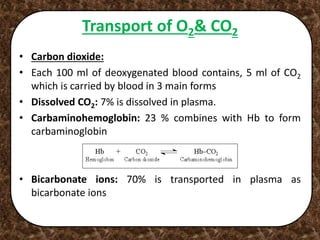
• Carbon dioxide:
• Each 100 ml of deoxygenated blood contains, 5 ml of CO2
which is carried by blood in 3 main forms
• Dissolved CO2: 7% is dissolved in plasma.
• Carbaminohemoglobin: 23 % combines with Hb to form
carbaminoglobin
• Bicarbonate ions: 70% is transported in plasma as
bicarbonate ions
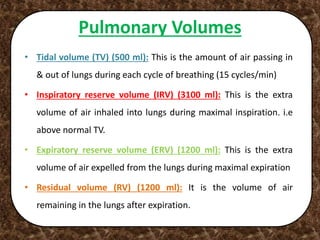
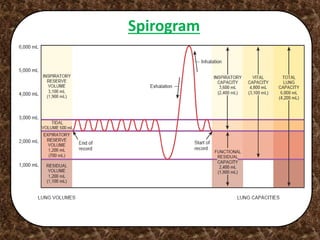
Pulmonary Volumes
• Tidal volume (TV) (500 ml): This is the amount of air passing in
& out of lungs during each cycle of breathing (15 cycles/min)
• Inspiratory reserve volume (IRV) (3100 ml): This is the extra
volume of air inhaled into lungs during maximal inspiration. i.e
above normal TV.
• Expiratory reserve volume (ERV) (1200 ml): This is the extra
volume of air expelled from the lungs during maximal expiration
• Residual volume (RV) (1200 ml): It is the volume of air
remaining in the lungs after expiration.
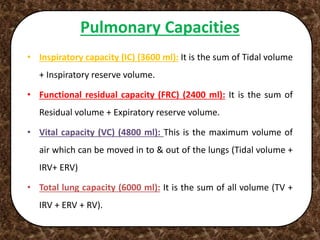
Pulmonary Capacities
• Inspiratory capacity (IC) (3600 ml): It is the sum of Tidal volume
+ Inspiratory reserve volume.
• Functional residual capacity (FRC) (2400 ml): It is the sum of
Residual volume + Expiratory reserve volume.
• Vital capacity (VC) (4800 ml): This is the maximum volume of
air which can be moved in to & out of the lungs (Tidal volume +
IRV+ ERV)
• Total lung capacity (6000 ml): It is the sum of all volume (TV +
IRV + ERV + RV).
Spirogram
Disorders of respiratory system
• Pneumonia:
• It is an acute inflammation of the alveoli.
• Most common cause of pneumonia is the pneumococcal
bacterium i.e. Streptococcus pneumoniae.
• Tuberculosis:
• The bacterium M. tuberculosis an infectious communicable
disease called as tuberculosis (TB) that most often affect the
lungs & the pleura but may involve other parts of the body.
• Symptoms are fatigue, weight loss, lethargy, anorexia, low grade
fever, night sweats, cough, dyspnoea, chest pain & hemolysis.
Disorders of respiratory system
• Coryza & influenza:
• A group of viruses called as rhinoviruses is responsible for about 40
% of all common cold.
• The symptoms are sneezing, excessive nasal secretion, dry cough &
congestion, chills, fever (more than 39oC), headache & muscular
aches.
• Pulmonary edema:
• It is an abnormal accumulation of fluid in the interstitial spaces &
alveoli of lungs.
• The symptoms are dyspnoea, wheezing, rapid breathing rate,
restlessness, feeling of suffocation, cyanosis, paleness, excessive
perspiration & pulmonary hypertension.
Disorders of respiratory system
• Cystic fibrosis (CF):
• It is an inherited disease of secretory epithelia that affects the airways,
liver, pancreas, small intestine and sweat glands.
• Asthma:
• It is characterised by chronic airway inflammation to variety of stimuli &
airway obstruction. Symptoms include difficult breathing, coughing,
wheezing, chest tightness, tachycardia, fatigue, moist skin and anxiety.
• Asbestos related disease:
• These are serious lung cancer disorders that develop after inhalation of
asbestos particles.
• When they are inhaled they penetrate the lung tissue
• However, the fibres usually destroy the WBC’s and scarring of lung tissue.
Disorders of respiratory system
• Chronic obstructive pulmonary disease (COPD):
• It is characterised by chronic and recurrent obstruction of airflow which
increases airway resistance.
• COPD are of 2 types
• Emphysema
• Chronic bronchitis
• Emphysema: It is characterised by destruction of alveoli walls producing
abnormally large air spaces that remain filled with air during exhalation. It
is cause by long term irritation, cigarette smoke; air pollution and
occupational exposure to industrial dust are most common.
• Chronic bronchitis: It is characterised by excessive secretion of bronchial
mucus. Cigarette smoking is the leading cause.
• Symptoms are productive cough (sputum), shortness of breath and
wheezing.
Disorders of respiratory system
• Lung cancer:
• In the US lung cancer is the leading cause of death both in males &
females.
• Cigarette smoking is the major cause.
• Symptoms are chronic cough, spitting blood from respiratory tract,
wheezing, and shortness of breath, chest pain, and hoarseness, difficulty
in swallowing weight loss, anorexia, fatigue, bone pain, confusing,
headache, anaemia, jaundice and thrombocytopenia.

Respiratory system

  • 1.
    Respiratory System Dr. Mrs.Deepa K. Ingawale (Mandlik) Department of Pharmacology Poona College of Pharmacy, Pune
  • 2.
    Learning Objectives • Tostudy the classification & functions of respiratory system. • To describe the anatomy & physiology of nose, pharynx, larynx, trachea, bronchi and lungs. • To describe the mechanism of external & internal respiration. • To study the physiology of voice production. • To describe the transports of oxygen & carbon dioxide. • To explain the different lung volumes & capacities. • To describe the various respiratory disorders.
  • 3.
  • 4.
    Terminology • Otorhinolaryngology: • Thebranch of medicine that deals with the diagnosis & treatment of diseases of ears, nose & throat.
  • 5.
    Respiration • The exchangeof gases between atmosphere, blood and cells is called as respiration. • The process of respiration is divided into 3; • Pulmonary ventilation: It is the inspiration (inflow) and expiration (outflow) of air between the atmosphere and lungs. • External respiration: It is the exchange of gases between the lungs and the blood. • Internal respiration: It is the exchange of gases between the blood and cells.
  • 6.
    Organs of theRespiratory system Copyright © 2003 Pearson Education, Inc. publishing as Benjamin Cummings  Nose  Pharynx  Larynx  Trachea  Bronchi  Lungs – alveoli Figure 13.1
  • 7.
    23- 7 Respiratory System Divisions •Upper respiratory tract – Nose – Pharynx • Lower respiratory tract – Larynx – Trachea – Bronchi – Lungs
  • 8.
     Passageway forair  Receptors for smell  Filtration of incoming air to remove larger foreign material  Moistens & warms the incoming air Upper Respiratory Tract Functions
  • 9.
     Larynx: Helpsin sound production  Trachea: Passageway for air to & from lungs  Bronchi: Transports air from trachea to lungs  Lungs: Transport air to alveoli for gas exchange Lower Respiratory Tract functions
  • 10.
    Respiratory System Functions •Gas exchange: Oxygen enters blood & carbon dioxide leaves the blood • Regulation of blood pH: Altered by changing blood CO2 levels by Carbonic acid Buffer system • Sound production: Movement of air through vocal folds produces sound & speech • Olfaction: Smell receptors are located into nose • Thermoregulation: Heating and cooling of body • Protection: Against m.o. by preventing entry & removing them
  • 11.
    Nose (Nasal Cavity) •External portion of respiratory system • Opens through the nostrils • Divided into left & right portion by a septum • It is made of cartilage, bone, muscle & skin • Nasal cavity is a hollow space lined by hairs & mucus membrane • The nose is lined by ciliated columnar epithelium cells containing mucus secreting goblet cells
  • 12.
    Functions of Nose •Act as a passageway for air • Moistens, warms & filters air • Sense of smell: Olfactory receptors are located in the nose
  • 13.
    Pharynx (Throat) • Itis funnel shaped tube of about 13 cm long. • Common passage for digestive & respiratory systems • Extends from internal nares to larynx • Its wall is composed of skeletal muscles and lined with mucus membrane.
  • 14.
    Division of Pharynx •It is divided into 3 parts; • Nasopharynx: The upper most part of pharynx, lies just posterior to nasal cavity. • Oropharynx: The middle part of pharynx lies just posterior to oral cavity. • Laryngopharynx: The lowest portion of pharynx lies just superior to larynx.
  • 15.
    Functions • Passageway forair & food: • Common organ involved in both respiratory & digestive system, air & food enters from nasal & oral section into pharynx • Warming and humidifying the air: • The air is further warmed & moistened as it passes through the pharynx. • Taste: • The olfactory receptors for taste are located in the pharynx. • Protection: • The lymphatic tissue (tonsils) produces antibodies in response to antigens. e. g microbes. • Speech: • It plays important role in speech by acting as a resonating chamber for sound.
  • 16.
    Larynx • Also calledas voice box. • It is short passage that connects the pharynx with the trachea. • The larynx is composed of irregular shaped cartilages. • The main cartilages are • 1 Thyroid cartilages • 1 Cricoid cartilage Hyaline cartilage • 2 Arytenoid cartilage • 1 Epiglottis: Elastic cartilage
  • 17.
  • 18.
  • 19.
  • 20.
    Larynx • Thyroid cartilage(Adam’s apple): • It consists of two fused plates of hyaline cartilage that forms anterior wall of larynx gives its triangular shape. • It is larger in males than in females. • Cricoid cartilage: • This lies below the thyroid cartilage. • It is attached to the 1st ring of trachea cartilage.
  • 21.
    Larynx • Arytenoid cartilage: •These are made up of hyaline cartilage located posterior to thyroid cartilage. • They provide attachment to the vocal cords. • Epiglottis: • It is a large leaf shaped piece of elastic cartilage. • The stem of epiglottis is attached to thyroid cartilage but the leaf portion is unattached & free to open & close like a trap door.
  • 22.
    Functions of larynx •Production of sound: • Responsible for production of sound. • Protection of lower respiratory tract: • During swallowing the larynx moves upward opens the pharynx & epiglottis closes the larynx. • This ensures that food passes into the esophagus not into lower respiratory tract.
  • 23.
    Functions of larynx •Passageway for air: • It acts as passageway for air. • Humidifying, filtering & warming: • It produces humidification, filtration & warming of air as it travels through the larynx.
  • 24.
    Voice Production • Vocalcords = two folds of mucus membrane with thyroid cartilage anteriorly & arytenoid cartilage posteriorly. • When the muscles controlling vocal cords are relaxed the vocal cords open & passage way of air through larynx is clear, the vocal cords are called as abducted (open vocal cords). • The pitch of sound produced by vibrating vocal cords is low. • When the muscle controlling the vocal cords contracts, vocal cords are closed & the vocal cords are called as adducted (closed vocal cords).
  • 25.
    Voice Production • Thepitch of sound produced by vocal cord is high. • The pitch of voice is determined by tension applied to the vocal cords through appropriate set of muscles. • Higher sound results by increasing the tension on the vocal cords. • Lower sound results by decreasing the tension on the vocal cords.
  • 26.
    Voice Production Inferior ofthe larynx viewed from aboveInferior of the larynx viewed from above Inferior of the larynx viewed from above Abducted Vocal Cords Adducted vocal cords Abducted Vocal Cords Adducted vocal cordsAdducted vocal cordsAdducted vocal cords Adducted Vocal Cords
  • 27.
    Trachea (Wind pipe) •Tubular passageway for air. • It is 12 cm long & 2.5 cm in diameter. • It extends from larynx to 5th thoracic vertebrae where it divides into left & right primary bronchi. • It is located anterior to esophagus & has ‘C’ shaped cartilaginous rings within the wall. • The trachea is made up of 4 layers. • Adventitia • Hyaline cartilage • Sub mucosa • Mucosa
  • 28.
    Trachea (Wind pipe) •The mucosa is made up of pseudo-stratified ciliated columnar epithelium containing ciliated columnar cells, goblet cells & basal cells. • The cilia move in a single direction thereby keeping the tract dust free & particles. • The single ‘C’ shaped cartilage rings provide a rigid support to tracheal wall. • The point at which the trachea divides into right & left primary bronchi called as carina.
  • 29.
    Trachea ‘C’ shaped cartilaginousrings of trachea Trachea and its associated structure
  • 30.
    Functions of trachea •Warming, humidifying & filtering: It produces humidification, filtration & warming of air as it travels through trachea. • Support: ‘C’ shaped cartilage rings gives support to trachea. • Mucociliary escalator: Mucus secreted by goblet cells moistens the air & traps the dust particles. • Cough reflex: A nerve ending in trachea & bronchi are sensitive to irritation produces cough response.
  • 31.
    Lungs • Two lungs,lying on each side of the midline • Cone shaped organs • They are separated from each other by heart & present in the thoracic cavity. • The lungs are divided into, • Apex • Base • Coastal surface • Medial surface
  • 32.
    Lungs • Apex: • Narrowsuperior portion • Base: • Broad inferior portion • Coastal surface: • Surface of lung lying against the ribs • Medial surface: • It contains a region hilus through which bronchi, pulmonary blood vessels, lymphatic vessels & nerves enters & exit.
  • 33.
  • 34.
    Pleura & PleuralCavities • The outer surface of each lung is covered by a serous membrane called as pleura. • Pleura is divided into; • Visceral pleura • Parietal pleura • The space between them is called as pleural cavity. • The pleural membranes produce a pleural fluid that circulates in pleural cavity & acts as a lubricant, ensuring minimal friction of lung during breathing.
  • 35.
    Lobes of lungs •The right lung is subdivided into 3 lobes: • Superior lobe • Middle lobe • Inferior lobe • The left lung is subdivided into 2 lobes; • Superior lobe • Inferior lobe • The right lung is thicker & broader than left lung.
  • 36.
  • 37.
    Fissures of lung •Right lung: It has two fissures • Oblique fissure • Horizontal fissure • Left lung: It has one fissure • Oblique fissure: It separates superior lobe & inferior lobe.
  • 38.
  • 39.
    Bronchi • At thecarina point, the trachea divides into right pulmonary bronchus for right lung & left pulmonary bronchus for left lung. • Right bronchus: • It is wider & shorter than left bronchus. • It is 2.5 cm long. • After entering into right lung, primary bronchi is divided into 3 secondary bronchi, one for each lobe of lung. • Left bronchus: • It is 5 cm long & narrower than the right bronchus. • After entering the left lung left primary bronchi is divided into 2 secondary bronchi, one for each lobe of lung.
  • 40.
    Bronchi • The secondarybronchi further divided into tertiary bronchi that divides into bronchioles. • Bronchioles further divided into tube like structure called as terminal bronchioles. • Terminal bronchioles are further divided into respiratory bronchioles.
  • 41.
  • 42.
    Lobules • Each lobeof lung is divided into many small compartments called as lobules. • Each lobule contains lymphatic vessels, an arteriole, a venule & a branch from a terminal bronchiole. • Terminal bronchioles are subdivided into small branches called as respiratory bronchioles. • Respiratory bronchioles are subdivided into 2-11 alveolar ducts. • The alveolar ducts are surrounded by alveoli & alveoli sacs. • The alveoli are cup-shaped structure & surrounded by capillary network.
  • 43.
    Lobules • The alveolarwall consisting of 2 types of cells. • Type 1 alveolar cells: It forms a lining of alveolar wall. • Type 2 alveolar cells: It secretes alveolar fluid (mixture of phospholipids & lipoproteins), which keeps the alveolar cells moist. Alveolar duct and sacAlveolar duct and sacAlveolar duct and sacAlveolar duct and sacAlveolar duct and sac
  • 44.
    Respiratory Tree Divisions Copyright© 2003 Pearson Education, Inc. publishing as Benjamin Cummings Primary bronchi Secondary bronchi Tertiary bronchi Terminal bronchiole Respiratory bronchiole Alveolar duct Alveoli Alveolar sac
  • 45.
    Bronchioles Copyright © 2003Pearson Education, Inc. publishing as Benjamin Cummings
  • 46.
    Physiology of respiration •Divided into 2 phases: • External respiration • Internal respiration
  • 47.
    External respiration (Pulmonary gasexchange) • It is the exchange of gases between the lungs & blood in pulmonary capillaries. • It is the diffusion of O2 from lung alveoli to blood in pulmonary capillaries & CO2 in opposite direction. • In this process, pulmonary capillary gains O2 & loses CO2. • Right ventricle: It pumps deoxygenated blood to lungs for purification. • Left ventricle: It pumps oxygenated blood to all other parts of body.
  • 48.
    External respiration (Pulmonary gasexchange) • External respiration convert deoxygenated blood into oxygenated blood. • O2 diffuses from lungs alveoli into blood in pulmonary capillaries, where its partial pressure is 105 mm Hg, PCO2 is 40 mm Hg in resting person.
  • 49.
    External respiration (Pulmonary gasexchange) • When the person doing exercise the PO2 will be even lower because contracting muscle fibres are using more O2. • Diffusion continues until the PO2 of pulmonary capillary blood increases to match the PO2 of alveolar air, 105 mm Hg. • While O2 is diffusing from alveolar air into deoxygenated blood, CO2 is diffusing in opposite direction. • The PCO2 of deoxygenated blood is 45 mm Hg in a resting person, whereas PCO2, alveolar air is 40 mm Hg.
  • 50.
    External respiration (Pulmonary gasexchange) • Because of this difference in PCO2, carbon dioxide diffuses from deoxygenated blood into the alveoli until the PCO2 of the blood decreases to 40 mm Hg. • Thus the PO2 & PCO2 of oxygenated blood leaving the lungs are same as in alveolar air. • The CO2 that diffuses into the alveoli is eliminated from the lungs during expiration.
  • 51.
    Internal respiration (Systemic gasexchange) • The exchange of gases between the blood in systemic capillary & systemic tissue cells. • In this process the systemic capillary gains CO2 & loses O2. • Internal respiration results in conversion of oxygenated blood to deoxygenated blood. • Oxygenated blood entering the tissue capillaries has a PO2 of 100 mm Hg, whereas tissue cells have an average of PO2 of 40 mm Hg.
  • 52.
    • Because ofthis difference in PO2, oxygen diffuses from the oxygenated blood through interstitial fluid & into tissue cells until the PO2 in the blood decreases to 40 mm Hg. • This is average PO2 of deoxygenated blood entering tissue when you are at rest. • While O2 diffuses from the tissue blood capillaries into tissue cells, CO2 diffuses in the opposite direction. Internal respiration (Systemic gas exchange)
  • 53.
    Internal respiration (Systemic gasexchange) • The average PCO2 of tissue cells is 45 mm Hg whereas, tissue capillary oxygenated blood is 40 mm Hg. • As a result CO2 diffuses from tissue cells through interstitial fluid into the oxygenated blood until the PCO2 in the blood increases to 45 mm Hg the PCO2 tissue capillary deoxygenated blood. • From here the deoxygenated blood returns to the heart and it is pumped to the lungs for another cycle of external respiration.
  • 55.
    Transport of oxygen& carbon dioxide • Transport of gases between the lungs & body tissues is a function of blood. • Oxygen: • O2 does not dissolve easily in water; only about 1.5 % is dissolved in blood plasma. • About 98.5 of O2 is transported to Hb & combines with it inside RBCs. • Each 100 ml of oxygenated blood contains about 20 ml of oxygen, 0.3 ml dissolved in plasma & 19.7 ml bound to haemoglobin.
  • 56.
    Transport of O2& CO2 • O2 & Hb combines in reversible reaction to form oxyhemoglobin as follows, • 98.5% of O2 is bound to haemoglobin & is trapped inside the RBCs, only dissolved O2 (1.5%) can diffuses out of tissue capillaries into cells. •98.5% of the O2 is bound to haemoglobin & is trapped inside the RBCs, only dissolved O2 (1.5%) can diffuses out of tissue capillaries into cells.
  • 57.
    Transport of O2&CO2 • Carbon dioxide: • Each 100 ml of deoxygenated blood contains, 5 ml of CO2 which is carried by blood in 3 main forms • Dissolved CO2: 7% is dissolved in plasma. • Carbaminohemoglobin: 23 % combines with Hb to form carbaminoglobin • Bicarbonate ions: 70% is transported in plasma as bicarbonate ions
  • 59.
    Pulmonary Volumes • Tidalvolume (TV) (500 ml): This is the amount of air passing in & out of lungs during each cycle of breathing (15 cycles/min) • Inspiratory reserve volume (IRV) (3100 ml): This is the extra volume of air inhaled into lungs during maximal inspiration. i.e above normal TV. • Expiratory reserve volume (ERV) (1200 ml): This is the extra volume of air expelled from the lungs during maximal expiration • Residual volume (RV) (1200 ml): It is the volume of air remaining in the lungs after expiration.
  • 60.
    Pulmonary Capacities • Inspiratorycapacity (IC) (3600 ml): It is the sum of Tidal volume + Inspiratory reserve volume. • Functional residual capacity (FRC) (2400 ml): It is the sum of Residual volume + Expiratory reserve volume. • Vital capacity (VC) (4800 ml): This is the maximum volume of air which can be moved in to & out of the lungs (Tidal volume + IRV+ ERV) • Total lung capacity (6000 ml): It is the sum of all volume (TV + IRV + ERV + RV).
  • 61.
  • 62.
    Disorders of respiratorysystem • Pneumonia: • It is an acute inflammation of the alveoli. • Most common cause of pneumonia is the pneumococcal bacterium i.e. Streptococcus pneumoniae. • Tuberculosis: • The bacterium M. tuberculosis an infectious communicable disease called as tuberculosis (TB) that most often affect the lungs & the pleura but may involve other parts of the body. • Symptoms are fatigue, weight loss, lethargy, anorexia, low grade fever, night sweats, cough, dyspnoea, chest pain & hemolysis.
  • 63.
    Disorders of respiratorysystem • Coryza & influenza: • A group of viruses called as rhinoviruses is responsible for about 40 % of all common cold. • The symptoms are sneezing, excessive nasal secretion, dry cough & congestion, chills, fever (more than 39oC), headache & muscular aches. • Pulmonary edema: • It is an abnormal accumulation of fluid in the interstitial spaces & alveoli of lungs. • The symptoms are dyspnoea, wheezing, rapid breathing rate, restlessness, feeling of suffocation, cyanosis, paleness, excessive perspiration & pulmonary hypertension.
  • 64.
    Disorders of respiratorysystem • Cystic fibrosis (CF): • It is an inherited disease of secretory epithelia that affects the airways, liver, pancreas, small intestine and sweat glands. • Asthma: • It is characterised by chronic airway inflammation to variety of stimuli & airway obstruction. Symptoms include difficult breathing, coughing, wheezing, chest tightness, tachycardia, fatigue, moist skin and anxiety. • Asbestos related disease: • These are serious lung cancer disorders that develop after inhalation of asbestos particles. • When they are inhaled they penetrate the lung tissue • However, the fibres usually destroy the WBC’s and scarring of lung tissue.
  • 65.
    Disorders of respiratorysystem • Chronic obstructive pulmonary disease (COPD): • It is characterised by chronic and recurrent obstruction of airflow which increases airway resistance. • COPD are of 2 types • Emphysema • Chronic bronchitis • Emphysema: It is characterised by destruction of alveoli walls producing abnormally large air spaces that remain filled with air during exhalation. It is cause by long term irritation, cigarette smoke; air pollution and occupational exposure to industrial dust are most common. • Chronic bronchitis: It is characterised by excessive secretion of bronchial mucus. Cigarette smoking is the leading cause. • Symptoms are productive cough (sputum), shortness of breath and wheezing.
  • 66.
    Disorders of respiratorysystem • Lung cancer: • In the US lung cancer is the leading cause of death both in males & females. • Cigarette smoking is the major cause. • Symptoms are chronic cough, spitting blood from respiratory tract, wheezing, and shortness of breath, chest pain, and hoarseness, difficulty in swallowing weight loss, anorexia, fatigue, bone pain, confusing, headache, anaemia, jaundice and thrombocytopenia.