Essentials of Human Anatomy & Physiology
Copyright © 2003 Pearson Education, Inc. publishing as Benjamin Cummings
Seventh Edition
Elaine N. Marieb
Chapter 13
The Respiratory System
Function of the Respiratory SystemFunction of the Respiratory System
Slide 13.2Copyright © 2003 Pearson Education, Inc. publishing as Benjamin Cummings
• Oversees gas exchanges (oxygen and carbon
dioxide) between the blood and external
environment
• Exchange of gasses takes place within the
lungs in the alveoli(only site of gas exchange,
other structures passageways
• Passageways to the lungs purify, warm, and
humidify the incoming air
• Shares responsibility with cardiovascular
system
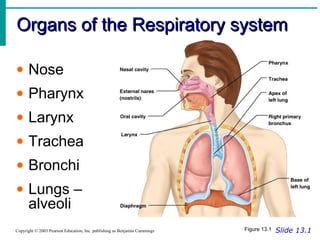
Organs of the Respiratory systemOrgans of the Respiratory system
Slide 13.1Copyright © 2003 Pearson Education, Inc. publishing as Benjamin Cummings
• Nose
• Pharynx
• Larynx
• Trachea
• Bronchi
• Lungs –
alveoli
Figure 13.1
SlideCopyright © 2003 Pearson Education, Inc. publishing as Benjamin Cummings
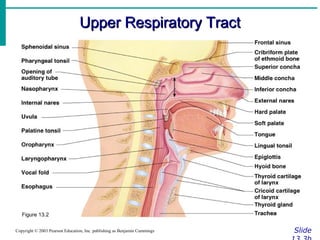
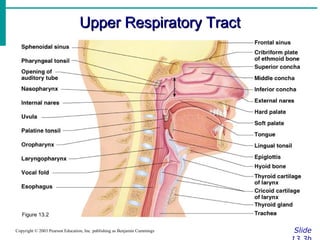
Figure 13.2
Upper Respiratory TractUpper Respiratory Tract
Anatomy of the Nasal CavityAnatomy of the Nasal Cavity
SlideCopyright © 2003 Pearson Education, Inc. publishing as Benjamin Cummings
• Olfactory receptors are located in the
mucosa on the superior surface
• The rest of the cavity is lined with
respiratory mucosa
•Moistens air
•Traps incoming foreign particles
Anatomy of the Nasal CavityAnatomy of the Nasal Cavity
SlideCopyright © 2003 Pearson Education, Inc. publishing as Benjamin Cummings
• Lateral walls have projections called
conchae
•Increases surface area
•Increases air turbulence within the nasal
cavity
• The nasal cavity is separated from the
oral cavity by the palate
•Anterior hard palate (bone)
•Posterior soft palate (muscle)
Paranasal SinusesParanasal Sinuses
SlideCopyright © 2003 Pearson Education, Inc. publishing as Benjamin Cummings
• Cavities within bones surrounding the
nasal cavity
•Frontal bone
•Sphenoid bone
•Ethmoid bone
•Maxillary bone
Paranasal SinusesParanasal Sinuses
SlideCopyright © 2003 Pearson Education, Inc. publishing as Benjamin Cummings
• Function of the sinuses
•Lighten the skull
•Act as resonance chambers for speech
•Produce mucus that drains into the nasal
cavity
Pharynx (Throat)Pharynx (Throat)
Slide 13.6Copyright © 2003 Pearson Education, Inc. publishing as Benjamin Cummings
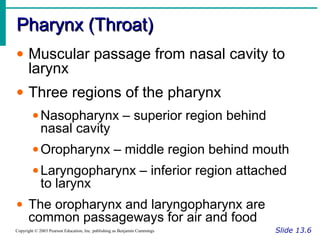
• Muscular passage from nasal cavity to
larynx
• Three regions of the pharynx
•Nasopharynx – superior region behind
nasal cavity
•Oropharynx – middle region behind mouth
•Laryngopharynx – inferior region attached
to larynx
• The oropharynx and laryngopharynx are
common passageways for air and food
SlideCopyright © 2003 Pearson Education, Inc. publishing as Benjamin Cummings
Figure 13.2
Upper Respiratory TractUpper Respiratory Tract
Structures of the PharynxStructures of the Pharynx
Slide 13.7Copyright © 2003 Pearson Education, Inc. publishing as Benjamin Cummings
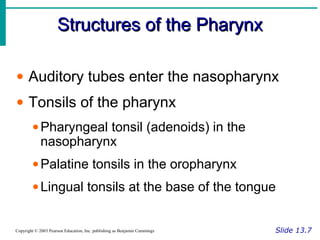
• Auditory tubes enter the nasopharynx
• Tonsils of the pharynx
•Pharyngeal tonsil (adenoids) in the
nasopharynx
•Palatine tonsils in the oropharynx
•Lingual tonsils at the base of the tongue
Larynx (Voice Box)Larynx (Voice Box)
Slide 13.8Copyright © 2003 Pearson Education, Inc. publishing as Benjamin Cummings
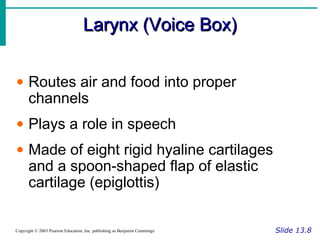
• Routes air and food into proper
channels
• Plays a role in speech
• Made of eight rigid hyaline cartilages
and a spoon-shaped flap of elastic
cartilage (epiglottis)
Structures of the LarynxStructures of the Larynx
SlideCopyright © 2003 Pearson Education, Inc. publishing as Benjamin Cummings
• Thyroid cartilage
•Largest hyaline cartilage
•Protrudes anteriorly (Adam’s apple)
• Epiglottis
•Superior opening of the larynx
•Routes food to the larynx and air toward the
trachea
Structures of the LarynxStructures of the Larynx
SlideCopyright © 2003 Pearson Education, Inc. publishing as Benjamin Cummings
• Vocal cords (vocal folds)
•Vibrate with expelled air to create sound
(speech)
• Glottis – opening between vocal cords
Trachea (Windpipe)Trachea (Windpipe)
SlideCopyright © 2003 Pearson Education, Inc. publishing as Benjamin Cummings
• Connects larynx with bronchi
• Lined with ciliated mucosa
•Beat continuously in the opposite direction of
incoming air
•Expel mucus loaded with dust and other
debris away from lungs
• Walls are reinforced with C-shaped
hyaline cartilage
Primary BronchiPrimary Bronchi
SlideCopyright © 2003 Pearson Education, Inc. publishing as Benjamin Cummings
• Formed by division of the trachea
• Enters the lung at the hilus
(medial depression)
• Right bronchus is wider, shorter,
and straighter than left
• Bronchi subdivide into smaller
and smaller branches
LungsLungs
SlideCopyright © 2003 Pearson Education, Inc. publishing as Benjamin Cummings
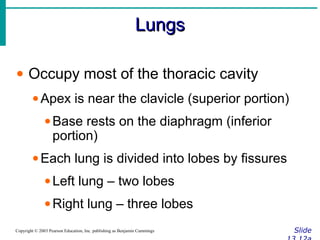
• Occupy most of the thoracic cavity
•Apex is near the clavicle (superior portion)
•Base rests on the diaphragm (inferior
portion)
•Each lung is divided into lobes by fissures
•Left lung – two lobes
•Right lung – three lobes
LungsLungs
SlideCopyright © 2003 Pearson Education, Inc. publishing as Benjamin Cummings
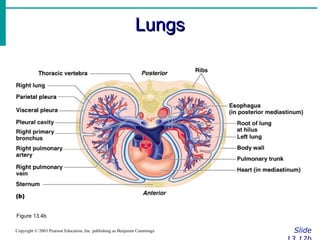
Figure 13.4b
Coverings of the LungsCoverings of the Lungs
SlideCopyright © 2003 Pearson Education, Inc. publishing as Benjamin Cummings
• Pulmonary (visceral) pleura covers the
lung surface
• Parietal pleura lines the walls of the
thoracic cavity
• Pleural fluid fills the area between layers
of pleura to allow gliding
Respiratory Tree DivisionsRespiratory Tree Divisions
SlideCopyright © 2003 Pearson Education, Inc. publishing as Benjamin Cummings
• Primary bronchi
• Secondary bronchi
• Tertiary bronchi
• Bronchioli
• Terminal bronchioli
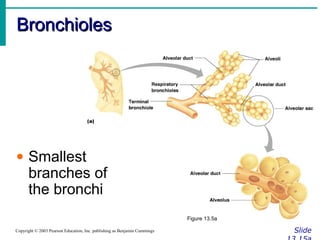
BronchiolesBronchioles
SlideCopyright © 2003 Pearson Education, Inc. publishing as Benjamin Cummings
Figure 13.5a
• Smallest
branches of
the bronchi
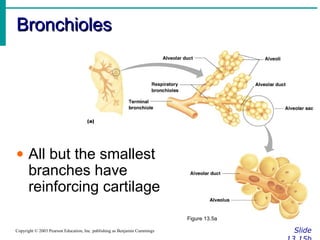
BronchiolesBronchioles
SlideCopyright © 2003 Pearson Education, Inc. publishing as Benjamin Cummings
Figure 13.5a
• All but the smallest
branches have
reinforcing cartilage
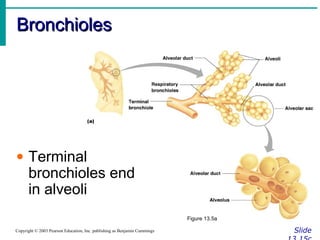
BronchiolesBronchioles
SlideCopyright © 2003 Pearson Education, Inc. publishing as Benjamin Cummings
• Terminal
bronchioles end
in alveoli
Figure 13.5a
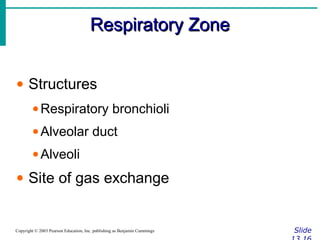
Respiratory ZoneRespiratory Zone
SlideCopyright © 2003 Pearson Education, Inc. publishing as Benjamin Cummings
• Structures
•Respiratory bronchioli
•Alveolar duct
•Alveoli
• Site of gas exchange
AlveoliAlveoli
SlideCopyright © 2003 Pearson Education, Inc. publishing as Benjamin Cummings
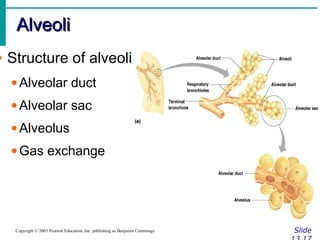
• Structure of alveoli
•Alveolar duct
•Alveolar sac
•Alveolus
•Gas exchange
Respiratory MembraneRespiratory Membrane
(Air-Blood Barrier)(Air-Blood Barrier)
SlideCopyright © 2003 Pearson Education, Inc. publishing as Benjamin Cummings
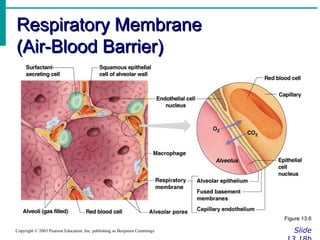
• Thin squamous epithelial layer lining
alveolar walls
• Pulmonary capillaries cover external
surfaces of alveoli
Respiratory MembraneRespiratory Membrane
(Air-Blood Barrier)(Air-Blood Barrier)
SlideCopyright © 2003 Pearson Education, Inc. publishing as Benjamin Cummings
Figure 13.6
Gas ExchangeGas Exchange
SlideCopyright © 2003 Pearson Education, Inc. publishing as Benjamin Cummings
• Gas crosses the respiratory membrane
by diffusion
•Oxygen enters the blood
•Carbon dioxide enters the alveoli
• Macrophages add protection
• Surfactant coats gas-exposed alveolar
surfaces
Events of RespirationEvents of Respiration
SlideCopyright © 2003 Pearson Education, Inc. publishing as Benjamin Cummings
• Pulmonary ventilation – moving air in and
out of the lungs
• External respiration – gas exchange
between pulmonary blood and alveoli
Events of RespirationEvents of Respiration
SlideCopyright © 2003 Pearson Education, Inc. publishing as Benjamin Cummings
• Respiratory gas transport – transport of
oxygen and carbon dioxide via the
bloodstream
• Internal respiration – gas exchange
between blood and tissue cells in
systemic capillaries
Mechanics of BreathingMechanics of Breathing
(Pulmonary Ventilation)(Pulmonary Ventilation)
SlideCopyright © 2003 Pearson Education, Inc. publishing as Benjamin Cummings
• Completely mechanical process
• Depends on volume changes in the
thoracic cavity
• Volume changes lead to pressure
changes, which lead to the flow of
gases to equalize pressure
Mechanics of BreathingMechanics of Breathing
(Pulmonary Ventilation)(Pulmonary Ventilation)
SlideCopyright © 2003 Pearson Education, Inc. publishing as Benjamin Cummings
• Two phases
•Inspiration – flow of air into lung
•Expiration – air leaving lung
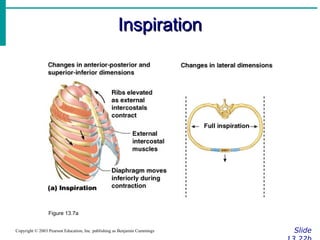
InspirationInspiration
SlideCopyright © 2003 Pearson Education, Inc. publishing as Benjamin Cummings
• Diaphragm and intercostal muscles
contract
• The size of the thoracic cavity increases
• External air is pulled into the lungs due to
an increase in intrapulmonary volume
InspirationInspiration
SlideCopyright © 2003 Pearson Education, Inc. publishing as Benjamin Cummings
Figure 13.7a
ExhalationExhalation
SlideCopyright © 2003 Pearson Education, Inc. publishing as Benjamin Cummings
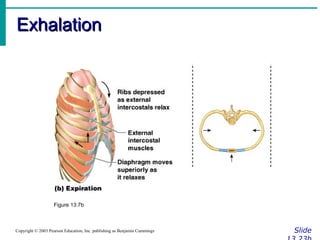
• Largely a passive process which depends
on natural lung elasticity
• As muscles relax, air is pushed out of the
lungs
• Forced expiration can occur mostly by
contracting internal intercostal muscles to
depress the rib cage
ExhalationExhalation
SlideCopyright © 2003 Pearson Education, Inc. publishing as Benjamin Cummings
Figure 13.7b
Nonrespiratory Air MovementsNonrespiratory Air Movements
SlideCopyright © 2003 Pearson Education, Inc. publishing as Benjamin Cummings
• Can be caused by reflexes or voluntary
actions
• Examples
•Cough and sneeze – clears lungs of debris
•Laughing
•Crying
•Yawn
•Hiccup
Respiratory Volumes and CapacitiesRespiratory Volumes and Capacities
SlideCopyright © 2003 Pearson Education, Inc. publishing as Benjamin Cummings
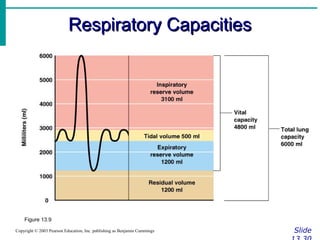
• Normal breathing moves about 500 ml of air
with each breath (tidal volume [TV])
• Many factors that affect respiratory capacity
•A person’s size
•Sex
•Age
•Physical condition
• Residual volume of air – after exhalation,
about 1200 ml of air remains in the lungs
Respiratory Volumes and CapacitiesRespiratory Volumes and Capacities
SlideCopyright © 2003 Pearson Education, Inc. publishing as Benjamin Cummings
• Inspiratory reserve volume (IRV)
•Amount of air that can be taken in forcibly
over the tidal volume
•Usually between 2100 and 3200 ml
• Expiratory reserve volume (ERV)
•Amount of air that can be forcibly exhaled
•Approximately 1200 ml
Respiratory Volumes and CapacitiesRespiratory Volumes and Capacities
SlideCopyright © 2003 Pearson Education, Inc. publishing as Benjamin Cummings
• Residual volume
•Air remaining in lung after expiration
•About 1200 ml
Respiratory Volumes and CapacitiesRespiratory Volumes and Capacities
SlideCopyright © 2003 Pearson Education, Inc. publishing as Benjamin Cummings
• Vital capacity
•The total amount of exchangeable air
•Vital capacity = TV + IRV + ERV
•Dead space volume
• Air that remains in conducting zone and
never reaches alveoli
• About 150 ml
Respiratory Volumes and CapacitiesRespiratory Volumes and Capacities
SlideCopyright © 2003 Pearson Education, Inc. publishing as Benjamin Cummings
• Functional volume
•Air that actually reaches the respiratory
zone
•Usually about 350 ml
• Respiratory capacities are measured
with a spirometer
Respiratory CapacitiesRespiratory Capacities
SlideCopyright © 2003 Pearson Education, Inc. publishing as Benjamin Cummings
Figure 13.9
Respiratory SoundsRespiratory Sounds
SlideCopyright © 2003 Pearson Education, Inc. publishing as Benjamin Cummings
• Sounds are monitored with a
stethoscope
• Bronchial sounds – produced by air
rushing through trachea and bronchi
• Vesicular breathing sounds – soft
sounds of air filling alveoli
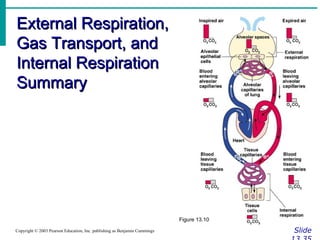
External RespirationExternal Respiration
SlideCopyright © 2003 Pearson Education, Inc. publishing as Benjamin Cummings
• Oxygen movement into the blood
•The alveoli always has more oxygen than
the blood
•Oxygen moves by diffusion towards the
area of lower concentration
•Pulmonary capillary blood gains oxygen
External RespirationExternal Respiration
SlideCopyright © 2003 Pearson Education, Inc. publishing as Benjamin Cummings
• Carbon dioxide movement out of the
blood
•Blood returning from tissues has higher
concentrations of carbon dioxide than air in
the alveoli
•Pulmonary capillary blood gives up carbon
dioxide
• Blood leaving the lungs is oxygen-rich
and carbon dioxide-poor
Gas Transport in the BloodGas Transport in the Blood
SlideCopyright © 2003 Pearson Education, Inc. publishing as Benjamin Cummings
• Oxygen transport in the blood
•Inside red blood cells attached to
hemoglobin (oxyhemoglobin [HbO2])
•A small amount is carried dissolved in the
plasma
Gas Transport in the BloodGas Transport in the Blood
SlideCopyright © 2003 Pearson Education, Inc. publishing as Benjamin Cummings
• Carbon dioxide transport in the blood
•Most is transported in the plasma as
bicarbonate ion (HCO3
–
)
•A small amount is carried inside red blood
cells on hemoglobin, but at different binding
sites than those of oxygen
Internal RespirationInternal Respiration
SlideCopyright © 2003 Pearson Education, Inc. publishing as Benjamin Cummings
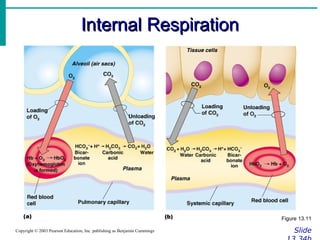
• Exchange of gases between blood and
body cells
• An opposite reaction to what occurs in
the lungs
•Carbon dioxide diffuses out of tissue to
blood
•Oxygen diffuses from blood into tissue
Internal RespirationInternal Respiration
SlideCopyright © 2003 Pearson Education, Inc. publishing as Benjamin Cummings
Figure 13.11
External Respiration,External Respiration,
Gas Transport, andGas Transport, and
Internal RespirationInternal Respiration
SummarySummary
SlideCopyright © 2003 Pearson Education, Inc. publishing as Benjamin Cummings
Figure 13.10
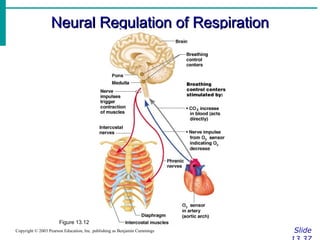
Neural Regulation of RespirationNeural Regulation of Respiration
SlideCopyright © 2003 Pearson Education, Inc. publishing as Benjamin Cummings
• Activity of respiratory muscles is transmitted
to the brain by the phrenic and intercostal
nerves
• Neural centers that control rate and depth are
located in the medulla
• The pons appears to smooth out respiratory
rate
• Normal respiratory rate (eupnea) is 12–15
respirations per minute
• Hypernia is increased respiratory rate often
due to extra oxygen needs
Neural Regulation of RespirationNeural Regulation of Respiration
SlideCopyright © 2003 Pearson Education, Inc. publishing as Benjamin Cummings
Figure 13.12
Factors Influencing RespiratoryFactors Influencing Respiratory
Rate and DepthRate and Depth
SlideCopyright © 2003 Pearson Education, Inc. publishing as Benjamin Cummings
• Physical factors
•Increased body temperature
•Exercise
•Talking
•Coughing
• Volition (conscious control)
• Emotional factors
Factors Influencing RespiratoryFactors Influencing Respiratory
Rate and DepthRate and Depth
SlideCopyright © 2003 Pearson Education, Inc. publishing as Benjamin Cummings
• Chemical factors
•Carbon dioxide levels
• Level of carbon dioxide in the blood is the
main regulatory chemical for respiration
• Increased carbon dioxide increases
respiration
• Changes in carbon dioxide act directly on
the medulla oblongata
Factors Influencing RespiratoryFactors Influencing Respiratory
Rate and DepthRate and Depth
SlideCopyright © 2003 Pearson Education, Inc. publishing as Benjamin Cummings
• Chemical factors (continued)
•Oxygen levels
• Changes in oxygen concentration in the
blood are detected by chemoreceptors in
the aorta and carotid artery
• Information is sent to the medulla oblongata
Respiratory Disorders: ChronicRespiratory Disorders: Chronic
Obstructive Pulmonary DiseaseObstructive Pulmonary Disease
(COPD)(COPD)
SlideCopyright © 2003 Pearson Education, Inc. publishing as Benjamin Cummings
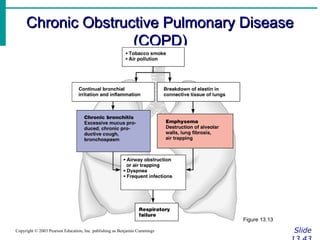
• Exemplified by chronic bronchitis and
emphysema
• Major causes of death and disability in
the United States
Respiratory Disorders: ChronicRespiratory Disorders: Chronic
Obstructive Pulmonary DiseaseObstructive Pulmonary Disease
(COPD)(COPD)
SlideCopyright © 2003 Pearson Education, Inc. publishing as Benjamin Cummings
• Features of these diseases
•Patients almost always have a history of
smoking
•Labored breathing (dyspnea) becomes
progressively more severe
•Coughing and frequent pulmonary
infections are common
Respiratory Disorders: ChronicRespiratory Disorders: Chronic
Obstructive Pulmonary DiseaseObstructive Pulmonary Disease
(COPD)(COPD)
SlideCopyright © 2003 Pearson Education, Inc. publishing as Benjamin Cummings
• Features of these diseases (continued)
•Most victimes retain carbon dioxide, are
hypoxic and have respiratory acidosis
•Those infected will ultimately develop
respiratory failure
EmphysemaEmphysema
SlideCopyright © 2003 Pearson Education, Inc. publishing as Benjamin Cummings
• Alveoli enlarge as adjacent chambers break
through
• Chronic inflammation promotes lung fibrosis
• Airways collapse during expiration
• Patients use a large amount of energy to
exhale
• Overinflation of the lungs leads to a
permanently expanded barrel chest
• Cyanosis appears late in the disease
Chronic BronchitisChronic Bronchitis
SlideCopyright © 2003 Pearson Education, Inc. publishing as Benjamin Cummings
• Mucosa of the lower respiratory
passages becomes severely inflamed
• Mucus production increases
• Pooled mucus impairs ventilation and
gas exchange
• Risk of lung infection increases
• Pneumonia is common
• Hypoxia and cyanosis occur early
Chronic Obstructive Pulmonary DiseaseChronic Obstructive Pulmonary Disease
(COPD)(COPD)
SlideCopyright © 2003 Pearson Education, Inc. publishing as Benjamin Cummings
Figure 13.13
Lung CancerLung Cancer
SlideCopyright © 2003 Pearson Education, Inc. publishing as Benjamin Cummings
• Accounts for 1/3 of all cancer deaths in
the United States
• Increased incidence associated with
smoking
• Three common types
•Squamous cell carcinoma
•Adenocarcinoma
•Small cell carcinoma
Sudden Infant Death syndromeSudden Infant Death syndrome
(SIDS)(SIDS)
SlideCopyright © 2003 Pearson Education, Inc. publishing as Benjamin Cummings
• Apparently healthy infant stops
breathing and dies during sleep
• Some cases are thought to be a
problem of the neural respiratory control
center
• One third of cases appear to be due to
heart rhythm abnormalities
AsthmaAsthma
SlideCopyright © 2003 Pearson Education, Inc. publishing as Benjamin Cummings
• Chronic inflamed hypersensitive
bronchiole passages
• Response to irritants with dyspnea,
coughing, and wheezing
Developmental Aspects of theDevelopmental Aspects of the
Respiratory SystemRespiratory System
SlideCopyright © 2003 Pearson Education, Inc. publishing as Benjamin Cummings
• Lungs are filled with fluid in the fetus
• Lungs are not fully inflated with air until
two weeks after birth
• Surfactant that lowers alveolar surface
tension is not present until late in fetal
development and may not be present in
premature babies
Developmental Aspects of theDevelopmental Aspects of the
Respiratory SystemRespiratory System
SlideCopyright © 2003 Pearson Education, Inc. publishing as Benjamin Cummings
• Important birth defects
•Cystic fibrosis – oversecretion of thick
mucus clogs the respiratory system
•Cleft palate
Aging EffectsAging Effects
SlideCopyright © 2003 Pearson Education, Inc. publishing as Benjamin Cummings
• Elasticity of lungs decreases
• Vital capacity decreases
• Blood oxygen levels decrease
• Stimulating effects of carbon dioxide
decreases
• More risks of respiratory tract infection
Respiratory Rate ChangesRespiratory Rate Changes
Throughout LifeThroughout Life
SlideCopyright © 2003 Pearson Education, Inc. publishing as Benjamin Cummings
• Newborns – 40 to 80 respirations per
minute
• Infants – 30 respirations per minute
• Age 5 – 25 respirations per minute
• Adults – 12 to 18 respirations per
minute
• Rate often increases somewhat with old
age

Introduction to respiratory system

  • 1.
    Essentials of HumanAnatomy & Physiology Copyright © 2003 Pearson Education, Inc. publishing as Benjamin Cummings Seventh Edition Elaine N. Marieb Chapter 13 The Respiratory System
  • 2.
    Function of theRespiratory SystemFunction of the Respiratory System Slide 13.2Copyright © 2003 Pearson Education, Inc. publishing as Benjamin Cummings • Oversees gas exchanges (oxygen and carbon dioxide) between the blood and external environment • Exchange of gasses takes place within the lungs in the alveoli(only site of gas exchange, other structures passageways • Passageways to the lungs purify, warm, and humidify the incoming air • Shares responsibility with cardiovascular system
  • 3.
    Organs of theRespiratory systemOrgans of the Respiratory system Slide 13.1Copyright © 2003 Pearson Education, Inc. publishing as Benjamin Cummings • Nose • Pharynx • Larynx • Trachea • Bronchi • Lungs – alveoli Figure 13.1
  • 4.
    SlideCopyright © 2003Pearson Education, Inc. publishing as Benjamin Cummings Figure 13.2 Upper Respiratory TractUpper Respiratory Tract
  • 5.
    Anatomy of theNasal CavityAnatomy of the Nasal Cavity SlideCopyright © 2003 Pearson Education, Inc. publishing as Benjamin Cummings • Olfactory receptors are located in the mucosa on the superior surface • The rest of the cavity is lined with respiratory mucosa •Moistens air •Traps incoming foreign particles
  • 6.
    Anatomy of theNasal CavityAnatomy of the Nasal Cavity SlideCopyright © 2003 Pearson Education, Inc. publishing as Benjamin Cummings • Lateral walls have projections called conchae •Increases surface area •Increases air turbulence within the nasal cavity • The nasal cavity is separated from the oral cavity by the palate •Anterior hard palate (bone) •Posterior soft palate (muscle)
  • 7.
    Paranasal SinusesParanasal Sinuses SlideCopyright© 2003 Pearson Education, Inc. publishing as Benjamin Cummings • Cavities within bones surrounding the nasal cavity •Frontal bone •Sphenoid bone •Ethmoid bone •Maxillary bone
  • 8.
    Paranasal SinusesParanasal Sinuses SlideCopyright© 2003 Pearson Education, Inc. publishing as Benjamin Cummings • Function of the sinuses •Lighten the skull •Act as resonance chambers for speech •Produce mucus that drains into the nasal cavity
  • 9.
    Pharynx (Throat)Pharynx (Throat) Slide13.6Copyright © 2003 Pearson Education, Inc. publishing as Benjamin Cummings • Muscular passage from nasal cavity to larynx • Three regions of the pharynx •Nasopharynx – superior region behind nasal cavity •Oropharynx – middle region behind mouth •Laryngopharynx – inferior region attached to larynx • The oropharynx and laryngopharynx are common passageways for air and food
  • 10.
    SlideCopyright © 2003Pearson Education, Inc. publishing as Benjamin Cummings Figure 13.2 Upper Respiratory TractUpper Respiratory Tract
  • 11.
    Structures of thePharynxStructures of the Pharynx Slide 13.7Copyright © 2003 Pearson Education, Inc. publishing as Benjamin Cummings • Auditory tubes enter the nasopharynx • Tonsils of the pharynx •Pharyngeal tonsil (adenoids) in the nasopharynx •Palatine tonsils in the oropharynx •Lingual tonsils at the base of the tongue
  • 12.
    Larynx (Voice Box)Larynx(Voice Box) Slide 13.8Copyright © 2003 Pearson Education, Inc. publishing as Benjamin Cummings • Routes air and food into proper channels • Plays a role in speech • Made of eight rigid hyaline cartilages and a spoon-shaped flap of elastic cartilage (epiglottis)
  • 13.
    Structures of theLarynxStructures of the Larynx SlideCopyright © 2003 Pearson Education, Inc. publishing as Benjamin Cummings • Thyroid cartilage •Largest hyaline cartilage •Protrudes anteriorly (Adam’s apple) • Epiglottis •Superior opening of the larynx •Routes food to the larynx and air toward the trachea
  • 14.
    Structures of theLarynxStructures of the Larynx SlideCopyright © 2003 Pearson Education, Inc. publishing as Benjamin Cummings • Vocal cords (vocal folds) •Vibrate with expelled air to create sound (speech) • Glottis – opening between vocal cords
  • 15.
    Trachea (Windpipe)Trachea (Windpipe) SlideCopyright© 2003 Pearson Education, Inc. publishing as Benjamin Cummings • Connects larynx with bronchi • Lined with ciliated mucosa •Beat continuously in the opposite direction of incoming air •Expel mucus loaded with dust and other debris away from lungs • Walls are reinforced with C-shaped hyaline cartilage
  • 16.
    Primary BronchiPrimary Bronchi SlideCopyright© 2003 Pearson Education, Inc. publishing as Benjamin Cummings • Formed by division of the trachea • Enters the lung at the hilus (medial depression) • Right bronchus is wider, shorter, and straighter than left • Bronchi subdivide into smaller and smaller branches
  • 17.
    LungsLungs SlideCopyright © 2003Pearson Education, Inc. publishing as Benjamin Cummings • Occupy most of the thoracic cavity •Apex is near the clavicle (superior portion) •Base rests on the diaphragm (inferior portion) •Each lung is divided into lobes by fissures •Left lung – two lobes •Right lung – three lobes
  • 18.
    LungsLungs SlideCopyright © 2003Pearson Education, Inc. publishing as Benjamin Cummings Figure 13.4b
  • 19.
    Coverings of theLungsCoverings of the Lungs SlideCopyright © 2003 Pearson Education, Inc. publishing as Benjamin Cummings • Pulmonary (visceral) pleura covers the lung surface • Parietal pleura lines the walls of the thoracic cavity • Pleural fluid fills the area between layers of pleura to allow gliding
  • 20.
    Respiratory Tree DivisionsRespiratoryTree Divisions SlideCopyright © 2003 Pearson Education, Inc. publishing as Benjamin Cummings • Primary bronchi • Secondary bronchi • Tertiary bronchi • Bronchioli • Terminal bronchioli
  • 21.
    BronchiolesBronchioles SlideCopyright © 2003Pearson Education, Inc. publishing as Benjamin Cummings Figure 13.5a • Smallest branches of the bronchi
  • 22.
    BronchiolesBronchioles SlideCopyright © 2003Pearson Education, Inc. publishing as Benjamin Cummings Figure 13.5a • All but the smallest branches have reinforcing cartilage
  • 23.
    BronchiolesBronchioles SlideCopyright © 2003Pearson Education, Inc. publishing as Benjamin Cummings • Terminal bronchioles end in alveoli Figure 13.5a
  • 24.
    Respiratory ZoneRespiratory Zone SlideCopyright© 2003 Pearson Education, Inc. publishing as Benjamin Cummings • Structures •Respiratory bronchioli •Alveolar duct •Alveoli • Site of gas exchange
  • 25.
    AlveoliAlveoli SlideCopyright © 2003Pearson Education, Inc. publishing as Benjamin Cummings • Structure of alveoli •Alveolar duct •Alveolar sac •Alveolus •Gas exchange
  • 26.
    Respiratory MembraneRespiratory Membrane (Air-BloodBarrier)(Air-Blood Barrier) SlideCopyright © 2003 Pearson Education, Inc. publishing as Benjamin Cummings • Thin squamous epithelial layer lining alveolar walls • Pulmonary capillaries cover external surfaces of alveoli
  • 27.
    Respiratory MembraneRespiratory Membrane (Air-BloodBarrier)(Air-Blood Barrier) SlideCopyright © 2003 Pearson Education, Inc. publishing as Benjamin Cummings Figure 13.6
  • 28.
    Gas ExchangeGas Exchange SlideCopyright© 2003 Pearson Education, Inc. publishing as Benjamin Cummings • Gas crosses the respiratory membrane by diffusion •Oxygen enters the blood •Carbon dioxide enters the alveoli • Macrophages add protection • Surfactant coats gas-exposed alveolar surfaces
  • 29.
    Events of RespirationEventsof Respiration SlideCopyright © 2003 Pearson Education, Inc. publishing as Benjamin Cummings • Pulmonary ventilation – moving air in and out of the lungs • External respiration – gas exchange between pulmonary blood and alveoli
  • 30.
    Events of RespirationEventsof Respiration SlideCopyright © 2003 Pearson Education, Inc. publishing as Benjamin Cummings • Respiratory gas transport – transport of oxygen and carbon dioxide via the bloodstream • Internal respiration – gas exchange between blood and tissue cells in systemic capillaries
  • 31.
    Mechanics of BreathingMechanicsof Breathing (Pulmonary Ventilation)(Pulmonary Ventilation) SlideCopyright © 2003 Pearson Education, Inc. publishing as Benjamin Cummings • Completely mechanical process • Depends on volume changes in the thoracic cavity • Volume changes lead to pressure changes, which lead to the flow of gases to equalize pressure
  • 32.
    Mechanics of BreathingMechanicsof Breathing (Pulmonary Ventilation)(Pulmonary Ventilation) SlideCopyright © 2003 Pearson Education, Inc. publishing as Benjamin Cummings • Two phases •Inspiration – flow of air into lung •Expiration – air leaving lung
  • 33.
    InspirationInspiration SlideCopyright © 2003Pearson Education, Inc. publishing as Benjamin Cummings • Diaphragm and intercostal muscles contract • The size of the thoracic cavity increases • External air is pulled into the lungs due to an increase in intrapulmonary volume
  • 34.
    InspirationInspiration SlideCopyright © 2003Pearson Education, Inc. publishing as Benjamin Cummings Figure 13.7a
  • 35.
    ExhalationExhalation SlideCopyright © 2003Pearson Education, Inc. publishing as Benjamin Cummings • Largely a passive process which depends on natural lung elasticity • As muscles relax, air is pushed out of the lungs • Forced expiration can occur mostly by contracting internal intercostal muscles to depress the rib cage
  • 36.
    ExhalationExhalation SlideCopyright © 2003Pearson Education, Inc. publishing as Benjamin Cummings Figure 13.7b
  • 37.
    Nonrespiratory Air MovementsNonrespiratoryAir Movements SlideCopyright © 2003 Pearson Education, Inc. publishing as Benjamin Cummings • Can be caused by reflexes or voluntary actions • Examples •Cough and sneeze – clears lungs of debris •Laughing •Crying •Yawn •Hiccup
  • 38.
    Respiratory Volumes andCapacitiesRespiratory Volumes and Capacities SlideCopyright © 2003 Pearson Education, Inc. publishing as Benjamin Cummings • Normal breathing moves about 500 ml of air with each breath (tidal volume [TV]) • Many factors that affect respiratory capacity •A person’s size •Sex •Age •Physical condition • Residual volume of air – after exhalation, about 1200 ml of air remains in the lungs
  • 39.
    Respiratory Volumes andCapacitiesRespiratory Volumes and Capacities SlideCopyright © 2003 Pearson Education, Inc. publishing as Benjamin Cummings • Inspiratory reserve volume (IRV) •Amount of air that can be taken in forcibly over the tidal volume •Usually between 2100 and 3200 ml • Expiratory reserve volume (ERV) •Amount of air that can be forcibly exhaled •Approximately 1200 ml
  • 40.
    Respiratory Volumes andCapacitiesRespiratory Volumes and Capacities SlideCopyright © 2003 Pearson Education, Inc. publishing as Benjamin Cummings • Residual volume •Air remaining in lung after expiration •About 1200 ml
  • 41.
    Respiratory Volumes andCapacitiesRespiratory Volumes and Capacities SlideCopyright © 2003 Pearson Education, Inc. publishing as Benjamin Cummings • Vital capacity •The total amount of exchangeable air •Vital capacity = TV + IRV + ERV •Dead space volume • Air that remains in conducting zone and never reaches alveoli • About 150 ml
  • 42.
    Respiratory Volumes andCapacitiesRespiratory Volumes and Capacities SlideCopyright © 2003 Pearson Education, Inc. publishing as Benjamin Cummings • Functional volume •Air that actually reaches the respiratory zone •Usually about 350 ml • Respiratory capacities are measured with a spirometer
  • 43.
    Respiratory CapacitiesRespiratory Capacities SlideCopyright© 2003 Pearson Education, Inc. publishing as Benjamin Cummings Figure 13.9
  • 44.
    Respiratory SoundsRespiratory Sounds SlideCopyright© 2003 Pearson Education, Inc. publishing as Benjamin Cummings • Sounds are monitored with a stethoscope • Bronchial sounds – produced by air rushing through trachea and bronchi • Vesicular breathing sounds – soft sounds of air filling alveoli
  • 45.
    External RespirationExternal Respiration SlideCopyright© 2003 Pearson Education, Inc. publishing as Benjamin Cummings • Oxygen movement into the blood •The alveoli always has more oxygen than the blood •Oxygen moves by diffusion towards the area of lower concentration •Pulmonary capillary blood gains oxygen
  • 46.
    External RespirationExternal Respiration SlideCopyright© 2003 Pearson Education, Inc. publishing as Benjamin Cummings • Carbon dioxide movement out of the blood •Blood returning from tissues has higher concentrations of carbon dioxide than air in the alveoli •Pulmonary capillary blood gives up carbon dioxide • Blood leaving the lungs is oxygen-rich and carbon dioxide-poor
  • 47.
    Gas Transport inthe BloodGas Transport in the Blood SlideCopyright © 2003 Pearson Education, Inc. publishing as Benjamin Cummings • Oxygen transport in the blood •Inside red blood cells attached to hemoglobin (oxyhemoglobin [HbO2]) •A small amount is carried dissolved in the plasma
  • 48.
    Gas Transport inthe BloodGas Transport in the Blood SlideCopyright © 2003 Pearson Education, Inc. publishing as Benjamin Cummings • Carbon dioxide transport in the blood •Most is transported in the plasma as bicarbonate ion (HCO3 – ) •A small amount is carried inside red blood cells on hemoglobin, but at different binding sites than those of oxygen
  • 49.
    Internal RespirationInternal Respiration SlideCopyright© 2003 Pearson Education, Inc. publishing as Benjamin Cummings • Exchange of gases between blood and body cells • An opposite reaction to what occurs in the lungs •Carbon dioxide diffuses out of tissue to blood •Oxygen diffuses from blood into tissue
  • 50.
    Internal RespirationInternal Respiration SlideCopyright© 2003 Pearson Education, Inc. publishing as Benjamin Cummings Figure 13.11
  • 51.
    External Respiration,External Respiration, GasTransport, andGas Transport, and Internal RespirationInternal Respiration SummarySummary SlideCopyright © 2003 Pearson Education, Inc. publishing as Benjamin Cummings Figure 13.10
  • 52.
    Neural Regulation ofRespirationNeural Regulation of Respiration SlideCopyright © 2003 Pearson Education, Inc. publishing as Benjamin Cummings • Activity of respiratory muscles is transmitted to the brain by the phrenic and intercostal nerves • Neural centers that control rate and depth are located in the medulla • The pons appears to smooth out respiratory rate • Normal respiratory rate (eupnea) is 12–15 respirations per minute • Hypernia is increased respiratory rate often due to extra oxygen needs
  • 53.
    Neural Regulation ofRespirationNeural Regulation of Respiration SlideCopyright © 2003 Pearson Education, Inc. publishing as Benjamin Cummings Figure 13.12
  • 54.
    Factors Influencing RespiratoryFactorsInfluencing Respiratory Rate and DepthRate and Depth SlideCopyright © 2003 Pearson Education, Inc. publishing as Benjamin Cummings • Physical factors •Increased body temperature •Exercise •Talking •Coughing • Volition (conscious control) • Emotional factors
  • 55.
    Factors Influencing RespiratoryFactorsInfluencing Respiratory Rate and DepthRate and Depth SlideCopyright © 2003 Pearson Education, Inc. publishing as Benjamin Cummings • Chemical factors •Carbon dioxide levels • Level of carbon dioxide in the blood is the main regulatory chemical for respiration • Increased carbon dioxide increases respiration • Changes in carbon dioxide act directly on the medulla oblongata
  • 56.
    Factors Influencing RespiratoryFactorsInfluencing Respiratory Rate and DepthRate and Depth SlideCopyright © 2003 Pearson Education, Inc. publishing as Benjamin Cummings • Chemical factors (continued) •Oxygen levels • Changes in oxygen concentration in the blood are detected by chemoreceptors in the aorta and carotid artery • Information is sent to the medulla oblongata
  • 57.
    Respiratory Disorders: ChronicRespiratoryDisorders: Chronic Obstructive Pulmonary DiseaseObstructive Pulmonary Disease (COPD)(COPD) SlideCopyright © 2003 Pearson Education, Inc. publishing as Benjamin Cummings • Exemplified by chronic bronchitis and emphysema • Major causes of death and disability in the United States
  • 58.
    Respiratory Disorders: ChronicRespiratoryDisorders: Chronic Obstructive Pulmonary DiseaseObstructive Pulmonary Disease (COPD)(COPD) SlideCopyright © 2003 Pearson Education, Inc. publishing as Benjamin Cummings • Features of these diseases •Patients almost always have a history of smoking •Labored breathing (dyspnea) becomes progressively more severe •Coughing and frequent pulmonary infections are common
  • 59.
    Respiratory Disorders: ChronicRespiratoryDisorders: Chronic Obstructive Pulmonary DiseaseObstructive Pulmonary Disease (COPD)(COPD) SlideCopyright © 2003 Pearson Education, Inc. publishing as Benjamin Cummings • Features of these diseases (continued) •Most victimes retain carbon dioxide, are hypoxic and have respiratory acidosis •Those infected will ultimately develop respiratory failure
  • 60.
    EmphysemaEmphysema SlideCopyright © 2003Pearson Education, Inc. publishing as Benjamin Cummings • Alveoli enlarge as adjacent chambers break through • Chronic inflammation promotes lung fibrosis • Airways collapse during expiration • Patients use a large amount of energy to exhale • Overinflation of the lungs leads to a permanently expanded barrel chest • Cyanosis appears late in the disease
  • 61.
    Chronic BronchitisChronic Bronchitis SlideCopyright© 2003 Pearson Education, Inc. publishing as Benjamin Cummings • Mucosa of the lower respiratory passages becomes severely inflamed • Mucus production increases • Pooled mucus impairs ventilation and gas exchange • Risk of lung infection increases • Pneumonia is common • Hypoxia and cyanosis occur early
  • 62.
    Chronic Obstructive PulmonaryDiseaseChronic Obstructive Pulmonary Disease (COPD)(COPD) SlideCopyright © 2003 Pearson Education, Inc. publishing as Benjamin Cummings Figure 13.13
  • 63.
    Lung CancerLung Cancer SlideCopyright© 2003 Pearson Education, Inc. publishing as Benjamin Cummings • Accounts for 1/3 of all cancer deaths in the United States • Increased incidence associated with smoking • Three common types •Squamous cell carcinoma •Adenocarcinoma •Small cell carcinoma
  • 64.
    Sudden Infant DeathsyndromeSudden Infant Death syndrome (SIDS)(SIDS) SlideCopyright © 2003 Pearson Education, Inc. publishing as Benjamin Cummings • Apparently healthy infant stops breathing and dies during sleep • Some cases are thought to be a problem of the neural respiratory control center • One third of cases appear to be due to heart rhythm abnormalities
  • 65.
    AsthmaAsthma SlideCopyright © 2003Pearson Education, Inc. publishing as Benjamin Cummings • Chronic inflamed hypersensitive bronchiole passages • Response to irritants with dyspnea, coughing, and wheezing
  • 66.
    Developmental Aspects oftheDevelopmental Aspects of the Respiratory SystemRespiratory System SlideCopyright © 2003 Pearson Education, Inc. publishing as Benjamin Cummings • Lungs are filled with fluid in the fetus • Lungs are not fully inflated with air until two weeks after birth • Surfactant that lowers alveolar surface tension is not present until late in fetal development and may not be present in premature babies
  • 67.
    Developmental Aspects oftheDevelopmental Aspects of the Respiratory SystemRespiratory System SlideCopyright © 2003 Pearson Education, Inc. publishing as Benjamin Cummings • Important birth defects •Cystic fibrosis – oversecretion of thick mucus clogs the respiratory system •Cleft palate
  • 68.
    Aging EffectsAging Effects SlideCopyright© 2003 Pearson Education, Inc. publishing as Benjamin Cummings • Elasticity of lungs decreases • Vital capacity decreases • Blood oxygen levels decrease • Stimulating effects of carbon dioxide decreases • More risks of respiratory tract infection
  • 69.
    Respiratory Rate ChangesRespiratoryRate Changes Throughout LifeThroughout Life SlideCopyright © 2003 Pearson Education, Inc. publishing as Benjamin Cummings • Newborns – 40 to 80 respirations per minute • Infants – 30 respirations per minute • Age 5 – 25 respirations per minute • Adults – 12 to 18 respirations per minute • Rate often increases somewhat with old age