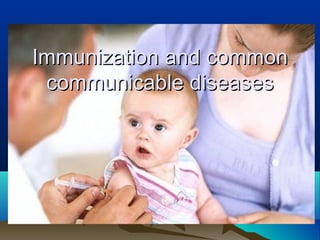
Immunization and commonImmunization and common
communicable diseasescommunicable diseases
outlineoutline
• Vaccination
• Types of vaccines
• Definition of vaccination
• Complications
• Nursing management
• communicable diseases
definition
• Symptoms
• Diagnosis
• Nursing intervention
• summary
• reference
objectiveobjective
• By the end of this presentation you will know:
• What is immunization
• What is the type of vaccination
• What is the complication of immunization
• What is the nursing management of vaccinated infant
• The definition of communicable diseases
• The symptoms of communicable diseases
• What is the influenza
• What is the common cold
• What is the management of communicable diseases
VaccinationVaccination
• Vaccination is a method of giving antigen to
stimulate the immune response through
active immunization.
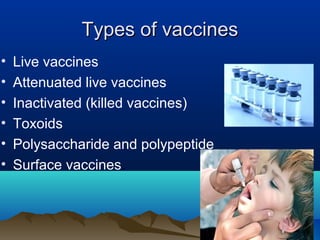
Types of vaccinesTypes of vaccines
• Live vaccines
• Attenuated live vaccines
• Inactivated (killed vaccines)
• Toxoids
• Polysaccharide and polypeptide
• Surface vaccines.
Types of vaccinesTypes of vaccines
Live
vaccines
Live
Attenuate
d
vaccines
Killed
Inactivated
vaccines
Toxoids Cellular
fraction
vaccines
Recombinan
t vaccines
•Small pox
variola
vaccine
•BCG
•Typhoid
oral
•Plague
•Oral
polio
•Yellow
fever
•Measles
•Mumps
•Rubella
•Intranas
al
Influenza
•Typhus
•Typhoid
•Cholera
•Pertussis
•Plague
•Rabies
•Salk polio
•Intra-
muscular
influenza
•Japanise
encephaliti
s
•Diphtheri
a
•Tetanus
•Meningococc
al
polysaccharide
vaccine
•Pneumococc
al
polysaccharide
vaccine
•Hepatitis B
polypeptide
vaccine
•Hepatitis B
vaccine
Vaccinations Schedule
complicationscomplications
Poliovirus
• More common Irritability
• loss of appetite
• tiredness
• Less common Itching or skin
rash
• redness, soreness, hard lump,
tenderness, or pain at the
place of injection
Hepatitis b pediatric vaccine Side
Effects
• fussiness, irritability, crying for an
hour or longer;
• unusual muscle weakness;
• changes in behavior; or
• fever with red or purple skin rash
that spreads and causes blistering
and peeling.
• nausea, diarrhea, loss of appetite;
• redness, pain, swelling, or a lump
where the shot was given;
• general ill feeling;
• mild fussiness or crying;
• low fever;
• runny nose.
complicationscomplications
pcv
• decreased appetite
• a slightly raised
temperature
• irritability
• redness at the site of the
injection
• hardness or swelling at
the site of the injection
• feeling sleepy
• not sleeping well
mmr
• rash, high temperature,
loss of appetite and a
general feeling of being
unwell for about two or
three days.
• Bruise-like spots
• Seizures
complicationscomplications
Rotavirus
• Difficulty breathing
• Wheezing
• Hives
• Paleness
• Fast heart beat
DTaP
• Had a seizure or
collapsed after a dose of
DTaP
• Cried nonstop for 3 hours
or more after a dose of
DTaP
• Had a fever over 105 F
after a dose of DTaP
Nursing managementNursing management
• Answer common patient questions about
vaccines
• Describe what to do if a vaccine reaction
occurs
• Identify how a patient or family can receive
compensation for an injury caused by a
vaccine
communicable diseasescommunicable diseases
definitiondefinition
• A communicable disease is an illness due
to a specific infectious agent or its toxic
products capable of being directly or
indirectly transmitted from man to man,
from animal to man, from animal to
animal, or from the environment (through
air, water, food, etc..) to man.
SymptomsSymptoms
• Each communicable disease has its own specific signs
and symptoms. General signs and symptoms common
to a number of communicable diseases include: child is
found to have increased body temperature,
• crying and nagging for no reason,
• restlessness,
• loss of appetite,
• lack of energy,
• shortness of breath,
• frequent eye rubbing
• or frequent scratching
DiagnosisDiagnosis
• Blood tests
• Urine tests
• Throat swabs
• Stool sample
• (lumbar puncture).
• Biopsies
• Sputum culture
• Imaging scans(such as X-rays, MRI
Common CommunicableCommon Communicable
DiseasesDiseases
The common cold
• is a respiratory infection
caused by over 200 different
viruses. Symptoms include
congestion, sore throat and
cough. It can be spread
through direct and indirect
contact. Treatment includes
rest, liquids and over the
counter medications.
Prevention techniques include
hand washing and avoiding
contact with infected persons.
Influenza
, more commonly called “flu”, is a
respiratory infection caused by
several groups of viruses.
Symptoms include high fever,
fatigue, muscle and joint aches.
It is spread through direct
contact with infected people
and water droplets in the air
from coughs and sneezes.
Treatment includes rest,
liquids, and over the counter
medications. Prevention
includes avoiding contact with
infected persons and
vaccines.
ManagementManagement
• Assess vital signs
• Assess the patient's general condition
• prevent spread-isolation
• reduce risk of cross contamination
• prevent complications
• Using sterile technique when caring of patient
• Give oxygen as needed
• Provide a quiet environment and comfortable
Monitor input and output
• Encourage follow-up care visits with physicians
summarysummary
• At this presentation we talk about the
immunization definition and the type of it
• And the complication of each type
• And the nursing management of
vaccinated infant
• We discussed the communicable diseases
• And its sings and symptoms and nursing
management of patient with
communicable diseases.
referencereference
• http://www.webmd.com/children/vaccines/dtap-
and-tdap-vaccines?page=2
• https://www.google.com/search?
q=vaccination+schedule&source=lnms&tbm=isc
h&sa=X&ved=0ahUKEwj_v-
Cq4v7KAhWB0xoKHVCdCToQ_AUIBygB&biw=
1366&bih=657#imgrc=O4yrcahrizSyoM%3A
• http://www.slideshare.net/nikki071096/communic
able-diseases-9436694
Immunization

Immunization

  • 1.
    Immunization and commonImmunizationand common communicable diseasescommunicable diseases
  • 2.
    outlineoutline • Vaccination • Typesof vaccines • Definition of vaccination • Complications • Nursing management • communicable diseases definition • Symptoms • Diagnosis • Nursing intervention • summary • reference
  • 3.
    objectiveobjective • By theend of this presentation you will know: • What is immunization • What is the type of vaccination • What is the complication of immunization • What is the nursing management of vaccinated infant • The definition of communicable diseases • The symptoms of communicable diseases • What is the influenza • What is the common cold • What is the management of communicable diseases
  • 4.
    VaccinationVaccination • Vaccination isa method of giving antigen to stimulate the immune response through active immunization.
  • 5.
    Types of vaccinesTypesof vaccines • Live vaccines • Attenuated live vaccines • Inactivated (killed vaccines) • Toxoids • Polysaccharide and polypeptide • Surface vaccines.
  • 6.
    Types of vaccinesTypesof vaccines Live vaccines Live Attenuate d vaccines Killed Inactivated vaccines Toxoids Cellular fraction vaccines Recombinan t vaccines •Small pox variola vaccine •BCG •Typhoid oral •Plague •Oral polio •Yellow fever •Measles •Mumps •Rubella •Intranas al Influenza •Typhus •Typhoid •Cholera •Pertussis •Plague •Rabies •Salk polio •Intra- muscular influenza •Japanise encephaliti s •Diphtheri a •Tetanus •Meningococc al polysaccharide vaccine •Pneumococc al polysaccharide vaccine •Hepatitis B polypeptide vaccine •Hepatitis B vaccine
  • 7.
  • 8.
    complicationscomplications Poliovirus • More commonIrritability • loss of appetite • tiredness • Less common Itching or skin rash • redness, soreness, hard lump, tenderness, or pain at the place of injection Hepatitis b pediatric vaccine Side Effects • fussiness, irritability, crying for an hour or longer; • unusual muscle weakness; • changes in behavior; or • fever with red or purple skin rash that spreads and causes blistering and peeling. • nausea, diarrhea, loss of appetite; • redness, pain, swelling, or a lump where the shot was given; • general ill feeling; • mild fussiness or crying; • low fever; • runny nose.
  • 9.
    complicationscomplications pcv • decreased appetite •a slightly raised temperature • irritability • redness at the site of the injection • hardness or swelling at the site of the injection • feeling sleepy • not sleeping well mmr • rash, high temperature, loss of appetite and a general feeling of being unwell for about two or three days. • Bruise-like spots • Seizures
  • 10.
    complicationscomplications Rotavirus • Difficulty breathing •Wheezing • Hives • Paleness • Fast heart beat DTaP • Had a seizure or collapsed after a dose of DTaP • Cried nonstop for 3 hours or more after a dose of DTaP • Had a fever over 105 F after a dose of DTaP
  • 11.
    Nursing managementNursing management •Answer common patient questions about vaccines • Describe what to do if a vaccine reaction occurs • Identify how a patient or family can receive compensation for an injury caused by a vaccine
  • 12.
  • 13.
    definitiondefinition • A communicabledisease is an illness due to a specific infectious agent or its toxic products capable of being directly or indirectly transmitted from man to man, from animal to man, from animal to animal, or from the environment (through air, water, food, etc..) to man.
  • 14.
    SymptomsSymptoms • Each communicabledisease has its own specific signs and symptoms. General signs and symptoms common to a number of communicable diseases include: child is found to have increased body temperature, • crying and nagging for no reason, • restlessness, • loss of appetite, • lack of energy, • shortness of breath, • frequent eye rubbing • or frequent scratching
  • 15.
    DiagnosisDiagnosis • Blood tests •Urine tests • Throat swabs • Stool sample • (lumbar puncture). • Biopsies • Sputum culture • Imaging scans(such as X-rays, MRI
  • 16.
    Common CommunicableCommon Communicable DiseasesDiseases Thecommon cold • is a respiratory infection caused by over 200 different viruses. Symptoms include congestion, sore throat and cough. It can be spread through direct and indirect contact. Treatment includes rest, liquids and over the counter medications. Prevention techniques include hand washing and avoiding contact with infected persons. Influenza , more commonly called “flu”, is a respiratory infection caused by several groups of viruses. Symptoms include high fever, fatigue, muscle and joint aches. It is spread through direct contact with infected people and water droplets in the air from coughs and sneezes. Treatment includes rest, liquids, and over the counter medications. Prevention includes avoiding contact with infected persons and vaccines.
  • 17.
    ManagementManagement • Assess vitalsigns • Assess the patient's general condition • prevent spread-isolation • reduce risk of cross contamination • prevent complications • Using sterile technique when caring of patient • Give oxygen as needed • Provide a quiet environment and comfortable Monitor input and output • Encourage follow-up care visits with physicians
  • 18.
    summarysummary • At thispresentation we talk about the immunization definition and the type of it • And the complication of each type • And the nursing management of vaccinated infant • We discussed the communicable diseases • And its sings and symptoms and nursing management of patient with communicable diseases.
  • 19.