The document defines psychosis as a loss of contact with reality and discusses its causes, types, signs and symptoms, diagnosis, treatment, and nursing management. Psychosis can be caused by genetic and medical factors as well as substance use and can involve hallucinations, delusions, and thought disorders. Diagnosis involves medical testing and evaluations to determine if underlying medical or substance conditions are present. Treatment includes antipsychotic medications, therapy, and rehabilitation services. Nursing care focuses on safety, communication, maintaining health, and addressing low self-esteem.
Out line
Objective
Introduction
Definition Of Psychosis
Causes Of Psychosis
Signs And Symptoms Of Psychosis
Diagnosis For Psychosis
Treatment For Psychosis
Nursing Management For Psychosis
Summary
References
3.
OBJECTIVE
Explain WhatThe Meaning Of Psychosis .
Explain What The Causes & Types & Signs And
Symptoms .
Explain What The Diagnosis & treatment.
Explain Nursing Care Plan.
4.
INTRODUCTION
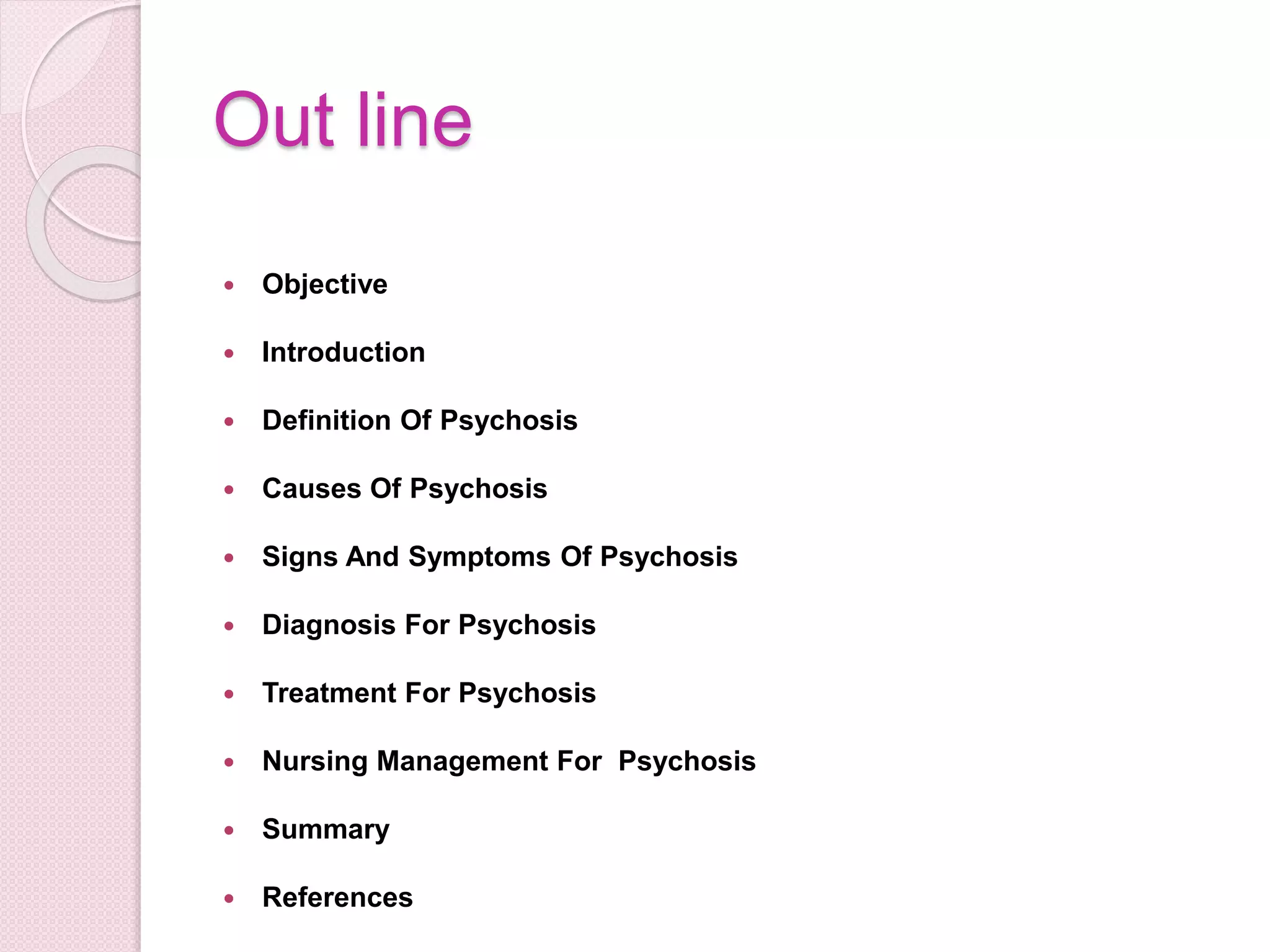
True psychosisusually involves
severe symptoms such as delusions
and/or paranoia. The common belief
that anyone who goes crazy or is
aggressive must be psychotic is not
strictly correct in medical terminology.
Psychotic disorders focus mainly on
the symptoms where the person is
detached from reality, and the main
such symptoms are delusions and
paranoia
5.
DEFINITION
Psychosis refersto an abnormal condition of
the mind described as involving a "loss of
contact with reality ". People experiencing
psychosis may exhibit some personality
changes and thought disorder. Depending on
its severity, this may be accompanied by
unusual or bizarre behavior, as well as
difficulty with social interaction and
impairment in carrying out daily life activities
Signs and symptoms
Hallucinations
Delusions
Thought Disorders
'Loss of contact with reality'
Depression
Emotional Changes
Personality Changes
Behavior Changes
9.
Diagnosis
An initialassessment includes a comprehensive history and physical
examination by a physician, psychiatrist, psychiatric nurse practitioner or
psychiatric physician assistant. Biological tests should be performed to exclude
psychosis associated with or caused by substance use, medication, toxins,
surgical complications, or other medical illnesses.
Thyroid-stimulating hormone to exclude hypo- or hyperthyroidism,
Basic electrolytes and serum calcium to rule out a metabolic
disturbance,
Full blood count including ESR to rule out a systemic infection or
chronic disease, and
Serology to exclude syphilis or HIV infection.
Other investigations include:
10.
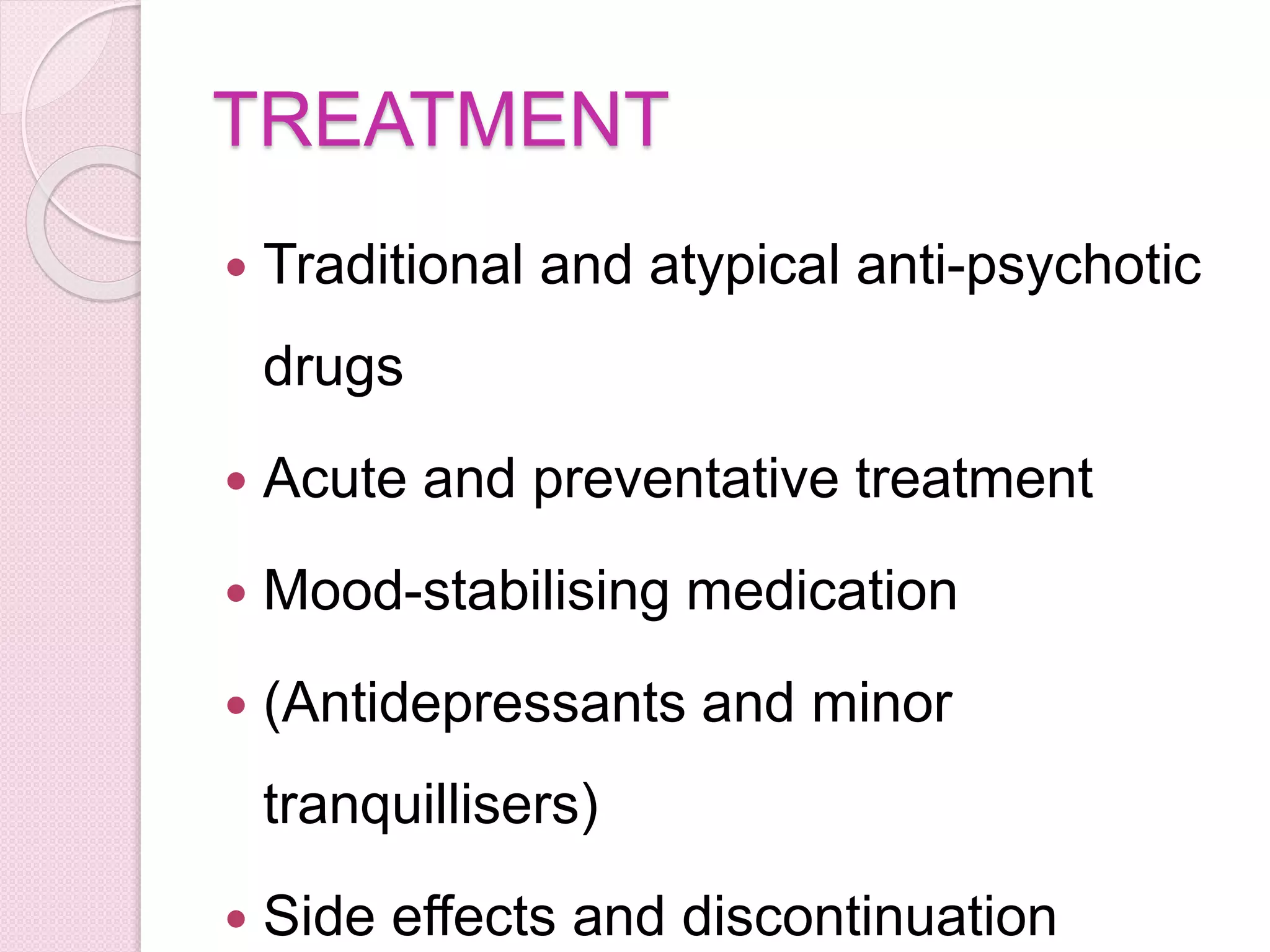
TREATMENT
Traditional andatypical anti-psychotic
drugs
Acute and preventative treatment
Mood-stabilising medication
(Antidepressants and minor
tranquillisers)
Side effects and discontinuation
11.
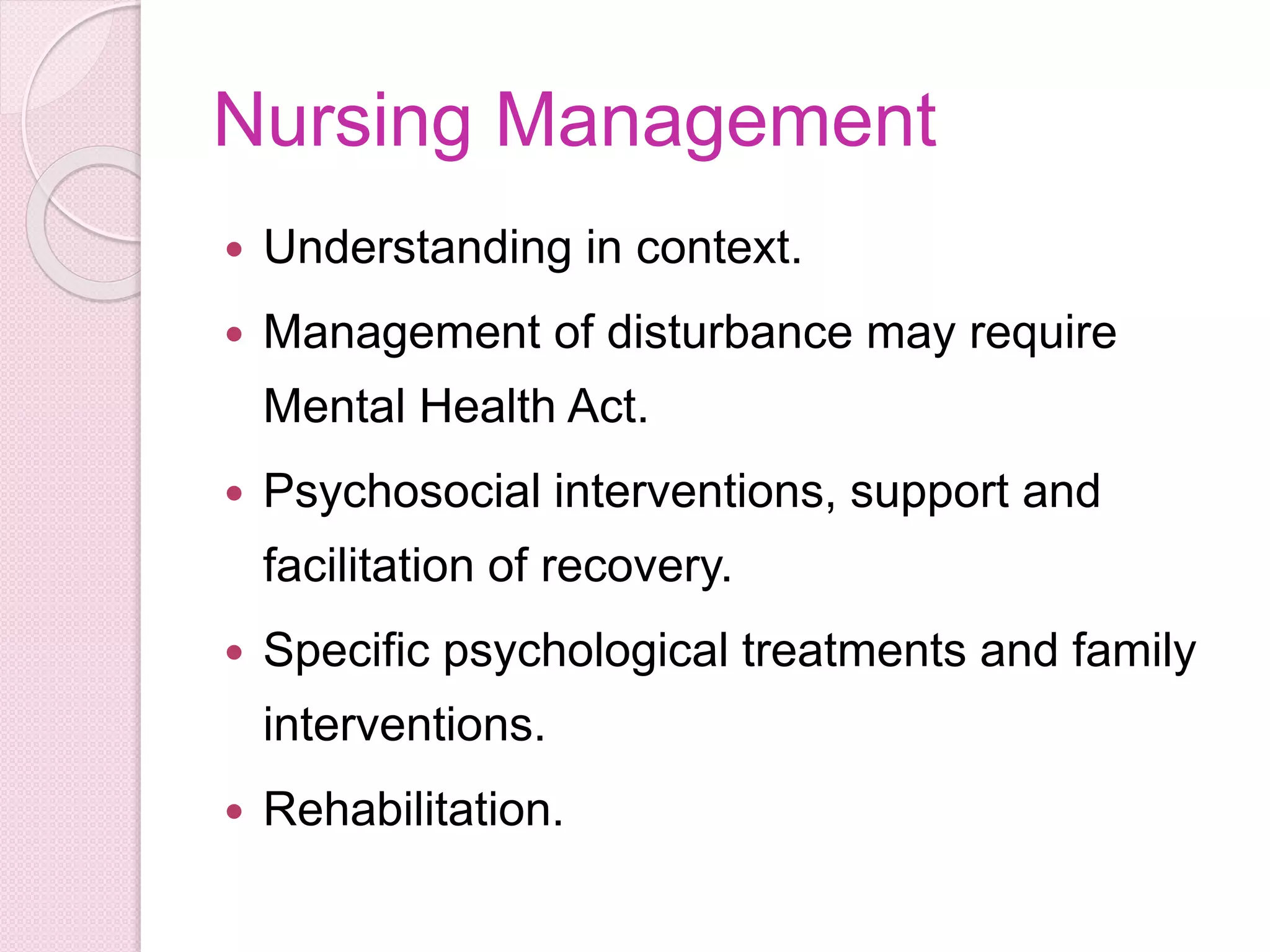
Nursing Management
Understandingin context.
Management of disturbance may require
Mental Health Act.
Psychosocial interventions, support and
facilitation of recovery.
Specific psychological treatments and family
interventions.
Rehabilitation.
12.
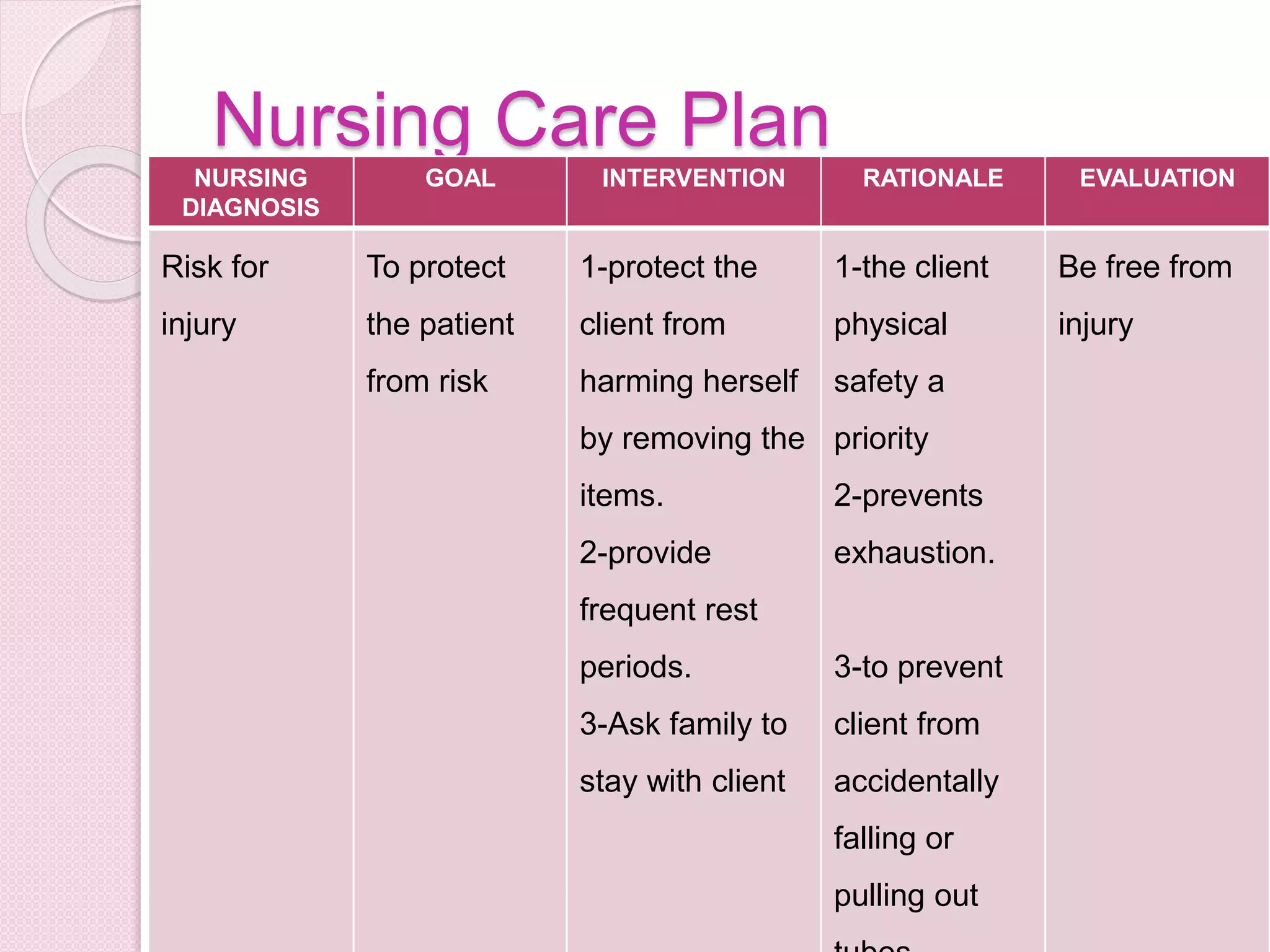
Nursing Care Plan
EVALUATIONRATIONALEINTERVENTIONGOALNURSING
DIAGNOSIS
Befree from
injury
1-the client
physical
safety a
priority
2-prevents
exhaustion.
3-to prevent
client from
accidentally
falling or
pulling out
1-protect the
client from
harming herself
by removing the
items.
2-provide
frequent rest
periods.
3-Ask family to
stay with client
To protect
the patient
from risk
Risk for
injury
13.
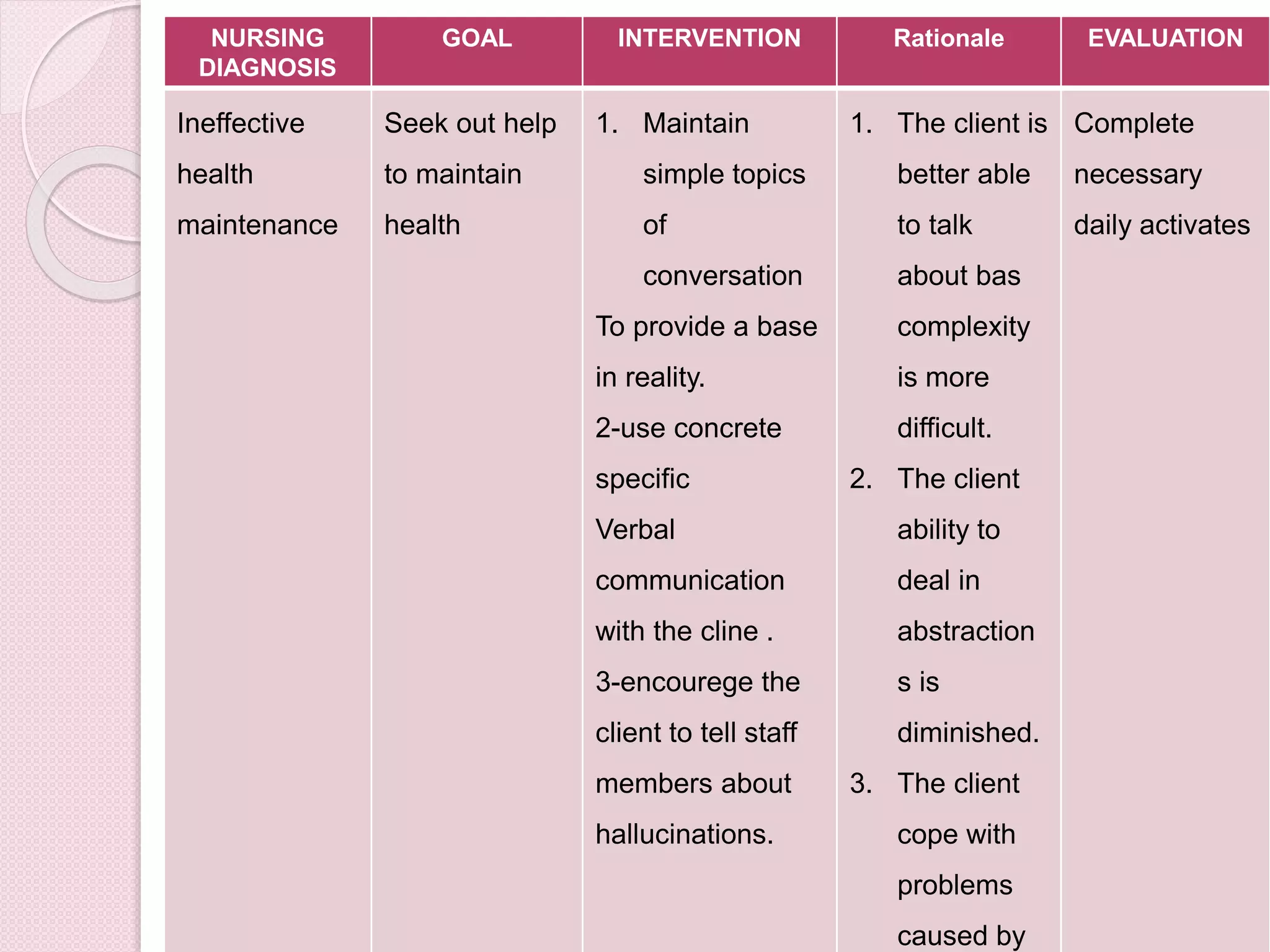
EVALUATIONRationaleINTERVENTIONGOALNURSING
DIAGNOSIS
Complete
necessary
daily activates
1. Theclient is
better able
to talk
about bas
complexity
is more
difficult.
2. The client
ability to
deal in
abstraction
s is
diminished.
3. The client
cope with
problems
caused by
1. Maintain
simple topics
of
conversation
To provide a base
in reality.
2-use concrete
specific
Verbal
communication
with the cline .
3-encourege the
client to tell staff
members about
hallucinations.
Seek out help
to maintain
health
Ineffective
health
maintenance
14.
RationalINTERVENTIONGOALNURSING
DIAGNOSIS
1To minimize the
feelingsof isolation
and provide an
atmosphere where
positive feedback
2-To promote a
healthier and more
realistic self-image
3-Low self-esteem
individuals often
have feelings of
unworthiness
1-Encourage the client
to participate in a
group therapy where
the members
2-. Teach visualization
techniques that can
help the client replace
negative self-images
3-Evaluate client’s
need for assertiveness
training tools to pursue
things he or she wants
or needs in life.-
Normal personChronic Low
Self-Esteem
15.
SUMMARY
Psychosis isa neurological syndrome. Symptoms develop when a
threshold level of damage is reached or changes occur in these
areas of the brain. People with psychosis may experience
hallucinations, delusions, and disorganised thoughts and actions
and may have personality changes. Psychosis can be due to
primary disorders or may have secondary causes. [1] Primary
psychotic disorders include schizophrenia, delusional disorder,
schizoaffective disorder, schizophreniform disorder, and brief
psychotic disorder. Secondary psychosis has many causes,
including psychoactive drugs and general medical conditions. It may
also accompany another psychiatric condition.



![SUMMARY
Psychosis is a neurological syndrome. Symptoms develop when a
threshold level of damage is reached or changes occur in these
areas of the brain. People with psychosis may experience
hallucinations, delusions, and disorganised thoughts and actions
and may have personality changes. Psychosis can be due to
primary disorders or may have secondary causes. [1] Primary
psychotic disorders include schizophrenia, delusional disorder,
schizoaffective disorder, schizophreniform disorder, and brief
psychotic disorder. Secondary psychosis has many causes,
including psychoactive drugs and general medical conditions. It may
also accompany another psychiatric condition.](https://image.slidesharecdn.com/psychosis-170406182301/75/Psychosis-15-2048.jpg)