Digestive System Walkthrough  November 18 2008  Mark Ealy
Digestion
Digestion  and its 3 Functions  Digestion is the process of breaking larger food particles into smaller particles that can pass through the plasma membrane .  Every cell in the body needs nutrients  Absorption- The circulation of nutrients in the body Elimination- Undigested waste material
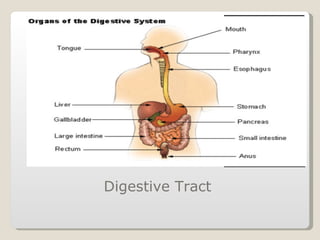
Digestive Tract
Mouth/ Oral Cavity  Receives Food Breaks food into smaller particles by chewing Salivary glands in the mouth secrete saliva to help lubricate the food  Saliva also has a digestive enzyme named Salivary amylase, which jump starts starch digestion  Tongue aids in chewing and swallowing and is a muscular organ, that contains taste buds that differentiate taste of different foods.
Teeth Also housed in the mouth/oral cavity.  32  in a complete set for adults  Are used to break food down into smaller particles for absorption  Covered in enamel the hardest substance in body to keep
Pharynx/ Throat  Separated into parts  Oropharynx-  contains the tonsils and is visible when you look into the mouth Nasopharynx – upward to the nasal cavity  Laryngeal Pharynx-  Downward Extend  The Tongue pushes food into the pharynx, swallowing is involuntary and happens quickly  Soft Palate and uvula raise to prevent food from entering nose cavity Food enters Esophagus
Esophagus  Muscular Tube Measuring about 25 cm  No additional digestion occurs in the esophagus  Food is lubricated with mucus and moved by peristalsis into the stomach  Must pass through the Esophageal Hiatus located in the Diaphragm before connecting with the stomach
Stomach  J Shaped organ in upper left region of the abdominal cavity. Has an Angled layer that aids in the grinding of food and mixing of digestive juices.  Contains Sphincters that regulate the size of the opening  Pylorus-  Leads to the sphincter that regulates how fast food moves into the small intestines  Functions as a digestive organ, churn, and storage pouch. Can stretch to hold one half of a gallon of food or water Gastric Juice formed by special cells in the lining of the stomach
Stomach Cont. Active components of Gastric Juice are : Hydrochloric acid- strong acid that helps break down protein and destroy foreign organisms  Pepsin- Inactive form of protein digesting enzyme only activated when food enters stomach and HCl is produced Chyme- Highly Acidic , mixture of gastric juice and food that leaves stomach and enters small intestine.
The Small Intestine  Longest part of digestive tract! Larger than larger intestines but smaller in diameter average width of 2.5 cm Duodenum- first 2mcm of the small intestines  Jejunum- next 2/5 cm  Ileum- the remaining portion  Mucus protect the intestine from the highly acidic chyme from the stomach.  Most digestion occurs here, due to the juices secreted by many glands that help aid in the breakdown of carbs and proteins.  Most absorption of digested food, water, and minerals also occur here.  Microvilli- increase the surface area of absorption in the small intestines  Contains a specialized lymphatic capillary called a lacteal, which absorbs fats.
The Large Intestine  Named for its wide diameter Cecum- first part small pouch  Ileocecal valve- between the ileum of the small intestines a sphincter that prevents food from traveling backward into the small intestines  Veriform- blind tube containing lymphoid tissue Contains the colon that empty in the rectum  Rectum- temporary storage area for indigestible or nonabsorbable food  Narrows into the anal canal, which leads to the outside of the body called the anus
The Large Intestines Cont.  Secretes a great amount of mucus, but no enzymes. No food is digested, but some water is reabsorbed and undigested food is stored and formed into solid waste, called feces and eliminated  Propels solid waste toward the rectum , aided by voluntary contractions defecation is achieved. Contains an anal sphincter that provides voluntary control over defecation  Some bacteria that live in the colon produce vitamin k and some B complex vitamins
The Accessory Organs
The Salivary Glands  Food mixes with salvia in the mouth which moistens the food and facilitates chewing and swallowing Contains antibodies and lysozyme that help reduce bacterial growth  Contains salivary amylase which begins the digestive process by converting sugar to starch. Manufactured in 3 pairs of glands.
Liver  Body's largest glandular organ Manufactures bile- substance needed for digestion of fats  Stores Glycogen and coverts it to glucose to restore normal blood sugar levels  Stores some vitamins and iron  Destruction of red blood cells and recycling or elimination of their breakdown products Synthesis of urea- waste product of protein metabolism Detoxification of harmful substances such as alcohol and drugs The main digestive function of the liver is the production of bile, breaks fats into smaller droplets that can be acted upon by digestive enzymes
The Gallbladder  Muscular sac on the inferior surface the liver that stores bile Contracts and squeezes bile through the cystic duct and into the common bile duct, when chyme enters the duodenum Stores bile because the body only needs it a few times a day.
The Pancreas  Long gland that extends from the duodenum to the spleen  Produces enzymes that digest fats, proteins, carbohydrates, and nucleic acids Protein digesting enzymes  are produced in inactive form and must be converted into active forms in the small intestines  Produces Alkaline fluid, that balances the acidic chyme protecting the lining of the SI Can also function as an endocrine gland, producing insulin and glucagon to regulate sugar metabolism
Enzymes/ Water Enzymes are proteins that are catalyst, that speed the rate of chemical reactions Highly Specific in its action  Water – is added to nutrient molecules as they are split by enzymes.  Hydrolysis- digestion by water  7 liters of water are secreted into the digestive tract each day, in addition to 2 liters taken in with food and drink Helps dilute food to move more easily through tract
Hormones Active In Digestion  Gastrin- Stimulates release of gastric Juice Gastric-Inhibitory Peptide- Stimulates insulin release from pancreas when glucose enters duodenum; inhibits release of gastric juice  Secretin- Stimulates release of water and bicarbonate from pancreas, stimulates release of bile from liver: inhibits the stomach Cholecystokinin- Stimulates release of digestive enzymes from pancreas, stimulates release of bile from gallbladder inhibits the stomach.

Digestive System Walkthrough Powerpoint

  • 1.
    Digestive System Walkthrough November 18 2008 Mark Ealy
  • 2.
  • 3.
    Digestion andits 3 Functions Digestion is the process of breaking larger food particles into smaller particles that can pass through the plasma membrane . Every cell in the body needs nutrients Absorption- The circulation of nutrients in the body Elimination- Undigested waste material
  • 4.
  • 5.
    Mouth/ Oral Cavity Receives Food Breaks food into smaller particles by chewing Salivary glands in the mouth secrete saliva to help lubricate the food Saliva also has a digestive enzyme named Salivary amylase, which jump starts starch digestion Tongue aids in chewing and swallowing and is a muscular organ, that contains taste buds that differentiate taste of different foods.
  • 6.
    Teeth Also housedin the mouth/oral cavity. 32 in a complete set for adults Are used to break food down into smaller particles for absorption Covered in enamel the hardest substance in body to keep
  • 7.
    Pharynx/ Throat Separated into parts Oropharynx- contains the tonsils and is visible when you look into the mouth Nasopharynx – upward to the nasal cavity Laryngeal Pharynx- Downward Extend The Tongue pushes food into the pharynx, swallowing is involuntary and happens quickly Soft Palate and uvula raise to prevent food from entering nose cavity Food enters Esophagus
  • 8.
    Esophagus MuscularTube Measuring about 25 cm No additional digestion occurs in the esophagus Food is lubricated with mucus and moved by peristalsis into the stomach Must pass through the Esophageal Hiatus located in the Diaphragm before connecting with the stomach
  • 9.
    Stomach JShaped organ in upper left region of the abdominal cavity. Has an Angled layer that aids in the grinding of food and mixing of digestive juices. Contains Sphincters that regulate the size of the opening Pylorus- Leads to the sphincter that regulates how fast food moves into the small intestines Functions as a digestive organ, churn, and storage pouch. Can stretch to hold one half of a gallon of food or water Gastric Juice formed by special cells in the lining of the stomach
  • 10.
    Stomach Cont. Activecomponents of Gastric Juice are : Hydrochloric acid- strong acid that helps break down protein and destroy foreign organisms Pepsin- Inactive form of protein digesting enzyme only activated when food enters stomach and HCl is produced Chyme- Highly Acidic , mixture of gastric juice and food that leaves stomach and enters small intestine.
  • 11.
    The Small Intestine Longest part of digestive tract! Larger than larger intestines but smaller in diameter average width of 2.5 cm Duodenum- first 2mcm of the small intestines Jejunum- next 2/5 cm Ileum- the remaining portion Mucus protect the intestine from the highly acidic chyme from the stomach. Most digestion occurs here, due to the juices secreted by many glands that help aid in the breakdown of carbs and proteins. Most absorption of digested food, water, and minerals also occur here. Microvilli- increase the surface area of absorption in the small intestines Contains a specialized lymphatic capillary called a lacteal, which absorbs fats.
  • 12.
    The Large Intestine Named for its wide diameter Cecum- first part small pouch Ileocecal valve- between the ileum of the small intestines a sphincter that prevents food from traveling backward into the small intestines Veriform- blind tube containing lymphoid tissue Contains the colon that empty in the rectum Rectum- temporary storage area for indigestible or nonabsorbable food Narrows into the anal canal, which leads to the outside of the body called the anus
  • 13.
    The Large IntestinesCont. Secretes a great amount of mucus, but no enzymes. No food is digested, but some water is reabsorbed and undigested food is stored and formed into solid waste, called feces and eliminated Propels solid waste toward the rectum , aided by voluntary contractions defecation is achieved. Contains an anal sphincter that provides voluntary control over defecation Some bacteria that live in the colon produce vitamin k and some B complex vitamins
  • 14.
  • 15.
    The Salivary Glands Food mixes with salvia in the mouth which moistens the food and facilitates chewing and swallowing Contains antibodies and lysozyme that help reduce bacterial growth Contains salivary amylase which begins the digestive process by converting sugar to starch. Manufactured in 3 pairs of glands.
  • 16.
    Liver Body'slargest glandular organ Manufactures bile- substance needed for digestion of fats Stores Glycogen and coverts it to glucose to restore normal blood sugar levels Stores some vitamins and iron Destruction of red blood cells and recycling or elimination of their breakdown products Synthesis of urea- waste product of protein metabolism Detoxification of harmful substances such as alcohol and drugs The main digestive function of the liver is the production of bile, breaks fats into smaller droplets that can be acted upon by digestive enzymes
  • 17.
    The Gallbladder Muscular sac on the inferior surface the liver that stores bile Contracts and squeezes bile through the cystic duct and into the common bile duct, when chyme enters the duodenum Stores bile because the body only needs it a few times a day.
  • 18.
    The Pancreas Long gland that extends from the duodenum to the spleen Produces enzymes that digest fats, proteins, carbohydrates, and nucleic acids Protein digesting enzymes are produced in inactive form and must be converted into active forms in the small intestines Produces Alkaline fluid, that balances the acidic chyme protecting the lining of the SI Can also function as an endocrine gland, producing insulin and glucagon to regulate sugar metabolism
  • 19.
    Enzymes/ Water Enzymesare proteins that are catalyst, that speed the rate of chemical reactions Highly Specific in its action Water – is added to nutrient molecules as they are split by enzymes. Hydrolysis- digestion by water 7 liters of water are secreted into the digestive tract each day, in addition to 2 liters taken in with food and drink Helps dilute food to move more easily through tract
  • 20.
    Hormones Active InDigestion Gastrin- Stimulates release of gastric Juice Gastric-Inhibitory Peptide- Stimulates insulin release from pancreas when glucose enters duodenum; inhibits release of gastric juice Secretin- Stimulates release of water and bicarbonate from pancreas, stimulates release of bile from liver: inhibits the stomach Cholecystokinin- Stimulates release of digestive enzymes from pancreas, stimulates release of bile from gallbladder inhibits the stomach.