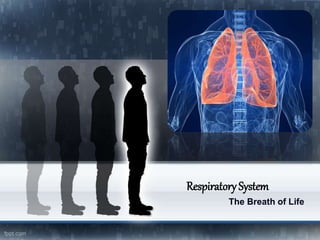
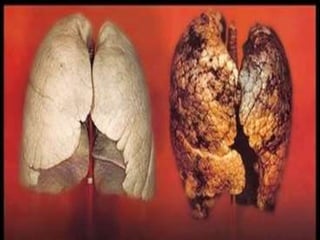
Respiratory System
The Breath of Life
Close Room
Mechanism of A Car
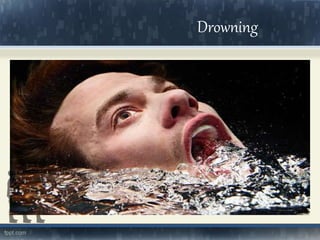
Drowning
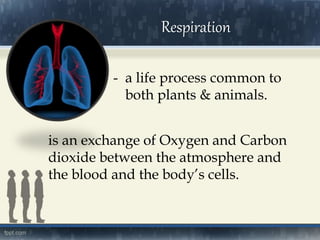
Respiration
- a life process common to
both plants & animals.
is an exchange of Oxygen and Carbon
dioxide between the atmosphere and
the blood and the body’s cells.
4 Respiration Processes
1. Breathing (ventilation)
– air in to and out of the lungs.
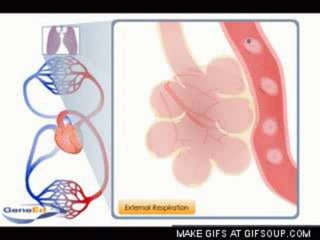
2. External respiration
– gas exchange between air and the blood.
3. Internal respiration
– gas exchange between blood and tissues.
4. Cellular respiration
– oxygen used to produce ATP, carbon dioxide
as waste.
Breathing vs. Respiration
Breathing = Inspiration + Expiration
– intake of air/inhale to bring fresh
supply of oxygen.
– breathing out of air/exhale to get rid of
CO2
Respiration – process of gas exchange
between various body compartments
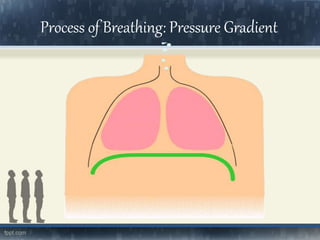
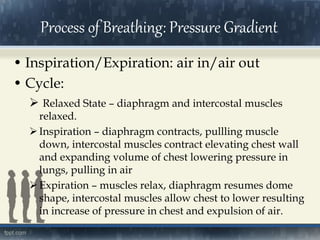
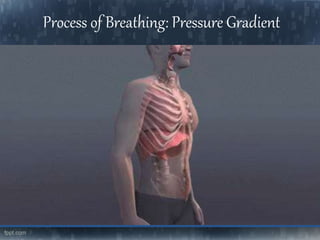
Process of Breathing: Pressure Gradient
• Inspiration/Expiration: air in/air out
• Cycle:
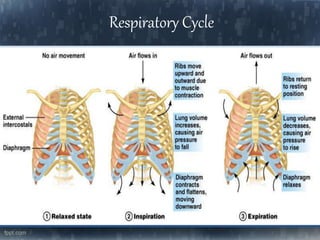
 Relaxed State – diaphragm and intercostal muscles
relaxed.
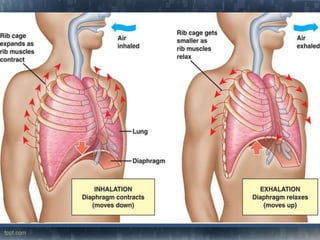
Inspiration – diaphragm contracts, pullling muscle
down, intercostal muscles contract elevating chest wall
and expanding volume of chest lowering pressure in
lungs, pulling in air
Expiration – muscles relax, diaphragm resumes dome
shape, intercostal muscles allow chest to lower resulting
in increase of pressure in chest and expulsion of air.
Respiratory Cycle
Process of Breathing: Pressure Gradient
Gas Exchange & Transport: A Passive Process
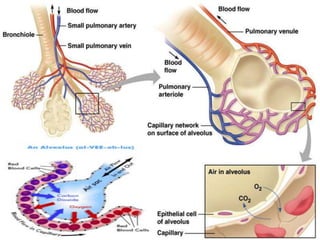
Gases diffuse according to their partial pressures.
 External Respiration – gases exchange between
air and blood
 Internal respiration – gases exchanged with
tissue fluids
 Oxygen transport – bound to hemoglobin in red
blood cells or dissolved in blood plasma
 Carbon dioxide transport – dissolved in blood
plasma, bound to hemoglobin
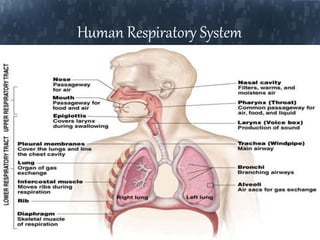
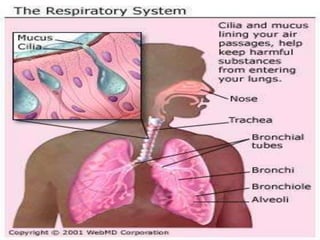
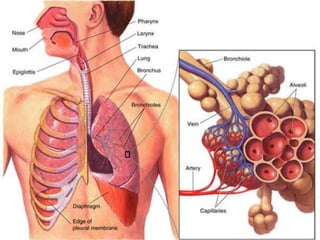
Human Respiratory System
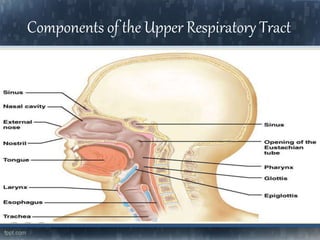
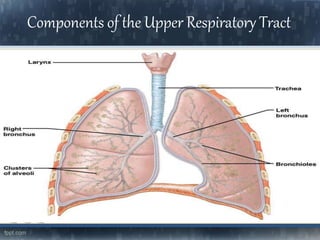
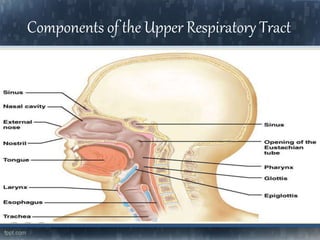
Components of the Upper Respiratory Tract
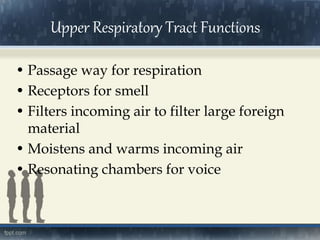
Upper Respiratory Tract Functions
• Passage way for respiration
• Receptors for smell
• Filters incoming air to filter large foreign
material
• Moistens and warms incoming air
• Resonating chambers for voice
Components of the Upper Respiratory Tract
Lower Respiratory Tract Functions
Larynx – maintains an open airway, routes
food and air appropriately, assists in
sound production
Trachea – transports air to and from lungs
Bronchi – branch into lungs
Lungs – transport air to alveoli for gas
exchange
Respiratory Organs
1. Nose
- main entrance and exit to the respiratory
system.
- connected to winding passages that warm,
moistened and filter the air as it passes through
respiratory tract.
- nostrils lined with hairs that filter out dust
- mucous membrane that sticks or traps
particles
2. Pharynx (FAIR-inks) / Throat
- passageway for both food and air
- assumes an important function in the
formation of sound particularly in the
creation of vowel sounds.
It is lined with cilia – hairlike parts that help
filter air on its way to the lungs.
Respiratory Organs
3. Larynx (LAIR-inks)/ Voicebox
- connects the pharynx with the trachea.
- its opening is at the base of the tongue.
- supported by nine pieces of cartilages; 3
are single and 3 are paired.
Thyroid cartilage – largest single piece
- Adam’s apple
Respiratory Organs
Epiglottis (ep-ih-GLOT-iss)
- a large, single leaf-shaped piece of cartilage.
- pulls down over the glottis when we swallow
to keep food or liquids from getting into the
trachea.
Glottis
- opening over the true vocal cords.
Respiratory Organs
Components of the Upper Respiratory Tract
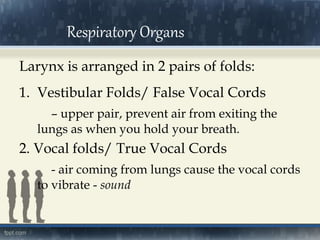
Larynx is arranged in 2 pairs of folds:
1. Vestibular Folds/ False Vocal Cords
– upper pair, prevent air from exiting the
lungs as when you hold your breath.
2. Vocal folds/ True Vocal Cords
- air coming from lungs cause the vocal cords
to vibrate - sound
Respiratory Organs
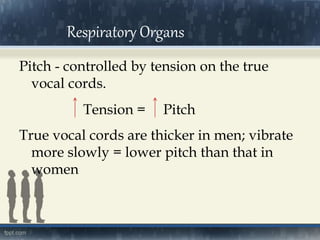
Pitch - controlled by tension on the true
vocal cords.
Tension = Pitch
True vocal cords are thicker in men; vibrate
more slowly = lower pitch than that in
women
Respiratory Organs
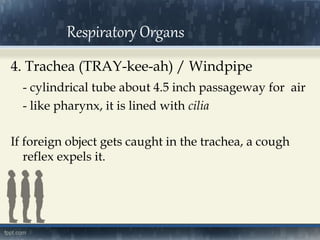
4. Trachea (TRAY-kee-ah) / Windpipe
- cylindrical tube about 4.5 inch passageway for air
- like pharynx, it is lined with cilia
If foreign object gets caught in the trachea, a cough
reflex expels it.
Respiratory Organs
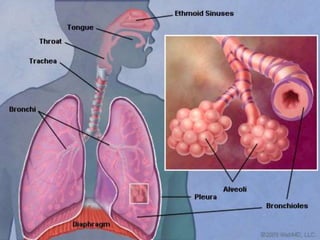
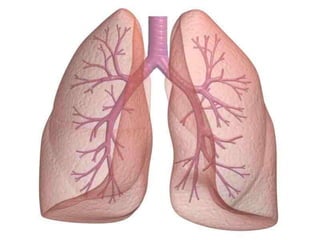
5. Bronchi (BRAHN-kigh)
- divided into 2 primary bronchi; left & right
- passageway going through the lungs
- branch into smaller branches called Bronchioles
Respiratory Organs
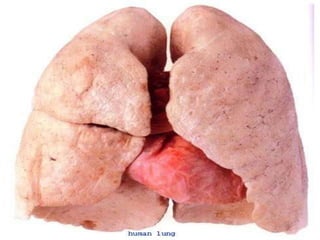
Lungs
Pleural membrane – encloses and protects each lung
- contains lubricating fluid to prevent friction as
lungs expand and contract during breathing.
Alveoli
Respiratory Organs
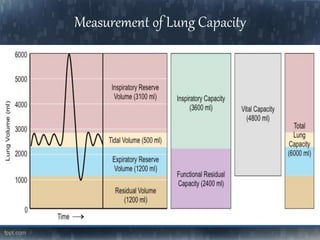
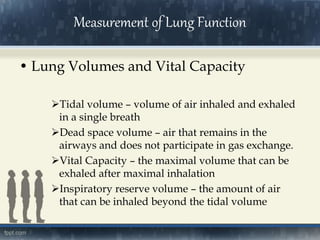
Measurement of Lung Capacity
• Lung Volumes and Vital Capacity
Tidal volume – volume of air inhaled and exhaled
in a single breath
Dead space volume – air that remains in the
airways and does not participate in gas exchange.
Vital Capacity – the maximal volume that can be
exhaled after maximal inhalation
Inspiratory reserve volume – the amount of air
that can be inhaled beyond the tidal volume
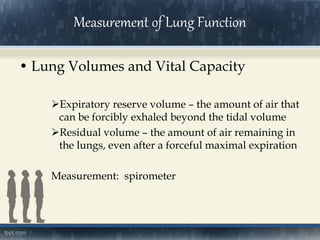
Measurement of Lung Function
• Lung Volumes and Vital Capacity
Expiratory reserve volume – the amount of air that
can be forcibly exhaled beyond the tidal volume
Residual volume – the amount of air remaining in
the lungs, even after a forceful maximal expiration
Measurement: spirometer
Measurement of Lung Function
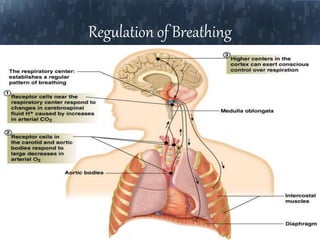
Regulation of Breathing
• Respiratory center in the medulla oblongata
- establishes basic breathing pattern
• Chemical receptors
- monitor carbon dioxide, hydrogen ions, and
oxygen levels
• Medulla
- sensitive to hydrogen ions in cerebrospinal
fluid resulting from carbon dioxide in blood
Regulation of Breathing: Nervous System
Involvement
• Carotid and aortic bodies
- sensitive to carbon dioxide, pH, and oxygen
levels
• Conscious control
– resides in higher brain centers; ability to
modify breath is limited
Regulation of Breathing: Nervous System
Involvement
1. Cough – is a mechanism for clearing
obstruction of the air.
2. Sneeze – described as an upper respiratory
cough. More and more air is inspired and the
air is expelled with and explosive force.
3. Hiccup – Spasmodic contraction of the
diaphragm, resulting from stimulation in the
diaphragm itself or in respiratory center of the
brain.
4. Yawn – aids respiratory by more completely
ventilating the lung.
Respiratory Phenomena
Disorders of Respiratory System
• Reduced air flow: Asthma, Emphysema,
Bronchitis
• Infections: pneumonia, tuberculosis,
botulism
• Lung Cancer
• Congestive Heart Failure
• Cystic fibrosis
• Asthma
– Respiratory pathways become irritated and
bronchioles constricted
• Emphysema
– Alveoli break down, resulting in reduced in
surface area needed for gas exchange with
alveoli’s blood capillaries
• Bronchitis
– Respiratory pathways become infected
resulting in coughing and production of mucus
Disorders of Respiratory System
• Tuberculosis
– a specific bacterium infects the lungs – less
elasticity of the capillaries surrounding alveoli
 decreasing effective gas exchange bet. air &
blood
Disorders of Respiratory System
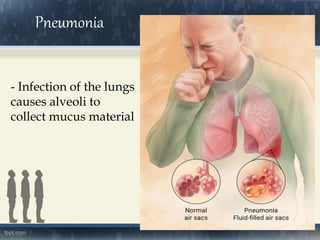
Pneumonia
- Infection of the lungs
causes alveoli to
collect mucus material
• Lung Cancer
– Uncontrolled cell growth in lung tissue –
persistent cough, shortness of breath,
bronchitis or pneumonia and even death.
Disorders of Respiratory System
Respiratory system
Respiratory system

Respiratory system

  • 1.
  • 2.
  • 3.
  • 4.
  • 5.
    Respiration - a lifeprocess common to both plants & animals. is an exchange of Oxygen and Carbon dioxide between the atmosphere and the blood and the body’s cells.
  • 6.
    4 Respiration Processes 1.Breathing (ventilation) – air in to and out of the lungs. 2. External respiration – gas exchange between air and the blood. 3. Internal respiration – gas exchange between blood and tissues. 4. Cellular respiration – oxygen used to produce ATP, carbon dioxide as waste.
  • 7.
    Breathing vs. Respiration Breathing= Inspiration + Expiration – intake of air/inhale to bring fresh supply of oxygen. – breathing out of air/exhale to get rid of CO2 Respiration – process of gas exchange between various body compartments
  • 8.
    Process of Breathing:Pressure Gradient
  • 9.
    Process of Breathing:Pressure Gradient • Inspiration/Expiration: air in/air out • Cycle:  Relaxed State – diaphragm and intercostal muscles relaxed. Inspiration – diaphragm contracts, pullling muscle down, intercostal muscles contract elevating chest wall and expanding volume of chest lowering pressure in lungs, pulling in air Expiration – muscles relax, diaphragm resumes dome shape, intercostal muscles allow chest to lower resulting in increase of pressure in chest and expulsion of air.
  • 10.
  • 12.
    Process of Breathing:Pressure Gradient
  • 13.
    Gas Exchange &Transport: A Passive Process Gases diffuse according to their partial pressures.  External Respiration – gases exchange between air and blood  Internal respiration – gases exchanged with tissue fluids  Oxygen transport – bound to hemoglobin in red blood cells or dissolved in blood plasma  Carbon dioxide transport – dissolved in blood plasma, bound to hemoglobin
  • 15.
  • 16.
    Components of theUpper Respiratory Tract
  • 17.
    Upper Respiratory TractFunctions • Passage way for respiration • Receptors for smell • Filters incoming air to filter large foreign material • Moistens and warms incoming air • Resonating chambers for voice
  • 18.
    Components of theUpper Respiratory Tract
  • 19.
    Lower Respiratory TractFunctions Larynx – maintains an open airway, routes food and air appropriately, assists in sound production Trachea – transports air to and from lungs Bronchi – branch into lungs Lungs – transport air to alveoli for gas exchange
  • 20.
    Respiratory Organs 1. Nose -main entrance and exit to the respiratory system. - connected to winding passages that warm, moistened and filter the air as it passes through respiratory tract. - nostrils lined with hairs that filter out dust - mucous membrane that sticks or traps particles
  • 21.
    2. Pharynx (FAIR-inks)/ Throat - passageway for both food and air - assumes an important function in the formation of sound particularly in the creation of vowel sounds. It is lined with cilia – hairlike parts that help filter air on its way to the lungs. Respiratory Organs
  • 23.
    3. Larynx (LAIR-inks)/Voicebox - connects the pharynx with the trachea. - its opening is at the base of the tongue. - supported by nine pieces of cartilages; 3 are single and 3 are paired. Thyroid cartilage – largest single piece - Adam’s apple Respiratory Organs
  • 24.
    Epiglottis (ep-ih-GLOT-iss) - alarge, single leaf-shaped piece of cartilage. - pulls down over the glottis when we swallow to keep food or liquids from getting into the trachea. Glottis - opening over the true vocal cords. Respiratory Organs
  • 25.
    Components of theUpper Respiratory Tract
  • 26.
    Larynx is arrangedin 2 pairs of folds: 1. Vestibular Folds/ False Vocal Cords – upper pair, prevent air from exiting the lungs as when you hold your breath. 2. Vocal folds/ True Vocal Cords - air coming from lungs cause the vocal cords to vibrate - sound Respiratory Organs
  • 28.
    Pitch - controlledby tension on the true vocal cords. Tension = Pitch True vocal cords are thicker in men; vibrate more slowly = lower pitch than that in women Respiratory Organs
  • 29.
    4. Trachea (TRAY-kee-ah)/ Windpipe - cylindrical tube about 4.5 inch passageway for air - like pharynx, it is lined with cilia If foreign object gets caught in the trachea, a cough reflex expels it. Respiratory Organs
  • 31.
    5. Bronchi (BRAHN-kigh) -divided into 2 primary bronchi; left & right - passageway going through the lungs - branch into smaller branches called Bronchioles Respiratory Organs
  • 32.
    Lungs Pleural membrane –encloses and protects each lung - contains lubricating fluid to prevent friction as lungs expand and contract during breathing. Alveoli Respiratory Organs
  • 36.
  • 37.
    • Lung Volumesand Vital Capacity Tidal volume – volume of air inhaled and exhaled in a single breath Dead space volume – air that remains in the airways and does not participate in gas exchange. Vital Capacity – the maximal volume that can be exhaled after maximal inhalation Inspiratory reserve volume – the amount of air that can be inhaled beyond the tidal volume Measurement of Lung Function
  • 38.
    • Lung Volumesand Vital Capacity Expiratory reserve volume – the amount of air that can be forcibly exhaled beyond the tidal volume Residual volume – the amount of air remaining in the lungs, even after a forceful maximal expiration Measurement: spirometer Measurement of Lung Function
  • 39.
  • 40.
    • Respiratory centerin the medulla oblongata - establishes basic breathing pattern • Chemical receptors - monitor carbon dioxide, hydrogen ions, and oxygen levels • Medulla - sensitive to hydrogen ions in cerebrospinal fluid resulting from carbon dioxide in blood Regulation of Breathing: Nervous System Involvement
  • 41.
    • Carotid andaortic bodies - sensitive to carbon dioxide, pH, and oxygen levels • Conscious control – resides in higher brain centers; ability to modify breath is limited Regulation of Breathing: Nervous System Involvement
  • 42.
    1. Cough –is a mechanism for clearing obstruction of the air. 2. Sneeze – described as an upper respiratory cough. More and more air is inspired and the air is expelled with and explosive force. 3. Hiccup – Spasmodic contraction of the diaphragm, resulting from stimulation in the diaphragm itself or in respiratory center of the brain. 4. Yawn – aids respiratory by more completely ventilating the lung. Respiratory Phenomena
  • 43.
    Disorders of RespiratorySystem • Reduced air flow: Asthma, Emphysema, Bronchitis • Infections: pneumonia, tuberculosis, botulism • Lung Cancer • Congestive Heart Failure • Cystic fibrosis
  • 44.
    • Asthma – Respiratorypathways become irritated and bronchioles constricted • Emphysema – Alveoli break down, resulting in reduced in surface area needed for gas exchange with alveoli’s blood capillaries • Bronchitis – Respiratory pathways become infected resulting in coughing and production of mucus Disorders of Respiratory System
  • 45.
    • Tuberculosis – aspecific bacterium infects the lungs – less elasticity of the capillaries surrounding alveoli  decreasing effective gas exchange bet. air & blood Disorders of Respiratory System
  • 46.
    Pneumonia - Infection ofthe lungs causes alveoli to collect mucus material
  • 47.
    • Lung Cancer –Uncontrolled cell growth in lung tissue – persistent cough, shortness of breath, bronchitis or pneumonia and even death. Disorders of Respiratory System