The
respiratory
System
Prepared by Mickelder Kercy, MD - Instructor
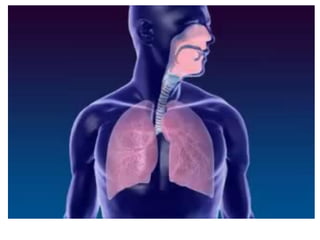
Upper Respiratory Tract : Nose, Paranasal
Sinuses, Pharynx(throat), Larynx(voice box)
and Trachea(Windpipe)
Lower Respiratory Tract : Bronchi, Bronchioles,
Alveolar Ducts, Alveolar Sacs
Organs of the Respiratory System
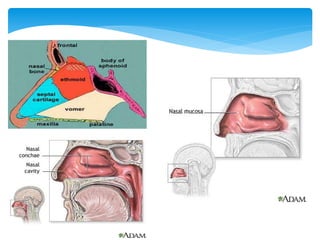
Divided into the 2 nares/nostrils by the septum
Septum has on each lateral wall a superior,
middle and inferior concha
The mucous membrane lines the conchae
The Nose
Drains fluid from the frontal sinuses, ethmoidal
sinuses, sphenoidal sinuses and the maxillary
sinuses
Drains fluid from the eyes through the nasolacrimal
duct
Serves as a passageway for air (nares)
Warms and moistens inhaled air (conchae)
Traps dust, pollen and other foreign matter with
hair-like projections (cilia) and mucous (mucous
membrane)
Functions of the Nose
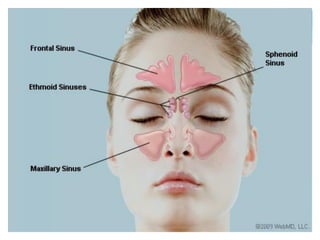
Air-filled spaces located within the bones of the
skull and face
Four sets of paired sinuses exist: Frontal,
Ethmoid, Sphenoid and Maxillary
Paranasal Sinuses
Lightens the weight of the head
Humidifies and heats inhaled air
Assist in the making of sounds for speaking and
singing by increasing resonance
 Serves as a crumple zone to protect vital
structures in the event of facial trauma
Functions of the Paranasal Sinuses
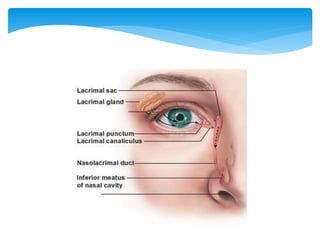
Lacrimal System
Lacrimal gland (secretes the tears)
Excretory ducts (drain the tears to the surface of
the eye)
 Lacrimal canaliculi, the lacrimal sac, and the
nasolacrimal duct (drain the tears to the nares)
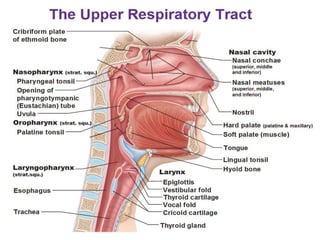
Connects the base of the skull to the trachea and
esophagus
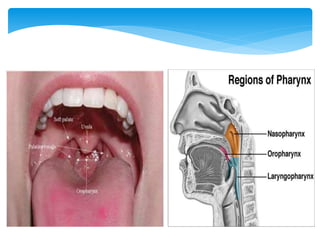
Divided into the Nasopharynx, oropharynx and
laryngopharynx
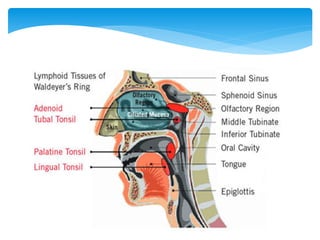
Contains the pharyngeal, palatine & lingual
tonsils/adenoids and the uvula
Pharynx
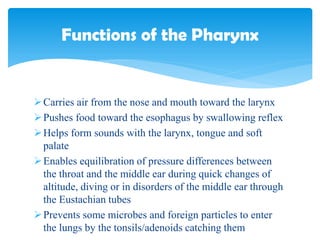
Carries air from the nose and mouth toward the larynx
Pushes food toward the esophagus by swallowing reflex
Helps form sounds with the larynx, tongue and soft
palate
Enables equilibration of pressure differences between
the throat and the middle ear during quick changes of
altitude, diving or in disorders of the middle ear through
the Eustachian tubes
Prevents some microbes and foreign particles to enter
the lungs by the tonsils/adenoids catching them
Functions of the Pharynx
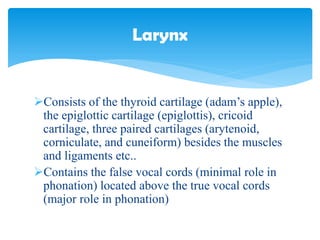
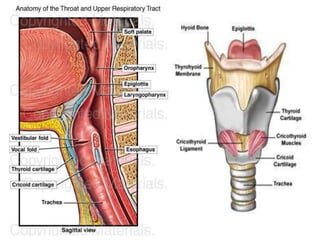
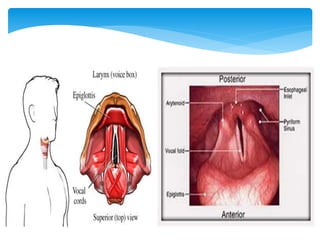
Consists of the thyroid cartilage (adam’s apple),
the epiglottic cartilage (epiglottis), cricoid
cartilage, three paired cartilages (arytenoid,
corniculate, and cuneiform) besides the muscles
and ligaments etc..
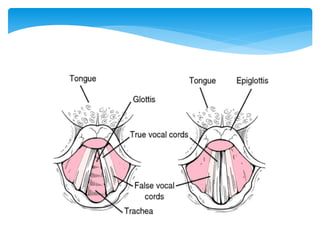
Contains the false vocal cords (minimal role in
phonation) located above the true vocal cords
(major role in phonation)
Larynx
Prevents food from entering the glottis (opening
between the vocal cords) when pulled upwards
while the epiglottis closes up the glottis
Production of vocal sounds when air passes
through the vocal cords
Functions of the Larynx
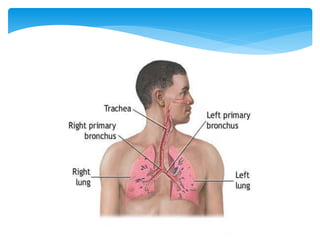
Links the larynx to the right and left bronchi
Passageway for the air entering the lungs
Trachea
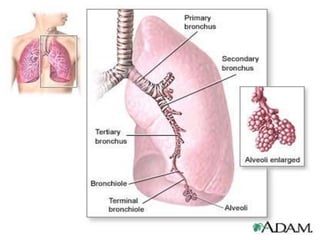
Two main branches of the trachea that extend
into the lungs
Right bronchus is wider, shorter, and more
vertical
Left bronchus is longer with a smaller caliber
They each divide into many small bronchi that
subdivide into the smaller bronchioles
Bronchi & Bronchioles
The bronchi conduct the air into the bronchioles
The bronchioles conduct the air into the alveolar
ducts
Functions of the Bronchi & Bronchioles
Mucus is a thin layer of sputum (phlegm) lining
the inside of the breathing tubes (trachea,
bronchi and bronchioles) to prevent irritants
from getting into the lungs
Cilia are little hairs lining the breathing tubes
moving the mucus from the lungs upward
toward the throat to the epiglottis that opens up
before the mucus is swallowed into the
esophagus
Cilia and Mucus
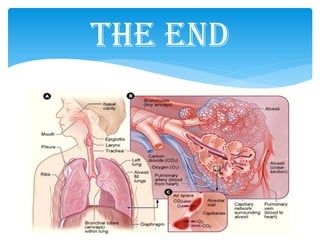
Composed of microscopic alveoli/alveolar sacs
(subdivision of the alveolar ducts)
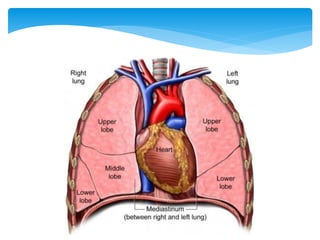
Right lung has an upper, middle and lower lobe
Left lung has an upper and lower lobe
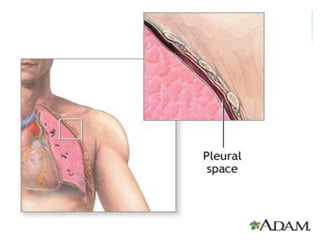
Covered by the visceral (internal) and parietal
(external) pleurae (pleural membranes)
Lungs
Gas exchange by bringing oxygen (O2) into the
body and removing carbon dioxide (CO2) from
the body
Functions of the Lungs
Produce serous fluid that cause the pleurae to
adhere closely to one another, holding the lungs
to the thoracic wall and allowing the pleural
membranes to move easily against each other
during breathing
Functions of the Pleurae
Ventilation is a process of inhalation (air moving down to
the alveoli) and exhalation (air moving out of the alveoli)
- During inhalation the diaphragm contracts
and flattens → elevation of the ribs → ↑ size of the thorax
(- pressure) as the air moves down to the alveoli
- During exhalation the diaphragm relaxes →
thorax returns to its resting size and shape (+ pressure) as
the air moves out of the alveoli
- During forceful expiration the internal and
external intercostal and abdominal muscles are involved
Mechanism of Breathing
Tidal Volume : Volume of air entering or leaving
the lungs during a single breath
Inspiratory Reserve Volume : Volume of air that
can be inhaled after a forceful inspiration
Expiratory Reserve Volume : Volume of air that
can be expelled after a forceful expiration
Residual Volume : Volume of air remaining in
the lungs after a maximal/forceful expiration
Respiratory Volumes and Capacity
Asphyxia : Suffocation resulting from the lack
of oxygen. ABG is a test used to detect the level
of oxygen and carbon dioxide in the blood
Asthma : Chronic inflammatory disease of the
bronchi caused by allergens or other irritating
substances.
Common Disorders associated with
the Respiratory System
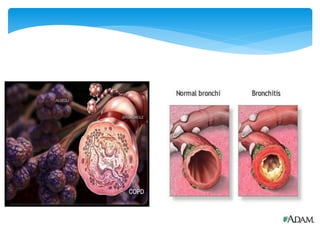
COPD : - Chronic Bronchitis (Chronic
inflammation of the mucous membrane in the
bronchial passages causing the membrane and
the mucus to thicken making it hard to breathe
(SOB) because the air cannot pass through easily.
It leads to SOB). Acute (lasting less than 6
weeks). Chronic (recurring for more than a year).
Mostly viral. Tobacco, Coal miners, grain
handlers, metal holders, dust etc…
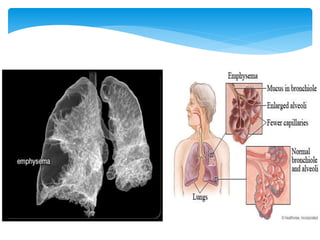
- Emphysema (Destruction of the
lung tissue around the bronchioles causing these
airways to collapse preventing the air to come out
during exhalation. The chest wall muscles have to
work harder to expel the air. There is also damage
of the walls between many of the air sacs. As a
result, the air sacs lose their shape and become
floppy causing a reduction in the amount of gas
exchange in the lungs. Tobacco, alpha-1
antitrypsin, air pollution, heredity etc..
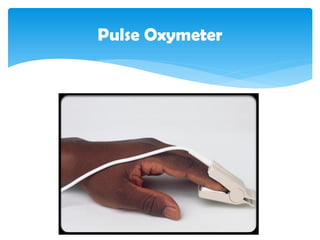
Pulse Oxymeter
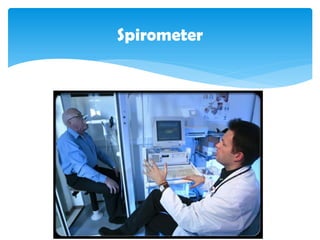
Spirometer
Common Cold : Viral infection of the upper
respiratory tract. Rhinovirus. Spread by droplets
through sneezing, coughing, and contacts and
fomites
Hay Fever : Seasonal allergic rhinitis or pollinosis.
Mucous membrane of the nose and the eyes become
inflamed
Influenza : Flu caused by viruses
Legionnaire’s Disease : Pneumonia caused by the
Legionella bacteria
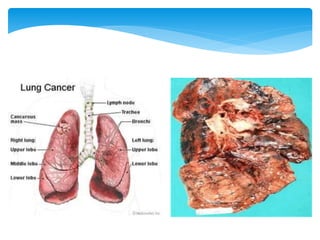
Lung Cancer : Leading cause of deaths in both
women and men in the USA. Smoking
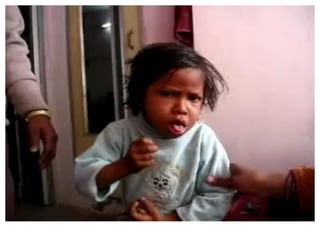
Pertussis : Whooping cough (Persistent and
severe cough) caused by the bacteria Bordetella
Pertussis
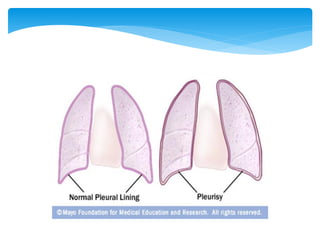
Pleurisy: Pleuritis or inflammation of the
pleurae
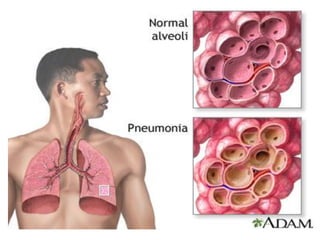
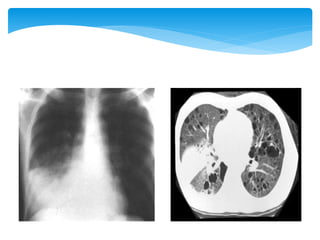
Pneumonia : Inflammation of the lungs caused
by bacteria/viruses/chemical irritants
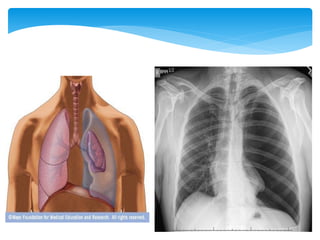
Pneumothorax : Air accumulation in the pleurae
compressing the lungs (collapsing)
Pulmonary Embolism : Blood clot in the lungs
coming from smaller vessels in the legs, pelvis
arm or heart. The clot obstructs partially or
completely the blood flow to a section of the
lung causing a pulmonary infarct
Severe Acute Respiratory syndrome : Mild to
moderate respiratory illness caused by
coronavirus
Sinusitis : Inflammation of mucous membranes
of the sinuses
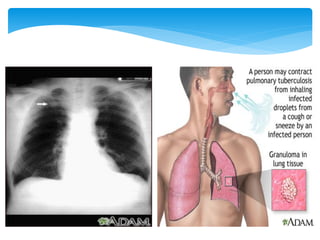
Pulmonary Tuberculosis : Pneumonia caused by
the bacteria Mycobacterium tuberculosis
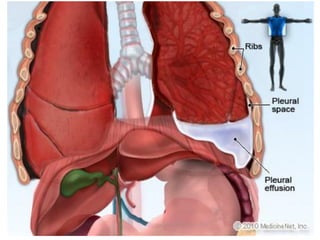
Pleural Effusion : Excessive liquid accumulating
in the space between the visceral and parietal
pleural membranes. CHF, Pneumonia, RF,
Cancer etc…
The End

The respiratory system

  • 1.
  • 2.
    Upper Respiratory Tract: Nose, Paranasal Sinuses, Pharynx(throat), Larynx(voice box) and Trachea(Windpipe) Lower Respiratory Tract : Bronchi, Bronchioles, Alveolar Ducts, Alveolar Sacs Organs of the Respiratory System
  • 3.
    Divided into the2 nares/nostrils by the septum Septum has on each lateral wall a superior, middle and inferior concha The mucous membrane lines the conchae The Nose
  • 5.
    Drains fluid fromthe frontal sinuses, ethmoidal sinuses, sphenoidal sinuses and the maxillary sinuses Drains fluid from the eyes through the nasolacrimal duct Serves as a passageway for air (nares) Warms and moistens inhaled air (conchae) Traps dust, pollen and other foreign matter with hair-like projections (cilia) and mucous (mucous membrane) Functions of the Nose
  • 6.
    Air-filled spaces locatedwithin the bones of the skull and face Four sets of paired sinuses exist: Frontal, Ethmoid, Sphenoid and Maxillary Paranasal Sinuses
  • 8.
    Lightens the weightof the head Humidifies and heats inhaled air Assist in the making of sounds for speaking and singing by increasing resonance  Serves as a crumple zone to protect vital structures in the event of facial trauma Functions of the Paranasal Sinuses
  • 9.
    Lacrimal System Lacrimal gland(secretes the tears) Excretory ducts (drain the tears to the surface of the eye)  Lacrimal canaliculi, the lacrimal sac, and the nasolacrimal duct (drain the tears to the nares)
  • 12.
    Connects the baseof the skull to the trachea and esophagus Divided into the Nasopharynx, oropharynx and laryngopharynx Contains the pharyngeal, palatine & lingual tonsils/adenoids and the uvula Pharynx
  • 15.
    Carries air fromthe nose and mouth toward the larynx Pushes food toward the esophagus by swallowing reflex Helps form sounds with the larynx, tongue and soft palate Enables equilibration of pressure differences between the throat and the middle ear during quick changes of altitude, diving or in disorders of the middle ear through the Eustachian tubes Prevents some microbes and foreign particles to enter the lungs by the tonsils/adenoids catching them Functions of the Pharynx
  • 16.
    Consists of thethyroid cartilage (adam’s apple), the epiglottic cartilage (epiglottis), cricoid cartilage, three paired cartilages (arytenoid, corniculate, and cuneiform) besides the muscles and ligaments etc.. Contains the false vocal cords (minimal role in phonation) located above the true vocal cords (major role in phonation) Larynx
  • 20.
    Prevents food fromentering the glottis (opening between the vocal cords) when pulled upwards while the epiglottis closes up the glottis Production of vocal sounds when air passes through the vocal cords Functions of the Larynx
  • 22.
    Links the larynxto the right and left bronchi Passageway for the air entering the lungs Trachea
  • 24.
    Two main branchesof the trachea that extend into the lungs Right bronchus is wider, shorter, and more vertical Left bronchus is longer with a smaller caliber They each divide into many small bronchi that subdivide into the smaller bronchioles Bronchi & Bronchioles
  • 26.
    The bronchi conductthe air into the bronchioles The bronchioles conduct the air into the alveolar ducts Functions of the Bronchi & Bronchioles
  • 27.
    Mucus is athin layer of sputum (phlegm) lining the inside of the breathing tubes (trachea, bronchi and bronchioles) to prevent irritants from getting into the lungs Cilia are little hairs lining the breathing tubes moving the mucus from the lungs upward toward the throat to the epiglottis that opens up before the mucus is swallowed into the esophagus Cilia and Mucus
  • 28.
    Composed of microscopicalveoli/alveolar sacs (subdivision of the alveolar ducts) Right lung has an upper, middle and lower lobe Left lung has an upper and lower lobe Covered by the visceral (internal) and parietal (external) pleurae (pleural membranes) Lungs
  • 32.
    Gas exchange bybringing oxygen (O2) into the body and removing carbon dioxide (CO2) from the body Functions of the Lungs
  • 33.
    Produce serous fluidthat cause the pleurae to adhere closely to one another, holding the lungs to the thoracic wall and allowing the pleural membranes to move easily against each other during breathing Functions of the Pleurae
  • 35.
    Ventilation is aprocess of inhalation (air moving down to the alveoli) and exhalation (air moving out of the alveoli) - During inhalation the diaphragm contracts and flattens → elevation of the ribs → ↑ size of the thorax (- pressure) as the air moves down to the alveoli - During exhalation the diaphragm relaxes → thorax returns to its resting size and shape (+ pressure) as the air moves out of the alveoli - During forceful expiration the internal and external intercostal and abdominal muscles are involved Mechanism of Breathing
  • 37.
    Tidal Volume :Volume of air entering or leaving the lungs during a single breath Inspiratory Reserve Volume : Volume of air that can be inhaled after a forceful inspiration Expiratory Reserve Volume : Volume of air that can be expelled after a forceful expiration Residual Volume : Volume of air remaining in the lungs after a maximal/forceful expiration Respiratory Volumes and Capacity
  • 38.
    Asphyxia : Suffocationresulting from the lack of oxygen. ABG is a test used to detect the level of oxygen and carbon dioxide in the blood Asthma : Chronic inflammatory disease of the bronchi caused by allergens or other irritating substances. Common Disorders associated with the Respiratory System
  • 40.
    COPD : -Chronic Bronchitis (Chronic inflammation of the mucous membrane in the bronchial passages causing the membrane and the mucus to thicken making it hard to breathe (SOB) because the air cannot pass through easily. It leads to SOB). Acute (lasting less than 6 weeks). Chronic (recurring for more than a year). Mostly viral. Tobacco, Coal miners, grain handlers, metal holders, dust etc…
  • 42.
    - Emphysema (Destructionof the lung tissue around the bronchioles causing these airways to collapse preventing the air to come out during exhalation. The chest wall muscles have to work harder to expel the air. There is also damage of the walls between many of the air sacs. As a result, the air sacs lose their shape and become floppy causing a reduction in the amount of gas exchange in the lungs. Tobacco, alpha-1 antitrypsin, air pollution, heredity etc..
  • 45.
  • 46.
  • 47.
    Common Cold :Viral infection of the upper respiratory tract. Rhinovirus. Spread by droplets through sneezing, coughing, and contacts and fomites Hay Fever : Seasonal allergic rhinitis or pollinosis. Mucous membrane of the nose and the eyes become inflamed Influenza : Flu caused by viruses Legionnaire’s Disease : Pneumonia caused by the Legionella bacteria
  • 48.
    Lung Cancer :Leading cause of deaths in both women and men in the USA. Smoking
  • 50.
    Pertussis : Whoopingcough (Persistent and severe cough) caused by the bacteria Bordetella Pertussis
  • 52.
    Pleurisy: Pleuritis orinflammation of the pleurae
  • 54.
    Pneumonia : Inflammationof the lungs caused by bacteria/viruses/chemical irritants
  • 57.
    Pneumothorax : Airaccumulation in the pleurae compressing the lungs (collapsing)
  • 59.
    Pulmonary Embolism :Blood clot in the lungs coming from smaller vessels in the legs, pelvis arm or heart. The clot obstructs partially or completely the blood flow to a section of the lung causing a pulmonary infarct
  • 61.
    Severe Acute Respiratorysyndrome : Mild to moderate respiratory illness caused by coronavirus Sinusitis : Inflammation of mucous membranes of the sinuses
  • 62.
    Pulmonary Tuberculosis :Pneumonia caused by the bacteria Mycobacterium tuberculosis
  • 64.
    Pleural Effusion :Excessive liquid accumulating in the space between the visceral and parietal pleural membranes. CHF, Pneumonia, RF, Cancer etc…
  • 67.