


Research 101: Qualitative Rigor
Harold Gamero
Rigor
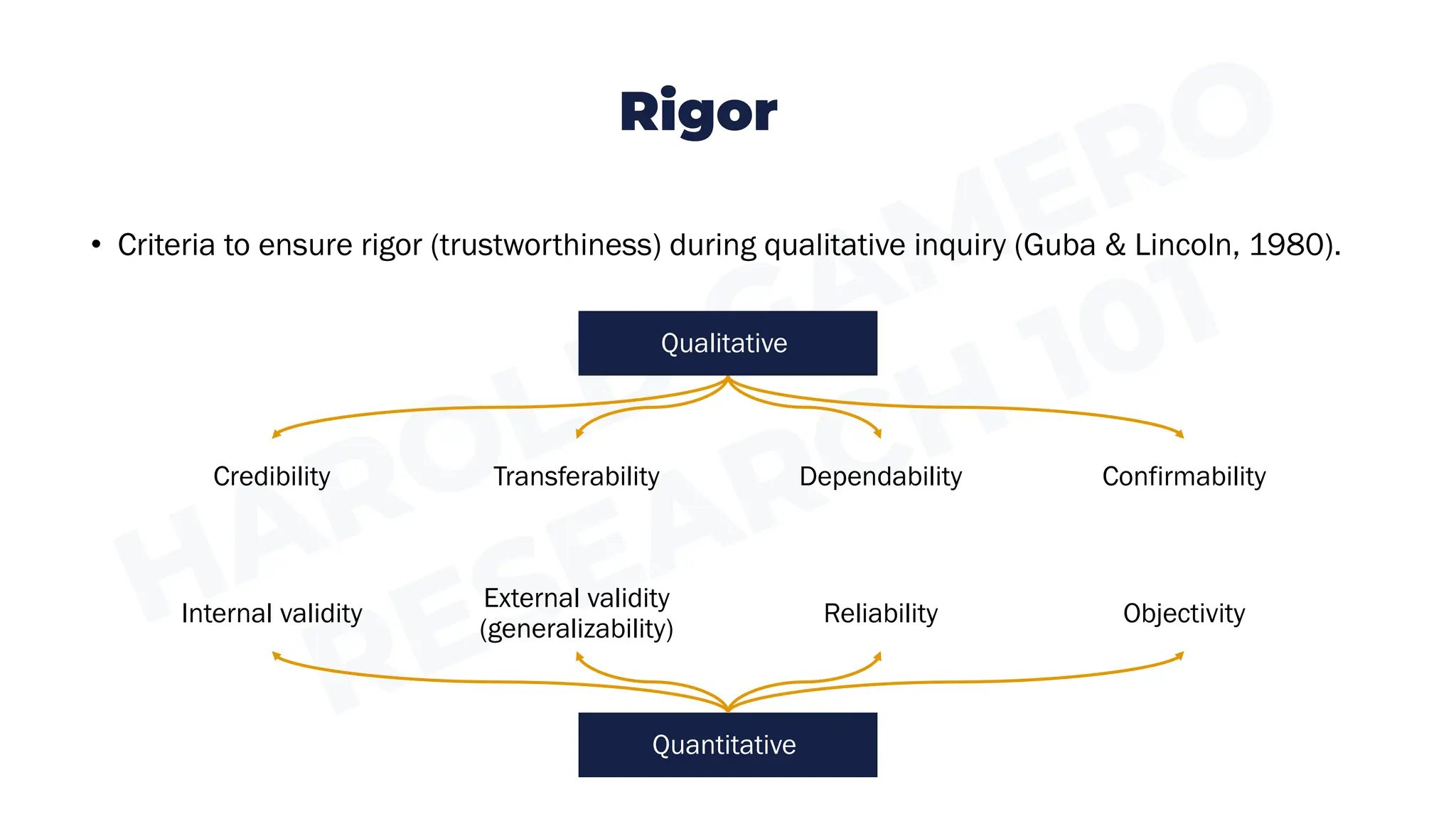
• Criteria to ensure rigor (trustworthiness) during qualitative inquiry (Guba & Lincoln, 1980).
Qualitative
Quantitative
Credibility
Internal validity
Transferability
External validity
(generalizability)
Dependability
Reliability
Confirmability
Objectivity
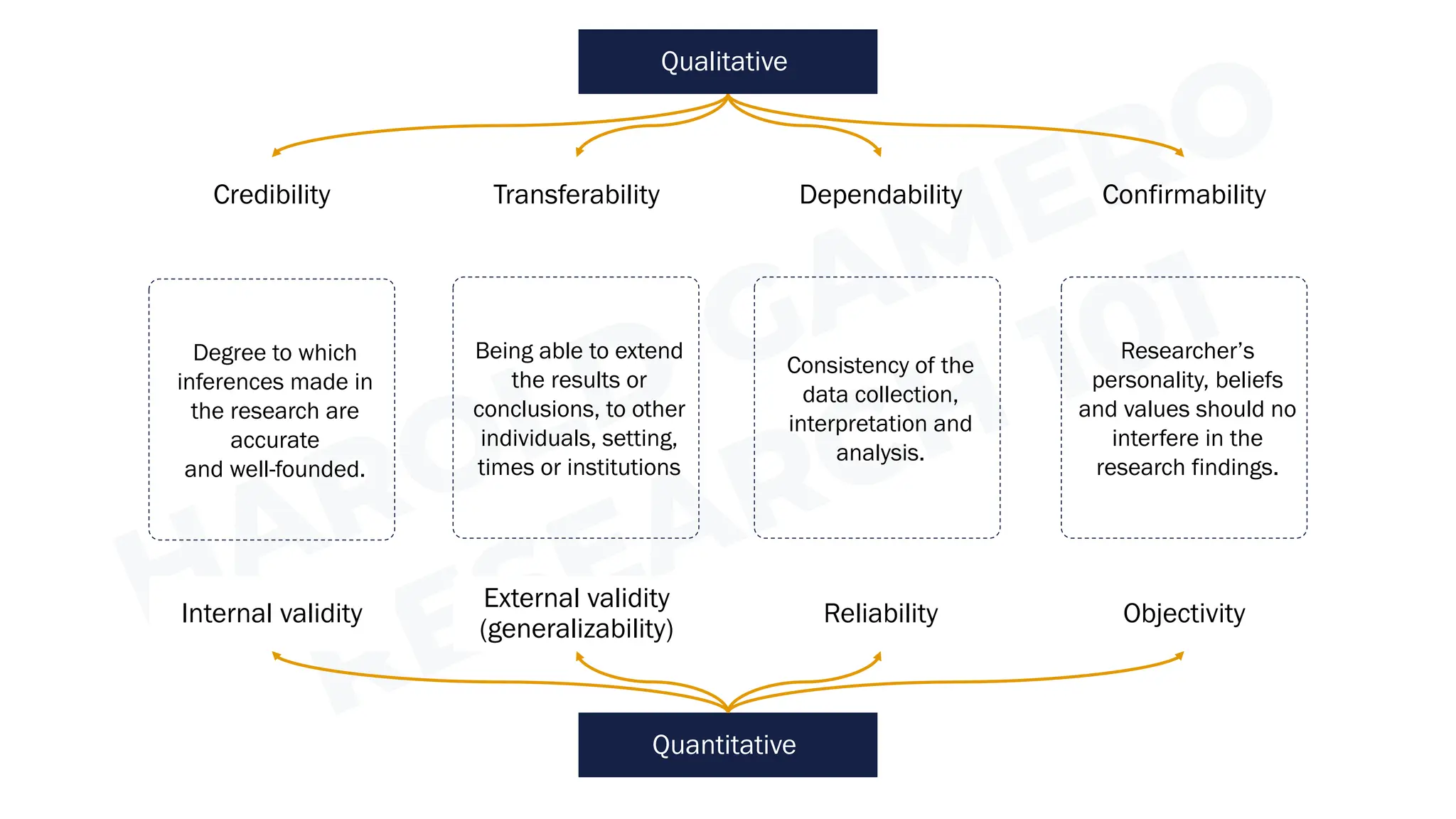
Qualitative
Transferability Dependability
Credibility Confirmability
Quantitative
External validity
(generalizability)
Reliability
Internal validity Objectivity
Degree to which
inferences made in
the research are
accurate
and well-founded.
Being able to extend
the results or
conclusions, to other
individuals, setting,
times or institutions
Consistency of the
data collection,
interpretation and
analysis.
Researcher’s
personality, beliefs
and values should no
interfere in the
research findings.
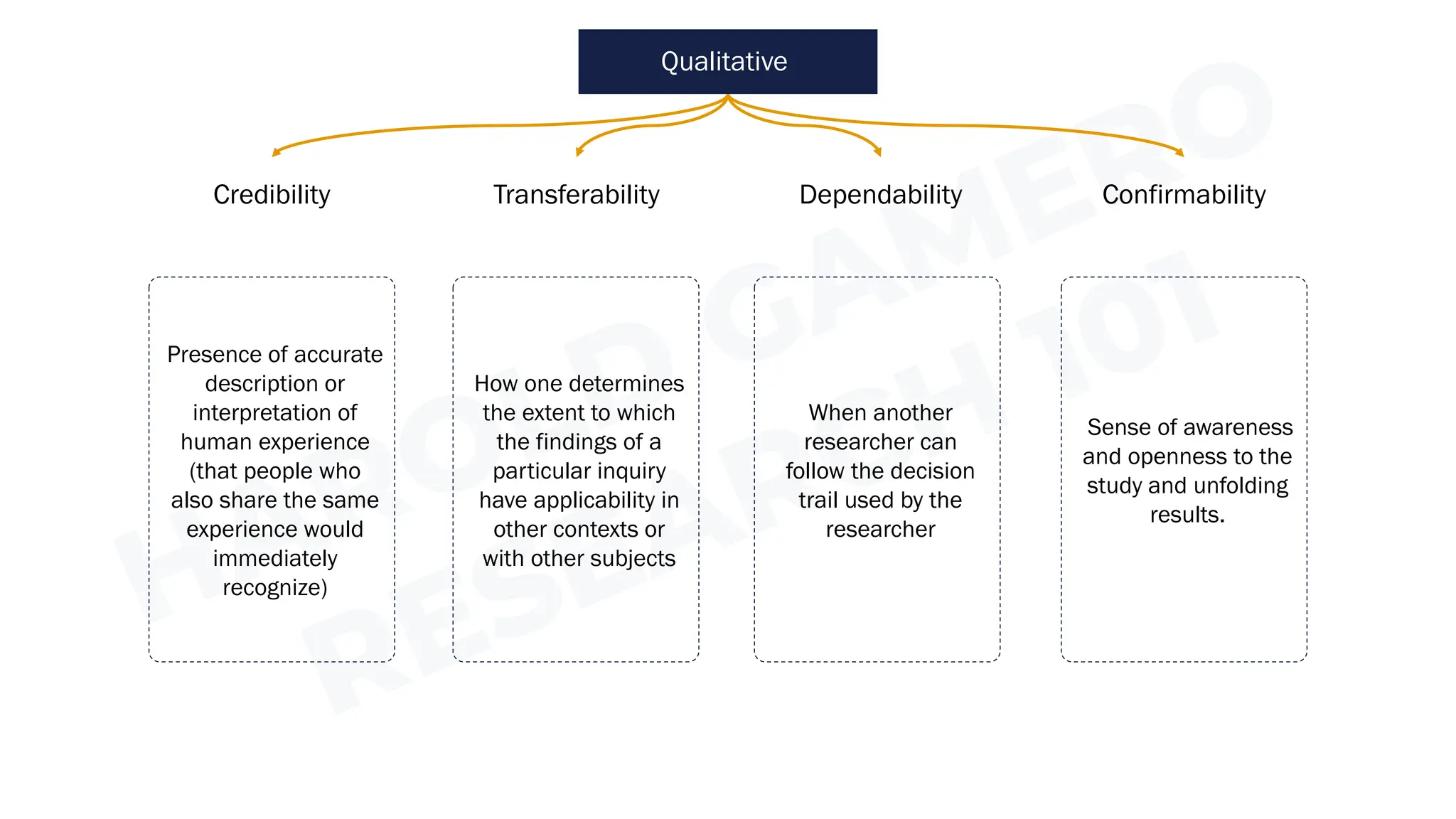
Qualitative
Transferability Dependability
Credibility Confirmability
Presence of accurate
description or
interpretation of
human experience
(that people who
also share the same
experience would
immediately
recognize)
How one determines
the extent to which
the findings of a
particular inquiry
have applicability in
other contexts or
with other subjects
When another
researcher can
follow the decision
trail used by the
researcher
Sense of awareness
and openness to the
study and unfolding
results.
Qualitative
Transferability Dependability
Credibility Confirmability
Presence of accurate
description or
interpretation of
human experience
(that people who
also share the same
experience would
immediately
recognize)
How one determines
the extent to which
the findings of a
particular inquiry
have applicability in
other contexts or
with other subjects
When another
researcher can
follow the decision
trail used by the
researcher
Sense of awareness
and openness to the
study and unfolding
results.
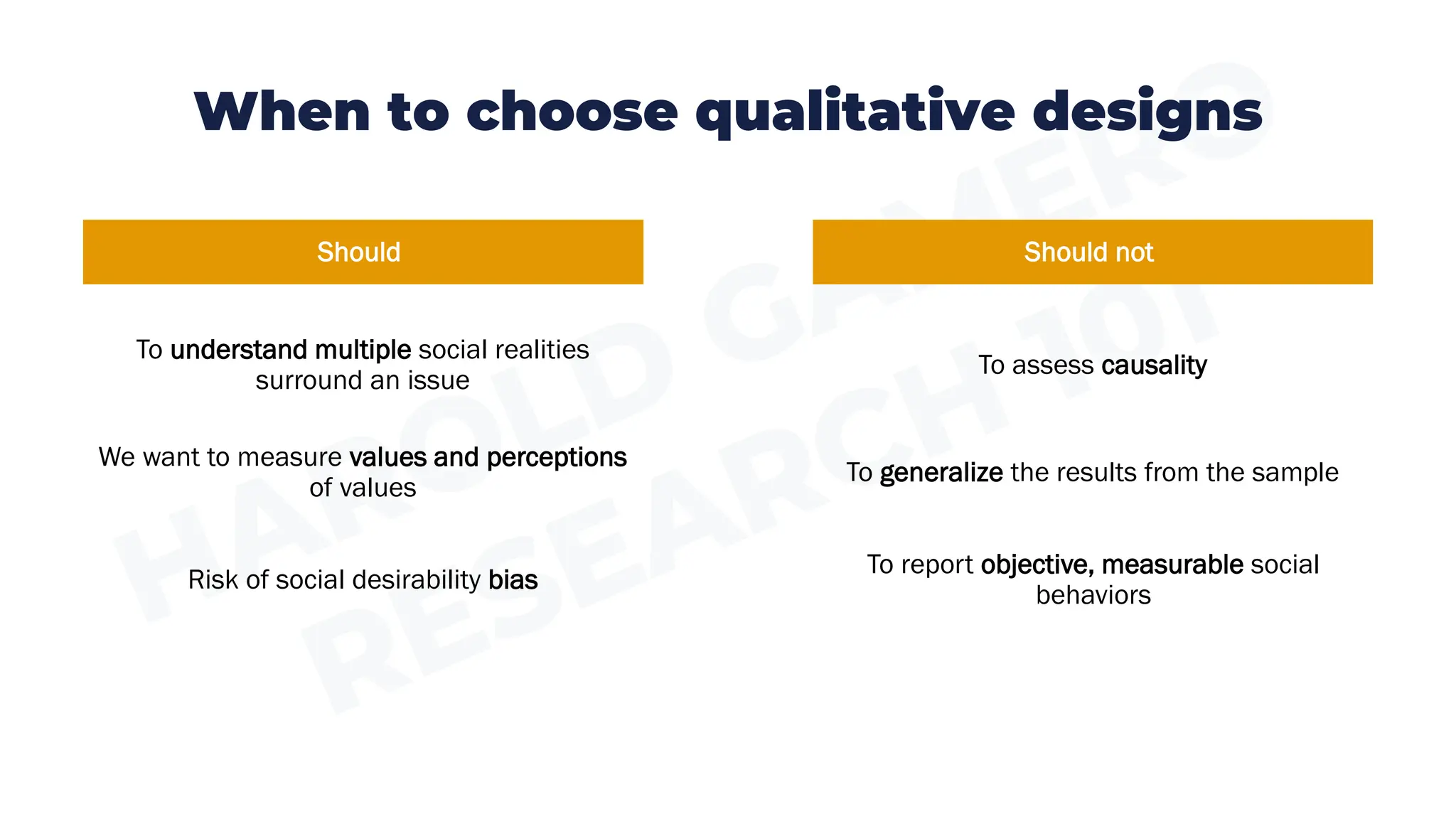
When to choose qualitative designs
To assess causality
To understand multiple social realities
surround an issue
Should not
Should
We want to measure values and perceptions
of values
Risk of social desirability bias
To generalize the results from the sample
To report objective, measurable social
behaviors
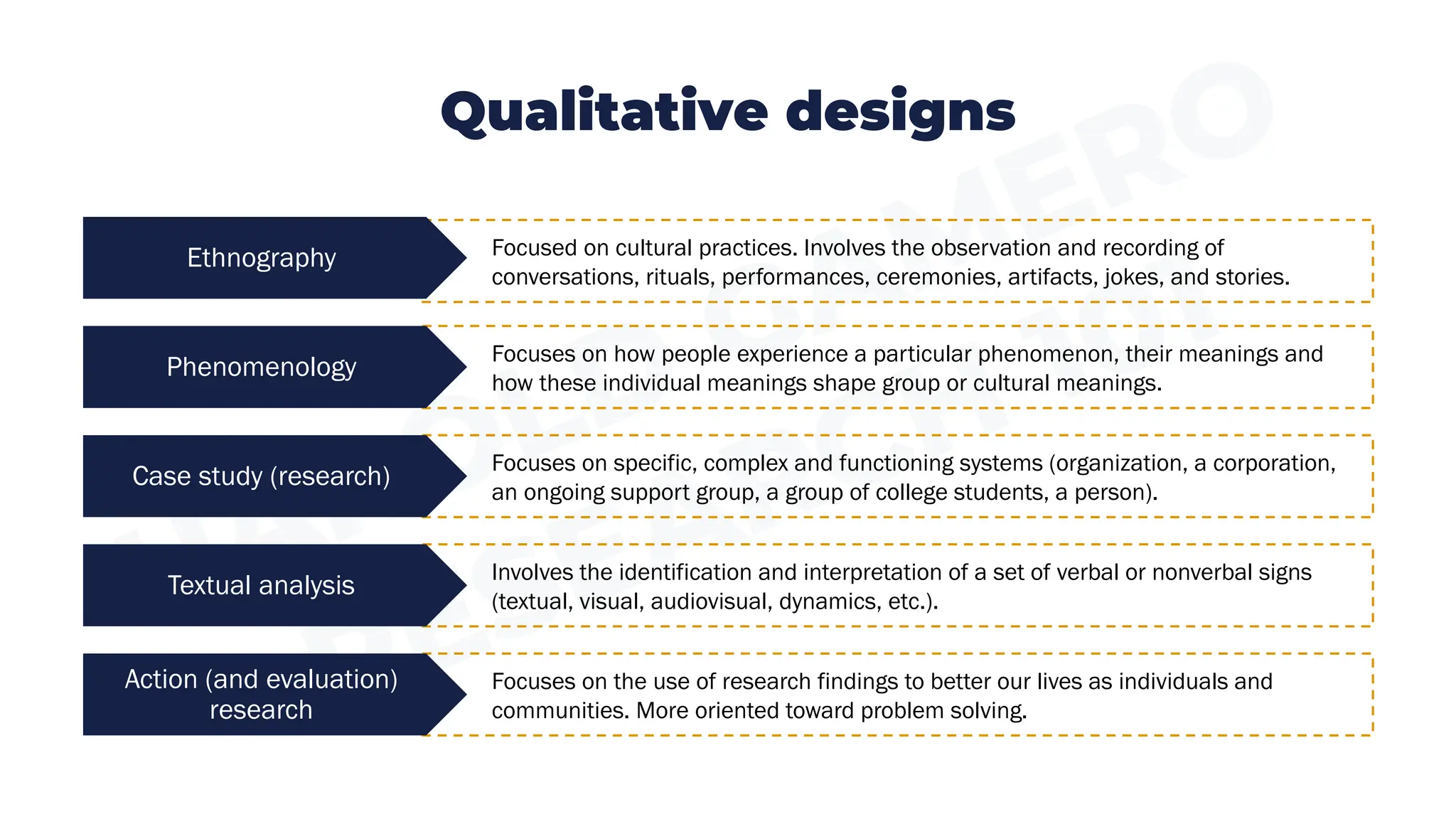
Qualitative designs
Focused on cultural practices. Involves the observation and recording of
conversations, rituals, performances, ceremonies, artifacts, jokes, and stories.
Focuses on how people experience a particular phenomenon, their meanings and
how these individual meanings shape group or cultural meanings.
Focuses on specific, complex and functioning systems (organization, a corporation,
an ongoing support group, a group of college students, a person).
Involves the identification and interpretation of a set of verbal or nonverbal signs
(textual, visual, audiovisual, dynamics, etc.).
Focuses on the use of research findings to better our lives as individuals and
communities. More oriented toward problem solving.
Phenomenology
Case study (research)
Textual analysis
Action (and evaluation)
research
Ethnography
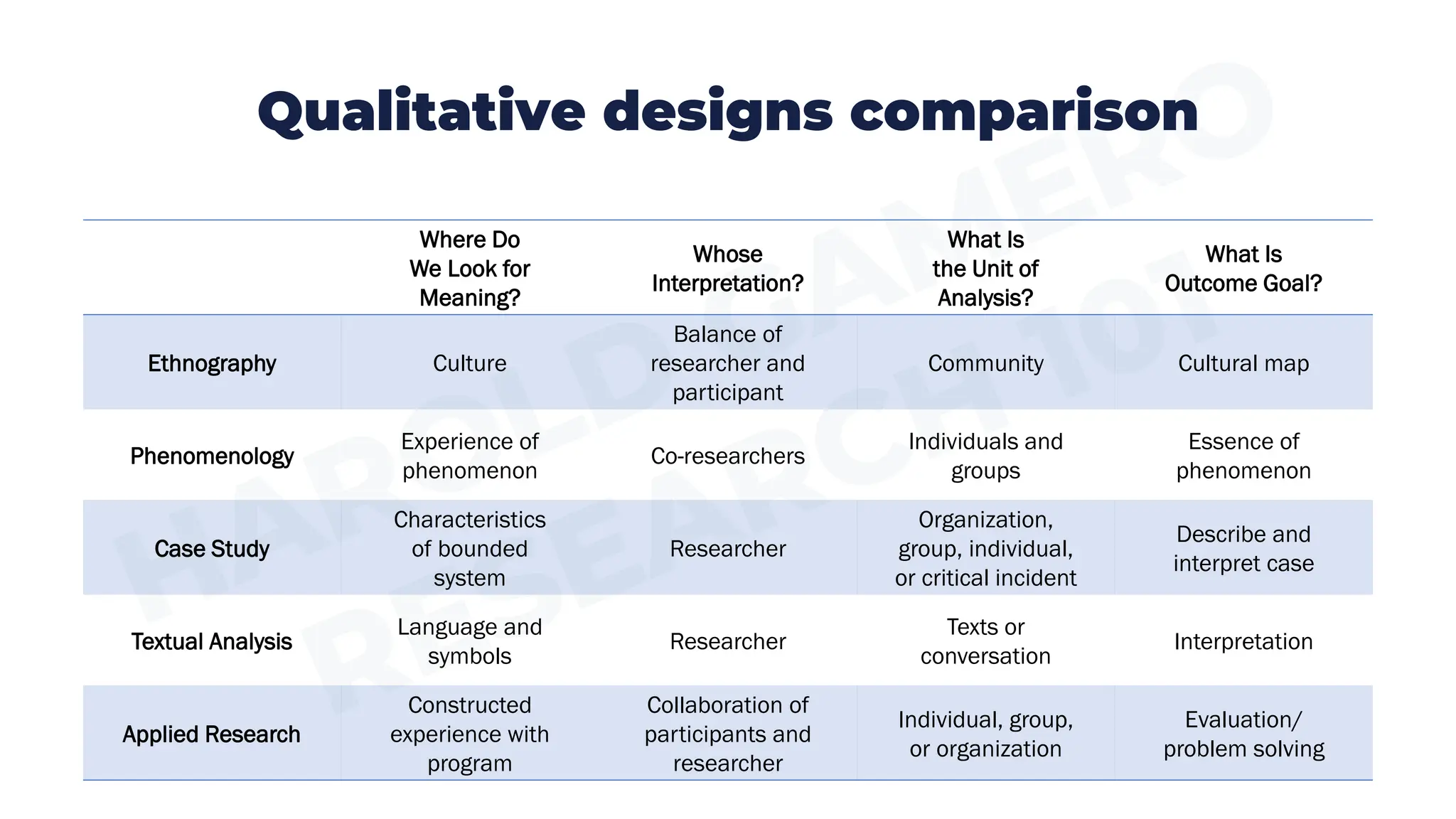
Where Do
We Look for
Meaning?
Whose
Interpretation?
What Is
the Unit of
Analysis?
What Is
Outcome Goal?
Ethnography Culture
Balance of
researcher and
participant
Community Cultural map
Phenomenology
Experience of
phenomenon
Co-researchers
Individuals and
groups
Essence of
phenomenon
Case Study
Characteristics
of bounded
system
Researcher
Organization,
group, individual,
or critical incident
Describe and
interpret case
Textual Analysis
Language and
symbols
Researcher
Texts or
conversation
Interpretation
Applied Research
Constructed
experience with
program
Collaboration of
participants and
researcher
Individual, group,
or organization
Evaluation/
problem solving
Qualitative designs comparison
Secondary data
Qualitative Data Collection Techniques
Observation
Interviews
Focus Group
Thank you.
Harold Gamero

Research 101: Rigor in Qualitative Research

  • 1.
    Research 101: QualitativeRigor Harold Gamero
  • 2.
    Rigor • Criteria toensure rigor (trustworthiness) during qualitative inquiry (Guba & Lincoln, 1980). Qualitative Quantitative Credibility Internal validity Transferability External validity (generalizability) Dependability Reliability Confirmability Objectivity
  • 3.
    Qualitative Transferability Dependability Credibility Confirmability Quantitative Externalvalidity (generalizability) Reliability Internal validity Objectivity Degree to which inferences made in the research are accurate and well-founded. Being able to extend the results or conclusions, to other individuals, setting, times or institutions Consistency of the data collection, interpretation and analysis. Researcher’s personality, beliefs and values should no interfere in the research findings.
  • 4.
    Qualitative Transferability Dependability Credibility Confirmability Presenceof accurate description or interpretation of human experience (that people who also share the same experience would immediately recognize) How one determines the extent to which the findings of a particular inquiry have applicability in other contexts or with other subjects When another researcher can follow the decision trail used by the researcher Sense of awareness and openness to the study and unfolding results.
  • 5.
    Qualitative Transferability Dependability Credibility Confirmability Presenceof accurate description or interpretation of human experience (that people who also share the same experience would immediately recognize) How one determines the extent to which the findings of a particular inquiry have applicability in other contexts or with other subjects When another researcher can follow the decision trail used by the researcher Sense of awareness and openness to the study and unfolding results.
  • 7.
    When to choosequalitative designs To assess causality To understand multiple social realities surround an issue Should not Should We want to measure values and perceptions of values Risk of social desirability bias To generalize the results from the sample To report objective, measurable social behaviors
  • 8.
    Qualitative designs Focused oncultural practices. Involves the observation and recording of conversations, rituals, performances, ceremonies, artifacts, jokes, and stories. Focuses on how people experience a particular phenomenon, their meanings and how these individual meanings shape group or cultural meanings. Focuses on specific, complex and functioning systems (organization, a corporation, an ongoing support group, a group of college students, a person). Involves the identification and interpretation of a set of verbal or nonverbal signs (textual, visual, audiovisual, dynamics, etc.). Focuses on the use of research findings to better our lives as individuals and communities. More oriented toward problem solving. Phenomenology Case study (research) Textual analysis Action (and evaluation) research Ethnography
  • 9.
    Where Do We Lookfor Meaning? Whose Interpretation? What Is the Unit of Analysis? What Is Outcome Goal? Ethnography Culture Balance of researcher and participant Community Cultural map Phenomenology Experience of phenomenon Co-researchers Individuals and groups Essence of phenomenon Case Study Characteristics of bounded system Researcher Organization, group, individual, or critical incident Describe and interpret case Textual Analysis Language and symbols Researcher Texts or conversation Interpretation Applied Research Constructed experience with program Collaboration of participants and researcher Individual, group, or organization Evaluation/ problem solving Qualitative designs comparison
  • 10.
    Secondary data Qualitative DataCollection Techniques Observation Interviews Focus Group
  • 11.