Research 101: Academic Writing Style
Harold Gamero
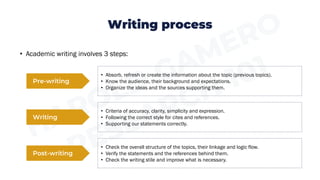
Writing process
• Academic writing involves 3 steps:
Pre-writing
Writing
Post-writing
• Absorb, refresh or create the information about the topic (previous topics).
• Know the audience, their background and expectations.
• Organize the ideas and the sources supporting them.
• Check the overall structure of the topics, their linkage and logic flow.
• Verify the statements and the references behind them.
• Check the writing stile and improve what is necessary.
• Criteria of accuracy, clarity, simplicity and expression.
• Following the correct style for cites and references.
• Supporting our statements correctly.
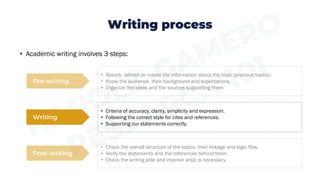
Writing process
• Academic writing involves 3 steps:
Pre-writing
Writing
Post-writing
• Absorb, refresh or create the information about the topic (previous topics).
• Know the audience, their background and expectations.
• Organize the ideas and the sources supporting them.
• Check the overall structure of the topics, their linkage and logic flow.
• Verify the statements and the references behind them.
• Check the writing stile and improve what is necessary.
• Criteria of accuracy, clarity, simplicity and expression.
• Following the correct style for cites and references.
• Supporting our statements correctly.
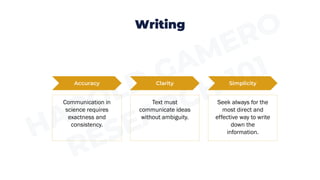
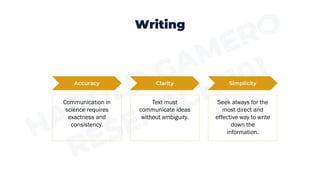
Writing
Accuracy Clarity Simplicity
Communication in
science requires
exactness and
consistency.
Text must
communicate ideas
without ambiguity.
Seek always for the
most direct and
effective way to write
down the
information.
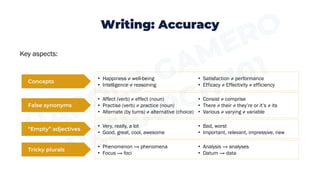
Writing: Accuracy
Key aspects:
Concepts
False synonyms
• Happiness ≠ well-being
• Intelligence ≠ reasoning
• Satisfaction ≠ performance
• Efficacy ≠ Effectivity ≠ efficiency
• Affect (verb) ≠ effect (noun)
• Practise (verb) ≠ practice (noun)
• Alternate (by turns) ≠ alternative (choice)
• Consist ≠ comprise
• There ≠ their ≠ they’re or it’s ≠ its
• Various ≠ varying ≠ variable
“Empty” adjectives
• Very, really, a lot
• Good, great, cool, awesome
• Bad, worst
• Important, relevant, impressive, new
Tricky plurals
• Phenomenon → phenomena
• Focus → foci
• Analysis → analyses
• Datum → data
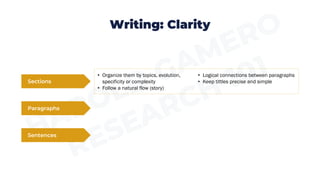
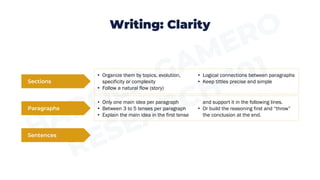
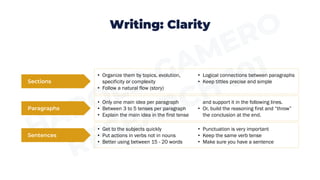
Writing: Clarity
• Organize them by topics, evolution,
specificity or complexity
• Follow a natural flow (story)
• Logical connections between paragraphs
• Keep tittles precise and simple
Sections
Paragraphs
Sentences
Writing: Clarity
Sections
• Organize them by topics, evolution,
specificity or complexity
• Follow a natural flow (story)
• Logical connections between paragraphs
• Keep tittles precise and simple
Paragraphs
• Only one main idea per paragraph
• Between 3 to 5 tenses per paragraph
• Explain the main idea in the first tense
and support it in the following lines.
• Or build the reasoning first and “throw”
the conclusion at the end.
Sentences
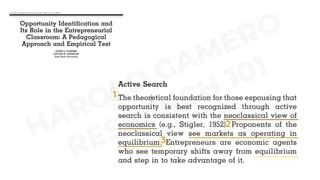
1
2
3
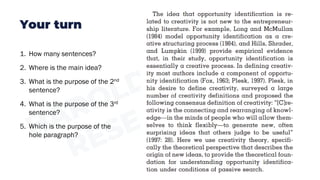
1. How many sentences?
2. Where is the main idea?
3. What is the purpose of the 2nd
sentence?
4. What is the purpose of the 3rd
sentence?
5. Which is the purpose of the
hole paragraph?
Your turn
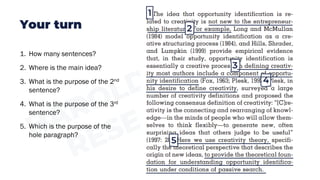
1
2
3
4
5
1. How many sentences?
2. Where is the main idea?
3. What is the purpose of the 2nd
sentence?
4. What is the purpose of the 3rd
sentence?
5. Which is the purpose of the
hole paragraph?
Your turn
Writing: Clarity
Sections
Paragraphs
Sentences
• Get to the subjects quickly
• Put actions in verbs not in nouns
• Better using between 15 - 20 words
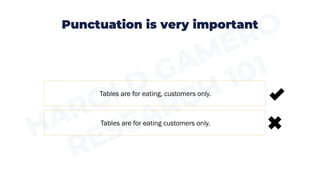
• Punctuation is very important
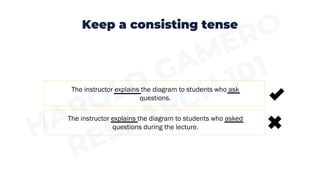
• Keep the same verb tense
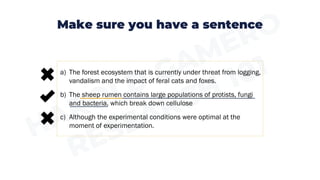
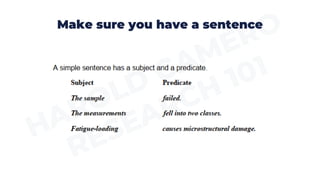
• Make sure you have a sentence
• Organize them by topics, evolution,
specificity or complexity
• Follow a natural flow (story)
• Logical connections between paragraphs
• Keep tittles precise and simple
• Only one main idea per paragraph
• Between 3 to 5 tenses per paragraph
• Explain the main idea in the first tense
and support it in the following lines.
• Or, build the reasoning first and “throw”
the conclusion at the end.
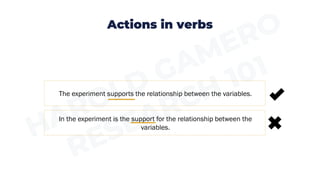
Actions in verbs
In the experiment is the support for the relationship between the
variables.
The experiment supports the relationship between the variables.
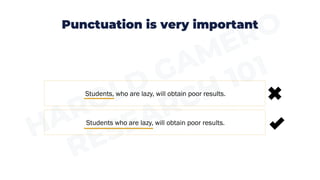
Punctuation is very important
Students, who are lazy, will obtain poor results.
Students who are lazy, will obtain poor results.
Punctuation is very important
Tables are for eating customers only.
Tables are for eating, customers only.
Keep a consisting tense
The instructor explains the diagram to students who asked
questions during the lecture.
The instructor explains the diagram to students who ask
questions.
Make sure you have a sentence
a) The forest ecosystem that is currently under threat from logging,
vandalism and the impact of feral cats and foxes.
b) The sheep rumen contains large populations of protists, fungi
and bacteria, which break down cellulose
c) Although the experimental conditions were optimal at the
moment of experimentation.
Make sure you have a sentence
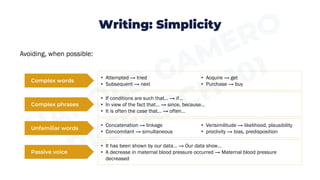
Writing: Simplicity
Avoiding, when possible:
Complex words
Complex phrases
• Attempted → tried
• Subsequent → next
• Acquire → get
• Purchase → buy
• If conditions are such that… → if…
• In view of the fact that… → since, because…
• It is often the case that… → often…
Unfamiliar words
• Concatenation → linkage
• Concomitant → simultaneous
• Verisimilitude → likelihood, plausibility
• proclivity → bias, predisposition
Passive voice
• It has been shown by our data… → Our data show…
• A decrease in maternal blood pressure occurred → Maternal blood pressure
decreased
Writing
Accuracy Clarity Simplicity
Communication in
science requires
exactness and
consistency.
Text must
communicate ideas
without ambiguity.
Seek always for the
most direct and
effective way to write
down the
information.
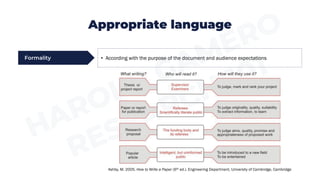
Formality • According with the purpose of the document and audience expectations
Appropriate language
Ashby, M. 2005. How to Write a Paper (6th ed.). Engineering Department, University of Cambridge, Cambridge
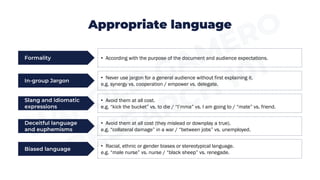
Formality
In-group Jargon
• According with the purpose of the document and audience expectations.
• Never use jargon for a general audience without first explaining it.
e.g. synergy vs. cooperation / empower vs. delegate.
Slang and idiomatic
expressions
• Avoid them at all cost.
e.g. “kick the bucket” vs. to die / “I’mma” vs. I am going to / “mate” vs. friend.
Deceitful language
and euphemisms
• Avoid them at all cost (they mislead or downplay a true).
e.g. “collateral damage” in a war / “between jobs” vs. unemployed.
Appropriate language
Biased language
• Racial, ethnic or gender biases or stereotypical language.
e.g. “male nurse” vs. nurse / “black sheep” vs. renegade.
Strong thesis statements
• Statements are the core of an academic document
• Based on existing information (previous researches, technical reports, etc.)
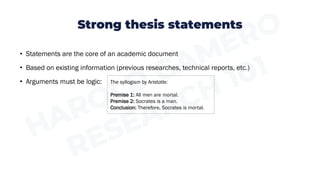
• Arguments must be logic: The syllogism by Aristotle:
Premise 1: All men are mortal.
Premise 2: Socrates is a man.
Conclusion: Therefore, Socrates is mortal.
Strong thesis statements
• Statements are the core of an academic document
• Based on existing information (previous researches, technical reports, etc.)
• Arguments must be logic
• Rhetorical: using language to persuade the readers in an effective way
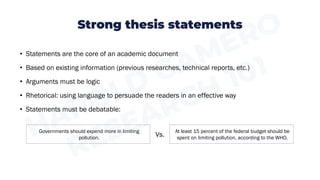
• Statements must be debatable:
Vs.
At least 15 percent of the federal budget should be
spent on limiting pollution, according to the WHO.
Governments should expend more in limiting
pollution.
Strong thesis statements
• Statements are the core of an academic document
• Based on existing information (previous researches, technical reports, etc.)
• Arguments must be logic
• Rhetorical: using language to persuade the readers in an effective way
• Statements must be debatable
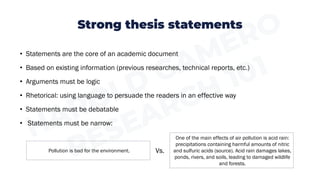
• Statements must be narrow:
Pollution is bad for the environment.
One of the main effects of air pollution is acid rain:
precipitations containing harmful amounts of nitric
and sulfuric acids (source). Acid rain damages lakes,
ponds, rivers, and soils, leading to damaged wildlife
and forests.
Vs.
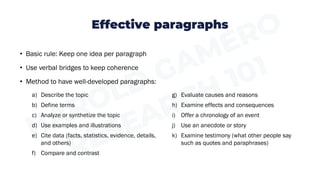
Effective paragraphs
• Basic rule: Keep one idea per paragraph
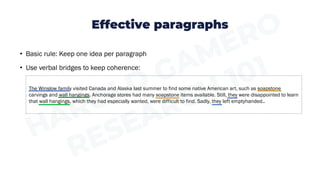
• Use verbal bridges to keep coherence:
The Winslow family visited Canada and Alaska last summer to find some native American art, such as soapstone
carvings and wall hangings. Anchorage stores had many soapstone items available. Still, they were disappointed to learn
that wall hangings, which they had especially wanted, were difficult to find. Sadly, they left emptyhanded..
Effective paragraphs
• Basic rule: Keep one idea per paragraph
• Use verbal bridges to keep coherence
• Method to have well-developed paragraphs:
a) Describe the topic
b) Define terms
c) Analyze or synthetize the topic
d) Use examples and illustrations
e) Cite data (facts, statistics, evidence, details,
and others)
f) Compare and contrast
g) Evaluate causes and reasons
h) Examine effects and consequences
i) Offer a chronology of an event
j) Use an anecdote or story
k) Examine testimony (what other people say
such as quotes and paraphrases)
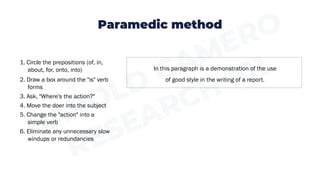
Paramedic method
In this paragraph is a demonstration of the use
of good style in the writing of a report.
1. Circle the prepositions (of, in,
about, for, onto, into)
2. Draw a box around the "is" verb
forms
3. Ask, "Where's the action?"
4. Move the doer into the subject
5. Change the "action" into a
simple verb
6. Eliminate any unnecessary slow
windups or redundancies
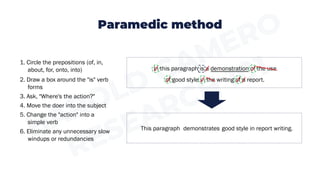
Paramedic method
In this paragraph is a demonstration of the use
of good style in the writing of a report.
demonstrates
This paragraph good style in report writing.
1. Circle the prepositions (of, in,
about, for, onto, into)
2. Draw a box around the "is" verb
forms
3. Ask, "Where's the action?"
4. Move the doer into the subject
5. Change the "action" into a
simple verb
6. Eliminate any unnecessary slow
windups or redundancies
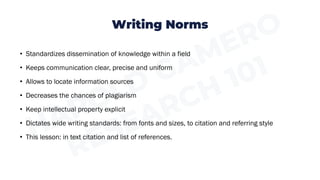
Writing Norms
• Standardizes dissemination of knowledge within a field
• Keeps communication clear, precise and uniform
• Allows to locate information sources
• Decreases the chances of plagiarism
• Keep intellectual property explicit
• Dictates wide writing standards: from fonts and sizes, to citation and referring style
• This lesson: in text citation and list of references.
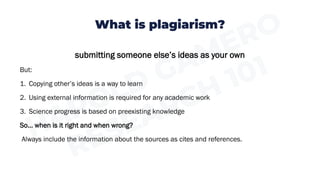
What is plagiarism?
submitting someone else’s ideas as your own
But:
1. Copying other’s ideas is a way to learn
2. Using external information is required for any academic work
3. Science progress is based on preexisting knowledge
So… when is it right and when wrong?
Always include the information about the sources as cites and references.
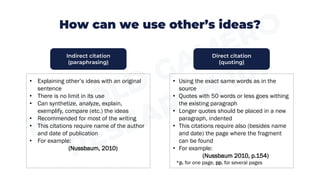
How can we use other’s ideas?
• Explaining other’s ideas with an original
sentence
• There is no limit in its use
• Can synthetize, analyze, explain,
exemplify, compare (etc.) the ideas
• Recommended for most of the writing
• This citations require name of the author
and date of publication
• For example:
(Nussbaum, 2010)
• Using the exact same words as in the
source
• Quotes with 50 words or less goes withing
the existing paragraph
• Longer quotes should be placed in a new
paragraph, indented
• This citations require also (besides name
and date) the page where the fragment
can be found
• For example:
(Nussbaum 2010, p.154)
*p. for one page, pp. for several pages
Indirect citation
(paraphrasing)
Direct citation
(quoting)
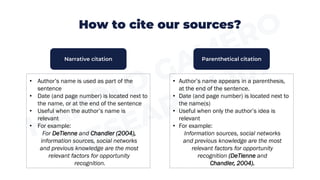
How to cite our sources?
• Author’s name is used as part of the
sentence
• Date (and page number) is located next to
the name, or at the end of the sentence
• Useful when the author’s name is
relevant
• For example:
For DeTienne and Chandler (2004),
information sources, social networks
and previous knowledge are the most
relevant factors for opportunity
recognition.
• Author’s name appears in a parenthesis,
at the end of the sentence.
• Date (and page number) is located next to
the name(s)
• Useful when only the author’s idea is
relevant
• For example:
Information sources, social networks
and previous knowledge are the most
relevant factors for opportunity
recognition (DeTienne and
Chandler, 2004).
Narrative citation Parenthetical citation
Overview
Author(s) Narrative citation Parenthetical citation
1 author Walker (2007) (Walker 2007)
2-3 authors Walker, Baron and Allen (2007) (Walker, Baron & Allen 2007)
4 or more authors Walker et al. (2007) (Walker et al. 2007)
Organization with acronym
1st: United Nations (UN, 2003)
After: UN (2003)
1st: (United Nations [UN] 2003)
After: (UN 2003)
Organization without
acronym
University of Pittsburgh (2003) (University of Pittsburgh 2003)
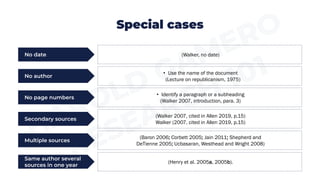
Special cases
No date (Walker, no date)
No author
• Use the name of the document
(Lecture on republicanism, 1975)
No page numbers
• Identify a paragraph or a subheading
(Walker 2007, introduction, para. 3)
Secondary sources
(Walker 2007, cited in Allen 2019, p.15)
Walker (2007, cited in Allen 2019, p.15)
Multiple sources
(Baron 2006; Corbett 2005; Jain 2011; Shepherd and
DeTienne 2005; Ucbasaran, Westhead and Wright 2008)
Same author several
sources in one year
(Henry et al. 2005a, 2005b).
Thank you.
Harold Gamero

Research 101: Academic Writing Style .

  • 1.
    Research 101: AcademicWriting Style Harold Gamero
  • 2.
    Writing process • Academicwriting involves 3 steps: Pre-writing Writing Post-writing • Absorb, refresh or create the information about the topic (previous topics). • Know the audience, their background and expectations. • Organize the ideas and the sources supporting them. • Check the overall structure of the topics, their linkage and logic flow. • Verify the statements and the references behind them. • Check the writing stile and improve what is necessary. • Criteria of accuracy, clarity, simplicity and expression. • Following the correct style for cites and references. • Supporting our statements correctly.
  • 3.
    Writing process • Academicwriting involves 3 steps: Pre-writing Writing Post-writing • Absorb, refresh or create the information about the topic (previous topics). • Know the audience, their background and expectations. • Organize the ideas and the sources supporting them. • Check the overall structure of the topics, their linkage and logic flow. • Verify the statements and the references behind them. • Check the writing stile and improve what is necessary. • Criteria of accuracy, clarity, simplicity and expression. • Following the correct style for cites and references. • Supporting our statements correctly.
  • 4.
    Writing Accuracy Clarity Simplicity Communicationin science requires exactness and consistency. Text must communicate ideas without ambiguity. Seek always for the most direct and effective way to write down the information.
  • 5.
    Writing: Accuracy Key aspects: Concepts Falsesynonyms • Happiness ≠ well-being • Intelligence ≠ reasoning • Satisfaction ≠ performance • Efficacy ≠ Effectivity ≠ efficiency • Affect (verb) ≠ effect (noun) • Practise (verb) ≠ practice (noun) • Alternate (by turns) ≠ alternative (choice) • Consist ≠ comprise • There ≠ their ≠ they’re or it’s ≠ its • Various ≠ varying ≠ variable “Empty” adjectives • Very, really, a lot • Good, great, cool, awesome • Bad, worst • Important, relevant, impressive, new Tricky plurals • Phenomenon → phenomena • Focus → foci • Analysis → analyses • Datum → data
  • 6.
    Writing: Clarity • Organizethem by topics, evolution, specificity or complexity • Follow a natural flow (story) • Logical connections between paragraphs • Keep tittles precise and simple Sections Paragraphs Sentences
  • 8.
    Writing: Clarity Sections • Organizethem by topics, evolution, specificity or complexity • Follow a natural flow (story) • Logical connections between paragraphs • Keep tittles precise and simple Paragraphs • Only one main idea per paragraph • Between 3 to 5 tenses per paragraph • Explain the main idea in the first tense and support it in the following lines. • Or build the reasoning first and “throw” the conclusion at the end. Sentences
  • 9.
  • 10.
    1. How manysentences? 2. Where is the main idea? 3. What is the purpose of the 2nd sentence? 4. What is the purpose of the 3rd sentence? 5. Which is the purpose of the hole paragraph? Your turn
  • 11.
    1 2 3 4 5 1. How manysentences? 2. Where is the main idea? 3. What is the purpose of the 2nd sentence? 4. What is the purpose of the 3rd sentence? 5. Which is the purpose of the hole paragraph? Your turn
  • 13.
    Writing: Clarity Sections Paragraphs Sentences • Getto the subjects quickly • Put actions in verbs not in nouns • Better using between 15 - 20 words • Punctuation is very important • Keep the same verb tense • Make sure you have a sentence • Organize them by topics, evolution, specificity or complexity • Follow a natural flow (story) • Logical connections between paragraphs • Keep tittles precise and simple • Only one main idea per paragraph • Between 3 to 5 tenses per paragraph • Explain the main idea in the first tense and support it in the following lines. • Or, build the reasoning first and “throw” the conclusion at the end.
  • 14.
    Actions in verbs Inthe experiment is the support for the relationship between the variables. The experiment supports the relationship between the variables.
  • 15.
    Punctuation is veryimportant Students, who are lazy, will obtain poor results. Students who are lazy, will obtain poor results.
  • 16.
    Punctuation is veryimportant Tables are for eating customers only. Tables are for eating, customers only.
  • 17.
    Keep a consistingtense The instructor explains the diagram to students who asked questions during the lecture. The instructor explains the diagram to students who ask questions.
  • 18.
    Make sure youhave a sentence a) The forest ecosystem that is currently under threat from logging, vandalism and the impact of feral cats and foxes. b) The sheep rumen contains large populations of protists, fungi and bacteria, which break down cellulose c) Although the experimental conditions were optimal at the moment of experimentation.
  • 19.
    Make sure youhave a sentence
  • 20.
    Writing: Simplicity Avoiding, whenpossible: Complex words Complex phrases • Attempted → tried • Subsequent → next • Acquire → get • Purchase → buy • If conditions are such that… → if… • In view of the fact that… → since, because… • It is often the case that… → often… Unfamiliar words • Concatenation → linkage • Concomitant → simultaneous • Verisimilitude → likelihood, plausibility • proclivity → bias, predisposition Passive voice • It has been shown by our data… → Our data show… • A decrease in maternal blood pressure occurred → Maternal blood pressure decreased
  • 21.
    Writing Accuracy Clarity Simplicity Communicationin science requires exactness and consistency. Text must communicate ideas without ambiguity. Seek always for the most direct and effective way to write down the information.
  • 22.
    Formality • Accordingwith the purpose of the document and audience expectations Appropriate language Ashby, M. 2005. How to Write a Paper (6th ed.). Engineering Department, University of Cambridge, Cambridge
  • 23.
    Formality In-group Jargon • Accordingwith the purpose of the document and audience expectations. • Never use jargon for a general audience without first explaining it. e.g. synergy vs. cooperation / empower vs. delegate. Slang and idiomatic expressions • Avoid them at all cost. e.g. “kick the bucket” vs. to die / “I’mma” vs. I am going to / “mate” vs. friend. Deceitful language and euphemisms • Avoid them at all cost (they mislead or downplay a true). e.g. “collateral damage” in a war / “between jobs” vs. unemployed. Appropriate language Biased language • Racial, ethnic or gender biases or stereotypical language. e.g. “male nurse” vs. nurse / “black sheep” vs. renegade.
  • 24.
    Strong thesis statements •Statements are the core of an academic document • Based on existing information (previous researches, technical reports, etc.) • Arguments must be logic: The syllogism by Aristotle: Premise 1: All men are mortal. Premise 2: Socrates is a man. Conclusion: Therefore, Socrates is mortal.
  • 25.
    Strong thesis statements •Statements are the core of an academic document • Based on existing information (previous researches, technical reports, etc.) • Arguments must be logic • Rhetorical: using language to persuade the readers in an effective way • Statements must be debatable: Vs. At least 15 percent of the federal budget should be spent on limiting pollution, according to the WHO. Governments should expend more in limiting pollution.
  • 26.
    Strong thesis statements •Statements are the core of an academic document • Based on existing information (previous researches, technical reports, etc.) • Arguments must be logic • Rhetorical: using language to persuade the readers in an effective way • Statements must be debatable • Statements must be narrow: Pollution is bad for the environment. One of the main effects of air pollution is acid rain: precipitations containing harmful amounts of nitric and sulfuric acids (source). Acid rain damages lakes, ponds, rivers, and soils, leading to damaged wildlife and forests. Vs.
  • 27.
    Effective paragraphs • Basicrule: Keep one idea per paragraph • Use verbal bridges to keep coherence: The Winslow family visited Canada and Alaska last summer to find some native American art, such as soapstone carvings and wall hangings. Anchorage stores had many soapstone items available. Still, they were disappointed to learn that wall hangings, which they had especially wanted, were difficult to find. Sadly, they left emptyhanded..
  • 28.
    Effective paragraphs • Basicrule: Keep one idea per paragraph • Use verbal bridges to keep coherence • Method to have well-developed paragraphs: a) Describe the topic b) Define terms c) Analyze or synthetize the topic d) Use examples and illustrations e) Cite data (facts, statistics, evidence, details, and others) f) Compare and contrast g) Evaluate causes and reasons h) Examine effects and consequences i) Offer a chronology of an event j) Use an anecdote or story k) Examine testimony (what other people say such as quotes and paraphrases)
  • 29.
    Paramedic method In thisparagraph is a demonstration of the use of good style in the writing of a report. 1. Circle the prepositions (of, in, about, for, onto, into) 2. Draw a box around the "is" verb forms 3. Ask, "Where's the action?" 4. Move the doer into the subject 5. Change the "action" into a simple verb 6. Eliminate any unnecessary slow windups or redundancies
  • 30.
    Paramedic method In thisparagraph is a demonstration of the use of good style in the writing of a report. demonstrates This paragraph good style in report writing. 1. Circle the prepositions (of, in, about, for, onto, into) 2. Draw a box around the "is" verb forms 3. Ask, "Where's the action?" 4. Move the doer into the subject 5. Change the "action" into a simple verb 6. Eliminate any unnecessary slow windups or redundancies
  • 31.
    Writing Norms • Standardizesdissemination of knowledge within a field • Keeps communication clear, precise and uniform • Allows to locate information sources • Decreases the chances of plagiarism • Keep intellectual property explicit • Dictates wide writing standards: from fonts and sizes, to citation and referring style • This lesson: in text citation and list of references.
  • 32.
    What is plagiarism? submittingsomeone else’s ideas as your own But: 1. Copying other’s ideas is a way to learn 2. Using external information is required for any academic work 3. Science progress is based on preexisting knowledge So… when is it right and when wrong? Always include the information about the sources as cites and references.
  • 33.
    How can weuse other’s ideas? • Explaining other’s ideas with an original sentence • There is no limit in its use • Can synthetize, analyze, explain, exemplify, compare (etc.) the ideas • Recommended for most of the writing • This citations require name of the author and date of publication • For example: (Nussbaum, 2010) • Using the exact same words as in the source • Quotes with 50 words or less goes withing the existing paragraph • Longer quotes should be placed in a new paragraph, indented • This citations require also (besides name and date) the page where the fragment can be found • For example: (Nussbaum 2010, p.154) *p. for one page, pp. for several pages Indirect citation (paraphrasing) Direct citation (quoting)
  • 34.
    How to citeour sources? • Author’s name is used as part of the sentence • Date (and page number) is located next to the name, or at the end of the sentence • Useful when the author’s name is relevant • For example: For DeTienne and Chandler (2004), information sources, social networks and previous knowledge are the most relevant factors for opportunity recognition. • Author’s name appears in a parenthesis, at the end of the sentence. • Date (and page number) is located next to the name(s) • Useful when only the author’s idea is relevant • For example: Information sources, social networks and previous knowledge are the most relevant factors for opportunity recognition (DeTienne and Chandler, 2004). Narrative citation Parenthetical citation
  • 35.
    Overview Author(s) Narrative citationParenthetical citation 1 author Walker (2007) (Walker 2007) 2-3 authors Walker, Baron and Allen (2007) (Walker, Baron & Allen 2007) 4 or more authors Walker et al. (2007) (Walker et al. 2007) Organization with acronym 1st: United Nations (UN, 2003) After: UN (2003) 1st: (United Nations [UN] 2003) After: (UN 2003) Organization without acronym University of Pittsburgh (2003) (University of Pittsburgh 2003)
  • 36.
    Special cases No date(Walker, no date) No author • Use the name of the document (Lecture on republicanism, 1975) No page numbers • Identify a paragraph or a subheading (Walker 2007, introduction, para. 3) Secondary sources (Walker 2007, cited in Allen 2019, p.15) Walker (2007, cited in Allen 2019, p.15) Multiple sources (Baron 2006; Corbett 2005; Jain 2011; Shepherd and DeTienne 2005; Ucbasaran, Westhead and Wright 2008) Same author several sources in one year (Henry et al. 2005a, 2005b).
  • 37.