Research 101: Quantitative Analysis -
Descriptive Statistics
Harold Gamero
Descriptive analysis
Definition
It is the description, grouping and presentation of the results of the
constructs of interest and the associations between them.
• In contrast, inferential statistics refers to statistical procedures for hypothesis testing.
• Specialized software is required (SPSS, Mplus, Stata, R, etc.).
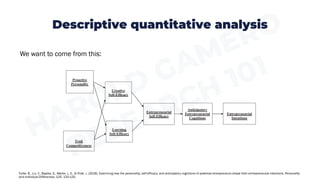
Descriptive quantitative analysis
We want to come from this:
Fuller, B., Liu, Y., Bajaba, S., Marler, L. E., & Pratt, J. (2018). Examining how the personality, self-efficacy, and anticipatory cognitions of potential entrepreneurs shape their entrepreneurial intentions. Personality
and Individual Differences, 125, 120-125.
Descriptive quantitative analysis
To this:
Fuller, B., Liu, Y., Bajaba, S., Marler, L. E., & Pratt, J. (2018). Examining how the personality, self-efficacy, and anticipatory cognitions of potential entrepreneurs shape their
entrepreneurial intentions. Personality and Individual Differences, 125, 120-125.
Descriptive quantitative analysis
Through this:
Descriptive quantitative analysis
Using this (or similar programs):
Univariate Analysis
• The most basic statistical calculation.
• It helps to know the general configuration of our data.
• It includes 3 types of analysis:
a) Frequency distribution
b) Central tendency
c) Dispersion
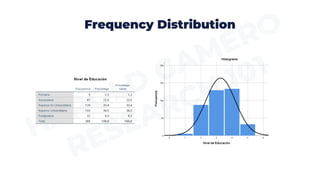
Frequency Distribution
• Count of individual values per variable or response category and their respective
percentages.
• These values can be presented in tables and graphs (histograms).
• In large, random samples, histograms should follow the shape of a normal distribution
curve.
• Recommended for categorical variables (nominal or ordinal).
• It should not be used to analyse individual items of a composite measurement scale.
Frequency Distribution
Central Tendency
• They estimate the central values of a variable in our data.
• These measures are: Mean, mode, median.
• Means can be:
➢ Arithmetic: Sum of values / Number of values.
➢ Geometric: n-th root of the product of n values.
➢ Harmonic: Inverse of the arithmetic mean of the inverses of these values.
• In the social sciences, the arithmetic mean is mainly used.
Dispersion
• They indicate the variability of the sample data around the central tendency.
• Three common measures of dispersion are: range, standard deviation & variance.
• The range is especially sensitive to outliers.
• The standard deviation corrects for this effect by weighting the distances between the
values and the mean. It is also presented in the same units as the data (interpretable).
• The variance is the standard deviation squared. It is useful for mathematical procedures.
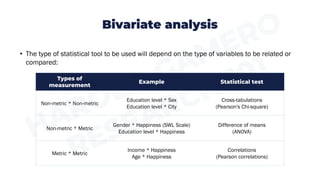
Bivariate analysis
• The type of statistical tool to be used will depend on the type of variables to be related or
compared:
Types of
measurement
Example Statistical test
Non-metric * Non-metric
Education level * Sex
Education level * City
Cross-tabulations
(Pearson's Chi-square)
Non-metric * Metric
Gender * Happiness (SWL Scale)
Education level * Happiness
Difference of means
(ANOVA)
Metric * Metric
Income * Happiness
Age * Happiness
Correlations
(Pearson correlations)
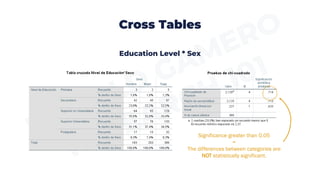
Cross Tables
Significance greater than 0.05
=
The differences between categories are
NOT statistically significant.
Education Level * Sex
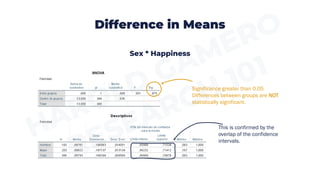
Difference in Means
Sex * Happiness
Significance greater than 0.05
Differences between groups are NOT
statistically significant.
This is confirmed by the
overlap of the confidence
intervals.
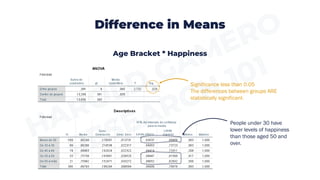
Difference in Means
Age Bracket * Happiness
Significance less than 0.05
The differences between groups ARE
statistically significant.
People under 30 have
lower levels of happiness
than those aged 50 and
over.
Correlations
The data are reflected in
the table as in a
transverse mirror.
The asterisks represent the level of
statistical significance.
Correlations
These two data are
identical because they
are the same
correlation.
These correlations will
always be 1 since it is the
correlation of a variable
with itself.
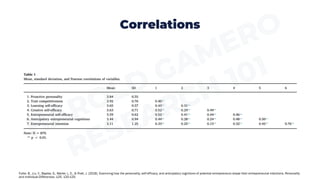
Correlations
Usually the table is presented:
1. Showing only the lower half
2. Eliminating other values from the table such as N and sig.
3. Eliminating correlations between the same variables
4. Replacing variable names with numbers in the headers.
Correlations
Fuller, B., Liu, Y., Bajaba, S., Marler, L. E., & Pratt, J. (2018). Examining how the personality, self-efficacy, and anticipatory cognitions of potential entrepreneurs shape their entrepreneurial intentions. Personality
and Individual Differences, 125, 120-125.
Thank you.
Harold Gamero

Research 101: Descriptive Quantitative Analysis

  • 1.
    Research 101: QuantitativeAnalysis - Descriptive Statistics Harold Gamero
  • 2.
    Descriptive analysis Definition It isthe description, grouping and presentation of the results of the constructs of interest and the associations between them. • In contrast, inferential statistics refers to statistical procedures for hypothesis testing. • Specialized software is required (SPSS, Mplus, Stata, R, etc.).
  • 3.
    Descriptive quantitative analysis Wewant to come from this: Fuller, B., Liu, Y., Bajaba, S., Marler, L. E., & Pratt, J. (2018). Examining how the personality, self-efficacy, and anticipatory cognitions of potential entrepreneurs shape their entrepreneurial intentions. Personality and Individual Differences, 125, 120-125.
  • 4.
    Descriptive quantitative analysis Tothis: Fuller, B., Liu, Y., Bajaba, S., Marler, L. E., & Pratt, J. (2018). Examining how the personality, self-efficacy, and anticipatory cognitions of potential entrepreneurs shape their entrepreneurial intentions. Personality and Individual Differences, 125, 120-125.
  • 5.
  • 6.
    Descriptive quantitative analysis Usingthis (or similar programs):
  • 7.
    Univariate Analysis • Themost basic statistical calculation. • It helps to know the general configuration of our data. • It includes 3 types of analysis: a) Frequency distribution b) Central tendency c) Dispersion
  • 8.
    Frequency Distribution • Countof individual values per variable or response category and their respective percentages. • These values can be presented in tables and graphs (histograms). • In large, random samples, histograms should follow the shape of a normal distribution curve. • Recommended for categorical variables (nominal or ordinal). • It should not be used to analyse individual items of a composite measurement scale.
  • 9.
  • 10.
    Central Tendency • Theyestimate the central values of a variable in our data. • These measures are: Mean, mode, median. • Means can be: ➢ Arithmetic: Sum of values / Number of values. ➢ Geometric: n-th root of the product of n values. ➢ Harmonic: Inverse of the arithmetic mean of the inverses of these values. • In the social sciences, the arithmetic mean is mainly used.
  • 11.
    Dispersion • They indicatethe variability of the sample data around the central tendency. • Three common measures of dispersion are: range, standard deviation & variance. • The range is especially sensitive to outliers. • The standard deviation corrects for this effect by weighting the distances between the values and the mean. It is also presented in the same units as the data (interpretable). • The variance is the standard deviation squared. It is useful for mathematical procedures.
  • 12.
    Bivariate analysis • Thetype of statistical tool to be used will depend on the type of variables to be related or compared: Types of measurement Example Statistical test Non-metric * Non-metric Education level * Sex Education level * City Cross-tabulations (Pearson's Chi-square) Non-metric * Metric Gender * Happiness (SWL Scale) Education level * Happiness Difference of means (ANOVA) Metric * Metric Income * Happiness Age * Happiness Correlations (Pearson correlations)
  • 13.
    Cross Tables Significance greaterthan 0.05 = The differences between categories are NOT statistically significant. Education Level * Sex
  • 14.
    Difference in Means Sex* Happiness Significance greater than 0.05 Differences between groups are NOT statistically significant. This is confirmed by the overlap of the confidence intervals.
  • 15.
    Difference in Means AgeBracket * Happiness Significance less than 0.05 The differences between groups ARE statistically significant. People under 30 have lower levels of happiness than those aged 50 and over.
  • 16.
    Correlations The data arereflected in the table as in a transverse mirror. The asterisks represent the level of statistical significance.
  • 17.
    Correlations These two dataare identical because they are the same correlation. These correlations will always be 1 since it is the correlation of a variable with itself.
  • 18.
    Correlations Usually the tableis presented: 1. Showing only the lower half 2. Eliminating other values from the table such as N and sig. 3. Eliminating correlations between the same variables 4. Replacing variable names with numbers in the headers.
  • 19.
    Correlations Fuller, B., Liu,Y., Bajaba, S., Marler, L. E., & Pratt, J. (2018). Examining how the personality, self-efficacy, and anticipatory cognitions of potential entrepreneurs shape their entrepreneurial intentions. Personality and Individual Differences, 125, 120-125.
  • 20.