Assoc. Prof. Dr.
Hasanain Faisal Ghazi
• MBChB (University of Baghdad)
Master & PhD (UKM, Malaysia)
• Publication:
89 Full papers (56 in SCOPUS)
H Index = 11
• Published Systematic Review & Meta
Analysis (7)
• Editor in Chief, Global Journal of Public
Health Medicine.
@AP_Dr_Hasanain_Faisal_Ghazi 2
INTRODUCTION
Why We Do Sys. Rev. ??????
@AP_Dr.Hasanain_Ghazi
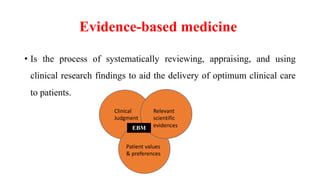
Evidence-based medicine
• Is the process of systematically reviewing, appraising, and using
clinical research findings to aid the delivery of optimum clinical care
to patients.
Clinical
Judgment
Relevant
scientific
evidences
Patient values
& preferences
EBM
Definition
• A systematic review summarises the results of available carefully
designed healthcare studies (controlled trials) and provides a high
level of evidence on the effectiveness of healthcare
interventions. Judgments may be made about the evidence and inform
recommendations for healthcare.
Reference: https://consumers.cochrane.org/what-systematic-review
@AP_Dr.Hasanain_Ghazi
SR & MA
• A systematic review answers a defined research question by
collecting and summarising all empirical evidence that fits pre-
specified eligibility criteria.
• A meta-analysis is the use of statistical methods to summarise the
results of these studies.
@AP_Dr.Hasanain_Ghazi
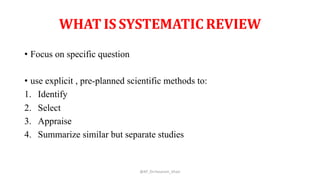
WHAT IS SYSTEMATIC REVIEW
• Focus on specific question
• use explicit , pre-planned scientific methods to:
1. Identify
2. Select
3. Appraise
4. Summarize similar but separate studies
@AP_Dr.Hasanain_Ghazi
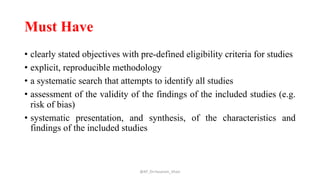
Must Have
• clearly stated objectives with pre-defined eligibility criteria for studies
• explicit, reproducible methodology
• a systematic search that attempts to identify all studies
• assessment of the validity of the findings of the included studies (e.g.
risk of bias)
• systematic presentation, and synthesis, of the characteristics and
findings of the included studies
@AP_Dr.Hasanain_Ghazi
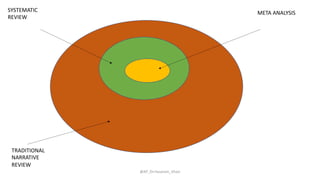
SYSTEMATIC
REVIEW
META ANALYSIS
TRADITIONAL
NARRATIVE
REVIEW
@AP_Dr.Hasanain_Ghazi
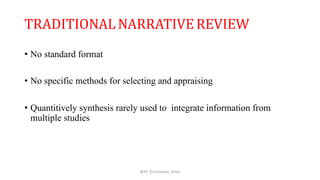
TRADITIONAL NARRATIVE REVIEW
• No standard format
• No specific methods for selecting and appraising
• Quantitively synthesis rarely used to integrate information from
multiple studies
@AP_Dr.Hasanain_Ghazi
SR Steps
1. Gather your team
2. Develop protocol
3. Data collection, locate and screen
@AP_Dr.Hasanain_Ghazi
4. abstract data , appraise risk of Bias
5. synthesis findings and interpret
6. report writing
7. update
@AP_Dr.Hasanain_Ghazi
META ANALYSIS
• Is an OPTIONAL component of systematic review.
• A statistical analysis which combines the results of several
independent studies considered by the analyst to be combinable
(Huque, 1988).
@AP_Dr.Hasanain_Ghazi
What meta analysis can help
• Assess strength of evidence
To determine whether an effect exists in a particular direction
• Combine results quantitively
To obtain a single summary result
• Investigate heterogeneity
To examine reasons for different results among studies
@AP_Dr.Hasanain_Ghazi
Addressing same question?
• What is the effect of interferon therapy in hepatitis C?
• Size of effect might be higher when participants are older, more
educated or healthier than others
• Different forms of interferon
• Different interferon doses
• Different viral subtypes of hepatitis C
@AP_Dr.Hasanain_Ghazi
WHEN TO DO MA??
• When more than 1 study has estimated a treatment effect or
association.
• When the difference in study characteristics are unlikely to effect
treatment effect.
• When the treatment effect have been measured and reported in similar
ways (or when data available) .
@AP_Dr.Hasanain_Ghazi
WHO IS DOING SYS. REV.
• Independent authors
• Cochrane collaboration
• Group interested in policy
• Business
@AP_Dr.Hasanain_Ghazi
Who is using Sys Rev
• Individual doctors and researchers
• Patient and consumers
• Guidelines producers
• Policy makers
@AP_Dr.Hasanain_Ghazi
IOM standers for systematic reviews
• Initiating a systematic review
• Establish a review team
• Manage bias and conflict of interest of the review team
• Ensure stakeholder input
• Manage bias and conflict of interest of those providing input
• Formulate the topic
• Develop the protocol
• Submit the protocol for peer review
• Make protocol publicly available
@AP_Dr.Hasanain_Ghazi
Formulate the Topic
• Confirm the need for a new review
• Develop an analytic framework
• Use a standard format to articulate each question of interest For
example, PICO(TS)
• State a rationale for each question
• Refine each question
@AP_Dr.Hasanain_Ghazi
Formulating the Question in a Systematic
Review
• “The most important maxim for data analysis to heed, and one which
many statisticians have shunned is this: ‘far better an approximate
answer to the right question, which is often vague, than an exact
answer to the wrong question, which can always be made precise.’”
@AP_Dr.Hasanain_Ghazi
Ways Similar Studies May Differ
• Patient population
• Inclusion and exclusion criteria
• Exposure definition/intervention composition, dose, timing
• Comparison group/controls
• Management protocol(co interventions) for trials
• Outcome definition(follow-up time, cause-specific mortality)
• Quality of design and execution
• Analysis
@AP_Dr.Hasanain_Ghazi
Components of well-structured question
• P patients or population
• I intervention/ exposure
• C comparison groups (s)
• O outcome
@AP_Dr.Hasanain_Ghazi
Type of people
• Define condition or disease, including explicit diagnostic criteria
• Population and setting of interest (age, race, sex, community, hospital,
outpatient)
@AP_Dr.Hasanain_Ghazi
Type of risk factors
• Timing of exposure
• Route of administration
• Dose of intensity
• Duration of exposure or therapy
@AP_Dr.Hasanain_Ghazi
Type of comparison group
• For trials :
• Placebo
• Standard therapy
• No treatment
• For epidemiological STUDIES
• No exposure
• Non-cases (hospital, neighborhood, etc)
@AP_Dr.Hasanain_Ghazi
Types of outcome
• Criteria of defining
• Important to consumers, providers
• Unpublished data
@AP_Dr.Hasanain_Ghazi
Well constructed and answerable clinical
question
• For preschool children with mild to moderate visual acuity
impairment, are glasses and patching effective in improving visual
acuity, compared with glasses alone or no treatment ?
@AP_Dr.Hasanain_Ghazi
Some groups add TS to PICO
• T= TIMING (Duration of minimum of follow up)
• S= sitting (primary care, specialty, inpatients )
@AP_Dr.Hasanain_Ghazi
• Effectiveness best answered with RCT
• Harm best answered with RCT but usually more practical to use
observational data (rare events, occurring after follow-up complete in
an RCT)
@AP_Dr.Hasanain_Ghazi
EXAMPLES
@AP_Dr.Hasanain_Ghazi
RESEARCH QUESTION
IS Drug therapy associated with long term morbidity and mortality in older
persons with moderate hypertension?
• P = older persons with moderate hypertension
• I= drug therapy
• C= not stated ( presumably any intervention other than named drug therapy
• O= long term morbidity and mortality
@AP_Dr.Hasanain_Ghazi
Finding the evidence
@AP_Dr.Hasanain_Ghazi
Major databases
• Major bibliographic databases for RCT
• Medline/Pubmed
• EMBASE
• Cochrane central register for controlled trials
• National and regional databases
• Subject specific datbases
• CINAHL
• PsychINFO
• OTSeeker
@AP_Dr.Hasanain_Ghazi
Citation databases
• Web of science
• SCOPUS
• Dissertation (ProQuest)
@AP_Dr.Hasanain_Ghazi
Register of ongoing trials
• www.clinicaltrials.gov
• www.centerwatch.com
• www.controlles-trials.com
• WHO Portal
@AP_Dr.Hasanain_Ghazi
Break into concepts
• P POPULATION
• I INTERVENTION
• C COMPARISON
• O OUTCOME
@AP_Dr.Hasanain_Ghazi
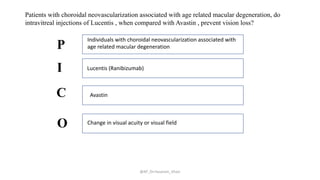
Patients with choroidal neovascularization associated with age related macular degeneration, do
intravitreal injections of Lucentis , when compared with Avastin , prevent vision loss?
Individuals with choroidal neovascularization associated with
age related macular degeneration
Lucentis (Ranibizumab)
Avastin
Change in visual acuity or visual field
P
I
C
O
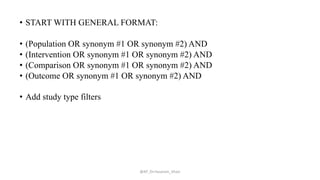
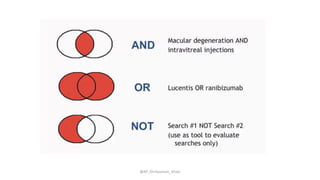
• START WITH GENERAL FORMAT:
• (Population OR synonym #1 OR synonym #2) AND
• (Intervention OR synonym #1 OR synonym #2) AND
• (Comparison OR synonym #1 OR synonym #2) AND
• (Outcome OR synonym #1 OR synonym #2) AND
• Add study type filters
@AP_Dr.Hasanain_Ghazi
Documenting the search
• Bibliographic software management
• Endnote
• Mendely
• QUOSA
@AP_Dr.Hasanain_Ghazi
• WHEN DID THE SEARCH
• Month/year
• Where you searched
• Electronic databases
• Hand searches
• Trial registers
• Internet
• bibliographies
@AP_Dr.Hasanain_Ghazi
• How you searched
• Strategies
• What you found
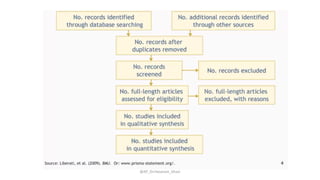
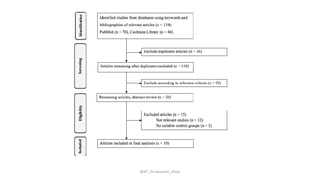
• PRISMA flow diagram
@AP_Dr.Hasanain_Ghazi
PRISMA
http://www.prisma-statement.org/
@AP_Dr.Hasanain_Ghazi
Preferred Reporting Items for Systematic Review and Meta-analysis
@AP_Dr.Hasanain_Ghazi
Assessing the risk of BIAS
@AP_Dr.Hasanain_Ghazi
ELEMENTS OF STUDY QUALITY THAT CAN
BE ASSESSED BY READING STUDY REPORT
• INTERNAL VALIDITY
• EXTERNAL VALIDITY
• RELEVANCE, ORIGINALITY
• ETHICS
@AP_Dr.Hasanain_Ghazi
BIAS
• SELECTION BIAS
• INFORMATION BIAS
• ANALYSIS
@AP_Dr.Hasanain_Ghazi
META ANALYSIS
@AP_Dr.Hasanain_Ghazi
• A meta-analysis is a survey in which the results of the studies included
in the review are statistically similar and are combined and analysed as
if they were one study.
@AP_Dr.Hasanain_Ghazi
PLANNING THE ANALYSIS
• Results of meta analysis can be very misleading if suitable attention
has not been given to:
• Formulate the review question
• Specify eligibility criteria
• Identify, select and critically appraise studies
• Collect appropriate data
• Decide what would be meaningful to analyze
@AP_Dr.Hasanain_Ghazi
• Systematic review contain analysis of the primary studies
• Qualitative: structured summary, description , and discussion of the
studies characteristics that may affect the cumulative evidence
• Quantitative: involves statistical analysis( meta-analysis)
@AP_Dr.Hasanain_Ghazi
A general framework for synthesis
• What is the direction of effect (association )
• What is the size of effect?
• Is the effect consistent across studies ?
• What is the strength of evidence for the effect ?
@AP_Dr.Hasanain_Ghazi
What is meta analysis
• An optional component of systematic review
• Definition:
• The statistical analysis of a large collection of analysis results from
individual studies for the purpose of integrating the findings (Glass 1976)
• The statistical analysis which combines the results of several independent
studies considered by the analyst to be combinable (Huque, 1988)
@AP_Dr.Hasanain_Ghazi
Data presentation
@AP_Dr.Hasanain_Ghazi
• FOREST GRAPHS
• FUNNEL PLOTS
• RADIAL PLOTS
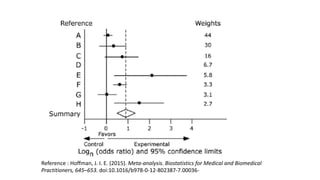
Reference : Hoffman, J. I. E. (2015). Meta-analysis. Biostatistics for Medical and Biomedical
Practitioners, 645–653. doi:10.1016/b978-0-12-802387-7.00036-
• Typical figure of response to some new treatment. The dots are the
mean log odds ratio, and the horizontal lines indicate 95% confidence
limits. Figures in the right-hand column are the weights assigned to
each study; the studies are often arranged in descending weights. The
solid vertical line at 0 indicates no difference between the groups, and
the dashed vertical line indicates the pooled average. Some figures
include the numbers of subjects in each group.
@AP_Dr.Hasanain_Ghazi
Note on interpretation
• The results of meta-analysis (estimate and confidence interval ) as any
other study must be interpreted in the context of a clinically important
effect size
• Statistically significant result may not be clinically important
• Results that is not statistically significant may still be compatible with
a clinically important effect
@AP_Dr.Hasanain_Ghazi
Why we do meta analysis
@AP_Dr.Hasanain_Ghazi
1. Increase power and precision (detect effect as statistically significant)
2. Quantify effect sizes and their uncertainty
Reduce problems of interpretation due to sampling variation
3. Assess homogeneity / heterogenicity of results
4. Answer questions not posed by individual studies
CONCLUSION
• Systematic review is essential for healthcare
• Meta analysis is an optional thing in SR
• SR should be done in team
@AP_Dr.Hasanain_Ghazi
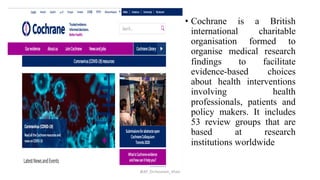
• Cochrane is a British
international charitable
organisation formed to
organise medical research
findings to facilitate
evidence-based choices
about health interventions
involving health
professionals, patients and
policy makers. It includes
53 review groups that are
based at research
institutions worldwide
@AP_Dr.Hasanain_Ghazi
FURTHER READINGS
@AP_Dr.Hasanain_Ghazi
https://www.nap.edu/
catalog/13059/finding
-what-works-in-health-
care-standards-for-
systematic-reviews
@AP_Dr.Hasanain_Ghazi
https://training.cochrane.org/handbook
@AP_Dr.Hasanain_Ghazi
THANK YOU
@AP_Dr.Hasanain_Ghazi

Introduction to Systematic Review & Meta-Analysis

  • 2.
    Assoc. Prof. Dr. HasanainFaisal Ghazi • MBChB (University of Baghdad) Master & PhD (UKM, Malaysia) • Publication: 89 Full papers (56 in SCOPUS) H Index = 11 • Published Systematic Review & Meta Analysis (7) • Editor in Chief, Global Journal of Public Health Medicine. @AP_Dr_Hasanain_Faisal_Ghazi 2
  • 3.
    INTRODUCTION Why We DoSys. Rev. ?????? @AP_Dr.Hasanain_Ghazi
  • 4.
    Evidence-based medicine • Isthe process of systematically reviewing, appraising, and using clinical research findings to aid the delivery of optimum clinical care to patients. Clinical Judgment Relevant scientific evidences Patient values & preferences EBM
  • 5.
    Definition • A systematicreview summarises the results of available carefully designed healthcare studies (controlled trials) and provides a high level of evidence on the effectiveness of healthcare interventions. Judgments may be made about the evidence and inform recommendations for healthcare. Reference: https://consumers.cochrane.org/what-systematic-review @AP_Dr.Hasanain_Ghazi
  • 6.
    SR & MA •A systematic review answers a defined research question by collecting and summarising all empirical evidence that fits pre- specified eligibility criteria. • A meta-analysis is the use of statistical methods to summarise the results of these studies. @AP_Dr.Hasanain_Ghazi
  • 7.
    WHAT IS SYSTEMATICREVIEW • Focus on specific question • use explicit , pre-planned scientific methods to: 1. Identify 2. Select 3. Appraise 4. Summarize similar but separate studies @AP_Dr.Hasanain_Ghazi
  • 8.
    Must Have • clearlystated objectives with pre-defined eligibility criteria for studies • explicit, reproducible methodology • a systematic search that attempts to identify all studies • assessment of the validity of the findings of the included studies (e.g. risk of bias) • systematic presentation, and synthesis, of the characteristics and findings of the included studies @AP_Dr.Hasanain_Ghazi
  • 9.
  • 10.
    TRADITIONAL NARRATIVE REVIEW •No standard format • No specific methods for selecting and appraising • Quantitively synthesis rarely used to integrate information from multiple studies @AP_Dr.Hasanain_Ghazi
  • 11.
    SR Steps 1. Gatheryour team 2. Develop protocol 3. Data collection, locate and screen @AP_Dr.Hasanain_Ghazi
  • 12.
    4. abstract data, appraise risk of Bias 5. synthesis findings and interpret 6. report writing 7. update @AP_Dr.Hasanain_Ghazi
  • 13.
    META ANALYSIS • Isan OPTIONAL component of systematic review. • A statistical analysis which combines the results of several independent studies considered by the analyst to be combinable (Huque, 1988). @AP_Dr.Hasanain_Ghazi
  • 14.
    What meta analysiscan help • Assess strength of evidence To determine whether an effect exists in a particular direction • Combine results quantitively To obtain a single summary result • Investigate heterogeneity To examine reasons for different results among studies @AP_Dr.Hasanain_Ghazi
  • 15.
    Addressing same question? •What is the effect of interferon therapy in hepatitis C? • Size of effect might be higher when participants are older, more educated or healthier than others • Different forms of interferon • Different interferon doses • Different viral subtypes of hepatitis C @AP_Dr.Hasanain_Ghazi
  • 16.
    WHEN TO DOMA?? • When more than 1 study has estimated a treatment effect or association. • When the difference in study characteristics are unlikely to effect treatment effect. • When the treatment effect have been measured and reported in similar ways (or when data available) . @AP_Dr.Hasanain_Ghazi
  • 17.
    WHO IS DOINGSYS. REV. • Independent authors • Cochrane collaboration • Group interested in policy • Business @AP_Dr.Hasanain_Ghazi
  • 18.
    Who is usingSys Rev • Individual doctors and researchers • Patient and consumers • Guidelines producers • Policy makers @AP_Dr.Hasanain_Ghazi
  • 19.
    IOM standers forsystematic reviews • Initiating a systematic review • Establish a review team • Manage bias and conflict of interest of the review team • Ensure stakeholder input • Manage bias and conflict of interest of those providing input • Formulate the topic • Develop the protocol • Submit the protocol for peer review • Make protocol publicly available @AP_Dr.Hasanain_Ghazi
  • 20.
    Formulate the Topic •Confirm the need for a new review • Develop an analytic framework • Use a standard format to articulate each question of interest For example, PICO(TS) • State a rationale for each question • Refine each question @AP_Dr.Hasanain_Ghazi
  • 21.
    Formulating the Questionin a Systematic Review • “The most important maxim for data analysis to heed, and one which many statisticians have shunned is this: ‘far better an approximate answer to the right question, which is often vague, than an exact answer to the wrong question, which can always be made precise.’” @AP_Dr.Hasanain_Ghazi
  • 22.
    Ways Similar StudiesMay Differ • Patient population • Inclusion and exclusion criteria • Exposure definition/intervention composition, dose, timing • Comparison group/controls • Management protocol(co interventions) for trials • Outcome definition(follow-up time, cause-specific mortality) • Quality of design and execution • Analysis @AP_Dr.Hasanain_Ghazi
  • 23.
    Components of well-structuredquestion • P patients or population • I intervention/ exposure • C comparison groups (s) • O outcome @AP_Dr.Hasanain_Ghazi
  • 24.
    Type of people •Define condition or disease, including explicit diagnostic criteria • Population and setting of interest (age, race, sex, community, hospital, outpatient) @AP_Dr.Hasanain_Ghazi
  • 25.
    Type of riskfactors • Timing of exposure • Route of administration • Dose of intensity • Duration of exposure or therapy @AP_Dr.Hasanain_Ghazi
  • 26.
    Type of comparisongroup • For trials : • Placebo • Standard therapy • No treatment • For epidemiological STUDIES • No exposure • Non-cases (hospital, neighborhood, etc) @AP_Dr.Hasanain_Ghazi
  • 27.
    Types of outcome •Criteria of defining • Important to consumers, providers • Unpublished data @AP_Dr.Hasanain_Ghazi
  • 28.
    Well constructed andanswerable clinical question • For preschool children with mild to moderate visual acuity impairment, are glasses and patching effective in improving visual acuity, compared with glasses alone or no treatment ? @AP_Dr.Hasanain_Ghazi
  • 29.
    Some groups addTS to PICO • T= TIMING (Duration of minimum of follow up) • S= sitting (primary care, specialty, inpatients ) @AP_Dr.Hasanain_Ghazi
  • 30.
    • Effectiveness bestanswered with RCT • Harm best answered with RCT but usually more practical to use observational data (rare events, occurring after follow-up complete in an RCT) @AP_Dr.Hasanain_Ghazi
  • 31.
  • 32.
    RESEARCH QUESTION IS Drugtherapy associated with long term morbidity and mortality in older persons with moderate hypertension? • P = older persons with moderate hypertension • I= drug therapy • C= not stated ( presumably any intervention other than named drug therapy • O= long term morbidity and mortality @AP_Dr.Hasanain_Ghazi
  • 33.
  • 34.
    Major databases • Majorbibliographic databases for RCT • Medline/Pubmed • EMBASE • Cochrane central register for controlled trials • National and regional databases • Subject specific datbases • CINAHL • PsychINFO • OTSeeker @AP_Dr.Hasanain_Ghazi
  • 35.
    Citation databases • Webof science • SCOPUS • Dissertation (ProQuest) @AP_Dr.Hasanain_Ghazi
  • 36.
    Register of ongoingtrials • www.clinicaltrials.gov • www.centerwatch.com • www.controlles-trials.com • WHO Portal @AP_Dr.Hasanain_Ghazi
  • 37.
    Break into concepts •P POPULATION • I INTERVENTION • C COMPARISON • O OUTCOME @AP_Dr.Hasanain_Ghazi
  • 38.
    @AP_Dr.Hasanain_Ghazi Patients with choroidalneovascularization associated with age related macular degeneration, do intravitreal injections of Lucentis , when compared with Avastin , prevent vision loss? Individuals with choroidal neovascularization associated with age related macular degeneration Lucentis (Ranibizumab) Avastin Change in visual acuity or visual field P I C O
  • 39.
    • START WITHGENERAL FORMAT: • (Population OR synonym #1 OR synonym #2) AND • (Intervention OR synonym #1 OR synonym #2) AND • (Comparison OR synonym #1 OR synonym #2) AND • (Outcome OR synonym #1 OR synonym #2) AND • Add study type filters @AP_Dr.Hasanain_Ghazi
  • 40.
  • 41.
    Documenting the search •Bibliographic software management • Endnote • Mendely • QUOSA @AP_Dr.Hasanain_Ghazi
  • 42.
    • WHEN DIDTHE SEARCH • Month/year • Where you searched • Electronic databases • Hand searches • Trial registers • Internet • bibliographies @AP_Dr.Hasanain_Ghazi
  • 43.
    • How yousearched • Strategies • What you found • PRISMA flow diagram @AP_Dr.Hasanain_Ghazi
  • 44.
  • 45.
  • 46.
  • 47.
    Assessing the riskof BIAS @AP_Dr.Hasanain_Ghazi
  • 48.
    ELEMENTS OF STUDYQUALITY THAT CAN BE ASSESSED BY READING STUDY REPORT • INTERNAL VALIDITY • EXTERNAL VALIDITY • RELEVANCE, ORIGINALITY • ETHICS @AP_Dr.Hasanain_Ghazi
  • 49.
    BIAS • SELECTION BIAS •INFORMATION BIAS • ANALYSIS @AP_Dr.Hasanain_Ghazi
  • 50.
  • 51.
    • A meta-analysisis a survey in which the results of the studies included in the review are statistically similar and are combined and analysed as if they were one study. @AP_Dr.Hasanain_Ghazi
  • 52.
    PLANNING THE ANALYSIS •Results of meta analysis can be very misleading if suitable attention has not been given to: • Formulate the review question • Specify eligibility criteria • Identify, select and critically appraise studies • Collect appropriate data • Decide what would be meaningful to analyze @AP_Dr.Hasanain_Ghazi
  • 53.
    • Systematic reviewcontain analysis of the primary studies • Qualitative: structured summary, description , and discussion of the studies characteristics that may affect the cumulative evidence • Quantitative: involves statistical analysis( meta-analysis) @AP_Dr.Hasanain_Ghazi
  • 54.
    A general frameworkfor synthesis • What is the direction of effect (association ) • What is the size of effect? • Is the effect consistent across studies ? • What is the strength of evidence for the effect ? @AP_Dr.Hasanain_Ghazi
  • 55.
    What is metaanalysis • An optional component of systematic review • Definition: • The statistical analysis of a large collection of analysis results from individual studies for the purpose of integrating the findings (Glass 1976) • The statistical analysis which combines the results of several independent studies considered by the analyst to be combinable (Huque, 1988) @AP_Dr.Hasanain_Ghazi
  • 56.
    Data presentation @AP_Dr.Hasanain_Ghazi • FORESTGRAPHS • FUNNEL PLOTS • RADIAL PLOTS
  • 57.
    Reference : Hoffman,J. I. E. (2015). Meta-analysis. Biostatistics for Medical and Biomedical Practitioners, 645–653. doi:10.1016/b978-0-12-802387-7.00036-
  • 58.
    • Typical figureof response to some new treatment. The dots are the mean log odds ratio, and the horizontal lines indicate 95% confidence limits. Figures in the right-hand column are the weights assigned to each study; the studies are often arranged in descending weights. The solid vertical line at 0 indicates no difference between the groups, and the dashed vertical line indicates the pooled average. Some figures include the numbers of subjects in each group. @AP_Dr.Hasanain_Ghazi
  • 59.
    Note on interpretation •The results of meta-analysis (estimate and confidence interval ) as any other study must be interpreted in the context of a clinically important effect size • Statistically significant result may not be clinically important • Results that is not statistically significant may still be compatible with a clinically important effect @AP_Dr.Hasanain_Ghazi
  • 60.
    Why we dometa analysis @AP_Dr.Hasanain_Ghazi 1. Increase power and precision (detect effect as statistically significant) 2. Quantify effect sizes and their uncertainty Reduce problems of interpretation due to sampling variation 3. Assess homogeneity / heterogenicity of results 4. Answer questions not posed by individual studies
  • 61.
    CONCLUSION • Systematic reviewis essential for healthcare • Meta analysis is an optional thing in SR • SR should be done in team @AP_Dr.Hasanain_Ghazi
  • 62.
    • Cochrane isa British international charitable organisation formed to organise medical research findings to facilitate evidence-based choices about health interventions involving health professionals, patients and policy makers. It includes 53 review groups that are based at research institutions worldwide @AP_Dr.Hasanain_Ghazi
  • 63.
  • 64.
  • 65.
  • 66.
  • 67.
  • 68.
  • 69.