
Research 101: Qualitative Designs
Harold Gamero
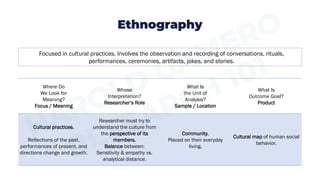
Ethnography
Focused in cultural practices. Involves the observation and recording of conversations, rituals,
performances, ceremonies, artifacts, jokes, and stories.
Where Do
We Look for
Meaning?
Focus / Meaning
Whose
Interpretation?
Researcher’s Role
What Is
the Unit of
Analysis?
Sample / Location
What Is
Outcome Goal?
Product
Cultural practices.
Reflections of the past,
performances of present, and
directions change and growth.
Researcher must try to
understand the culture from
the perspective of its
members.
Balance between:
Sensitivity & empathy vs.
analytical distance.
Community.
Placed on their everyday
living.
Cultural map of human social
behavior.
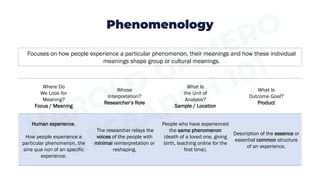
Phenomenology
Focuses on how people experience a particular phenomenon, their meanings and how these individual
meanings shape group or cultural meanings.
Where Do
We Look for
Meaning?
Focus / Meaning
Whose
Interpretation?
Researcher’s Role
What Is
the Unit of
Analysis?
Sample / Location
What Is
Outcome Goal?
Product
Human experience.
How people experience a
particular phenomenon, the
sine qua non of an specific
experience.
The researcher relays the
voices of the people with
minimal reinterpretation or
reshaping.
People who have experienced
the same phenomenon
(death of a loved one, giving
birth, teaching online for the
first time).
Description of the essence or
essential common structure
of an experience.
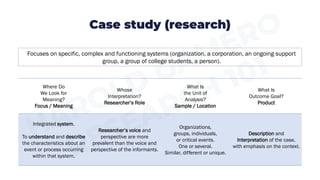
Case study (research)
Focuses on specific, complex and functioning systems (organization, a corporation, an ongoing support
group, a group of college students, a person).
Where Do
We Look for
Meaning?
Focus / Meaning
Whose
Interpretation?
Researcher’s Role
What Is
the Unit of
Analysis?
Sample / Location
What Is
Outcome Goal?
Product
Integrated system.
To understand and describe
the characteristics about an
event or process occurring
within that system.
Researcher’s voice and
perspective are more
prevalent than the voice and
perspective of the informants.
Organizations,
groups, individuals,
or critical events.
One or several.
Similar, different or unique.
Description and
Interpretation of the case,
with emphasis on the context.
Textual Analysis
Involves the identification and interpretation of a set of verbal or nonverbal signs (textual, visual,
audiovisual, dynamics, etc.).
Where Do
We Look for
Meaning?
Focus / Meaning
Whose
Interpretation?
Researcher’s Role
What Is
the Unit of
Analysis?
Sample / Location
What Is
Outcome Goal?
Product
Language and
Symbols
Set of verbal or nonverbal
signs.
Researcher is the interpreter
of the selected text or texts.
Even when other
interpretations are sought.
Any object or verbal or visual
text that carries symbolic
meaning is a source for
textual analysis.
(films, speeches, ads, books,
memorials, magazines, etc.)
Researcher interpretation of
the texts, supported by
examples or excerpts from
the sample.
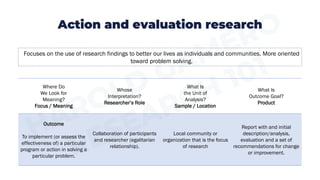
Action and evaluation research
Focuses on the use of research findings to better our lives as individuals and communities. More oriented
toward problem solving.
Where Do
We Look for
Meaning?
Focus / Meaning
Whose
Interpretation?
Researcher’s Role
What Is
the Unit of
Analysis?
Sample / Location
What Is
Outcome Goal?
Product
Outcome
To implement (or assess the
effectiveness of) a particular
program or action in solving a
particular problem.
Collaboration of participants
and researcher (egalitarian
relationship).
Local community or
organization that is the focus
of research
Report with and initial
description/analysis,
evaluation and a set of
recommendations for change
or improvement.
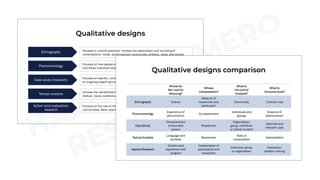
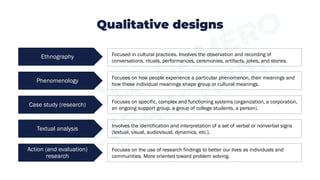
Qualitative designs
Phenomenology
Focused in cultural practices. Involves the observation and recording of
conversations, rituals, performances, ceremonies, artifacts, jokes, and stories.
Case study (research)
Textual analysis
Action (and evaluation)
research
Ethnography
Focuses on how people experience a particular phenomenon, their meanings and
how these individual meanings shape group or cultural meanings.
Focuses on specific, complex and functioning systems (organization, a corporation,
an ongoing support group, a group of college students, a person).
Involves the identification and interpretation of a set of verbal or nonverbal signs
(textual, visual, audiovisual, dynamics, etc.).
Focuses on the use of research findings to better our lives as individuals and
communities. More oriented toward problem solving.
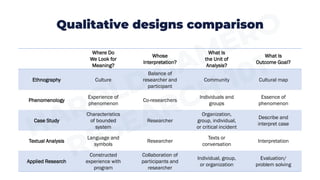
Where Do
We Look for
Meaning?
Whose
Interpretation?
What Is
the Unit of
Analysis?
What Is
Outcome Goal?
Ethnography Culture
Balance of
researcher and
participant
Community Cultural map
Phenomenology
Experience of
phenomenon
Co-researchers
Individuals and
groups
Essence of
phenomenon
Case Study
Characteristics
of bounded
system
Researcher
Organization,
group, individual,
or critical incident
Describe and
interpret case
Textual Analysis
Language and
symbols
Researcher
Texts or
conversation
Interpretation
Applied Research
Constructed
experience with
program
Collaboration of
participants and
researcher
Individual, group,
or organization
Evaluation/
problem solving
Qualitative designs comparison
Thank you.
Harold Gamero

Research 101: Qualitative Research Designs

  • 1.
    Research 101: QualitativeDesigns Harold Gamero
  • 3.
    Ethnography Focused in culturalpractices. Involves the observation and recording of conversations, rituals, performances, ceremonies, artifacts, jokes, and stories. Where Do We Look for Meaning? Focus / Meaning Whose Interpretation? Researcher’s Role What Is the Unit of Analysis? Sample / Location What Is Outcome Goal? Product Cultural practices. Reflections of the past, performances of present, and directions change and growth. Researcher must try to understand the culture from the perspective of its members. Balance between: Sensitivity & empathy vs. analytical distance. Community. Placed on their everyday living. Cultural map of human social behavior.
  • 4.
    Phenomenology Focuses on howpeople experience a particular phenomenon, their meanings and how these individual meanings shape group or cultural meanings. Where Do We Look for Meaning? Focus / Meaning Whose Interpretation? Researcher’s Role What Is the Unit of Analysis? Sample / Location What Is Outcome Goal? Product Human experience. How people experience a particular phenomenon, the sine qua non of an specific experience. The researcher relays the voices of the people with minimal reinterpretation or reshaping. People who have experienced the same phenomenon (death of a loved one, giving birth, teaching online for the first time). Description of the essence or essential common structure of an experience.
  • 5.
    Case study (research) Focuseson specific, complex and functioning systems (organization, a corporation, an ongoing support group, a group of college students, a person). Where Do We Look for Meaning? Focus / Meaning Whose Interpretation? Researcher’s Role What Is the Unit of Analysis? Sample / Location What Is Outcome Goal? Product Integrated system. To understand and describe the characteristics about an event or process occurring within that system. Researcher’s voice and perspective are more prevalent than the voice and perspective of the informants. Organizations, groups, individuals, or critical events. One or several. Similar, different or unique. Description and Interpretation of the case, with emphasis on the context.
  • 6.
    Textual Analysis Involves theidentification and interpretation of a set of verbal or nonverbal signs (textual, visual, audiovisual, dynamics, etc.). Where Do We Look for Meaning? Focus / Meaning Whose Interpretation? Researcher’s Role What Is the Unit of Analysis? Sample / Location What Is Outcome Goal? Product Language and Symbols Set of verbal or nonverbal signs. Researcher is the interpreter of the selected text or texts. Even when other interpretations are sought. Any object or verbal or visual text that carries symbolic meaning is a source for textual analysis. (films, speeches, ads, books, memorials, magazines, etc.) Researcher interpretation of the texts, supported by examples or excerpts from the sample.
  • 7.
    Action and evaluationresearch Focuses on the use of research findings to better our lives as individuals and communities. More oriented toward problem solving. Where Do We Look for Meaning? Focus / Meaning Whose Interpretation? Researcher’s Role What Is the Unit of Analysis? Sample / Location What Is Outcome Goal? Product Outcome To implement (or assess the effectiveness of) a particular program or action in solving a particular problem. Collaboration of participants and researcher (egalitarian relationship). Local community or organization that is the focus of research Report with and initial description/analysis, evaluation and a set of recommendations for change or improvement.
  • 8.
    Qualitative designs Phenomenology Focused incultural practices. Involves the observation and recording of conversations, rituals, performances, ceremonies, artifacts, jokes, and stories. Case study (research) Textual analysis Action (and evaluation) research Ethnography Focuses on how people experience a particular phenomenon, their meanings and how these individual meanings shape group or cultural meanings. Focuses on specific, complex and functioning systems (organization, a corporation, an ongoing support group, a group of college students, a person). Involves the identification and interpretation of a set of verbal or nonverbal signs (textual, visual, audiovisual, dynamics, etc.). Focuses on the use of research findings to better our lives as individuals and communities. More oriented toward problem solving.
  • 9.
    Where Do We Lookfor Meaning? Whose Interpretation? What Is the Unit of Analysis? What Is Outcome Goal? Ethnography Culture Balance of researcher and participant Community Cultural map Phenomenology Experience of phenomenon Co-researchers Individuals and groups Essence of phenomenon Case Study Characteristics of bounded system Researcher Organization, group, individual, or critical incident Describe and interpret case Textual Analysis Language and symbols Researcher Texts or conversation Interpretation Applied Research Constructed experience with program Collaboration of participants and researcher Individual, group, or organization Evaluation/ problem solving Qualitative designs comparison
  • 10.