Nursing education
seminar on
administering a test,
scoring, grading
versus marks
Administering a test:-
introduction
 Administering the written test is perhaps the
most important aspect of the examining process.
 The test administrator’s manner, bearing, and
attitude may well inspire confidence in
competitors and put them at ease while
participating in the testing process.
Steps of administering a test
motivate
direction
Time
accuracy
record
Collection
Principles in test administration:-
 all students must be given a fair chance to
demonstrates their achievement of the learning
 Students will not perform at their best if they are
tense an anxious during testing, the antidote to
anxiety is to convey to students, by word and deed,
that the test results are to be used to help them to
complete the test.
Avoiding things while testing:-
1). Avoid talking
2). Keep
interruption
3). Avoid
giving
hints
4).
Discourage
cheating
Environmental condition
Conti...
Distributing material
Conti...
Answering questions during test
Conti...
Preventing cheating
Conti...
Collecting test material
Conti...
Collaborative testing
scoring
Introduction:-
 Some standardized testing uses
multiple-choice tests, which are
relatively inexpensive to score, but
any form of assessment can be used.
Scoring issues:-
 Human scoring is often variable, which is why
computer scoring is preferred when feasible.
 Open-ended components of tests are often only a
small proportion of the test. Most commonly, a
major test includes both human-scored and
computer-scored sections. These major tests do not
measure the student's overall ability in learning.
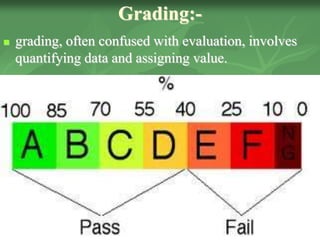
Grading:-
 grading, often confused with evaluation, involves
quantifying data and assigning value.
Methods of grading:-
 Analytic method:-
 Advantages of analytic method:-
 It can yield very reliable scores.
 The preparation of detailed answer may bring to the
teachers. Attention such errors as faculty wording
extreme difficulty, complexity of the question and
unrealistic time; limits.
 The subdivision of the model answer can make it
easier to discuss with the students the marks
awarded to them.
Limitations of analytical method:-
 It is very laborious and time
consuming.
 In attempting to identify the elements,
Undue attention may be given to
superficial aspects.
Global method:-
 In global scoring the ideal answer is not subdivided
into specific points and component points. the
examiner is interacted to read the responses rapidly
from a general impression and using some slandered
assign a rating to the responses-use good-average-
poor for final discrimination use.
 Advantages:-it is very effective when large
numbers of essays are to be ready.
MARKING: -
 marking or scoring is the process of awarding
a number (usually), or a symbol to represent
the level of student learning achievement. The

most common method is by adding up the
number of correct answers on a test, and
assigning a number that correlates
Marking schemes:-
Marking Criteria and Standards
 Marking criteria are the categories or dimensions
that the marker will be using to judge the student
work. (e.g. quality of argument, research, technical
aspects, etc).
 Standards are the actual level of performance which
might be achieved by students against each criterion.
Marking criteria:-
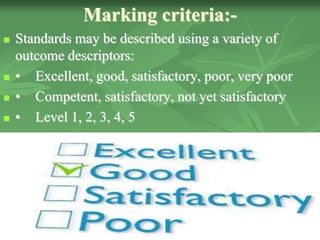
 Standards may be described using a variety of
outcome descriptors:
 • Excellent, good, satisfactory, poor, very poor
 • Competent, satisfactory, not yet satisfactory
 • Level 1, 2, 3, 4, 5
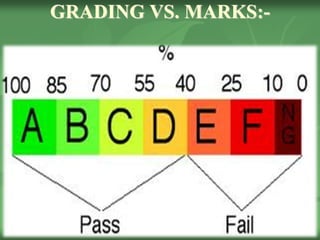
GRADING VS. MARKS:-
Conti....
 symbolic representations that summarise the quality
of student work and level of achievement.
 A grading system and a "marks" system are really
the same thing, so one of them is not better than the
other.
 Both the marking system and the grading system
have their pros and cons. Whereas marks help
students identify their exact scores, grades place
students in predefined categories such as A and B.
 Under the marking system, even if two students are
of similar calibre, one can ace out the other by a
fraction of a point.
Conti...
 This level of assessment encourages
competitiveness.
 To score that one extra mark,
students devote more time to
study and pay attention to detail.
The positive side-effect of this is
that the students acquire knowledge.
administrating test,scoring,grading vs marks

administrating test,scoring,grading vs marks

  • 1.
    Nursing education seminar on administeringa test, scoring, grading versus marks
  • 2.
    Administering a test:- introduction Administering the written test is perhaps the most important aspect of the examining process.  The test administrator’s manner, bearing, and attitude may well inspire confidence in competitors and put them at ease while participating in the testing process.
  • 3.
    Steps of administeringa test motivate direction Time accuracy record Collection
  • 4.
    Principles in testadministration:-  all students must be given a fair chance to demonstrates their achievement of the learning  Students will not perform at their best if they are tense an anxious during testing, the antidote to anxiety is to convey to students, by word and deed, that the test results are to be used to help them to complete the test.
  • 5.
    Avoiding things whiletesting:- 1). Avoid talking 2). Keep interruption 3). Avoid giving hints 4). Discourage cheating
  • 6.
  • 7.
  • 8.
  • 9.
  • 10.
  • 11.
  • 12.
  • 13.
    Introduction:-  Some standardizedtesting uses multiple-choice tests, which are relatively inexpensive to score, but any form of assessment can be used.
  • 14.
    Scoring issues:-  Humanscoring is often variable, which is why computer scoring is preferred when feasible.  Open-ended components of tests are often only a small proportion of the test. Most commonly, a major test includes both human-scored and computer-scored sections. These major tests do not measure the student's overall ability in learning.
  • 15.
    Grading:-  grading, oftenconfused with evaluation, involves quantifying data and assigning value.
  • 16.
    Methods of grading:- Analytic method:-  Advantages of analytic method:-  It can yield very reliable scores.  The preparation of detailed answer may bring to the teachers. Attention such errors as faculty wording extreme difficulty, complexity of the question and unrealistic time; limits.  The subdivision of the model answer can make it easier to discuss with the students the marks awarded to them.
  • 17.
    Limitations of analyticalmethod:-  It is very laborious and time consuming.  In attempting to identify the elements, Undue attention may be given to superficial aspects.
  • 18.
    Global method:-  Inglobal scoring the ideal answer is not subdivided into specific points and component points. the examiner is interacted to read the responses rapidly from a general impression and using some slandered assign a rating to the responses-use good-average- poor for final discrimination use.  Advantages:-it is very effective when large numbers of essays are to be ready.
  • 19.
    MARKING: -  markingor scoring is the process of awarding a number (usually), or a symbol to represent the level of student learning achievement. The most common method is by adding up the number of correct answers on a test, and assigning a number that correlates
  • 20.
  • 21.
    Marking Criteria andStandards  Marking criteria are the categories or dimensions that the marker will be using to judge the student work. (e.g. quality of argument, research, technical aspects, etc).  Standards are the actual level of performance which might be achieved by students against each criterion.
  • 22.
    Marking criteria:-  Standardsmay be described using a variety of outcome descriptors:  • Excellent, good, satisfactory, poor, very poor  • Competent, satisfactory, not yet satisfactory  • Level 1, 2, 3, 4, 5
  • 23.
  • 24.
    Conti....  symbolic representationsthat summarise the quality of student work and level of achievement.  A grading system and a "marks" system are really the same thing, so one of them is not better than the other.  Both the marking system and the grading system have their pros and cons. Whereas marks help students identify their exact scores, grades place students in predefined categories such as A and B.  Under the marking system, even if two students are of similar calibre, one can ace out the other by a fraction of a point.
  • 25.
    Conti...  This levelof assessment encourages competitiveness.  To score that one extra mark, students devote more time to study and pay attention to detail. The positive side-effect of this is that the students acquire knowledge.