Presented By
Content
 Interview
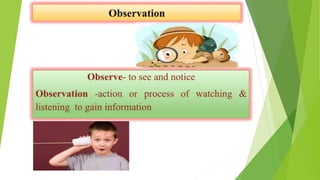
 Observation
 Focus Group Discussion
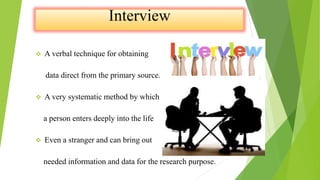
 A verbal technique for obtaining
data direct from the primary source.
 A very systematic method by which
a person enters deeply into the life
 Even a stranger and can bring out
needed information and data for the research purpose.
 C. F. Cannell and R. N. Kahn (1975): There are three essential element of
interviews
 Accessibility
 Cognitive Condition
 Motivation
 Honesty
 Interest
 Accuracy
 Adaptability
 Personality and temperament
 Intelligent and education
 Special skill
 Appropriate preparation
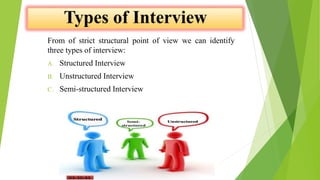
From of strict structural point of view we can identify
three types of interview:
A. Structured Interview
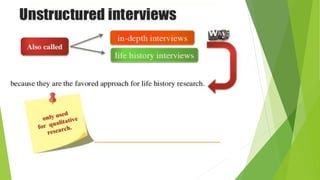
B. Unstructured Interview
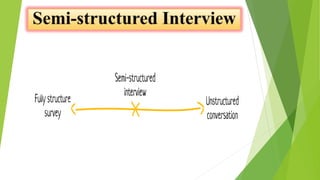
C. Semi-structured Interview
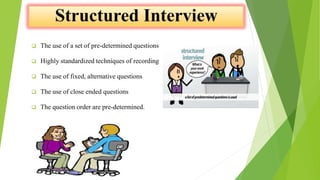
 The use of a set of pre-determined questions
 Highly standardized techniques of recording
 The use of fixed, alternative questions
 The use of close ended questions
 The question order are pre-determined.
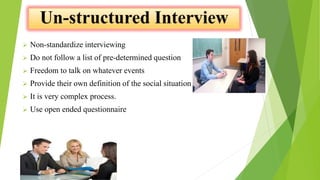
 Non-standardize interviewing
 Do not follow a list of pre-determined question
 Freedom to talk on whatever events
 Provide their own definition of the social situation
 It is very complex process.
 Use open ended questionnaire
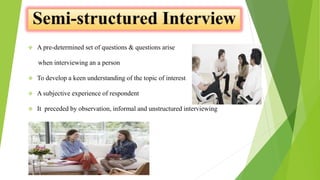
 A pre-determined set of questions & questions arise
when interviewing an a person
 To develop a keen understanding of the topic of interest
 A subjective experience of respondent
 It preceded by observation, informal and unstructured interviewing
Besides These
 Clinical Interview
 Telephone Interview
 E-Mail Interviews
 It may not be possible to gather groups of
individuals or to visit one-on-one
 An asking a small number of general
questions
 Closed site access
 Use open ended question
 A researcher does not have direct contact with the participant
 Limited communication to understand the interviewee’s
perceptions of the phenomenon
 A geographically dispersed group
of people
 To provides rapid access to large
numbers of people
 To promote follow-up
conversations
 To raise complex ethical issues
 May be unstructured, semi structured, or structured
 Try to understand individual feeling and motivation
 Information of the client is willing to share
 Face-to-face interaction between a client and interviewer
 An intake interview, an admission interview, a mental status exam or a diagnostic
interview.
1) Participant
2) Non- participant
3) Experiment
 Independent & Dependent variable
 Pre- testing, pro-testing
 Experimental & control groups
4) Audio visual/recording observation
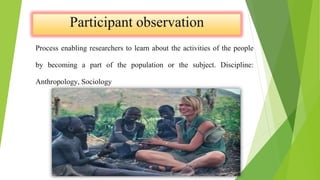
Process enabling researchers to learn about the activities of the people
by becoming a part of the population or the subject. Discipline:
Anthropology, Sociology
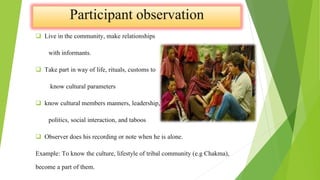
 Live in the community, make relationships
with informants.
 Take part in way of life, rituals, customs to
know cultural parameters
 know cultural members manners, leadership,
politics, social interaction, and taboos
 Observer does his recording or note when he is alone.
Example: To know the culture, lifestyle of tribal community (e.g Chakma),
become a part of them.
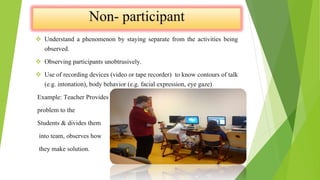
 Understand a phenomenon by staying separate from the activities being
observed.
 Observing participants unobtrusively.
 Use of recording devices (video or tape recorder) to know contours of talk
(e.g. intonation), body behavior (e.g. facial expression, eye gaze)
Example: Teacher Provides a
problem to the
Students & divides them
into team, observes how
they make solution.
A mode of observation that takes action & observe the consequences of that
action.
 Select a group of subjects
 Do something to them
 Observe the effect of what was done
 It involves 3 components Independent & Dependent variable, Pre- testing,
post-testing, Experimental & control groups
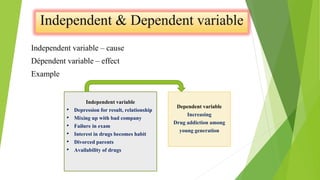
Independent variable – cause
Dépendent variable – effect
Example
Independent variable
• Depression for result, relationship
• Mixing up with bad company
• Failure in exam
• Interest in drugs becomes habit
• Divorced parents
• Availability of drugs
Dependent variable
Increasing
Drug addiction among
young generation
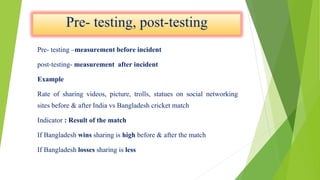
Pre- testing –measurement before incident
post-testing- measurement after incident
Example
Rate of sharing videos, picture, trolls, statues on social networking
sites before & after India vs Bangladesh cricket match
Indicator : Result of the match
If Bangladesh wins sharing is high before & after the match
If Bangladesh losses sharing is less
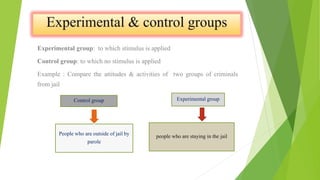
Experimental group: to which stimulus is applied
Control group: to which no stimulus is applied
Example : Compare the attitudes & activities of two groups of criminals
from jail
Control group
People who are outside of jail by
parole
Experimental group
people who are staying in the jail
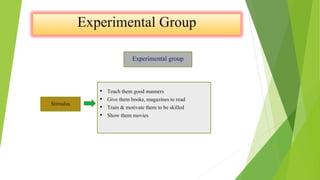
Experimental group
• Teach them good manners
• Give them books, magazines to read
• Train & motivate them to be skilled
• Show them movies
Stimulus
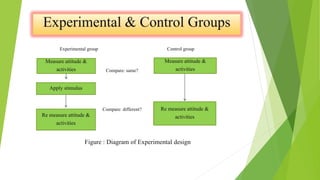
Experimental group Control group
Compare: same?
Compare: different?
Figure : Diagram of Experimental design
Measure attitude &
activities
Apply stimulus
Re measure attitude &
activities
Re measure attitude &
activities
Measure attitude &
activities
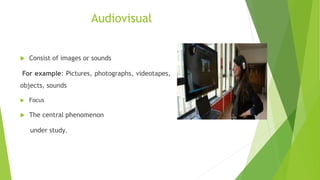
Audiovisual
 Consist of images or sounds
For example: Pictures, photographs, videotapes,
objects, sounds
 Focus
 The central phenomenon
under study.
Advantage
 people easily relate to images
 share directly their perceptions of reality
Disadvantage
 They are difficult to analyze
Focus group discussion(FGD)
Formally organized, structured groups of individuals
 “In-depth” research technique
 discuss a specific topic of interest
 guide future action
 also called group interviewing
Sample size
 Typically 5 to 15 people
For example: political or marketing research
Focus group discussion(FGD)
Advantage
 The technique is a socially oriented research
 method capturing real-life data in a social environment.
 It has flexibility.
 It has high face validity.
 It has speedy results.
 It is low in cost
Disadvantage
 Focus groups afford the researcher less control than individual interviews.
 Data are difficult to analyze.
 Moderators require special skills.
How are focus groups different from regular "groups"?
 has a specific, focused discussion topic.
 a trained leader, or facilitator.
 carefully planned to create a nonthreatening
environment
 Members are actively encouraged
Why are focus groups used?
 learn more about group or community opinions and needs
 what people are really thinking and feeling, their expression
 depth and complexity of response
When should you used FGD
 a new program or service
 asked or answered on a written survey
 time, knowledge, and resources
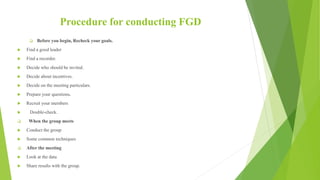
Procedure for conducting FGD
 Before you begin, Recheck your goals.
 Find a good leader
 Find a recorder.

 Decide who should be invited.
 Decide about incentives.
 Decide on the meeting particulars.
 Prepare your questions.
 Recruit your members
 Double-check.
 When the group meets
 Conduct the group
 Some common techniques
 After the meeting
 Look at the data
 Share results with the group.
Thank you
?

Techniques of data collection in qualitative method

  • 3.
  • 4.
  • 5.
     A verbaltechnique for obtaining data direct from the primary source.  A very systematic method by which a person enters deeply into the life  Even a stranger and can bring out needed information and data for the research purpose.
  • 6.
     C. F.Cannell and R. N. Kahn (1975): There are three essential element of interviews  Accessibility  Cognitive Condition  Motivation
  • 7.
     Honesty  Interest Accuracy  Adaptability  Personality and temperament  Intelligent and education  Special skill  Appropriate preparation
  • 8.
    From of strictstructural point of view we can identify three types of interview: A. Structured Interview B. Unstructured Interview C. Semi-structured Interview
  • 9.
     The useof a set of pre-determined questions  Highly standardized techniques of recording  The use of fixed, alternative questions  The use of close ended questions  The question order are pre-determined.
  • 11.
     Non-standardize interviewing Do not follow a list of pre-determined question  Freedom to talk on whatever events  Provide their own definition of the social situation  It is very complex process.  Use open ended questionnaire
  • 13.
     A pre-determinedset of questions & questions arise when interviewing an a person  To develop a keen understanding of the topic of interest  A subjective experience of respondent  It preceded by observation, informal and unstructured interviewing
  • 14.
    Besides These  ClinicalInterview  Telephone Interview  E-Mail Interviews
  • 15.
     It maynot be possible to gather groups of individuals or to visit one-on-one  An asking a small number of general questions  Closed site access  Use open ended question  A researcher does not have direct contact with the participant  Limited communication to understand the interviewee’s perceptions of the phenomenon
  • 16.
     A geographicallydispersed group of people  To provides rapid access to large numbers of people  To promote follow-up conversations  To raise complex ethical issues
  • 17.
     May beunstructured, semi structured, or structured  Try to understand individual feeling and motivation  Information of the client is willing to share  Face-to-face interaction between a client and interviewer  An intake interview, an admission interview, a mental status exam or a diagnostic interview.
  • 19.
    1) Participant 2) Non-participant 3) Experiment  Independent & Dependent variable  Pre- testing, pro-testing  Experimental & control groups 4) Audio visual/recording observation
  • 20.
    Process enabling researchersto learn about the activities of the people by becoming a part of the population or the subject. Discipline: Anthropology, Sociology
  • 21.
     Live inthe community, make relationships with informants.  Take part in way of life, rituals, customs to know cultural parameters  know cultural members manners, leadership, politics, social interaction, and taboos  Observer does his recording or note when he is alone. Example: To know the culture, lifestyle of tribal community (e.g Chakma), become a part of them.
  • 22.
     Understand aphenomenon by staying separate from the activities being observed.  Observing participants unobtrusively.  Use of recording devices (video or tape recorder) to know contours of talk (e.g. intonation), body behavior (e.g. facial expression, eye gaze) Example: Teacher Provides a problem to the Students & divides them into team, observes how they make solution.
  • 23.
    A mode ofobservation that takes action & observe the consequences of that action.  Select a group of subjects  Do something to them  Observe the effect of what was done  It involves 3 components Independent & Dependent variable, Pre- testing, post-testing, Experimental & control groups
  • 24.
    Independent variable –cause Dépendent variable – effect Example Independent variable • Depression for result, relationship • Mixing up with bad company • Failure in exam • Interest in drugs becomes habit • Divorced parents • Availability of drugs Dependent variable Increasing Drug addiction among young generation
  • 25.
    Pre- testing –measurementbefore incident post-testing- measurement after incident Example Rate of sharing videos, picture, trolls, statues on social networking sites before & after India vs Bangladesh cricket match Indicator : Result of the match If Bangladesh wins sharing is high before & after the match If Bangladesh losses sharing is less
  • 26.
    Experimental group: towhich stimulus is applied Control group: to which no stimulus is applied Example : Compare the attitudes & activities of two groups of criminals from jail Control group People who are outside of jail by parole Experimental group people who are staying in the jail
  • 27.
    Experimental group • Teachthem good manners • Give them books, magazines to read • Train & motivate them to be skilled • Show them movies Stimulus
  • 28.
    Experimental group Controlgroup Compare: same? Compare: different? Figure : Diagram of Experimental design Measure attitude & activities Apply stimulus Re measure attitude & activities Re measure attitude & activities Measure attitude & activities
  • 29.
    Audiovisual  Consist ofimages or sounds For example: Pictures, photographs, videotapes, objects, sounds  Focus  The central phenomenon under study.
  • 30.
    Advantage  people easilyrelate to images  share directly their perceptions of reality Disadvantage  They are difficult to analyze
  • 31.
    Focus group discussion(FGD) Formallyorganized, structured groups of individuals  “In-depth” research technique  discuss a specific topic of interest  guide future action  also called group interviewing Sample size  Typically 5 to 15 people For example: political or marketing research
  • 32.
    Focus group discussion(FGD) Advantage The technique is a socially oriented research  method capturing real-life data in a social environment.  It has flexibility.  It has high face validity.  It has speedy results.  It is low in cost Disadvantage  Focus groups afford the researcher less control than individual interviews.  Data are difficult to analyze.  Moderators require special skills.
  • 33.
    How are focusgroups different from regular "groups"?  has a specific, focused discussion topic.  a trained leader, or facilitator.  carefully planned to create a nonthreatening environment  Members are actively encouraged
  • 34.
    Why are focusgroups used?  learn more about group or community opinions and needs  what people are really thinking and feeling, their expression  depth and complexity of response When should you used FGD  a new program or service  asked or answered on a written survey  time, knowledge, and resources
  • 35.
    Procedure for conductingFGD  Before you begin, Recheck your goals.  Find a good leader  Find a recorder.  Decide who should be invited.  Decide about incentives.  Decide on the meeting particulars.  Prepare your questions.  Recruit your members  Double-check.  When the group meets  Conduct the group  Some common techniques  After the meeting  Look at the data  Share results with the group.
  • 36.