

Research 101:
Qualitative vs. Quantitative
Research
Harold Gamero
Paradigms of Social Science
• “Paradigms”, term popularized by Thomas Kuhn (1962).
• General philosophical orientation about the world and the nature of research.
• Reality can be seen in different ways by different people.
• “Mental frames” or “worldviews” that help to organize our reasoning and observations.
• 4 main paradigms in social sciences.
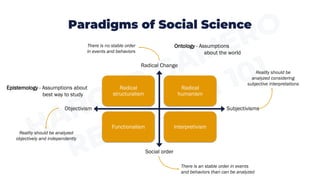
Paradigms of Social Science
Radical
structuralism
Radical
humanism
Functionalism Interpretivism
Social order
Radical Change
Subjectivisms
Objectivism
There is an stable order in events
and behaviors than can be analyzed
There is no stable order
in events and behaviors
Reality should be analyzed
objectively and independently
Reality should be
analyzed considering
subjective interpretations
Ontology - Assumptions
about the world
Epistemology - Assumptions about
best way to study
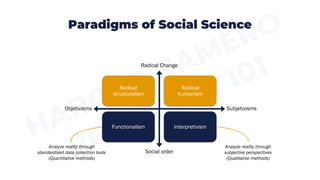
Paradigms of Social Science
Radical
structuralism
Radical
humanism
Functionalism Interpretivism
Social order
Radical Change
Subjetivisms
Objetivisms
Analyze reality through
standardized data collection tools
(Quantitative methods)
Analyze reality through
subjective perspectives
(Qualitative methods)
Paradigms of Social Science
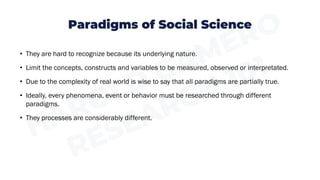
• They are hard to recognize because its underlying nature.
• Limit the concepts, constructs and variables to be measured, observed or interpretated.
• Due to the complexity of real world is wise to say that all paradigms are partially true.
• Ideally, every phenomena, event or behavior must be researched through different
paradigms.
• They processes are considerably different.
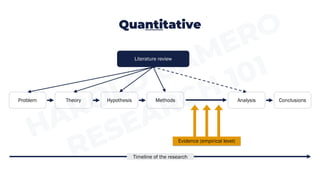
Quantitative
Problem Analysis
Evidence (empirical level)
Literature review
Theory Hypothesis Methods Conclusions
Timeline of the research
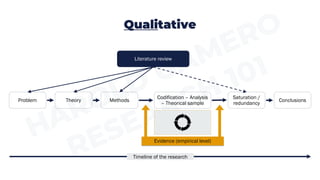
Qualitative
Problem
Saturation /
redundancy
Timeline of the research
Literature review
Theory Methods Conclusions
Evidence (empirical level)
Codification – Analysis
– Theorical sample
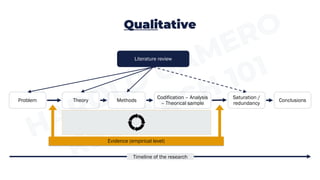
Qualitative
Problem
Saturation /
redundancy
Timeline of the research
Literature review
Theory Methods Conclusions
Evidence (empirical level)
Codification – Analysis
– Theorical sample
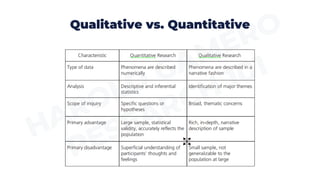
Qualitative vs. Quantitative
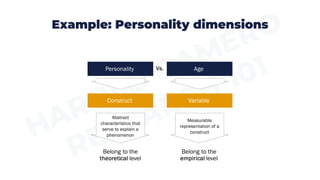
Example: Personality dimensions
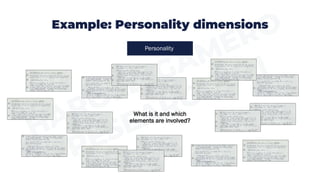
Personality
What is it and which
elements are involved?
Example: Personality dimensions
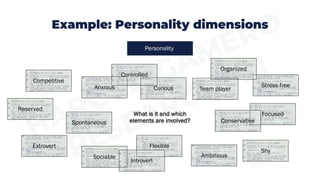
Personality
What is it and which
elements are involved?
Competitive
Controlled
Anxious Curious Team player
Organized
Stress free
Focused
Conservative
Shy
Ambitious
Flexible
Introvert
Sociable
Extrovert
Spontaneous
Reserved
Example: Personality dimensions
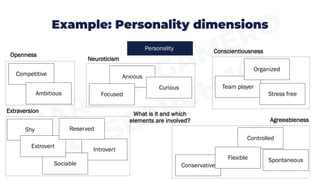
Personality
What is it and which
elements are involved?
Competitive
Controlled
Anxious
Curious Team player
Organized
Stress free
Focused
Conservative
Shy
Ambitious
Flexible
Introvert
Sociable
Extrovert
Spontaneous
Reserved
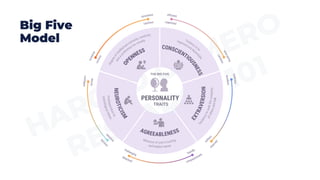
Openness
Conscientiousness
Agreeableness
Extraversion
Neuroticism
Big Five
Model
Thank you.
Harold Gamero

Research 101: Qualitative vs. Quantitative Research

  • 1.
    Research 101: Qualitative vs.Quantitative Research Harold Gamero
  • 2.
    Paradigms of SocialScience • “Paradigms”, term popularized by Thomas Kuhn (1962). • General philosophical orientation about the world and the nature of research. • Reality can be seen in different ways by different people. • “Mental frames” or “worldviews” that help to organize our reasoning and observations. • 4 main paradigms in social sciences.
  • 3.
    Paradigms of SocialScience Radical structuralism Radical humanism Functionalism Interpretivism Social order Radical Change Subjectivisms Objectivism There is an stable order in events and behaviors than can be analyzed There is no stable order in events and behaviors Reality should be analyzed objectively and independently Reality should be analyzed considering subjective interpretations Ontology - Assumptions about the world Epistemology - Assumptions about best way to study
  • 4.
    Paradigms of SocialScience Radical structuralism Radical humanism Functionalism Interpretivism Social order Radical Change Subjetivisms Objetivisms Analyze reality through standardized data collection tools (Quantitative methods) Analyze reality through subjective perspectives (Qualitative methods)
  • 5.
    Paradigms of SocialScience • They are hard to recognize because its underlying nature. • Limit the concepts, constructs and variables to be measured, observed or interpretated. • Due to the complexity of real world is wise to say that all paradigms are partially true. • Ideally, every phenomena, event or behavior must be researched through different paradigms. • They processes are considerably different.
  • 6.
    Quantitative Problem Analysis Evidence (empiricallevel) Literature review Theory Hypothesis Methods Conclusions Timeline of the research
  • 7.
    Qualitative Problem Saturation / redundancy Timeline ofthe research Literature review Theory Methods Conclusions Evidence (empirical level) Codification – Analysis – Theorical sample
  • 8.
    Qualitative Problem Saturation / redundancy Timeline ofthe research Literature review Theory Methods Conclusions Evidence (empirical level) Codification – Analysis – Theorical sample
  • 9.
  • 10.
  • 11.
    Example: Personality dimensions Personality Whatis it and which elements are involved?
  • 12.
    Example: Personality dimensions Personality Whatis it and which elements are involved? Competitive Controlled Anxious Curious Team player Organized Stress free Focused Conservative Shy Ambitious Flexible Introvert Sociable Extrovert Spontaneous Reserved
  • 13.
    Example: Personality dimensions Personality Whatis it and which elements are involved? Competitive Controlled Anxious Curious Team player Organized Stress free Focused Conservative Shy Ambitious Flexible Introvert Sociable Extrovert Spontaneous Reserved Openness Conscientiousness Agreeableness Extraversion Neuroticism
  • 14.
  • 16.