Research 101: Types of Research
Harold Gamero
Understand &
explain reality
Different
worldviews
Complexity
of reality
Basic research Applied research
Meaning
It is aimed to expand the
existing base of
scientific knowledge.
Designed to solve specific
practical problems or answer
certain questions.
Nature Theoretical - Empirical Practical
Utility Universal Limited
Concerned
with
Developing scientific
knowledge and predictions
Development of technology
and technique
Goal
To add some knowledge
to the existing one.
To find out a solution for
an existing problem/need.
Scientific?
Works within the
scientific cycle
No connection with
the scientific cycle
Applied research
Basic research
(fundamental or pure)
• Any research that fits in the scientific
circle.
• Variety of designs, techniques and
methods.
• Development of new technologies
(hardware & software)
• Business plans, strategic analysis,
market research, etc.
• Professional researches or business
consulting (journalists, forensics, police,
detectives, engineers, accountants,
managers, etc.)
• Can use the same designs, techniques
and methods as basic researches
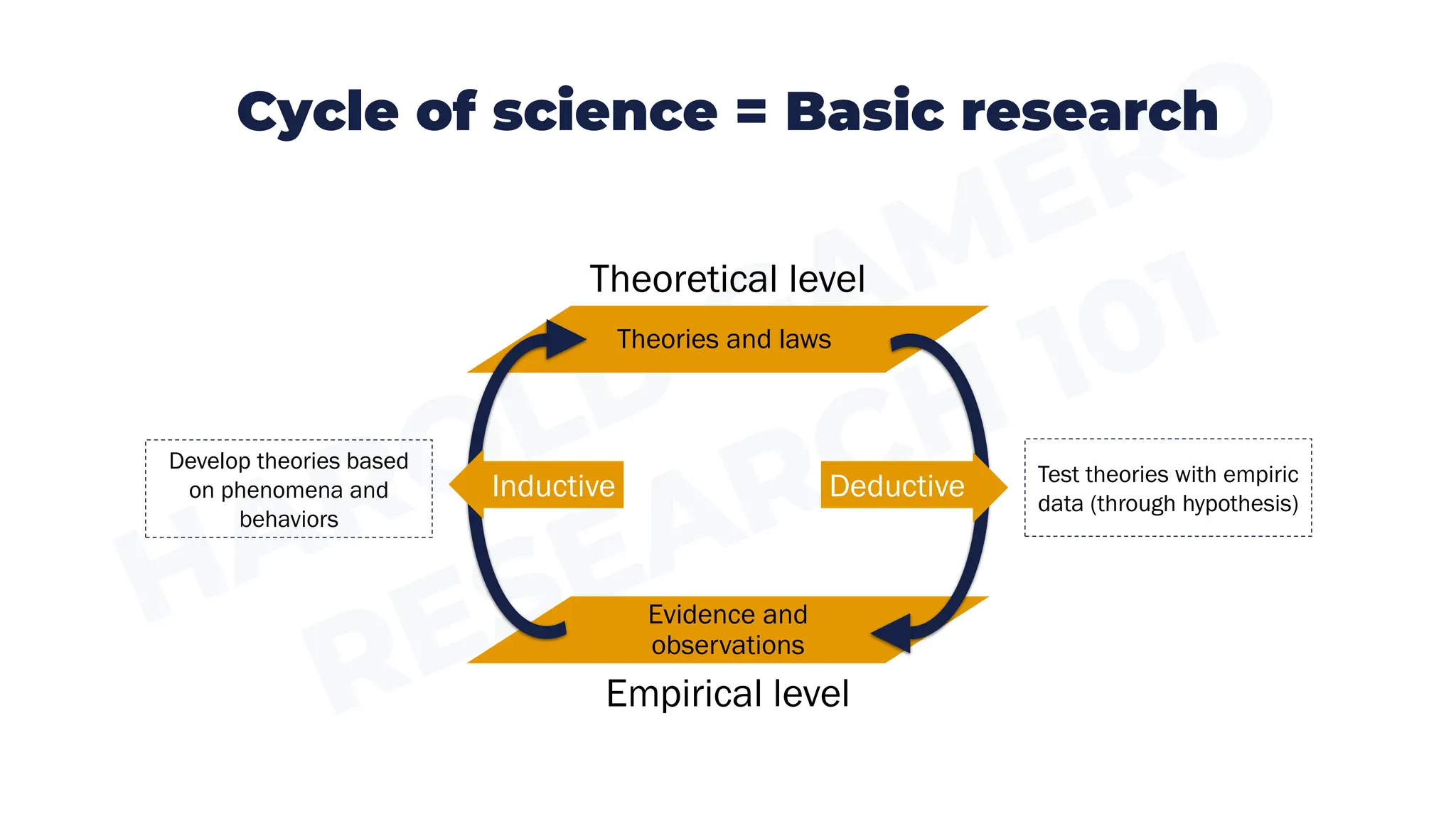
Cycle of science = Basic research
Theories and laws
Evidence and
observations
Theoretical level
Empirical level
Develop theories based
on phenomena and
behaviors
Test theories with empiric
data (through hypothesis)
Deductive
Inductive
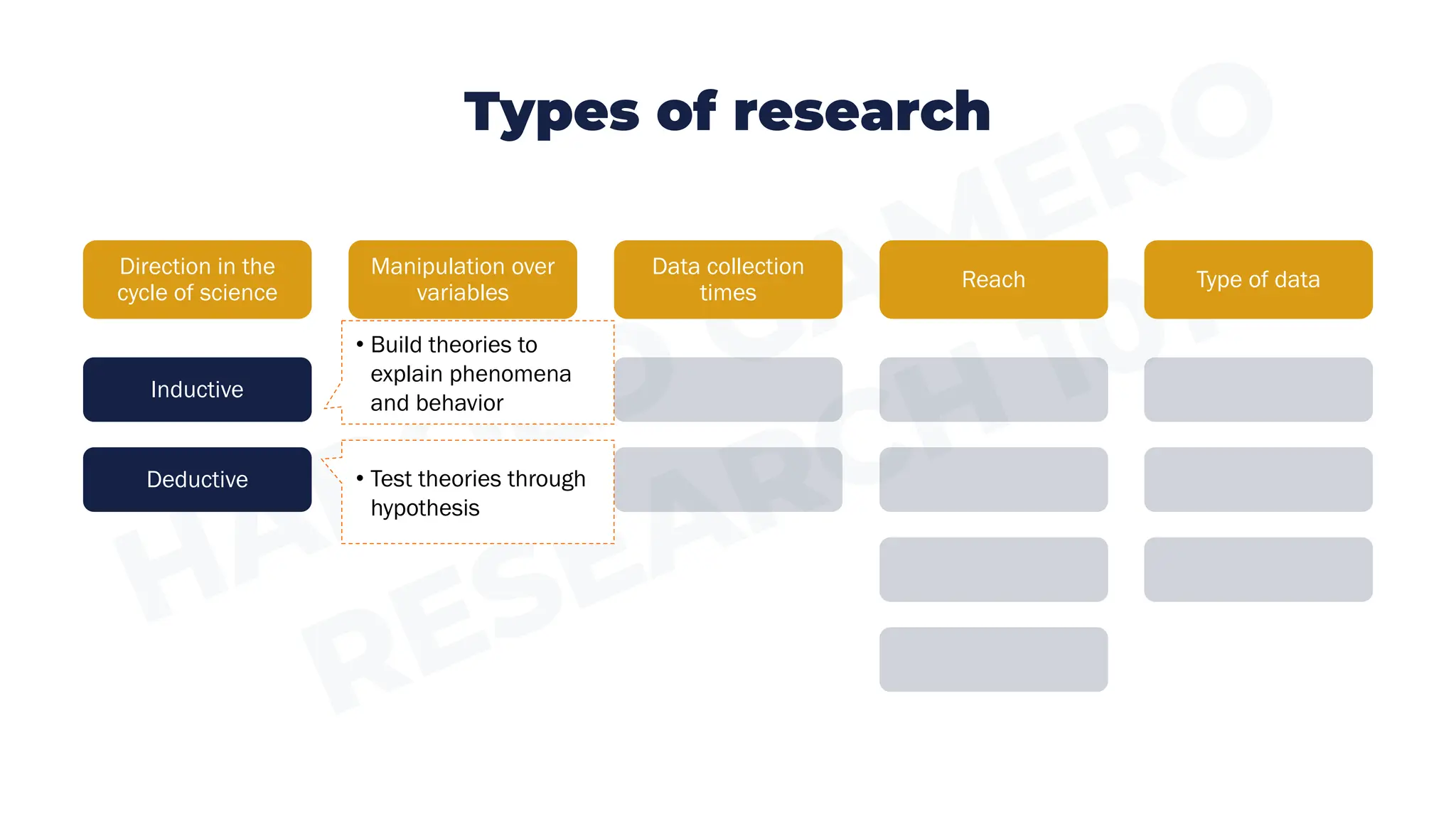
Types of research
Types of research
Direction in the
cycle of science
Reach Type of data
Manipulation over
variables
Data collection
times
Types of research
Inductive
Deductive
Direction in the
cycle of science
Reach Type of data
Manipulation over
variables
Data collection
times
• Test theories through
hypothesis
• Build theories to
explain phenomena
and behavior
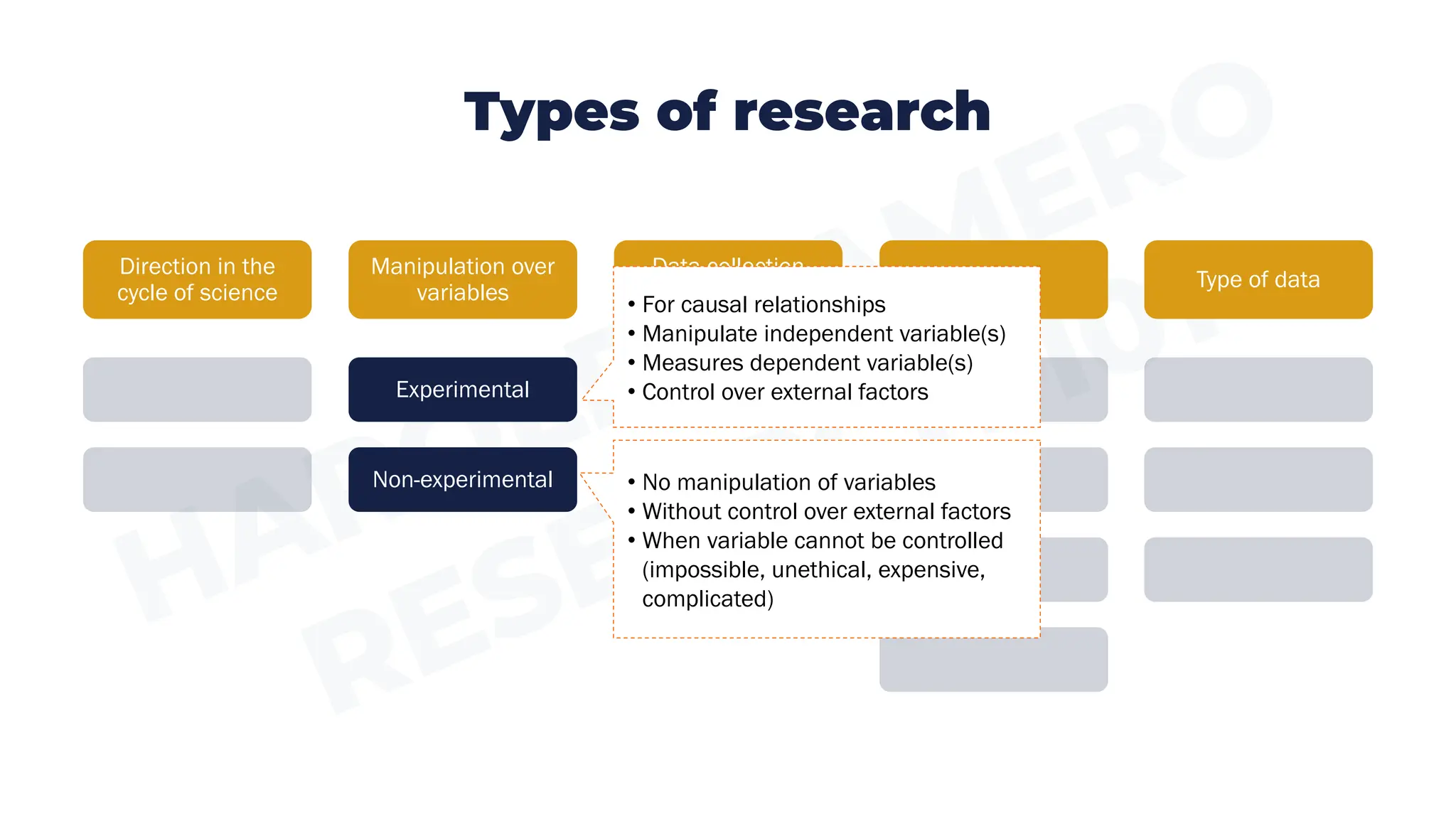
Types of research
Direction in the
cycle of science
Reach Type of data
Manipulation over
variables
Non-experimental
Experimental
Data collection
times
• For causal relationships
• Manipulate independent variable(s)
• Measures dependent variable(s)
• Control over external factors
• No manipulation of variables
• Without control over external factors
• When variable cannot be controlled
(impossible, unethical, expensive,
complicated)
Types of research
Direction in the
cycle of science
Reach Type of data
Manipulation over
variables
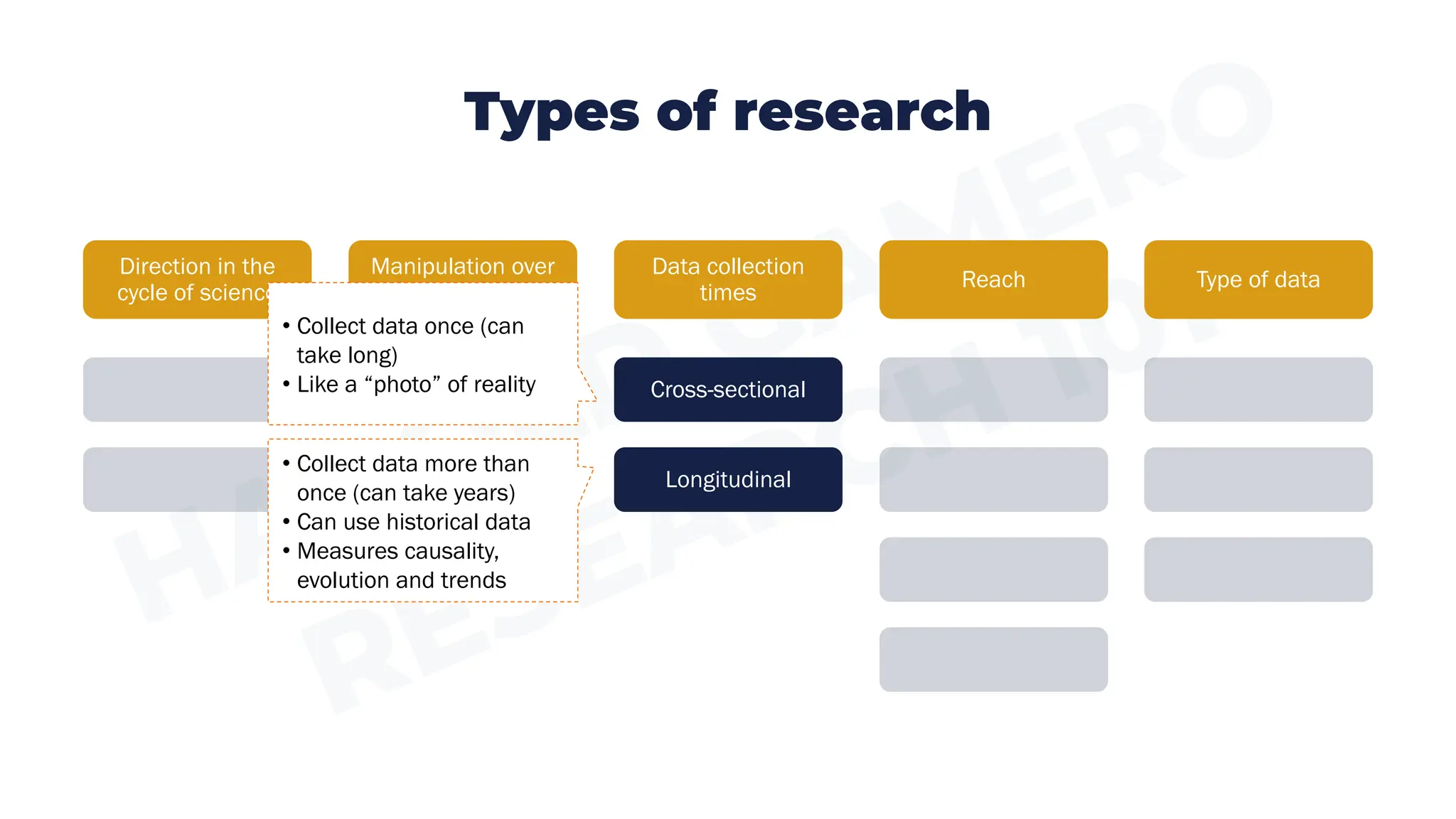
Longitudinal
Cross-sectional
Data collection
times
• Collect data more than
once (can take years)
• Can use historical data
• Measures causality,
evolution and trends
• Collect data once (can
take long)
• Like a “photo” of reality
Types of research
Direction in the
cycle of science
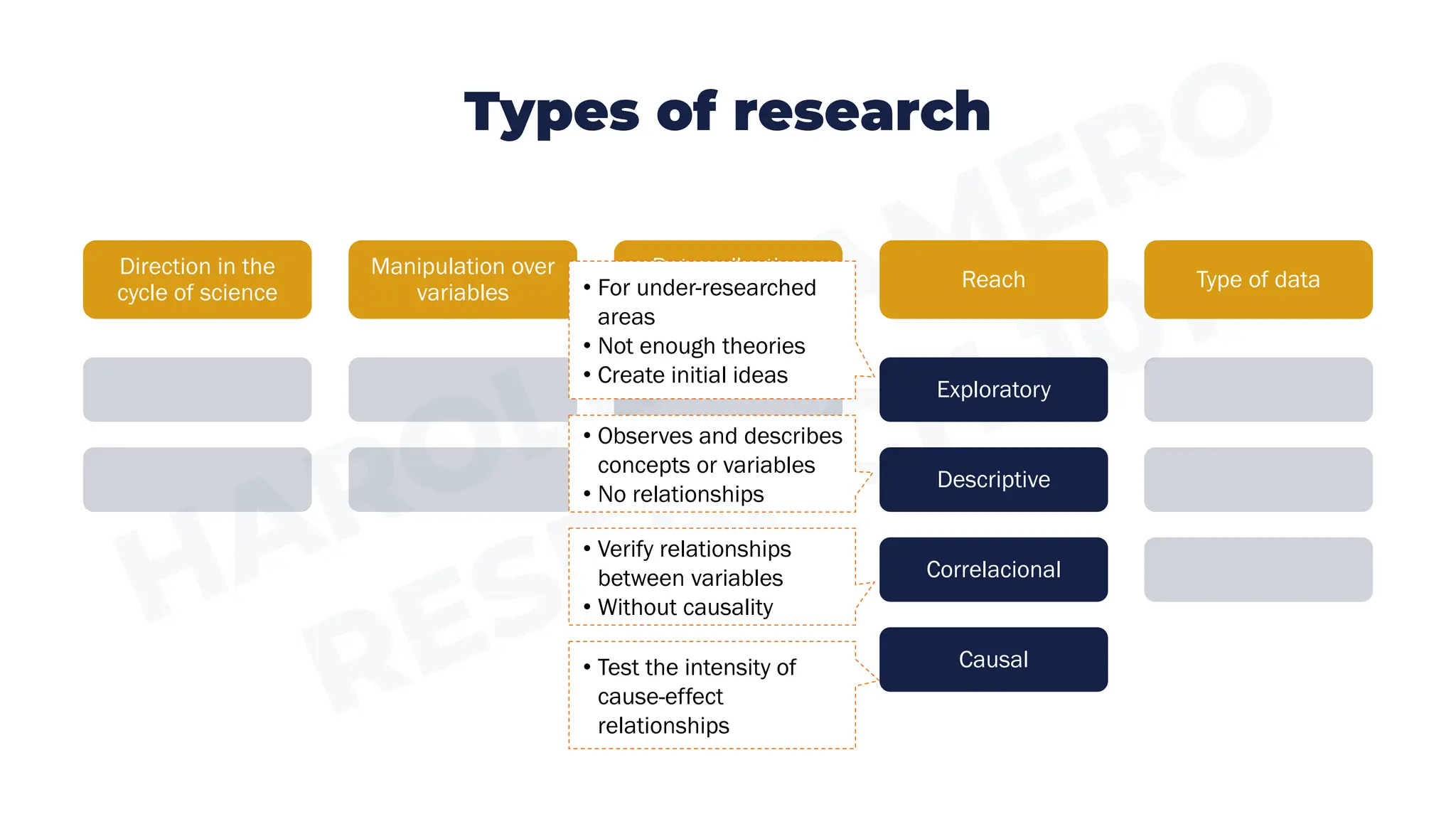
Exploratory
Descriptive
Correlacional
Causal
Reach Type of data
Manipulation over
variables
Data collection
times
• Verify relationships
between variables
• Without causality
• Test the intensity of
cause-effect
relationships
• Observes and describes
concepts or variables
• No relationships
• For under-researched
areas
• Not enough theories
• Create initial ideas
Types of research
Direction in the
cycle of science
Reach
Qualitative
Quantitative
Mixed
Type of data
Manipulation over
variables
Data collection
times • Use standardized
instruments
• Results can be
extrapolated
• Wide approach
• Detail enriched
information
• Deep approach
• Benefits of both
approaches
• More resource intake
Types of research
Inductive
Deductive
Direction in the
cycle of science
Exploratory
Descriptive
Correlacional
Causal
Reach
Qualitative
Quantitative
Mixed
Type of data
Manipulation over
variables
Non-experimental
Experimental
Longitudinal
Cross-sectional
Data collection
times
Types of research
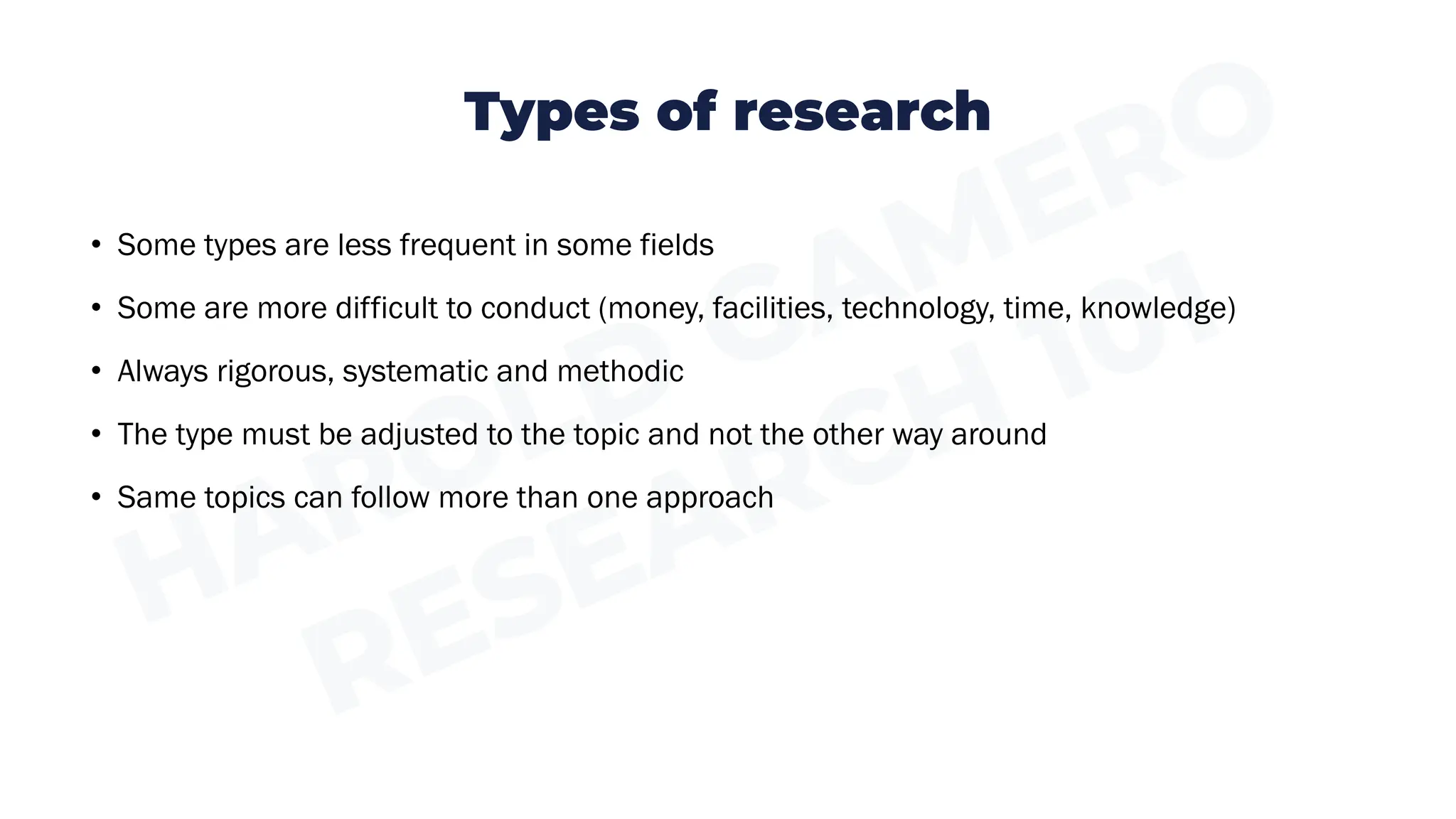
• Some types are less frequent in some fields
• Some are more difficult to conduct (money, facilities, technology, time, knowledge)
• Always rigorous, systematic and methodic
• The type must be adjusted to the topic and not the other way around
• Same topics can follow more than one approach
Relationship between self-esteem and
addiction to social networks among teenagers
Direction in the
cycle of science
Reach Type of data
Manipulation over
variables
Data collection
times
Deductive
Correlacional
Quantitative
Mixed
Non-experimental Longitudinal
Cross-sectional
Insights into the factors influencing student
motivation in e-learning environments
Direction in the
cycle of science
Reach Type of data
Manipulation over
variables
Data collection
times
Inductive Exploratory
Qualitative
Mixed
Non-experimental Longitudinal
Cross-sectional
Thank you.
Harold Gamero

Research 101: Types of Scientific Research

  • 1.
    Research 101: Typesof Research Harold Gamero
  • 2.
  • 3.
  • 4.
    Basic research Appliedresearch Meaning It is aimed to expand the existing base of scientific knowledge. Designed to solve specific practical problems or answer certain questions. Nature Theoretical - Empirical Practical Utility Universal Limited Concerned with Developing scientific knowledge and predictions Development of technology and technique Goal To add some knowledge to the existing one. To find out a solution for an existing problem/need. Scientific? Works within the scientific cycle No connection with the scientific cycle
  • 5.
    Applied research Basic research (fundamentalor pure) • Any research that fits in the scientific circle. • Variety of designs, techniques and methods. • Development of new technologies (hardware & software) • Business plans, strategic analysis, market research, etc. • Professional researches or business consulting (journalists, forensics, police, detectives, engineers, accountants, managers, etc.) • Can use the same designs, techniques and methods as basic researches
  • 6.
    Cycle of science= Basic research Theories and laws Evidence and observations Theoretical level Empirical level Develop theories based on phenomena and behaviors Test theories with empiric data (through hypothesis) Deductive Inductive
  • 7.
  • 8.
    Types of research Directionin the cycle of science Reach Type of data Manipulation over variables Data collection times
  • 9.
    Types of research Inductive Deductive Directionin the cycle of science Reach Type of data Manipulation over variables Data collection times • Test theories through hypothesis • Build theories to explain phenomena and behavior
  • 10.
    Types of research Directionin the cycle of science Reach Type of data Manipulation over variables Non-experimental Experimental Data collection times • For causal relationships • Manipulate independent variable(s) • Measures dependent variable(s) • Control over external factors • No manipulation of variables • Without control over external factors • When variable cannot be controlled (impossible, unethical, expensive, complicated)
  • 11.
    Types of research Directionin the cycle of science Reach Type of data Manipulation over variables Longitudinal Cross-sectional Data collection times • Collect data more than once (can take years) • Can use historical data • Measures causality, evolution and trends • Collect data once (can take long) • Like a “photo” of reality
  • 12.
    Types of research Directionin the cycle of science Exploratory Descriptive Correlacional Causal Reach Type of data Manipulation over variables Data collection times • Verify relationships between variables • Without causality • Test the intensity of cause-effect relationships • Observes and describes concepts or variables • No relationships • For under-researched areas • Not enough theories • Create initial ideas
  • 13.
    Types of research Directionin the cycle of science Reach Qualitative Quantitative Mixed Type of data Manipulation over variables Data collection times • Use standardized instruments • Results can be extrapolated • Wide approach • Detail enriched information • Deep approach • Benefits of both approaches • More resource intake
  • 14.
    Types of research Inductive Deductive Directionin the cycle of science Exploratory Descriptive Correlacional Causal Reach Qualitative Quantitative Mixed Type of data Manipulation over variables Non-experimental Experimental Longitudinal Cross-sectional Data collection times
  • 15.
    Types of research •Some types are less frequent in some fields • Some are more difficult to conduct (money, facilities, technology, time, knowledge) • Always rigorous, systematic and methodic • The type must be adjusted to the topic and not the other way around • Same topics can follow more than one approach
  • 16.
    Relationship between self-esteemand addiction to social networks among teenagers Direction in the cycle of science Reach Type of data Manipulation over variables Data collection times Deductive Correlacional Quantitative Mixed Non-experimental Longitudinal Cross-sectional
  • 17.
    Insights into thefactors influencing student motivation in e-learning environments Direction in the cycle of science Reach Type of data Manipulation over variables Data collection times Inductive Exploratory Qualitative Mixed Non-experimental Longitudinal Cross-sectional
  • 18.