Dr Elham Ahmadnezhad is a researcher at the Department of
Disaster and Emergency Management, National institute of health
research, Tehran University of Medical Sciences. I’m a medical doctor
and now I am studying PhD of Epidemiology. My interest is Disaster
Epidemiology. My Email: elhamahmadnezhad@gmail.com
12/11/2021
Elham Ahmadnezhad. Mixed Methods 2
 Briefly History
 Why Mixed Methods?
 Type of Research designs
 Criteria for Choosing a Strategies
 Alternative Strategies and Visual Models
 Data Collection Procedures
 Data Analysis and Validation Procedures
 Report Presentation Structure
12/11/2021 3
Elham Ahmadnezhad. Mixed Methods
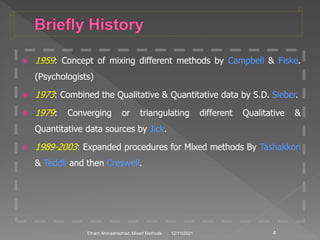
 1959: Concept of mixing different methods by Campbell & Fiske.
(Psychologists)
 1973: Combined the Qualitative & Quantitative data by S.D. Sieber.
 1979: Converging or triangulating different Qualitative &
Quantitative data sources by Jick.
 1989-2003: Expanded procedures for Mixed methods By Tashakkori
& Teddli and then Creswell.
12/11/2021 4
Elham Ahmadnezhad. Mixed Methods
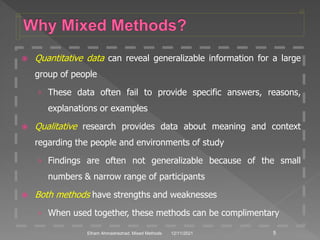
 Quantitative data can reveal generalizable information for a large
group of people
› These data often fail to provide specific answers, reasons,
explanations or examples
 Qualitative research provides data about meaning and context
regarding the people and environments of study
› Findings are often not generalizable because of the small
numbers & narrow range of participants
 Both methods have strengths and weaknesses
› When used together, these methods can be complimentary
12/11/2021
Elham Ahmadnezhad. Mixed Methods 5
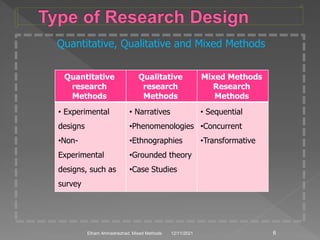
Quantitative, Qualitative and Mixed Methods
Mixed Methods
Research
Methods
Qualitative
research
Methods
Quantitative
research
Methods
• Sequential
•Concurrent
•Transformative
• Narratives
•Phenomenologies
•Ethnographies
•Grounded theory
•Case Studies
• Experimental
designs
•Non-
Experimental
designs, such as
survey
12/11/2021 6
Elham Ahmadnezhad. Mixed Methods
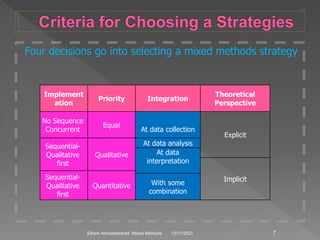
Four decisions go into selecting a mixed methods strategy
Theoretical
Perspective
Integration
Priority
Implement
ation
Explicit
At data collection
Equal
No Sequence
Concurrent
At data analysis
Qualitative
Sequential-
Qualitative
first
At data
interpretation
Implicit
Quantitative
Sequential-
Qualitative
first
With some
combination
12/11/2021 7
Elham Ahmadnezhad. Mixed Methods
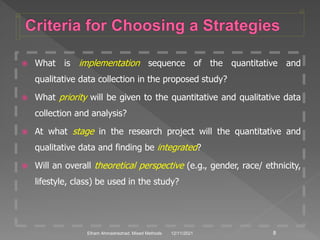
 What is implementation sequence of the quantitative and
qualitative data collection in the proposed study?
 What priority will be given to the quantitative and qualitative data
collection and analysis?
 At what stage in the research project will the quantitative and
qualitative data and finding be integrated?
 Will an overall theoretical perspective (e.g., gender, race/ ethnicity,
lifestyle, class) be used in the study?
12/11/2021 8
Elham Ahmadnezhad. Mixed Methods
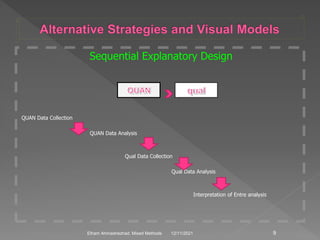
Sequential Explanatory Design
QUAN Data Collection
QUAN Data Analysis
Qual Data Collection
Qual Data Analysis
Interpretation of Entre analysis
12/11/2021 9
Elham Ahmadnezhad. Mixed Methods
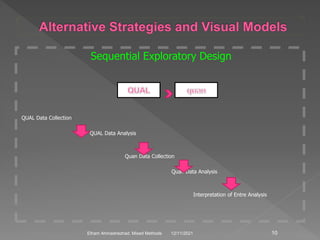
Sequential Exploratory Design
QUAL Data Collection
QUAL Data Analysis
Quan Data Collection
Quan Data Analysis
Interpretation of Entre Analysis
12/11/2021 10
Elham Ahmadnezhad. Mixed Methods
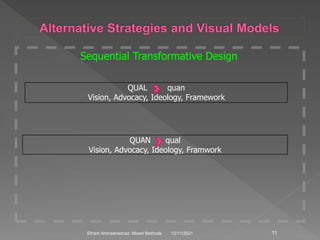
Sequential Transformative Design
QUAN qual
Vision, Advocacy, Ideology, Framwork
QUAL quan
Vision, Advocacy, Ideology, Framework
12/11/2021 11
Elham Ahmadnezhad. Mixed Methods
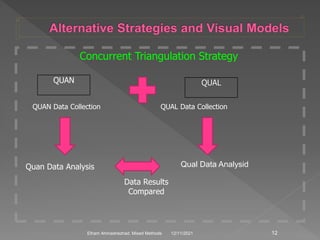
Concurrent Triangulation Strategy
QUAL Data Collection
QUAN Data Collection
QUAN QUAL
Quan Data Analysis Qual Data Analysid
Data Results
Compared
12/11/2021 12
Elham Ahmadnezhad. Mixed Methods
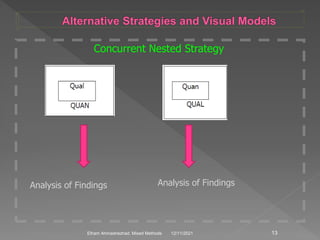
Analysis of Findings Analysis of Findings
12/11/2021 13
Elham Ahmadnezhad. Mixed Methods
Concurrent Nested Strategy
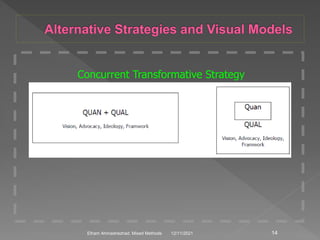
Concurrent Transformative Strategy
12/11/2021 14
Elham Ahmadnezhad. Mixed Methods
 Identify and be specific about the type of data. Some forms of data
such as interviews and observations can be either quantitative or
qualitative. Although reduction information to numbers is the
approach used in quantitative research, it is also used in qual.
Research.
 Recognize that quantitative data often involve random sampling, so
that each individual has no equal probability of being selected and
the sample can be generalized to the larger population. In
qualitative data collection, purposeful sampling is used to that
individuals are selected because they have experienced the central
phenomenon.
12/11/2021 15
Elham Ahmadnezhad. Mixed Methods
 Relate the procedures specifically to the visual model. For e.g, in a
sequential explanatory model, the general procedures can be
detailed even further. A discussion of this approach might include
describing the use of survey data collection followed by both
descriptive and infertial data analysis in the first phase. Then
qualitative observations and coding and thematic analysis within an
ethnographic design might be mentioned for the second phase.
12/11/2021 16
Elham Ahmadnezhad. Mixed Methods
It’s related to the type of research strategy chosen for the procedures.
Some of the more popular approaches:
 Data transformation: In the concurrent strategies involve creating
codes and themes qualitatively, then counting the number of times
they occur in the text data. This quantification of qualitative data
enables a researcher to compare quantitative results with the
qualitative data. For instance, in a factor analysis of data from a
scale on an instrument, the researcher may create factors or
themes that then can be compared with themes from the
qualitative database.
12/11/2021 17
Elham Ahmadnezhad. Mixed Methods
 Explore outliers: In a sequential model, an analysis of quantitative data in the
first phase can yield extreme or outlier cases. Follow-up qualitative interviews
with these outlier cases can provide insight about why they diverged from the
quantitative sample.
 Instrument development: In a sequential approach, obtain themes and specific
statements from participants in an initial qualitative data collection. In the next
phase, use these statements as specific items and the themes for scales to
create a survey instrument that is grounded in the views of the participants. A
third, final phase might be to validate the instrument with large sample
representative of a population.
 Examine multiple levels: in a concurrent nested model, conduct a survey at one
level (e.g. with families) to gather quantitative results about a sample. At the
same time, collect qualitative interviews (e.g., with individuals) to explore the
phenomenon with specific individuals in families.
12/11/2021 18
Elham Ahmadnezhad. Mixed Methods
 It is necessary the validation of both qualitative
and quantitative phases of study. Each of
methods has the specific ways, for the
qualitative data, the strategies that will be used
to check the accuracy of the findings need to be
mentioned.
12/11/2021 19
Elham Ahmadnezhad. Mixed Methods
 For a sequential study, mixed method researcher typically organize
the report of procedures into quantitative data collection and
qualitative data analysis followed by qualitative data and collection
and analysis. Then, in the conclusions or interpretation phase of
the study, the researcher comments on how the qualitative findings
helped to elaborate on or extend the quantitative results.
Alternatively, the qualitative data collection and analysis could
come first followed by the quantitative data collection and analysis.
In either structure, the writer typically will present the project as
two distinct phases, with separate headings of each.
12/11/2021 20
Elham Ahmadnezhad. Mixed Methods
 In concurrent study. The quantitative and
qualitative data collection may be presented in
separate section, but the analysis and
interpretation combines the two forms of data
to seek convergence among the results. The
structure of this type of mixed methods study
does not as clearly make a distinction between
the quantitative and qualitative phases.
12/11/2021 21
Elham Ahmadnezhad. Mixed Methods
 In a transformative study, the structure typically
involves advancing the advocacy issue in the beginning
of the study and then using either the sequential or
concurrent structure as a means of organizing the
content of the study. In the end of the study, a separate
section may advance an agenda for change or reform
that has developed as a result of the research.
12/11/2021 22
Elham Ahmadnezhad. Mixed Methods
Creswell, J. W. (2003). Research design. Sage publication.
Tashakkori, A., & Tedllie, C. (2003). Handbook of mixed methods in the
social and behavioral sciences. Thousand Oaks, CA: Sage.
12/11/2021 23
Elham Ahmadnezhad. Mixed Methods

Mixed Method Research

  • 2.
    Dr Elham Ahmadnezhadis a researcher at the Department of Disaster and Emergency Management, National institute of health research, Tehran University of Medical Sciences. I’m a medical doctor and now I am studying PhD of Epidemiology. My interest is Disaster Epidemiology. My Email: elhamahmadnezhad@gmail.com 12/11/2021 Elham Ahmadnezhad. Mixed Methods 2
  • 3.
     Briefly History Why Mixed Methods?  Type of Research designs  Criteria for Choosing a Strategies  Alternative Strategies and Visual Models  Data Collection Procedures  Data Analysis and Validation Procedures  Report Presentation Structure 12/11/2021 3 Elham Ahmadnezhad. Mixed Methods
  • 4.
     1959: Conceptof mixing different methods by Campbell & Fiske. (Psychologists)  1973: Combined the Qualitative & Quantitative data by S.D. Sieber.  1979: Converging or triangulating different Qualitative & Quantitative data sources by Jick.  1989-2003: Expanded procedures for Mixed methods By Tashakkori & Teddli and then Creswell. 12/11/2021 4 Elham Ahmadnezhad. Mixed Methods
  • 5.
     Quantitative datacan reveal generalizable information for a large group of people › These data often fail to provide specific answers, reasons, explanations or examples  Qualitative research provides data about meaning and context regarding the people and environments of study › Findings are often not generalizable because of the small numbers & narrow range of participants  Both methods have strengths and weaknesses › When used together, these methods can be complimentary 12/11/2021 Elham Ahmadnezhad. Mixed Methods 5
  • 6.
    Quantitative, Qualitative andMixed Methods Mixed Methods Research Methods Qualitative research Methods Quantitative research Methods • Sequential •Concurrent •Transformative • Narratives •Phenomenologies •Ethnographies •Grounded theory •Case Studies • Experimental designs •Non- Experimental designs, such as survey 12/11/2021 6 Elham Ahmadnezhad. Mixed Methods
  • 7.
    Four decisions gointo selecting a mixed methods strategy Theoretical Perspective Integration Priority Implement ation Explicit At data collection Equal No Sequence Concurrent At data analysis Qualitative Sequential- Qualitative first At data interpretation Implicit Quantitative Sequential- Qualitative first With some combination 12/11/2021 7 Elham Ahmadnezhad. Mixed Methods
  • 8.
     What isimplementation sequence of the quantitative and qualitative data collection in the proposed study?  What priority will be given to the quantitative and qualitative data collection and analysis?  At what stage in the research project will the quantitative and qualitative data and finding be integrated?  Will an overall theoretical perspective (e.g., gender, race/ ethnicity, lifestyle, class) be used in the study? 12/11/2021 8 Elham Ahmadnezhad. Mixed Methods
  • 9.
    Sequential Explanatory Design QUANData Collection QUAN Data Analysis Qual Data Collection Qual Data Analysis Interpretation of Entre analysis 12/11/2021 9 Elham Ahmadnezhad. Mixed Methods
  • 10.
    Sequential Exploratory Design QUALData Collection QUAL Data Analysis Quan Data Collection Quan Data Analysis Interpretation of Entre Analysis 12/11/2021 10 Elham Ahmadnezhad. Mixed Methods
  • 11.
    Sequential Transformative Design QUANqual Vision, Advocacy, Ideology, Framwork QUAL quan Vision, Advocacy, Ideology, Framework 12/11/2021 11 Elham Ahmadnezhad. Mixed Methods
  • 12.
    Concurrent Triangulation Strategy QUALData Collection QUAN Data Collection QUAN QUAL Quan Data Analysis Qual Data Analysid Data Results Compared 12/11/2021 12 Elham Ahmadnezhad. Mixed Methods
  • 13.
    Analysis of FindingsAnalysis of Findings 12/11/2021 13 Elham Ahmadnezhad. Mixed Methods Concurrent Nested Strategy
  • 14.
    Concurrent Transformative Strategy 12/11/202114 Elham Ahmadnezhad. Mixed Methods
  • 15.
     Identify andbe specific about the type of data. Some forms of data such as interviews and observations can be either quantitative or qualitative. Although reduction information to numbers is the approach used in quantitative research, it is also used in qual. Research.  Recognize that quantitative data often involve random sampling, so that each individual has no equal probability of being selected and the sample can be generalized to the larger population. In qualitative data collection, purposeful sampling is used to that individuals are selected because they have experienced the central phenomenon. 12/11/2021 15 Elham Ahmadnezhad. Mixed Methods
  • 16.
     Relate theprocedures specifically to the visual model. For e.g, in a sequential explanatory model, the general procedures can be detailed even further. A discussion of this approach might include describing the use of survey data collection followed by both descriptive and infertial data analysis in the first phase. Then qualitative observations and coding and thematic analysis within an ethnographic design might be mentioned for the second phase. 12/11/2021 16 Elham Ahmadnezhad. Mixed Methods
  • 17.
    It’s related tothe type of research strategy chosen for the procedures. Some of the more popular approaches:  Data transformation: In the concurrent strategies involve creating codes and themes qualitatively, then counting the number of times they occur in the text data. This quantification of qualitative data enables a researcher to compare quantitative results with the qualitative data. For instance, in a factor analysis of data from a scale on an instrument, the researcher may create factors or themes that then can be compared with themes from the qualitative database. 12/11/2021 17 Elham Ahmadnezhad. Mixed Methods
  • 18.
     Explore outliers:In a sequential model, an analysis of quantitative data in the first phase can yield extreme or outlier cases. Follow-up qualitative interviews with these outlier cases can provide insight about why they diverged from the quantitative sample.  Instrument development: In a sequential approach, obtain themes and specific statements from participants in an initial qualitative data collection. In the next phase, use these statements as specific items and the themes for scales to create a survey instrument that is grounded in the views of the participants. A third, final phase might be to validate the instrument with large sample representative of a population.  Examine multiple levels: in a concurrent nested model, conduct a survey at one level (e.g. with families) to gather quantitative results about a sample. At the same time, collect qualitative interviews (e.g., with individuals) to explore the phenomenon with specific individuals in families. 12/11/2021 18 Elham Ahmadnezhad. Mixed Methods
  • 19.
     It isnecessary the validation of both qualitative and quantitative phases of study. Each of methods has the specific ways, for the qualitative data, the strategies that will be used to check the accuracy of the findings need to be mentioned. 12/11/2021 19 Elham Ahmadnezhad. Mixed Methods
  • 20.
     For asequential study, mixed method researcher typically organize the report of procedures into quantitative data collection and qualitative data analysis followed by qualitative data and collection and analysis. Then, in the conclusions or interpretation phase of the study, the researcher comments on how the qualitative findings helped to elaborate on or extend the quantitative results. Alternatively, the qualitative data collection and analysis could come first followed by the quantitative data collection and analysis. In either structure, the writer typically will present the project as two distinct phases, with separate headings of each. 12/11/2021 20 Elham Ahmadnezhad. Mixed Methods
  • 21.
     In concurrentstudy. The quantitative and qualitative data collection may be presented in separate section, but the analysis and interpretation combines the two forms of data to seek convergence among the results. The structure of this type of mixed methods study does not as clearly make a distinction between the quantitative and qualitative phases. 12/11/2021 21 Elham Ahmadnezhad. Mixed Methods
  • 22.
     In atransformative study, the structure typically involves advancing the advocacy issue in the beginning of the study and then using either the sequential or concurrent structure as a means of organizing the content of the study. In the end of the study, a separate section may advance an agenda for change or reform that has developed as a result of the research. 12/11/2021 22 Elham Ahmadnezhad. Mixed Methods
  • 23.
    Creswell, J. W.(2003). Research design. Sage publication. Tashakkori, A., & Tedllie, C. (2003). Handbook of mixed methods in the social and behavioral sciences. Thousand Oaks, CA: Sage. 12/11/2021 23 Elham Ahmadnezhad. Mixed Methods

Editor's Notes

  • #7 Strategies Associated with the quantitative approach: Experiments: include true experiments, with the random assignment of subjects to treatment conditions. Surveys: include cross- sectional and longitudinal studies using questionnaires or structured interviews for data collection, with the intent of generalizing from a sample to a population. Strategies Associated with the qualitative approach: Narrative research: a form of inquiry in with the researcher studies the lives of individuals and asks one or more individuals to provide stories about their lives. This information is then retold or restoried by the researcher into narrative chronology. In the end, the narrative combines views from the participant’s life with those of the researcher’s life in a collaborative narrative. Phenomenological research: in which the researcher identifies the “essence” of human experiences concerning a phenomenon, as described by participants in a study. Understanding the “lived experiences” marks phenomenology as a philosophy as well as a method, and the procedure involves studying a small number of subjects through extensive and prolonged engagement to develop patterns and relationships of meaning. In this process, the researcher “brackets” his or her own experiences in order to understand those of the participants in the study. Ethnographies: in which the researcher studies an intact cultural group in a natural setting over a prolonged period of time by collecting, primarily, observational data. The research process is flexible and typically evolves contextually in response to the lived realities encountered in the field setting. Grounded theory: in which the researcher attempts to derive a general, abstract theory of a process, action, or interaction grounded in the views of participants in a study. This process involves using multiple stages of data collection and the refinement and interrelationship of categories of information. Two primary characteristics of this design are the constant comparison of data with emerging categories and theoretical sampling of different groups to maximize the similarities and the differences of information. Case studies: in which the researcher explores in depth a program, an event, an activity, a process, or one or more individuals. The case(s) are bounded by time and activity, and researchers collect detailed information using a variety of data collection procedures over a sustained period of time. Strategies Associated with the mixed methods approach: Sequential procedures: in which the researcher seeks to elaborate on or expand the findings of one method with another method. This may involve beginning with a qualitative method for exploratory purposes and following up with a quantitative method with a large sample so that the researcher can generalize results to a population. Alternatively, the study may begin with a quantitative method in which theories or concepts are tested, to be followed by a qualitative method involving detailed exploration with a few cases or individuals. Concurrent procedures: in which the researcher converges quantitative and qualitative data in order to provide a comprehensive analysis of the research problem. In this design, the investigator collects both forms of data at the same time during the study and then integrates the information in the interpretation of the overall results. Also, in this design, the researcher nests one form of data within another, larger data collection procedure in order to analyze different questions or levels of units in an organization. Transformative procedures: in which the researcher uses a theoretical lens as in overarching perspective within a design that contains both quantitative and qualitative data. This lens provides a framework for topics of interest, methods for collecting data, and outcomes or changes anticipated by the study. Within this lens could be data collection method that involves a sequential or a concurrent approach.
  • #8 -Implementation means either that the researchers collect both the quantitative and qualitative data in phases (sequentially) or that they gather it at the same time (concurrently). When the data are collected in phases, either the quantitative or quantitative data can come first. A second factor that goes into the choice of a strategy is whether greater priority or weight is given to the quantitative data and analysis. The priority might be equal, or it might be skewed toward either qualitative or quantitative data. A priority for one type of data or the other depends on the interests of the researcher, the audience for the study, and what the investigator seeks to emphasize in the study. In practical terms, priority occurs in a mixed methods study through such strategies as whether quantitative or qualitative information is emphasized first in the study, the extent of treatment of one type of data or the other, and use of a theory as an inductive or deductive framework for the study. Integration of the two types of data might occur at several stages in the process of research: the data collection, the data analysis, interpretation, or some combination of places. Integration means that the researcher “mixes” the data. A final factor to consider is whether a larger, theoretical perspective guides the entire design. This perspective may be one from the social sciences or from an advocacy/ participatory lens (e.g., gender, race, class). Although all designs have implicit theories, mixed methods researchers can make the theory explicit as a guiding framework for the study. This framework would operate regardless of the implementation, priority, and integrative features of the strategy of inquiry.
  • #16 Although the visual model provide a picture of procedures, it is helpful in a proposal to discuss the specific types of data to be collected. It is also important to identify the sampling strategies and the approaches used to establish validity of the data.
  • #18 Data analysis in mixed methods research relates to the type of research strategy chosen for the procedures. Thus, in a proposal, the procedures need to be identified within the design. However, analysis occurs both within the quantitative (descriptive and inferential numeric analysis) approach and the qualitative (description and thematic text or image analysis) approach, and often between the two approaches.
  • #21 The structure for the report, like the data analysis, follows the type of strategy chosen for the proposal study. Because mixed methods studies may not be familiar to audiences, it is helpful to provide some guidance as to how the final report will be structured.
  • #24 The books. Google links of that books: http://books.google.com/books?id=nSVxmN2KWeYC&printsec=frontcover&dq=Mixed+methods+books&lr=&source=gbs_similarbooks_s&cad=1#v=onepage&q=Mixed%20methods%20books&f=false http://books.google.com/books?id=F8BFOM8DCKoC&printsec=frontcover&dq=Mixed+methods+books&lr=&source=gbs_similarbooks_s&cad=1#v=onepage&q=Mixed%20methods%20books&f=false